Cloud Computing in 2021: The Future of ERP
We have all known the advantages of cloud computing solutions. If we talk about the future of ERP, there are various cloud computing trends like hybrid cloud, serverless computing and containers that will rule the industry in 2021. In fact, cloud technologies are now embedded in enterprises’ business strategies. Ninety-two percent say their IT environment (infrastructure, applications, data analytics, etc.) relies on the cloud and is predicted to grow to 95% in 18 months. If that wasn’t convincing enough, 54% of enterprises’ cloud based systems moved from on-premise systems to the cloud. Meanwhile, 46% of them were purpose-built for a cloud computing solution.

The Power of AI in ERP
The use of Artificial Intelligence (AI) in ERP systems to help with (or actually perform) decision making processes. These will be supported by data analytics capabilities that are increasingly included in ERP solutions—or integrated with them. Examples of this trend include continually self-optimizing operational models and intelligent customer interfaces for configure-to-quote. Data analytics in general will play a bigger role in operations management.
Serverless Computing
Cloud serverless computing is a technique for implementing functions in the cloud on a required basis. The enterprises rely on serverless computing as it provides the space for working on the core product without the stress of operating or managing the servers. Such a serverless platform has the potential to change the game of enterprise preferences and conception of cloud adoption with endless advantages.
Hybrid Cloud
According to Gartner, the worldwide public cloud services market is about to grow by almost 17%, computing to produce a gross amount of $266.4 billion by 2020. This is a staggering number compared to the $227.8 billion, calculated in the previous year. Where the actual amount of enterprises using hybrid cloud was 58% in 2019 and 52% in the year 2018, the present year witnesses huge increment. When everybody was discussing this new technological existence, MarketsandMarkets also discussed the increased demand for hybrid cloud computing. They highlighted its feature, focusing on its multiple advantages. What advantages? Speed, Control and Security.
The Future of ERP
Cloud adoption has seen a significant increase over the last few years. The cloud is obviously here to stay. Many organizations are currently rushing to migrate to cloud computing solutions with the belief that cloud based ERP systems go hand-in-hand with advancement. Almost everything in the tech industry is connected to the cloud in some way or another — unless it’s specifically kept in local storage for security reasons. As tech giants and tech startups find new ways to organize, process and present data, cloud computing will further become an integral part of the industry.
To learn more about the benefits of transitioning into a cloud based ERP solution, you can check out our last blog here.
4 Benefits of Cloud Based ERP
Enterprise Resource Planning, known simply as ERP, is management software, usually offered as a bundle of applications that aims to help businesses automate the collection, storage, management and interpretation of data from various sources. With cloud based ERP, business owners and managers can get an integrated real-time view of business processes, resources and commitments.
Cloud based ERP and on-premise ERP each have their own benefits. The best choice for you will depend on your organization’s structure and business strategy. While this post focuses on the benefits of cloud based ERP, it is by no means superior to on-premise ERP. The benefits realized from any technology will depend on project execution before, during and after implementation. Most people probably think, "if it's the same thing, then why jeopardize security with a cloud based ERP system?" It’s important to keep in mind that cloud ERP systems are extremely secure, and data may actually be far more secure than it would be in an on-premise ERP environment.
One company, who shall remain unnamed, recently discovered that its on-premise ERP servers were no match for a ransomware attack. This attack wiped out all of the company’s data. Hoping to shore up its defenses after the attack, the company upgraded to Acumatica Cloud ERP. Cloud-based ERP solutions are simply a suite of ERP apps delivered to users over the Internet, usually accessed via a browser. The software usually does not need to be installed on computers and is offered on a per-user, per-month, flat-rate fee.
1. Cost Efficiency
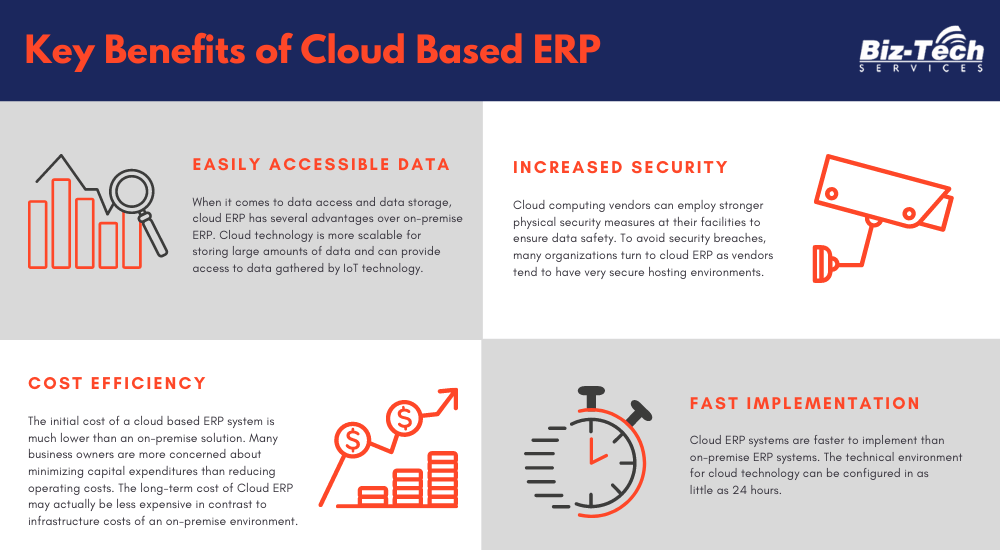
Some businesses don't realize how much running an on-premise ERP system costs. An in-house solution requires the purchase of software, licenses and related hardware to support the system. On top of that, staff needs to maintain the ERP system. This typically drives up the overall budget. The initial cost of a cloud based ERP system is much lower than an on-premise solution. While subscription costs can add up, many business owners are more concerned about minimizing capital expenditures than reducing operating costs. For smaller businesses, the long-term cost of Cloud ERP may actually be less expensive in contrast to infrastructure costs of an on-premise environment.
2. Increased Security
When it comes to physical security of their data and facilities, small to medium sized businesses can only do so much to prevent breaches. But cloud computing vendors can employ stronger physical security measures at their facilities to ensure data safety. To avoid security breaches, many organizations turn to cloud ERP as cloud vendors tend to have very secure hosting environments. Cloud vendors have a lot to lose – with multiple customers, they are popular targets for security breaches. This may sound like a disadvantage, but in many cases, it forces vendors to develop sophisticated security in order to protect business owners.

3. Easily Accessible Data
When it comes to data access and data storage, cloud ERP has several advantages over on-premise ERP. Cloud technology is more scalable for storing large amounts of data and can provide access to data gathered by IoT (Internet of Things) technology. All of an organization's information and data can be accessed virtually anywhere, as long as there is an internet connection available. Sharing data is easier across locations and departments, and because everyone in the company is interacting with centralized data through a common interface, the likelihood of interpreting the data differently between functions is lessened and opportunity for collaboration is increased.
4. Fast Implementation
Cloud ERP systems are faster to implement than on-premise ERP systems. The technical environment for cloud technology can be configured in as little as 24 hours. This gives organizations more time to focus on the business side of transformation. Change management and business process management require the same time and resources whether cloud or on-premise ERP is being implemented. With cloud based solutions, the provider takes care of hosting.
Bottom Line
The final decision rests with the organization’s management and how they see their future. Do they want to remain contained and in control, or do they want to take advantage of cloud computing power and cloud based solutions? Whichever the case, every successful business requires a healthy and dynamic data ecosystem. Having a reliable and scalable infrastructure in place which can support end-to-end visibility of data flows, fast and secure file transfers, data transformation and storage is integral to success.
Is Small Business ERP Right for You?
Small businesses often face a dilemma in deciding how to invest in order to gain the greatest return. In pure startup mode, businesses must invest in an operational and efficient foundation that will directly help in building the company. That's where small business ERP implementation comes into play.
Decision making is driven more by gut feeling rather than data and hard facts. These methods may be effective in early phases of the business, but once past that crucial startup phase, neglecting to invest can slow you down. Investing in appropriate ERP solutions (Enterprise Resource Planning) can significantly boost growth and profitability.
Hunting for small business ERP prices online is notoriously difficult. Most top vendors want to speak to their prospects first, then give a custom solution and price. That makes sense. But it also makes it very hard for small businesses to get an idea of affordability.
The truth is that there are affordable small business ERP solutions. Above all, proper implementation of such a solution will actually save money in the long run. Consider how much time and manpower you will save by choosing an ERP solution that will automate many of the tasks your employees currently perform with your current unsynchronized software. You will also be able to integrate your ERP with your other common office software, creating a more streamlined process which will in turn reduce the likelihood of costly errors in accounting.
Successful small and medium businesses often find themselves in the unique position of having a tremendous amount of data in a variety of formats without the personnel or resources to effectively process and analyze it. With the right small business ERP solutions in place, your business will have a better handle on daily functions and also have longer-term analysis and reports that will help your business grow and reach its full potential.
Nothing has a more significant impact on the long-term success or failure of your ERP system than the quality of ERP implementation. Done well, you’re more likely to experience a greater ROI (Return of Investment) in a much shorter time frame. If the implementation process was poorly executed, you could waste a lot of time and money without ever seeing any advantages. That being said, you need to evaluate the total cost of ownership (TCO) for your chosen ERP. It’s this figure that you need to budget for and to measure your ROI against.
Just as importantly, ERP allows a measure of efficiency and control over your business that is not possible to achieve otherwise. Without ERP, often business is managed through spreadsheets, manual processes and paper, possibly augmented with disparate business applications such as stand-alone accounting software, typically based on older closed architectures that limit interoperability.
A well executed ERP implementation can enable change and provide ongoing savings that can help you sustain and grow your business. Not only will you be operating at a competitive advantage, but you can incur major growth and profitability․
To learn more about ERP and if it's the right step for your business, speak with one of our experts! You can reach us at +1 818-484-5004 or email us at sales@biz-techservices.com. Or, read about what we offer on our Acumatica and Sage 100 pages.
The Importance of System Integration in Businesses
In today’s day and age, when companies want to stay ahead of the game they need their systems to work synchronously. Organizations that don't have system integration in place see significant increases in cost and resource consumption.
What is System Integration?
System integration is the method of connecting different sub-systems into one larger system that functions as a single source. In regard to software solutions, system integration is commonly defined as the process of associating various IT systems, services and/or software to enable them to function seamlessly together. System integrations are typically done one of four ways; Horizontal Integration, Vertical Integration, Star Integration and Common Data Integration.
The main reason for businesses to use system integration is the growing need to improve productivity and quality of day-to-day operations. The goal is to get organization and business IT systems to communicate with each other through integration. This accelerates information outflow and reduces operational costs. System integration is not only used to connect an organization’s internal systems, but to also integrate third parties that organizations operates with.
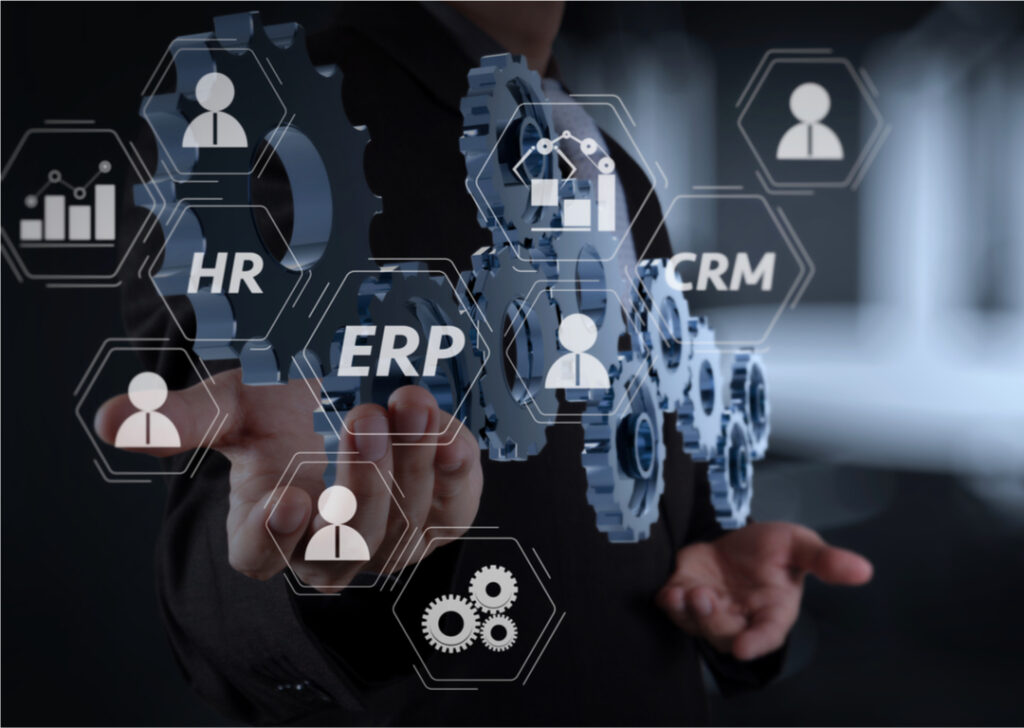
System Integration Methods
Horizontal Integration
In Horizontal Integration, a separate sub-system is used as an interface layer between other sub-systems. This layer is often referred to as an Enterprise Service Bus. This technique allows each sub-system to have a single interface to communicate with. One benefit of using Horizontal Integration is each sub-system can be changed or replaced without having to revise other systems.
Vertical Integration
Vertical Integration is a method where system components are integrated by creating 'depositories', starting with the most basic function to the most complex. Normally, this method is simple and only involves a limited number of systems. However, a hindrance of this integration is it may be more difficult to manage in the long run as any new functionality will require its own 'depository'.
Star Integration
Star Integration is when a systems sub-systems are connected with other sub-systems using point-to-point connections. Above all, this allows for better functionality. A major drawback of this integration is as systems increase, the number of integrations increase as well. This leads to difficulty managing the integrations.
Common Data Integration
Common Data Integration helps systems avoid having the adapter convert to and from each application format. Systems using this technique set a common or application-independent format, or they provide a service that does the transformation to or from one application into to the common application.
Why is it Important?
A system integrator is an independent entity that uses technical and project management activities to integrate commercially available software. Using a variety of programs that do not integrate with each other can make it impossible for employees/admins to work effectively or for the organization to achieve its goals. Having your data in one central location will also reduce costs and storage compared to having multiple systems simultaneously. Businesses often struggle when the task of managing their data is not aligned. If your systems and processes are not working together, it can be very tedious and time-consuming to manage everything individually. Most importantly, by integrating, you reap the benefits of efficiency and effectiveness, whilst reducing the disruption caused by having data from multiple sources. This naturally leads to better analysis of data.
The Disadvantages of Not Using System Integration
- Reduced Employee Productivity — If employees are to be productive they mustn’t be bogged down with unnecessary admin. When staff have to manage multiple tasks such as order processing and invoicing via separate systems, the tasks take longer to complete and the risk of errors is increased.
- Lack of real-time information — In addition to being labor-intensive, transferring data between systems causes data to be out of sync. Overlapping databases prevent business owners from having an accurate view of business performance. Critical decisions are therefore made slowly, if at all.
- Constant upgrades and excess cost — Maintaining multiple systems is expensive and requires substantial IT resources. Once a system is upgraded more changes will need to be made to other systems so that they can still work together.
For a list of services Biz-Tech Services can integrate for you, check out our Acumatica and Sage100 pages. If you can’t see your favorite service, our skilled programmers will find a solution. To speak with one of our experts please call us at +1 818-484-5004 or email us at sales@biz-techservices.com.