

ShipStation Connector
ShipStation Connector is a native Acumatica extension that governs the full order-to-fulfillment loop from a single store configuration. It connects via Consumer Key, Consumer Secret, and Base URL, validates connectivity through integrated testing, and facilitates bidirectional data flow between systems. The connector imports ShipStation orders into Acumatica as Sales Orders or SO Invoices, maps diverse order statuses—ranging from Awaiting Shipment to Cancelled—and automates the creation of new items and customers on-the-fly.
ShipStation Connector
ShipStation Connector acts as a real-time data bridge that automatically funnels e-commerce orders from over 70 sales channels directly into your Acumatica system. It streamlines the entire order-to-fulfillment loop by syncing tracking numbers, mapping shipping carriers, and automating customer creation to ensure your warehouse operations stay perfectly in sync with your online storefronts.
1
Bidirectional Data Flow (Integration Options)
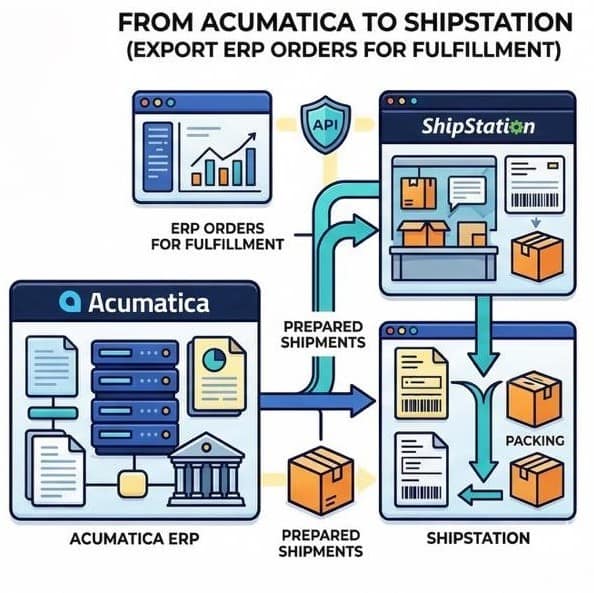
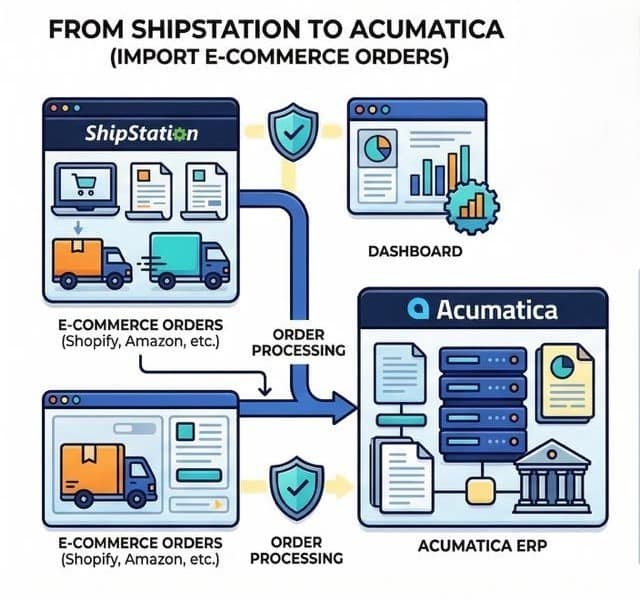
The integration allows you to define the direction of the data flow between the two systems. You can configure the integration to run from ShipStation to Acumatica (for importing e-commerce orders) or from Acumatica to ShipStation (for exporting ERP orders for fulfillment).
2
Order and Status Mapping
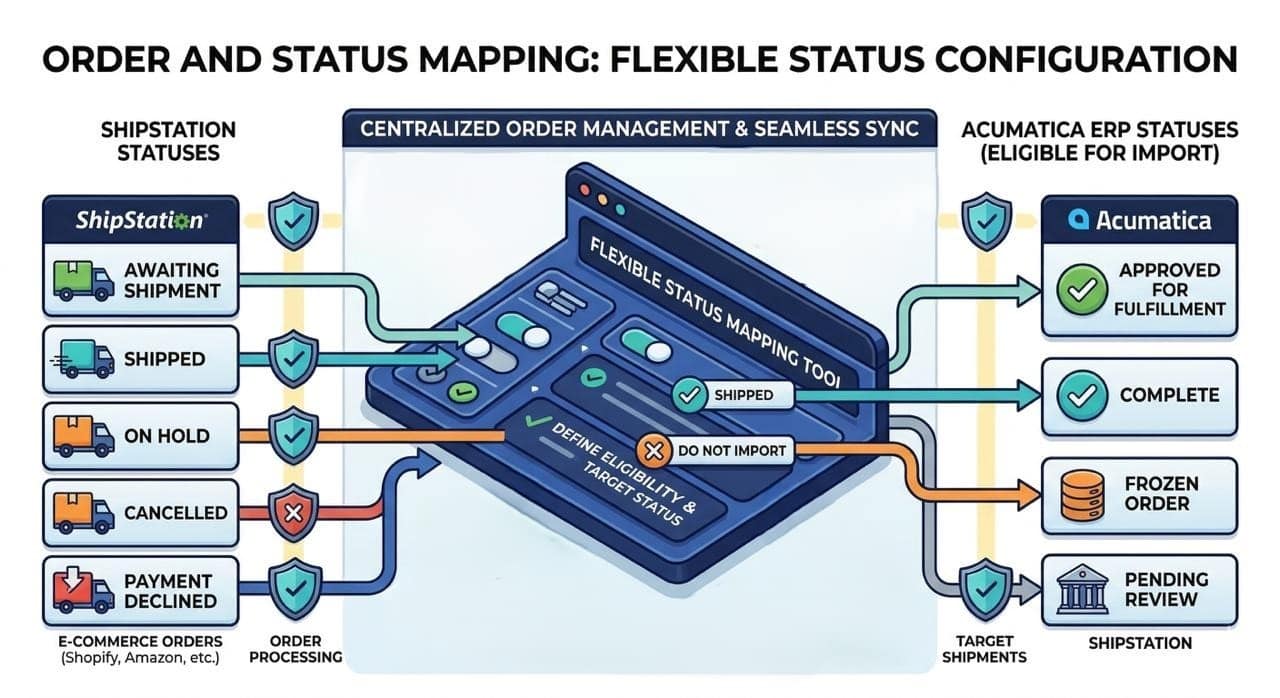
The system centralizes order management by seamlessly syncing orders across platforms. It features a flexible status mapping tool that allows you to specify exactly which ShipStation order statuses (such as Awaiting Shipment, Shipped, or On Hold) are eligible to be imported into Acumatica
3
Automated Item and SKU Generation
During the order import process, if the system detects an item that does not exist in Acumatica, it can automatically create a new stock or non-stock item record. This feature supports automatic SKU generation using Acumatica’s numbering sequences, assigns default warehouse values, and can even import product images directly from ShipStation.
4
Customer and Tax Synchronization
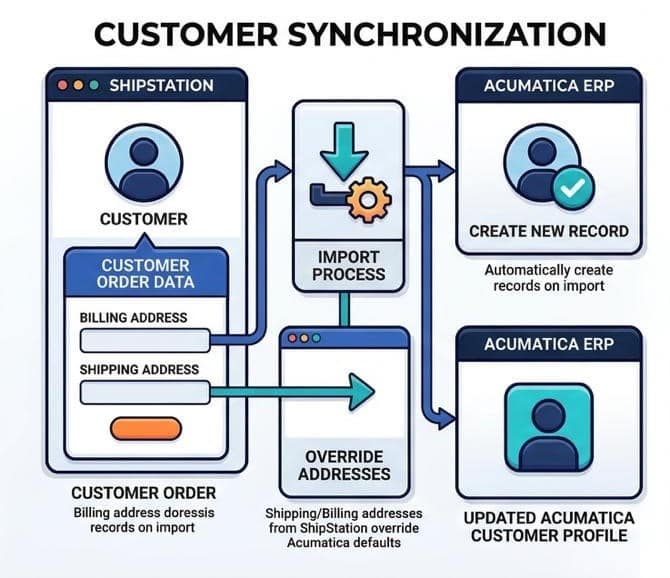
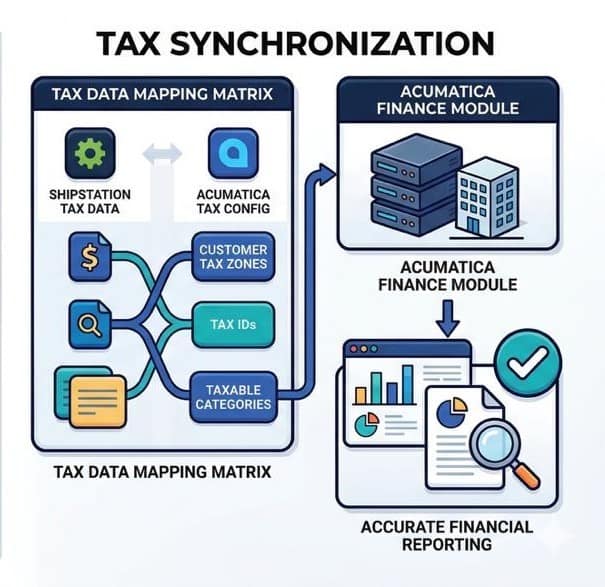
The integration can automatically create new customer records in Acumatica during the import process, and it allows the shipping and billing addresses from ShipStation to override the default addresses in Acumatica. Additionally, it supports full tax synchronization, including mapping for customer tax zones, tax IDs, and taxable categories to ensure accurate financial reporting.
5
Cross-Reference Mapping System
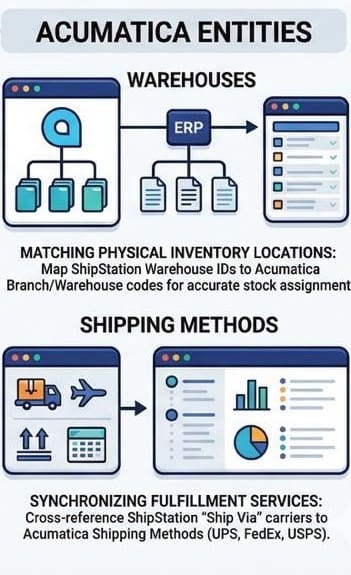
To ensure logistical accuracy, the integration includes specialized cross-reference options that match specific entities between the two platforms. Users can enable cross-referencing to perfectly map Warehouses and Shipping Methods (Ship Via) between ShipStation and Acumatica
6
Flexible Shipment Workflows
The module supports multiple operational workflows for handling shipments. You can either process shipments within ShipStation and import the resulting tracking numbers and shipment data back into Acumatica, or you can generate and confirm shipments directly within Acumatica, which will automatically export the data to create the corresponding order and shipment in ShipStation.
Tagline
SCHEDULE A DEMO
Think of ShipStation integration for Acumatica as a high-speed digital logistics bridge that seamlessly connects your entire e-commerce ecosystem to your ERP system,. Just as a master conductor coordinates every musician in a large orchestra to play in perfect harmony, this solution consolidates orders from more than 70 different e-commerce channels into one central, intuitive interface. This feature ensures that whenever a customer places an order, the data is automatically synchronized, statuses are mapped, and shipping labels are generated in batch mode without your team having to manually enter data or worry about carrier cross-references,,. It’s like having a tireless logistics manager who intuitively knows which warehouse to use and instantly updates your customers with tracking information the second their package is ready for delivery.
Tagline
SCHEDULE A DEMO
Think of ShipStation integration for Acumatica as a high-speed digital logistics bridge that seamlessly connects your entire e-commerce ecosystem to your ERP system. Just as a master conductor coordinates every musician in a large orchestra to play in perfect harmony, this solution consolidates orders from more than 70 different e-commerce channels into one central, intuitive interface. This feature ensures that whenever a customer places an order, the data is automatically synchronized, statuses are mapped, and shipping labels are generated in batch mode without your team having to manually enter data or worry about carrier cross-references. It’s like having a tireless logistics manager who intuitively knows which warehouse to use and instantly updates your customers with tracking information the second their package is ready for delivery.

Shopify Connector is an integration link for two platforms‒Shopify’s e-commerce system and Acumatica
Cloud ERP. The connector supplies all the tools a business needs to improve its order processing strategy,
to simplify inventory management, pricing, payment, and streamline its logistics processes. Bilateral
synchronization makes it possible to manage orders in Acumatica and mark them fulfilled in the Shopify system automatically. Using this connector allows better time management and facilitates the connection between the platforms. Above all, the connector also streamlines the process of handling the payment information.
ShipHero–Acumatica Integration is a native extension that synchronizes fulfillment and ERP data through a governed store configuration. It supports two directional modes (ShipHero to Acumatica and Acumatica to ShipHero), validates connectivity, imports orders and shipments, exports orders and purchase orders, brings receipts back, and synchronizes items, vendors, warehouses, and inventory quantities. Centralized options for taxes, packaging, customers, items, and cross-references keep postings consistent and auditable across the order, shipment, and receiving lifecycle.

Salesforce–Acumatica Integration provides a governed store configuration that connects Salesforce and Acumatica with credential validation, cross-reference mapping, and policy-driven import and export flows. Orders are imported from Salesforce into Acumatica with configurable defaults; customers, items, price books, and discounts can be synchronized; and approved changes in Acumatica can be pushed back to Salesforce. Options for taxes, payments, and address overrides keep postings compliant, while inquiry and history pages give operators traceability from initial import through updates and releases.
WHAT OUR CLIENTS SAY
“Exceptional experience from start to finish — their professionalism truly stands out.”
Laura Bennett
Marketing Director
“Fast, reliable, and always one step ahead. Couldn’t ask for better support.”
David Romero
Head of Operations
“They deliver quality every single time. A trusted partner for our business growth.”
Sophie Klein
Managing Partner