
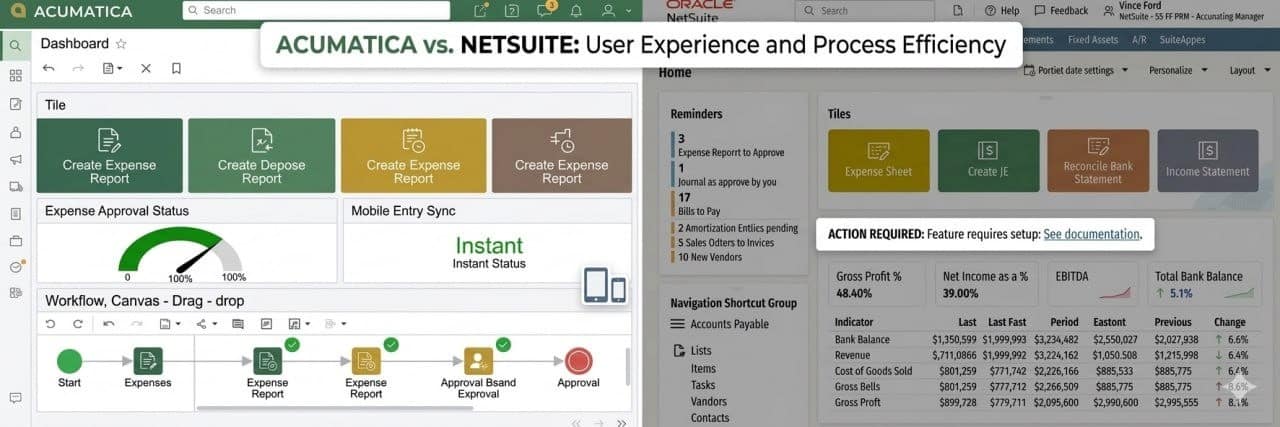
Acumatica ERP vs Oracle NetSuite ERP: a detailed comparison—and why businesses often win with Acumatica
If you’re choosing an ERP system and your shortlist includes Acumatica ERP and Oracle NetSuite ERP, you’ve already moved beyond “basic accounting software” and are looking for a platform that becomes your company’s operating system: finance, sales, purchasing, inventory/warehouse, manufacturing/service/projects, analytics, integrations, and process control in one environment.
This article is not a neutral “both are good” overview. The goal is clear: to explain why, in many real-world scenarios, Acumatica is the more practical and cost-effective choice, especially for growing companies (distribution, manufacturing, eCommerce, services, construction, project-based businesses). NetSuite is a strong SaaS platform—but it has structural characteristics that can translate into higher long-term costs, slower change cycles, and stronger vendor dependency.
1) Quick takeaway: what to choose if you’re mid-market and growing
Acumatica ERP is often the better fit if:
- you’re growing headcount and want to give ERP access to more people without a “per-user tax”;
- you need deployment flexibility (public cloud / private cloud / hosted) and more control over the environment;
- you expect your processes to change often (new warehouses, new channels, new statuses, new allocation rules, new reporting);
- you want to reduce vendor lock-in and keep options on partners, integrators, and infrastructure.
Oracle NetSuite ERP often makes more sense if:
- you’re comfortable with a strict SaaS model and are willing to adapt processes to the platform;
- you’re closer to an enterprise-style global footprint and you want the Oracle ecosystem;
- you plan limited customization and prioritize standardization over flexibility.
2) Why Acumatica vs NetSuite is not primarily a “feature checklist” decision
A common ERP selection mistake is comparing checkboxes. Both platforms have broad functionality and many modules. But ERP is typically a 5–10 year decision, and the real question is:
What will ownership cost over time—and what will every meaningful business change cost?
In practice, it comes down to:
- licensing and cost scaling;
- implementation flexibility and speed of change;
- control over infrastructure and data;
- integration and extension complexity;
- dependency risk (vendor/partner lock-in).
Across these dimensions, Acumatica often delivers more pragmatic long-term economics.
3) Licensing model: NetSuite’s “hidden tax” and how Acumatica often avoids it
3.1. NetSuite and the typical per-user scaling logic
In many scenarios, NetSuite pricing is commonly experienced as a combination of:
- base subscription,
- paid user seats,
- add-on modules,
- implementation and ongoing services.
The practical effect is simple: hire more people, pay more for ERP. Expand warehouse operations, add sales reps, add managers, provide executive access—and recurring costs typically grow with headcount.
3.2. What per-user pricing does inside companies
When licensing is “per seat,” companies often start optimizing for licensing costs rather than process transparency:
- parts of the workflow remain in spreadsheets and chat threads,
- people bypass the system because “they don’t have a license,”
- data fragments across tools,
- reporting becomes less reliable,
- leadership stops trusting the numbers.
That’s not a software problem. It’s a management problem caused by a cost structure.
3.3. Why Acumatica is often better for growth
Acumatica is frequently chosen based on one core idea: ERP should scale with the business without punishing growth in users. Depending on the licensing model and deployment approach, the emphasis is often less about “every new user equals a new monthly fee” and more about usage levels, capacity, or consumption-based scaling.
In plain terms:
- it’s easier to give ERP access to everyone involved in the process,
- adoption is often faster because fewer people are excluded,
- you’re less likely to pay simply for headcount growth.
4) Deployment and control: Acumatica offers options, NetSuite is strict SaaS
4.1. NetSuite: convenient, but you live by the platform’s rules
NetSuite is a classic SaaS approach: you subscribe, you use the service, and you don’t manage infrastructure. That’s convenient if the standard model fits your requirements.
But there’s a trade-off:
- less control over the environment,
- tighter boundaries around “deep” infrastructure choices,
- dependency on vendor update schedules and platform constraints,
- sometimes more complexity when you have non-standard security, compliance, or integration requirements.
4.2. Acumatica: when ERP must adapt to the business—not the other way around
Acumatica tends to be strong when companies need:
- private cloud deployment,
- a dedicated environment,
- alignment with internal IT and security policies,
- specialized integration architecture that benefits from more flexible deployment choices.
This is especially relevant when ERP is the core of digital transformation: CRM + ERP + warehouse + eCommerce + BI + API integrations + workflow automation.
5) Speed of change: why “the cost of every adjustment” is often lower with Acumatica
ERP is rarely “set and forget.” Business changes constantly:
- new sales channels (marketplaces, dealers, online store),
- changing allocation, reservation, and shipping rules,
- new warehouses and locations,
- new pricing, promotions, and discount logic,
- new document requirements and reporting,
- new approvals, limits, and internal controls.
The key question is: how quickly—and at what cost—can you adapt ERP to these changes?
5.1. NetSuite: powerful, but changes can be more expensive
NetSuite has a mature ecosystem for extensions and development. But deeper customization often means:
- stronger dependence on NetSuite-specific skill sets,
- careful handling of updates and platform changes,
- higher cost per change when requirements become more specialized.
This isn’t “bad.” It just means non-standard requirements have a price.
5.2. Acumatica: a mid-market focus on configurability and practical adaptation
Acumatica is frequently selected by mid-market businesses that want:
- high configurability,
- a clearer path to extend and adjust processes,
- faster iteration cycles for operational improvements.
As a result, in many typical mid-market scenarios (distribution, services, projects, construction, mid-complexity manufacturing), time-to-change and cost-to-change often look better.
6) Integrations and automation: where Acumatica often provides a more controllable architecture
Modern ERP rarely lives alone. Typical adjacent systems include:
- CRM (Dynamics, HubSpot, Bitrix24, etc.),
- eCommerce (Shopify, WooCommerce, Magento),
- WMS/TMS,
- marketplaces,
- banking and payment gateways,
- BI/analytics,
- automation platforms (n8n, Make, Zapier),
- telephony, helpdesk, field service.
6.1. What really matters in integrations
In real projects, “integration success” depends on:
- API reliability and predictability,
- stable mapping of statuses, documents, inventory, and pricing,
- observability (logging, alerts, retries),
- scalability as transaction volume and business complexity grows.
6.2. Why this is often easier to package around Acumatica
When you have more deployment options and fewer strict SaaS boundaries, integration architecture often becomes:
- more controllable,
- easier to monitor and troubleshoot,
- simpler to evolve as business logic changes,
- more resilient under growth.
A strong positioning statement is:
ERP should be a platform you can connect everything to—not a monolith that forces everything else to adapt.
7) Functional perspective: finance, distribution, manufacturing, and projects
This section is intentionally not a “feature matrix.” The real difference is often how each platform behaves under practical pressure.
7.1. Finance and management accounting
Both systems are strong in financial capabilities. The difference is usually not “can it do it,” but:
- how quickly you can adapt the structure to your real business,
- how easy it is to build practical management reporting,
- how expensive ongoing change and support become.
For many mid-market companies, the real needs are:
- faster period close,
- transparent AR/AP,
- profitability by product, channel, and project,
- cash flow controls and forecasts.
Acumatica often wins here as a change-friendly operational platform.
7.2. Distribution and inventory (Distribution ERP)
Distribution businesses typically care about:
- price lists, discounts, promotions,
- inventory allocation and reservations,
- replenishment and purchasing,
- shipping and fulfillment,
- margin and inventory turns.
If you need a true Distribution ERP and you’re growing in warehouses and operational users, “per-user licensing” becomes a material cost driver—because warehouse operations involve many users. This is where Acumatica’s growth-friendly model often becomes a strong advantage.
7.3. Manufacturing (Manufacturing ERP)
Manufacturing typically requires:
- bills of materials (BOM),
- routings and scheduling,
- material issues and backflushing,
- costing and variance analysis,
- quality and traceability (depending on industry).
NetSuite can be a good fit if you want a standardized SaaS approach. Acumatica often performs well when manufacturing needs:
- practical tailoring to real shop-floor workflows,
- phased rollout (by plant, line, or process),
- flexible integration with external systems and warehouse operations.
7.4. Projects and services (Project Accounting / Professional Services)
For services, implementation firms, recurring service contracts, construction, and project-based operations:
- budgeting and forecasting,
- plan vs actual tracking,
- resource planning,
- billing and invoicing,
- profitability by project and phase.
These businesses change frequently (change orders, scope adjustments, approvals). A platform where changes are easier and cheaper often wins—and that is a common reason companies choose Acumatica.
8) Implementation reality: why time-to-value is often better with Acumatica
8.1. What “successful ERP implementation” actually means
Success is not “go-live happened.” Success is when:
- key processes truly run inside ERP,
- data is consistent and trusted,
- reporting is usable for decisions,
- users do not bypass the system,
- integrations remain stable,
- ongoing improvements do not turn into endless projects.
8.2. Where ERP implementations typically fail
Failure usually comes from one root cause:
- the system was implemented “as the vendor expects,” while the business runs differently,
- users don’t like the workflow and return to spreadsheets,
- licensing limits access (per-user cost pressure),
- changes are too expensive, so the process freezes.
8.3. Why Acumatica reduces these risks
Acumatica often reduces risk through a combination of:
- easier broad user adoption,
- more flexible deployment and integration architecture,
- better fit for mid-market process evolution,
- more predictable scaling for growing organizations.
9) Vendor lock-in: why dependency is real money
ERP is data. Data is control. The more you depend on one vendor and one ecosystem:
- the more expensive changes become,
- the harder it is to switch partners,
- the harder it is to optimize infrastructure costs,
- the higher the risk if commercial terms change.
NetSuite’s strict SaaS model naturally increases lock-in.
Acumatica’s deployment flexibility often provides more levers:
- choice of infrastructure,
- choice of partners,
- a clearer path to evolve integrations without being boxed into a single model.
10) Who should choose Acumatica: the “ideal fit” company profile
If this sounds like you, Acumatica is typically the more advantageous ERP platform:
10.1. Growing distribution, wholesale, retail, and eCommerce operations
- many operational users (warehouse, sales, purchasing),
- high transaction volume,
- frequent process changes,
- integrations with online stores and marketplaces,
- strong need for margin transparency.
10.2. Mid-complexity manufacturing
- BOM, costing, planning,
- tight linkage between purchasing, inventory, and production,
- gradual expansion of functionality as the business grows.
10.3. Project-based companies, services, construction, field service
- processes change often,
- profitability by project is critical,
- approvals and reporting must stay flexible.
11) Final conclusion: why Acumatica is often the better choice than Oracle NetSuite ERP
Acumatica ERP often wins for growing, changing businesses because:
- its scaling economics are typically more growth-friendly (broad user access without constant cost spikes),
- deployment options give more control and architectural flexibility,
- process changes are often faster and less expensive,
- vendor and partner lock-in risk is often lower.
Oracle NetSuite ERP remains a strong option for organizations that:
- accept a strict SaaS operating model,
- are ready to standardize processes heavily,
- want the Oracle ecosystem and are willing to pay for it.
But if you’re reading this with the mindset, “We need an ERP for growth, we want the whole team working in one system, and we want to reduce spreadsheet dependency,” then in many practical mid-market cases, Acumatica is the more rational choice.
Acumatica ERP is built for companies that grow and don’t want to pay a penalty for expanding their teams. It offers deployment flexibility, scalable economics, and a practical path to adapt the system to real-world business processes. Oracle NetSuite ERP is a strong SaaS platform, but its scaling model and strict SaaS constraints can make ownership more expensive and less flexible over time for many mid-market organizations. If you need an ERP system that becomes the operational backbone of your business—and you want broad adoption, predictable scaling, and a platform that adapts as you evolve—Acumatica is often the smarter choice.