
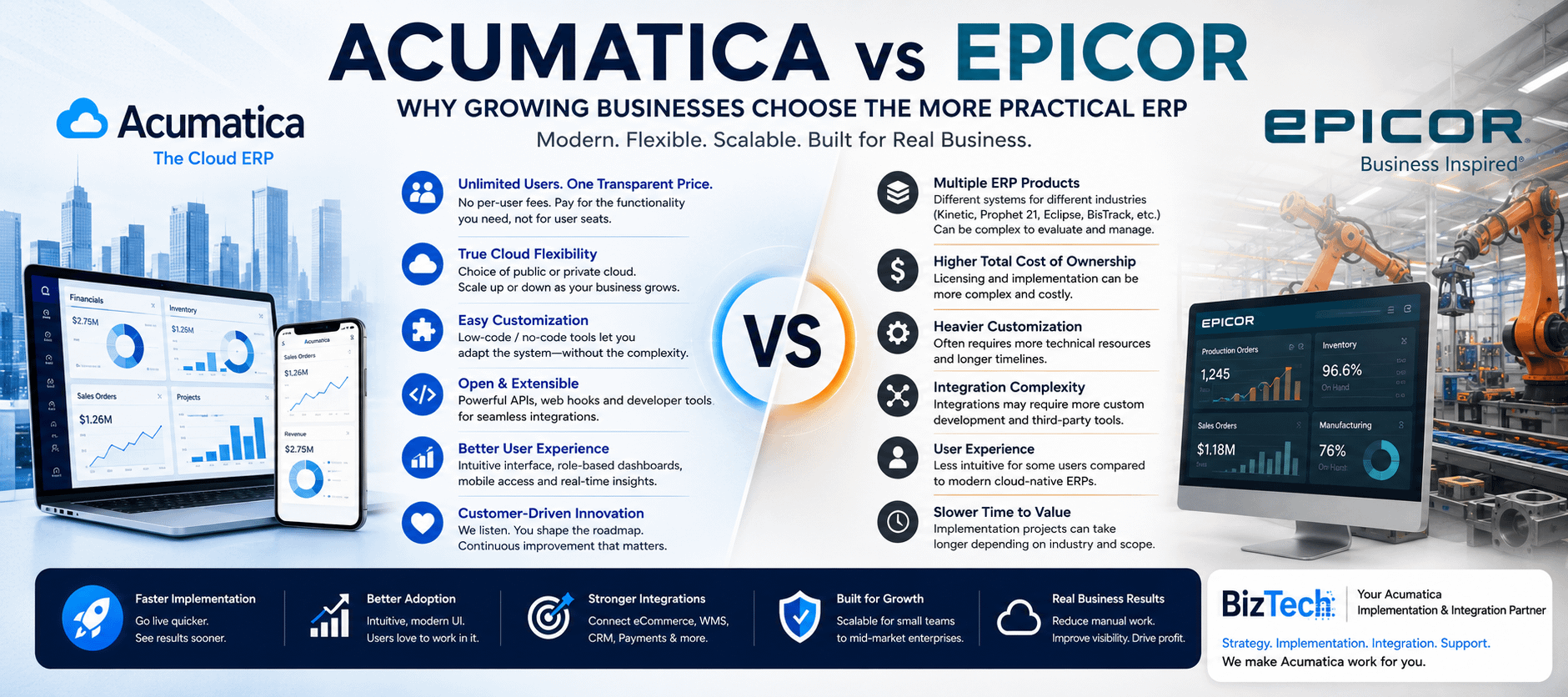
Acumatica vs Epicor: Why Growing Businesses Choose the More Practical ERP
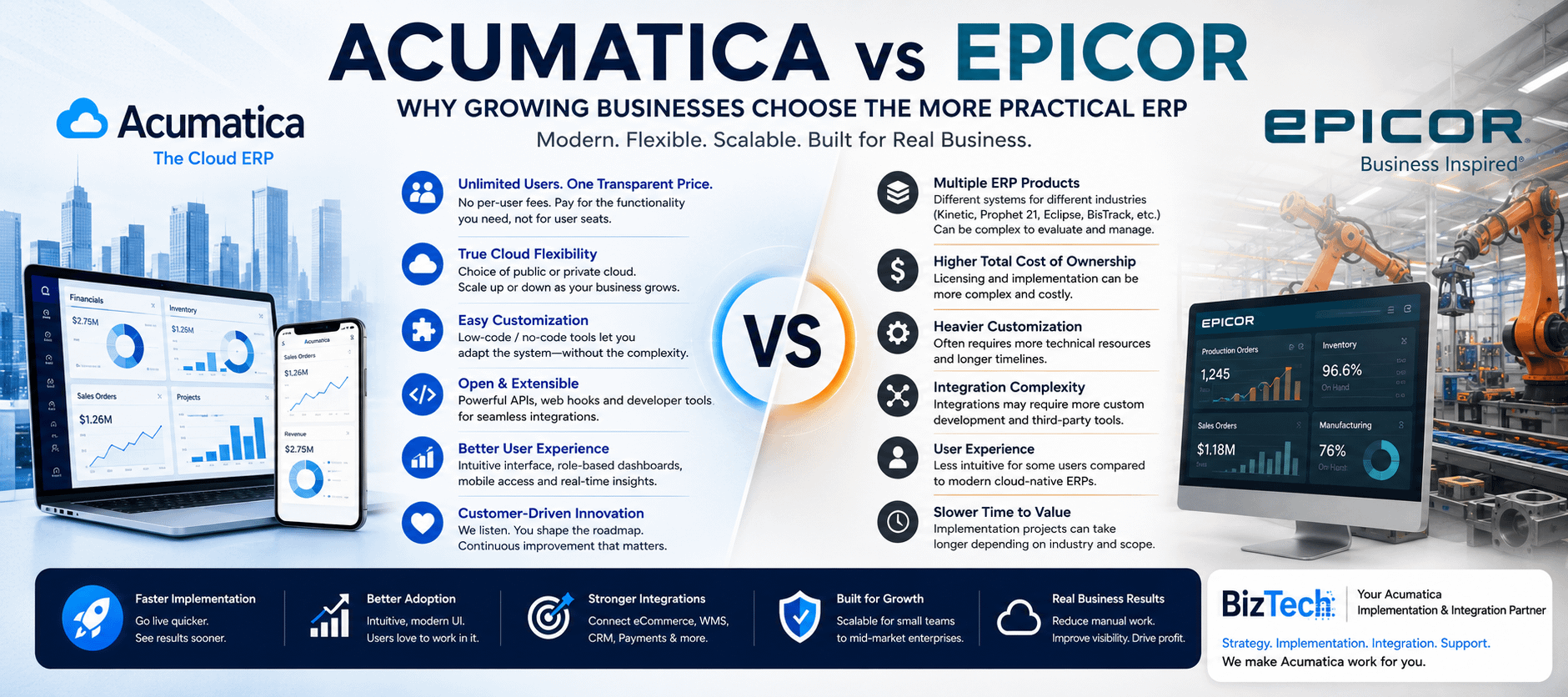
Acumatica vs Epicor: Why Growing Businesses Are Choosing the More Practical ERP
Choosing between Acumatica vs Epicor is not just a technology decision. It is a decision about how your company will manage finance, operations, inventory, purchasing, sales, manufacturing, distribution, reporting, automation, integrations, and long-term growth. ERP is not a small internal tool. It becomes the operational backbone of the business. That is why the comparison between Acumatica ERP and Epicor ERP matters so much.
Both platforms are serious ERP solutions. Both are known in the midmarket. Both can support manufacturing, distribution, financial management, operations, and industry-specific workflows. Epicor has a long history in ERP and is especially known for products such as Epicor Kinetic, Epicor Prophet 21, Epicor Eclipse, Epicor BisTrack, and other industry-focused systems.
But a strong product history does not automatically mean the best fit for every growing business.
For many companies evaluating Acumatica vs Epicor, the real question is not “Which ERP has more years in the market?” The better question is:
Which ERP is easier to adopt, easier to scale, easier to customize, easier to integrate, easier to support, and easier to keep aligned with the way the business actually works?
That is where Acumatica often becomes the more practical and more reasonable choice.
Acumatica is a modern cloud ERP platform built around flexible pricing, unlimited users, integrated applications, projected resource-based scaling, deployment choice, open architecture, low-code and no-code customization, dashboards, web APIs, webhooks, industry editions, and customer-driven innovation.
This is a major advantage in the Acumatica vs Epicor decision.
Epicor can be powerful, especially for manufacturing and distribution companies. But Epicor can also feel more product-fragmented, more industry-siloed, and more complex to evaluate because Epicor’s ERP portfolio includes several separate products for different industries and use cases. Acumatica, by contrast, often feels more unified, modern, open, and practical for growing businesses that want one adaptable ERP platform instead of a portfolio decision.
This is why companies searching for Acumatica vs Epicor, Acumatica vs Epicor Kinetic, Epicor alternative, Epicor Kinetic alternative, best cloud ERP for manufacturing, best ERP for distribution, Acumatica ERP vs Epicor ERP, cloud ERP comparison, and midmarket ERP comparison are increasingly taking Acumatica seriously.
And this is also where implementation matters. Choosing Acumatica is important, but implementing it correctly is what creates business value. As an Acumatica implementation and integration partner, BizTech helps companies turn Acumatica into a practical operating system: configured around real workflows, connected to external systems, supported with dashboards, integrated with eCommerce and payment tools, and optimized for daily business performance.
Acumatica vs Epicor: The Real Difference Is Practicality
At a high level, both Acumatica and Epicor are ERP systems. Both can support accounting, operations, inventory, purchasing, sales, manufacturing, reporting, and industry-specific needs. But the difference is not just feature coverage.
The real difference is how each ERP feels when the business has to use it every day.
A growing company does not need ERP complexity for its own sake. It needs ERP that helps people work better. It needs ERP that departments can adopt without excessive friction. It needs ERP that does not become a bottleneck every time a process changes. It needs ERP that connects easily to the rest of the technology stack. It needs ERP that gives management clean data and gives operational users practical workflows.
That is where Acumatica often looks stronger.
Acumatica is designed around practical midmarket ERP adoption. Its platform story emphasizes a modern cloud platform, low-code and no-code customization, role-based personalization, dashboards, workflows, mobile access, APIs, and webhooks. That is exactly the kind of foundation growing companies need when ERP must connect finance, operations, eCommerce, warehouse systems, payment platforms, CRM, analytics, and custom workflows.
Epicor is also serious ERP software, but its portfolio is more product-specific. Epicor lists multiple ERP products, including BisTrack, CMS, Eclipse, Indago, Kinetic, LumberTrack, Prophet 21, Vision, and others. Epicor Kinetic is specifically positioned as a manufacturing ERP. Epicor Eclipse is described for electrical, plumbing, HVAC, and PVF distributors. Prophet 21 is positioned as a built-for-distribution answer. BisTrack is positioned for building suppliers.
That industry focus can be useful. But it can also make Epicor feel less unified for a growing business that wants one modern cloud ERP platform with broad adaptability.
This is one of the most important points in the Acumatica vs Epicor comparison:
Epicor often feels like a collection of strong industry ERP products. Acumatica feels more like a unified, flexible cloud ERP platform that can adapt across industries.
For many growing companies, that difference matters more than a long feature checklist.
Why Acumatica Often Feels More Modern
Modern ERP is not only about being in the cloud. It is about how easily the system can adapt, integrate, and support change.
A modern ERP should allow the company to:
- bring more users into the system;
- customize workflows without excessive technical overhead;
- create dashboards and reports quickly;
- connect external systems through APIs;
- support mobile and remote work;
- integrate eCommerce, payments, warehouse, and marketplace tools;
- scale without constantly rethinking the system;
- evolve based on customer feedback and market changes.
This is where Acumatica’s platform story is especially strong.
Acumatica’s public platform materials emphasize low-code and no-code customization, usability, modern cloud technology, mobility, dashboards, reports, workflows, role-based access, web APIs, webhooks, and developer tools. That makes Acumatica highly attractive for companies that want practical ERP flexibility without turning every change into a large development project.
Epicor has modernized substantially, especially with Epicor Kinetic and related cloud offerings. But Epicor’s product story is still heavily tied to specific industries and specific ERP products. That can work well for companies that fit exactly into one Epicor product lane. But for businesses that need broader flexibility, Acumatica often feels more future-ready.
This matters because growing businesses rarely stay in one clean operational box.
A manufacturer may add eCommerce. A distributor may add light assembly. A retailer may add wholesale. A construction company may need field service. A service business may start selling physical products. A company that begins with one entity may become multi-entity. An ERP system must be able to adapt as the business changes.
Acumatica is usually easier to position for that kind of fluid growth.
That is why Acumatica vs Epicor is not only a comparison between two ERP vendors. It is a comparison between two different ERP philosophies.
Cost and Licensing: Why Acumatica’s Unlimited User Model Matters
One of the strongest reasons to choose Acumatica in the Acumatica vs Epicor comparison is licensing philosophy.
ERP value increases when more people use the system properly.
Finance needs access. Sales needs access. Purchasing needs access. Warehouse teams need access. Project managers need access. Manufacturing supervisors need access. Executives need dashboards. Customer service needs visibility. Operations leaders need live information. The more people who work inside the ERP, the stronger the system becomes as a single source of truth.
This is why Acumatica’s pricing model is such a major advantage.
Acumatica publicly positions its pricing around unlimited users, transparent pricing, the applications implemented, projected resources, and deployment/license choice. It also emphasizes paying for the functionality the business needs rather than paying for user seats.
That changes the psychology of ERP adoption.
With Acumatica, the business can ask:
Who should be using the ERP to make the business more accurate and efficient?
With a more traditional or less transparent ERP pricing structure, the business may start asking:
Who really needs access, and who can we keep outside the system?
Those are very different questions.
A company should not have to ration ERP visibility. If the warehouse needs access, give the warehouse access. If managers need dashboards, give managers dashboards. If project teams need live job information, give them access. If customer service needs order visibility, bring them into the system.
That is how ERP becomes useful.
In contrast, when user access feels expensive, complicated, or restricted, companies often build side processes. They use spreadsheets. They export data. They share screenshots. They wait for licensed users to pull reports. They create manual workarounds. Eventually, ERP becomes less central than it should be.
This is one of the clearest reasons Acumatica often beats Epicor in practical ERP evaluations. It supports broad adoption more naturally.
For companies searching Acumatica vs Epicor cost, Acumatica vs Epicor pricing, ERP cost comparison, unlimited user ERP, ERP without user-based pricing, and best ERP for growing teams, Acumatica has a strong story.
It is not only about cost savings. It is about building a better operating model.
User Reviews: Acumatica Scores Stronger in Key Practical Categories
A vendor can claim almost anything in marketing. User review data gives buyers another angle.
In public software review comparisons, Acumatica is frequently positioned strongly against Epicor Kinetic in practical categories such as ease of use, ease of setup, quality of support, business partner rating, product direction, workflow capability, customization, reporting, dashboards, and performance.
Those categories matter.
ERP buyers should pay attention to ratings like:
- Ease of Use;
- Ease of Setup;
- Quality of Support;
- Product Direction;
- Workflow Capability;
- Customization;
- Performance and Reliability;
- Dashboards;
- Custom Reporting;
- Integration APIs.
These are not cosmetic. They determine whether the system is practical after go-live.
A system can have powerful functionality and still be harder to use, harder to implement, or harder to support. Acumatica’s advantage is that it pairs strong ERP functionality with a more practical user experience and stronger user-review signals in several areas that directly affect adoption.
This is highly relevant for companies deciding between Acumatica ERP vs Epicor Kinetic.
Product Direction: Why Acumatica’s Customer-Driven Innovation Matters
ERP is not a one-time purchase. It is a long-term relationship with a platform and vendor.
That is why product direction matters.
A company choosing ERP today should ask:
- Is the vendor improving the system?
- Is the vendor listening to customers?
- Is the product roadmap aligned with real business needs?
- Is innovation practical or just marketing?
- Does the vendor move with the market?
- Will the ERP still feel modern in five years?
This is another area where Acumatica has a strong advantage.
Acumatica’s product direction emphasizes AI-powered and industry-focused enhancements, customer-driven innovation, modern user experiences, no-code personalization, AI-assisted reporting, AI-powered workflows, industry-specific improvements, and close collaboration with customers to shape product strategy.
That language matters.
Acumatica is not only adding features. It is publicly framing its innovation around customer needs, real workflows, usability, and practical business outcomes. For growing companies, that is exactly the type of vendor behavior that creates confidence.
Epicor also continues to innovate. Its product portfolio includes ERP, analytics, integration tools, connected worker capabilities, EDI, WMS, MES, and industry-specific solutions.
But Acumatica’s product direction often feels more directly tied to modern midmarket ERP usability and customer-driven evolution.
That matters because growing companies want to feel heard.
They want an ERP vendor that responds to feedback. They want improvements that make daily work easier. They want modernization that supports adoption, automation, and reporting. They want practical AI, not just enterprise messaging.
This is why Acumatica vs Epicor is also a comparison of roadmap confidence.
For many businesses, Acumatica feels like the vendor moving more closely with customer feedback and modern ERP expectations.
Acumatica vs Epicor Kinetic
The most common comparison is Acumatica vs Epicor Kinetic.
Epicor Kinetic is Epicor’s manufacturing ERP and is positioned to help manufacturers grow, compete globally, work smarter, and stay connected. For manufacturing companies, Kinetic can be a legitimate option. It has a strong manufacturing identity and deep industry recognition.
But the question is whether it is the most practical choice for every growing manufacturer.
Acumatica is often the better choice for manufacturers that want:
- broader cloud ERP flexibility;
- unlimited user access;
- easier adoption across teams;
- more open integration possibilities;
- modern dashboards and reporting;
- lower-friction customization;
- strong user-review signals in practical categories;
- a system that can support manufacturing while also adapting to distribution, commerce, service, and project needs.
Manufacturers are changing. Many no longer operate as pure production companies. They may sell through eCommerce. They may manage service contracts. They may run multiple warehouses. They may need customer portals. They may need EDI. They may need marketplace integrations. They may need payment automation. They may need advanced reporting across multiple entities.
This is where Acumatica can be more practical than Epicor Kinetic.
Epicor Kinetic is manufacturing-centered. Acumatica is a broader modern ERP platform with strong manufacturing capabilities and a more flexible business model.
For many companies, that broader flexibility is more valuable than a manufacturing-only identity.
Acumatica vs Epicor for Manufacturing
Manufacturing companies need ERP that supports production, inventory, purchasing, costing, scheduling, bills of materials, shop floor visibility, reporting, quality, and operational control.
Epicor has strong manufacturing roots. That is one of its clearest strengths.
But manufacturing ERP success depends on more than manufacturing features. It depends on how well the ERP supports the entire business.
A manufacturer still needs:
- financial management;
- inventory control;
- purchasing;
- supplier management;
- warehouse operations;
- sales orders;
- customer service;
- dashboards;
- integrations;
- reporting;
- mobile access;
- eCommerce or B2B portals;
- payment workflows;
- multi-entity visibility.
Acumatica is strong because it can support manufacturing while also remaining a flexible cloud ERP platform across the rest of the business.
This matters for companies searching Acumatica vs Epicor manufacturing, Epicor Kinetic alternative, best manufacturing ERP, cloud manufacturing ERP, ERP for discrete manufacturing, and midmarket manufacturing ERP.
Acumatica often becomes the more reasonable choice when the manufacturer wants not only production control, but also operational agility.
With BizTech as the implementation and integration partner, manufacturers can configure Acumatica around real shop-floor and back-office workflows, connect external tools, improve dashboards, automate order-to-cash and procure-to-pay processes, and build integrations with eCommerce, EDI, shipping, and payment systems.
That is the practical advantage.
Acumatica vs Epicor for Distribution
Distribution is another major area in the Acumatica vs Epicor comparison.
Epicor has strong distribution products. Epicor’s portfolio includes distribution-focused solutions for wholesale, industrial, electrical, plumbing, HVAC, building-supply, and related distributors. Epicor Prophet 21 and Epicor Eclipse are especially associated with distribution ERP use cases.
This means Epicor can be a serious option for distributors.
But Acumatica often becomes the better fit for distributors that want a modern cloud ERP platform with flexible access, integrated applications, open APIs, eCommerce readiness, and practical scalability.
Distribution businesses need:
- accurate inventory;
- multi-warehouse visibility;
- pricing controls;
- order management;
- replenishment;
- purchasing;
- sales reporting;
- margin analysis;
- customer service visibility;
- shipping integration;
- eCommerce integration;
- EDI;
- dashboards;
- payment integration.
In a distribution business, user access matters a lot. Warehouse staff, buyers, sales teams, managers, customer service, finance, and executives all need visibility. Acumatica’s unlimited user philosophy makes it easier to bring the right people into the system without turning every access decision into a licensing discussion.
That is a major reason Acumatica can be more practical than Epicor for growing distributors.
Epicor’s distribution products can be deep and industry-specific. But Acumatica’s unified cloud ERP model, open platform, and access-friendly pricing philosophy often create a more flexible path for companies that want to scale across channels, warehouses, and systems.
For search intent around Acumatica vs Epicor distribution, Epicor Prophet 21 alternative, Epicor Eclipse alternative, best ERP for wholesale distribution, distribution ERP comparison, and cloud ERP for distributors, Acumatica should be positioned as the practical modern choice.
Acumatica vs Epicor for Construction and Project-Based Businesses
Epicor is strongest in manufacturing, distribution, retail, building supply, and related industries. Acumatica has a broader practical story for companies that also need construction, project accounting, field service, and professional services workflows.
This matters because many growing companies are not purely manufacturing or purely distribution. They may have project-driven revenue. They may provide services after the sale. They may need job costing. They may need field teams. They may manage installations, maintenance, construction projects, or customer-specific work.
Acumatica’s product family includes construction management, professional services management, field service management, project accounting, payroll, CRM, WMS, order management, reporting, dashboards, BI, commerce connectors, and other modules.
That broad integrated scope is important.
A company that needs project accounting plus inventory plus field service plus financials plus customer management may find Acumatica more flexible than an Epicor product designed primarily for one industry lane.
This is one of the underappreciated strengths of Acumatica.
It can support companies that sit between categories.
A distributor that does installations.
A manufacturer that does service.
A retailer that does wholesale.
A contractor that manages inventory.
A professional services firm that needs project accounting and billing.
A product company that also manages field work.
For these hybrid business models, Acumatica often feels more adaptable.
That is why Acumatica vs Epicor is not only about manufacturing ERP. It is about business model flexibility.
Integration: Why Acumatica and BizTech Are a Strong Combination
Modern ERP must integrate.
No serious business runs on ERP alone. Companies need ERP to connect with:
- eCommerce platforms;
- Amazon;
- Shopify;
- WooCommerce;
- BigCommerce;
- Magento;
- payment processors;
- PayPal;
- shipping carriers;
- tax automation tools;
- EDI systems;
- warehouse systems;
- CRM platforms;
- BI tools;
- custom applications;
- customer portals;
- vendor portals;
- marketplace platforms.
This is one of the strongest reasons to choose Acumatica.
Acumatica’s platform supports web APIs, webhooks, developer tools, low-code and no-code customization, configurable workflows, dashboards, reporting, and personalized workspaces. That makes Acumatica a strong foundation for integration-heavy businesses.
This is where BizTech becomes part of the value proposition.
BizTech helps companies turn Acumatica into a connected business platform. That can include:
- eCommerce integrations;
- marketplace automation;
- PayPal and payment integrations;
- WooCommerce and WordPress ERP sync;
- Amazon FBA/FBM automation;
- warehouse integrations;
- shipping automation;
- custom dashboards;
- data synchronization;
- customer portals;
- API-based automation;
- reporting and BI improvements.
This matters because ERP should not become a closed box. It should become the center of a connected operating environment.
Epicor also supports integration, and Epicor includes API, integration, data management, analytics, EDI, WMS, and other connected capabilities across its ecosystem.
But Acumatica often feels more accessible for midmarket companies that want practical integrations without excessive complexity.
That is the real difference.
With Acumatica and BizTech together, the business can design ERP around real workflows and connect the systems that actually matter.
User Adoption: Why Ease of Use Matters More Than Feature Count
Many ERP buyers overvalue features and undervalue adoption.
That is a mistake.
A feature that users avoid is not valuable.
A dashboard nobody trusts is not valuable.
A workflow that people bypass is not valuable.
An ERP that forces teams back into spreadsheets is not successful.
That is why user adoption should be central in the Acumatica vs Epicor comparison.
Acumatica’s usability advantage aligns with its platform messaging: modern user interface, dashboards, mobile access, configurable workflows, reports, alerts, and personalized workspaces.
This is one of the biggest reasons Acumatica can be the more reasonable choice.
Epicor may have deep functionality, especially in specific manufacturing and distribution scenarios. But if users find a system harder to learn, harder to set up, or harder to support, the total business value suffers.
Acumatica’s advantage is practical adoption.
It is easier to bring more users in.
It is easier to personalize workflows.
It is easier to expose dashboards.
It is easier to create a unified operating environment.
It is easier to build around customer feedback and modern cloud expectations.
That is why Acumatica often wins in the real world.
Reporting, Dashboards, and Decision-Making
ERP is not only about transactions. It is about decisions.
A growing business needs to know:
- What is profitable?
- What inventory is available?
- Which orders are delayed?
- Which customers are growing?
- Which suppliers are creating risk?
- Which jobs are over budget?
- Which products have margin pressure?
- Which warehouses are underperforming?
- Which workflows are creating bottlenecks?
This is where reporting and dashboards matter.
Acumatica’s platform emphasizes reporting, dashboards, BI, custom reports, workflows, alerts, and analytics. Acumatica also highlights AI-powered reporting and modernized user experiences in its product direction.
This is a major business advantage.
ERP data should not be locked away. It should be usable. Management needs dashboards that expose reality. Finance needs reliable reports. Operations needs fast visibility. Sales needs accurate order and inventory information. Warehouse teams need live data. Executives need trends and exceptions.
Acumatica makes a strong case as the more practical ERP for visibility.
And with BizTech, companies can take that further by designing role-specific dashboards, KPI reports, profitability dashboards, operational exception reports, eCommerce performance dashboards, payment visibility dashboards, and warehouse performance views.
This turns Acumatica from an ERP system into a decision platform.
Customization and Workflow Flexibility
No ERP implementation is successful if the system cannot adapt.
Every business has processes that make it different. Some are good differences. Some are inefficient differences that should be improved. A strong ERP implementation has to know which is which.
Acumatica’s advantage is that it supports flexibility without forcing every change into a heavy development cycle. The platform emphasizes low-code/no-code customization, configurable workflows, dashboards, reports, screens, and developer tools.
That matters because workflow flexibility affects real operations.
A manufacturer may need custom approvals.
A distributor may need pricing rules.
A service company may need job-specific billing.
A construction company may need project-specific dashboards.
An eCommerce company may need unique order routing.
A multi-entity company may need specialized reporting.
A warehouse may need customized inventory views.
The ERP should support those needs without making the company feel trapped.
This is another reason Acumatica often feels more practical than Epicor.
Epicor can be customizable, and it can be strong in certain industry-specific scenarios. But Acumatica’s combination of modern platform flexibility, open architecture, user-friendly customization, unlimited user pricing, and customer-driven innovation makes its customization story especially compelling.
Epicor’s Strengths: Where It Can Make Sense
A good comparison should be honest.
Epicor can make sense.
Epicor may be a strong choice for companies that fit very cleanly into one of its industry-specific ERP products. A manufacturer with highly specific production requirements may consider Epicor Kinetic. A distributor in an industry where Prophet 21 or Eclipse has strong historical fit may evaluate Epicor seriously. A building supply company may look at BisTrack. A retail business may evaluate Epicor retail solutions.
Epicor has deep industry experience, especially in manufacturing and distribution.
So the right conclusion is not “Epicor is bad.”
The better conclusion is:
Epicor can be strong in specific industry lanes, but Acumatica is often the more flexible, modern, practical, and scalable cloud ERP choice for growing businesses that want broader adaptability.
That is a more credible and more effective argument.
Why Acumatica Often Comes Out Ahead
When buyers compare Acumatica vs Epicor, Acumatica often comes out ahead because it solves the practical problems that matter most after go-live.
Acumatica offers:
- unlimited user pricing philosophy;
- transparent pricing based on functionality, applications, resources, and deployment choice;
- modern cloud ERP platform;
- open APIs and webhooks;
- low-code/no-code customization;
- strong usability positioning;
- broad industry coverage;
- customer-driven innovation;
- strong fit for hybrid business models;
- practical implementation path with partners like BizTech.
Epicor offers deep industry products, especially for manufacturing and distribution, but Acumatica often feels like the better long-term platform for companies that want flexibility without unnecessary complexity.
That is the key SEO and business message.
For searches like:
- Acumatica vs Epicor
- Acumatica vs Epicor Kinetic
- Acumatica ERP vs Epicor ERP
- Epicor alternative
- Epicor Kinetic alternative
- Acumatica manufacturing ERP
- Epicor manufacturing ERP alternative
- Acumatica distribution ERP
- Epicor Prophet 21 alternative
- Epicor Eclipse alternative
- cloud ERP comparison
- best ERP for midmarket
- best ERP for growing business
- ERP cost comparison
- unlimited user ERP
- ERP implementation partner
- Acumatica implementation partner
- BizTech Acumatica integration
Acumatica should be positioned as the more practical, modern, and growth-friendly choice.
Why BizTech Matters in an Acumatica ERP Project
Choosing Acumatica is the first step. Implementing it correctly is what creates value.
That is where BizTech fits naturally.
BizTech helps companies design Acumatica around real business workflows. The goal is not just to install ERP. The goal is to make ERP useful, connected, and scalable.
A BizTech-led Acumatica project can include:
- business process analysis;
- ERP requirements discovery;
- system configuration;
- data migration planning;
- dashboard and reporting design;
- workflow automation;
- third-party integrations;
- eCommerce integrations;
- Amazon FBA/FBM automation;
- WooCommerce and WordPress ERP sync;
- PayPal payment integration;
- warehouse and shipping integrations;
- custom API development;
- user training;
- post-go-live support;
- long-term optimization.
This is important because ERP success depends on fit.
A company moving from Epicor, evaluating Epicor Kinetic, replacing a legacy ERP, or implementing cloud ERP for the first time needs more than software. It needs a partner who can translate operational reality into a working system.
That is what BizTech does with Acumatica.
The result is not just an ERP implementation. It is a more connected business.
Final Verdict: Acumatica vs Epicor
The best ERP is not always the one with the deepest legacy in a specific industry. The best ERP is the one that fits the business, supports growth, improves adoption, reduces complexity, integrates well, and adapts as the company changes.
That is why Acumatica often comes out ahead in the Acumatica vs Epicor comparison.
Epicor is strong. Epicor has deep manufacturing and distribution experience. Epicor has multiple industry ERP products. For some companies, especially those that fit very specifically into one Epicor lane, it may be a serious option.
But Acumatica is often the more reasonable choice for growing businesses that want a modern, flexible, cloud-first ERP platform with unlimited user pricing, open integrations, strong usability, practical customization, customer-driven innovation, and a more unified platform experience.
Acumatica is easier to position as the ERP that grows with the business instead of forcing the business into a narrower product structure.
And with BizTech as the Acumatica implementation and integration partner, companies get more than ERP software. They get a practical path to better workflows, stronger integrations, cleaner reporting, better automation, wider adoption, and more scalable operations.
That is the real reason growing businesses choose Acumatica.
Not because Epicor is weak.
But because Acumatica is often the more practical ERP for how modern businesses actually grow.
FAQ: Acumatica vs Epicor
Is Acumatica better than Epicor?
For many growing businesses, Acumatica is often the more practical choice. Epicor can be strong in manufacturing and distribution, but Acumatica usually offers a more flexible cloud ERP platform, stronger unlimited user pricing logic, open APIs, easier customization, and broader adaptability.
Is Acumatica a good Epicor alternative?
Yes. Acumatica is a strong Epicor alternative, especially for companies evaluating Epicor Kinetic alternative, Epicor Prophet 21 alternative, or Epicor Eclipse alternative. Acumatica is especially attractive for companies that want a modern cloud ERP platform with flexible integrations and broad user access.
How does Acumatica compare to Epicor Kinetic?
Epicor Kinetic is a manufacturing-focused ERP. Acumatica also supports manufacturing, but it is broader as a cloud ERP platform and often better suited for companies that need manufacturing plus distribution, eCommerce, project accounting, service, reporting, and integrations.
Why do companies choose Acumatica over Epicor?
Companies often choose Acumatica over Epicor because Acumatica offers unlimited user pricing, open architecture, cloud flexibility, low-code/no-code customization, strong usability, modern dashboards, API-based integrations, and customer-driven product direction.
Is Epicor only for manufacturing?
No. Epicor has several products for different industries, including manufacturing, distribution, retail, building supply, automotive, and others. However, Epicor Kinetic is specifically positioned as manufacturing ERP, while other Epicor products serve different industry lanes.
Which ERP is better for distribution: Acumatica or Epicor?
Epicor has strong distribution-specific products such as Prophet 21 and Eclipse. Acumatica can be better for distributors that want a modern cloud ERP platform, broad user access, eCommerce readiness, open integrations, dashboards, and flexibility across multiple channels and warehouses.
What role does BizTech play in Acumatica implementation?
BizTech helps companies implement, integrate, customize, and optimize Acumatica. That includes process design, data migration, integrations, dashboards, reporting, workflow automation, eCommerce connectors, payment integrations, and post-go-live support.
Which ERP is better for growth: Acumatica or Epicor?
For many growing companies, Acumatica is the better growth platform because it supports broad user access, flexible customization, open integrations, scalable cloud architecture, and practical implementation. Epicor may be a good fit for specific industry requirements, but Acumatica often provides a more adaptable path for changing business models.


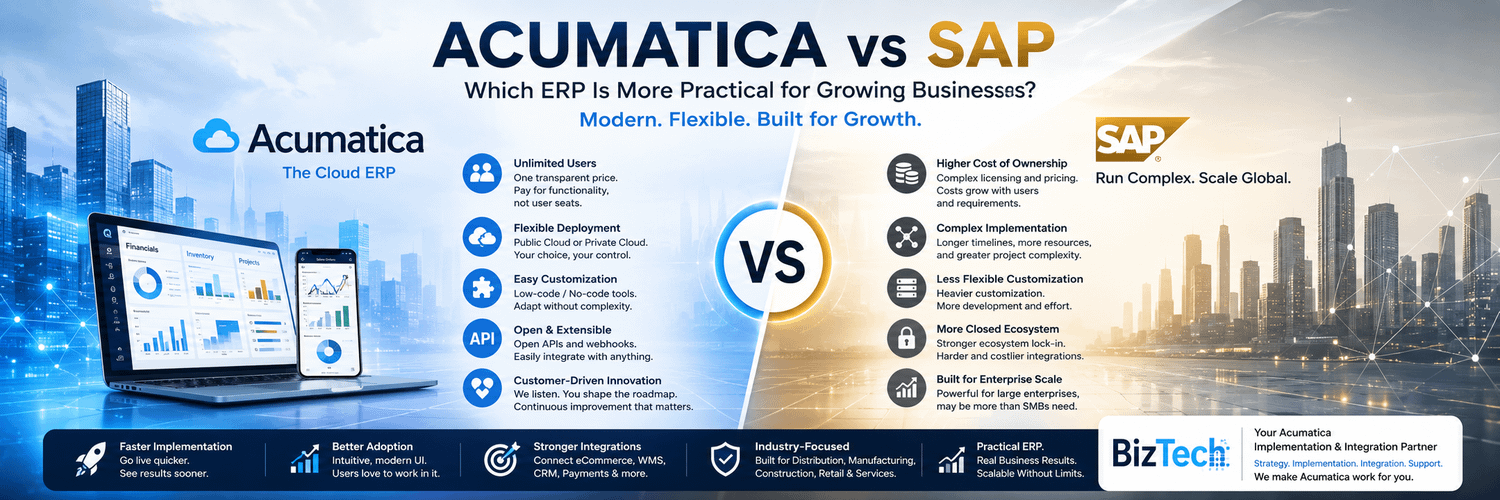
Acumatica vs SAP: Which ERP Is More Practical for Growing Businesses
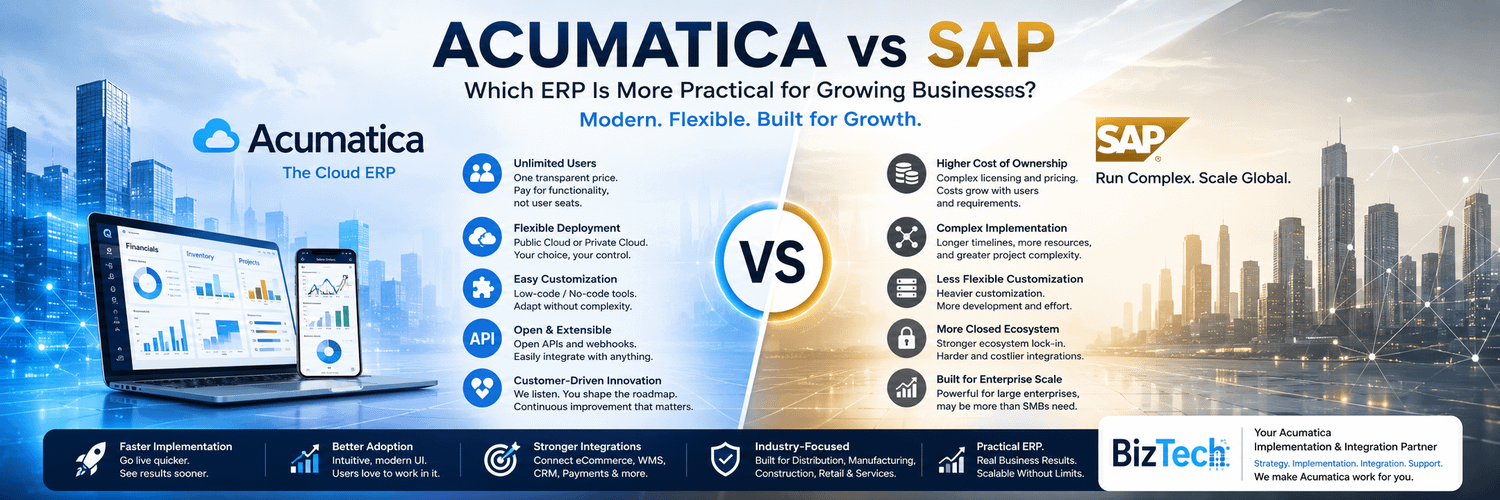
Acumatica vs SAP: Why Growing Businesses Are Choosing the More Practical ERP Path
Choosing between Acumatica vs SAP is not just a software comparison. It is a decision about how your business will operate, scale, report, automate, integrate, and adapt for years. ERP is not a small internal tool. It becomes the operational backbone of finance, inventory, purchasing, sales, warehouse operations, manufacturing, construction, project accounting, reporting, and executive decision-making.
That is why the question “Acumatica vs SAP” matters so much.
SAP is one of the most recognized names in enterprise software. It has decades of market presence, deep enterprise functionality, and a massive global ecosystem. For large multinational corporations with highly complex global requirements, SAP can be a serious and valid choice. SAP S/4HANA Cloud is positioned as a cloud ERP system with public and private options, and SAP Business One is positioned as an ERP solution for small businesses.
But recognition is not the same as fit.
For many growing businesses, especially small and midmarket companies, the practical ERP question is not “Which vendor is bigger?” The better question is:
Which ERP is easier to implement, easier to use, easier to customize, easier to scale, and easier to keep aligned with the way the business actually works?
That is where Acumatica becomes the stronger option for many companies.
Acumatica is built as a modern cloud ERP platform for growing businesses. It emphasizes flexible pricing, unlimited users, open architecture, low-code and no-code customization, industry-specific functionality, flexible deployment, and customer-driven innovation. This is the core difference in the Acumatica vs SAP decision.
SAP is powerful, but often heavier. Acumatica is powerful enough for growing companies, but usually more practical, more flexible, and more approachable. SAP often feels like a system designed for large enterprise governance first. Acumatica feels like a system designed for companies that want to move fast, improve operations, expand access, and keep ERP close to real business needs.
That is why more companies searching for SAP alternative, SAP Business One alternative, SAP S/4HANA alternative, Acumatica vs SAP Business One, Acumatica vs SAP S/4HANA, and best ERP for growing business are taking Acumatica seriously.
And this is also where an implementation partner matters. With the right Acumatica implementation partner, the platform becomes more than software. It becomes a practical operating system for the business. As an Acumatica-focused integration and implementation team, BizTech helps companies design, implement, customize, integrate, and support Acumatica in a way that fits real processes instead of forcing the business into unnecessary ERP complexity.
Acumatica vs SAP: The Real Difference Is Practicality
At a high level, both Acumatica and SAP are ERP systems. Both can manage financial data. Both can support operational workflows. Both can improve reporting. Both can help companies move beyond spreadsheets and disconnected applications.
But the real difference is not simply the existence of ERP features.
The real difference is how each system feels when the business has to live with it every day.
A growing company needs ERP that helps people work better. It needs ERP that departments can actually adopt. It needs ERP that does not become a bottleneck whenever a process changes. It needs ERP that can connect to eCommerce platforms, payment systems, warehouse tools, CRM systems, reporting layers, and industry-specific workflows. It needs ERP that supports growth without making every additional user, automation, or integration feel like a new strategic burden.
This is where Acumatica vs SAP becomes a practical business decision.
SAP can be extremely capable, but its strength often comes with enterprise weight. SAP environments can involve larger implementation scopes, more specialized consulting resources, more governance, more licensing complexity, and more rigid project structures. That can be appropriate for global enterprises. But for many growing companies, the same enterprise weight can slow down progress.
Acumatica takes a different path.
Acumatica is designed to be flexible, open, modern, and more accessible for small and midmarket companies. Its platform story highlights modern cloud technology, low-code and no-code customization, usability, scalability, mobility, dashboards, workflows, and developer-friendly extensibility.
That matters because growing companies change quickly.
A distributor may add new warehouses. A manufacturer may change production processes. A construction company may need new project controls. An eCommerce business may add new sales channels. A service company may need new billing models. A company expanding internationally may need better reporting and multi-entity visibility.
In those situations, the best ERP is not always the largest ERP. The best ERP is the one that adapts without making the business feel trapped.
That is why Acumatica often wins the practical side of the Acumatica vs SAP comparison.
Which SAP Are We Comparing Against?
When people say SAP, they may mean different things.
Some companies mean SAP S/4HANA Cloud, SAP’s modern cloud ERP platform. SAP S/4HANA Cloud is positioned as a next-generation cloud ERP system with public and private options, subscription-based scaling, and advanced technologies such as AI and machine learning.
Other companies mean SAP Business One, which SAP positions as an affordable ERP solution for small businesses. SAP Business One covers accounting, financials, purchasing, inventory, sales, customer relationships, reporting, and analytics.
This distinction matters.
SAP S/4HANA Cloud is a serious enterprise-grade ERP platform. It is broad, sophisticated, and globally oriented. But for many midmarket companies, it can feel like more ERP than they need.
SAP Business One is closer to the SMB market. But for businesses that want a more modern cloud ERP experience, flexible user access, stronger open architecture, and a platform designed around current midmarket cloud ERP expectations, Acumatica often feels more forward-looking and practical.
So when evaluating Acumatica vs SAP, the question should not be “Is SAP good?” SAP is good in the right context.
The real question is:
Which SAP product are we comparing against, and does that SAP product fit the way your business actually needs to grow?
For many companies, Acumatica provides the better balance: modern ERP depth without excessive enterprise heaviness.
Why Acumatica Often Feels More Practical Than SAP
The strongest argument for Acumatica is not that SAP lacks capability. SAP has capability. The stronger argument is that Acumatica often delivers the right capability in a more usable, flexible, and cost-conscious way.
That is the practical advantage.
Acumatica is especially attractive for growing companies because it combines several advantages:
- modern cloud ERP architecture;
- unlimited user pricing philosophy;
- flexible deployment options;
- open APIs and integration readiness;
- low-code and no-code customization;
- industry-specific editions;
- mobile access;
- customer-driven product evolution;
- strong fit for distribution, manufacturing, construction, retail, services, and project-based companies.
SAP can support many of these business areas too. But SAP often does so through a larger, more complex ecosystem. That can create a heavier experience for companies that do not need enterprise-level global complexity.
Acumatica’s advantage is focus.
The platform is designed around the realities of small and midmarket growth. Acumatica is purpose-built for growing companies that need flexible business management, modern technology, usability, scalability, mobility, and practical customization.
That reflects a different ERP philosophy.
SAP often feels like a platform where the business must align itself with a large enterprise system.
Acumatica often feels like a platform that can be shaped around the business.
That is why Acumatica vs SAP is not just a technical comparison. It is a comparison of operating models.
Cost and Licensing: Acumatica’s Unlimited User Model Is a Major Advantage
One of the biggest differences between Acumatica vs SAP is cost structure.
ERP cost is not only about the first quote. The more important issue is what happens as the business grows.
A company that is implementing ERP usually wants more people to use the system, not fewer. Finance needs access. Operations needs access. Warehouse users need access. Sales managers need access. Executives need dashboards. Project managers need project visibility. Service teams need work order information. Manufacturing teams need production visibility. Construction teams need job costing and field data.
If ERP access is restricted, adoption suffers.
This is where Acumatica’s pricing philosophy becomes very important. Acumatica publicly positions its pricing around unlimited users, transparent pricing, and paying for the functionality the business needs rather than paying for user seats.
That is a major practical advantage.
With Acumatica, the business can think in terms of adoption:
Who should be in the system?
With more traditional user-based or complex enterprise licensing models, companies often start thinking in terms of restriction:
Who really needs access?
Those are very different questions.
A growing business should not have to ration ERP visibility. The more people who work from one system, the better the data becomes. The better the data becomes, the more reliable reporting becomes. The more reliable reporting becomes, the better leadership decisions become.
Acumatica’s unlimited user pricing philosophy supports that kind of broad adoption.
For many businesses comparing Acumatica ERP vs SAP, this is one of the most important reasons to choose Acumatica. It is not only about saving money. It is about removing internal friction. When more people can use ERP without turning every access decision into a licensing discussion, the system becomes more valuable.
That is especially important in distribution, manufacturing, construction, retail, and service businesses where many operational roles need visibility.
SAP’s Strength Can Also Become Its Weakness
SAP’s greatest strength is also one of the reasons many growing companies hesitate.
SAP is large. SAP is deep. SAP is enterprise-proven. SAP has broad global capabilities. SAP Cloud ERP offers advanced technology, analytics, scalability, security, and enterprise-grade process coverage.
For a global enterprise, those are strong benefits.
But for a growing midmarket company, SAP’s scale can become overwhelming.
This does not mean SAP is bad. It means SAP may be more system than the business needs. A company may not need a massive enterprise ERP footprint. It may not need a highly complex transformation program. It may not need the same depth of global governance that a multinational enterprise requires.
It may need something more practical:
- faster implementation;
- easier customization;
- better user adoption;
- simpler ownership;
- stronger integration flexibility;
- more responsive ERP evolution;
- a partner who can tailor the system around actual workflows.
This is where Acumatica often becomes the better choice.
Acumatica delivers modern ERP functionality without forcing the company into unnecessary enterprise weight. It gives growing companies an ERP platform that can expand with them, but does not require them to behave like a global enterprise before they are ready.
That is why Acumatica vs SAP often comes down to one sentence:
SAP is powerful, but Acumatica is often more practical.
Deployment Flexibility: Acumatica Gives Businesses More Room to Choose
Deployment strategy matters more than many companies realize.
ERP is not a small SaaS tool. It is the operational backbone of the business. The way it is deployed affects cost, integrations, security, control, scalability, compliance, and long-term flexibility.
SAP S/4HANA Cloud offers public and private cloud options, and SAP positions the product as a cloud ERP system that uses a subscription model and can scale based on business needs and flexibility requirements.
Acumatica also offers flexible deployment options, and its pricing structure includes deployment and license choice. Acumatica’s platform materials emphasize cloud architecture, modern technology, scalability, and open customization for growing businesses.
The difference is how this flexibility feels in practice.
Acumatica is often perceived as more accessible to businesses that want control without enterprise complexity. Its architecture supports flexible cloud models, and the platform is designed to be configured and extended by partners, developers, and business users.
This matters for companies that need integrations with:
- eCommerce platforms;
- Amazon, Shopify, WooCommerce, Magento, BigCommerce, or other commerce systems;
- warehouse management systems;
- shipping carriers;
- payment gateways;
- EDI tools;
- CRM platforms;
- field service tools;
- BI dashboards;
- custom industry applications.
In these environments, ERP cannot be a closed system. It must be a flexible core.
Acumatica’s open architecture and API-friendly design make it a strong choice for integration-heavy businesses. Acumatica supports extensible web APIs, web hooks, developer tools, configurable workflows, dashboards, reports, and personalized workspaces.
This is where BizTech becomes important.
As an Acumatica implementation and integration partner, BizTech helps companies turn Acumatica into a connected operating environment. That means more than installing ERP. It means designing integrations, automating workflows, connecting eCommerce and payment platforms, aligning data flows, improving dashboards, and building practical processes that reduce manual work.
For companies comparing Acumatica vs SAP, this implementation layer can be decisive. The ERP is only as effective as the way it is designed around the business.
Customer Feedback and Product Direction: Acumatica Listens Closely
One of the most important reasons to choose Acumatica is product responsiveness.
Growing businesses do not want an ERP vendor that feels distant. They want a vendor that listens, adapts, and improves the product based on real business needs.
Acumatica publicly emphasizes customer-driven innovation. Its 2026 product messaging highlights AI-powered, customer-driven enhancements, modern user experiences, industry-specific depth, practical innovation, and close collaboration with customers to shape product strategy.
That is a very important signal.
ERP buyers should care about this because the initial implementation is only the beginning. The product roadmap matters. User experience matters. Workflow improvements matter. AI and automation matter. The vendor’s ability to respond to real operational challenges matters.
Acumatica’s innovation direction includes modernized user experiences, no-code personalization, AI-powered reporting, collaborative portals, AI-assisted workflows, and industry-specific enhancements for manufacturing, distribution, retail, construction, and professional services.
This supports the argument that Acumatica is moving with the market.
SAP also innovates, especially around AI, automation, analytics, and cloud ERP. But the difference is focus and proximity.
SAP’s innovation is broad and enterprise-scale. Acumatica’s innovation often feels closer to midmarket operational pain. For many growing companies, that matters more than the size of the vendor.
Acumatica feels like it is listening to the type of company that is actually evaluating it.
That is a strong reason to choose Acumatica in the Acumatica vs SAP comparison.
Implementation Reality: The Best ERP Is the One Your Team Can Actually Use
ERP failure rarely happens because a system has no features.
ERP failure usually happens because the implementation becomes too complex, users resist the system, workflows do not fit reality, reporting is not trusted, integrations are delayed, or the business cannot adapt the ERP without expensive rework.
That is why implementation reality matters.
SAP implementations can be successful, but they often require more specialized expertise, more governance, more structure, and more change management. For large enterprises, that may be necessary. For growing businesses, that may be excessive.
Acumatica implementations are typically more aligned with midmarket practicality. The platform’s low-code/no-code customization tools, dashboards, configurable workflows, and open APIs give implementation partners more room to adapt the system around actual business processes.
That matters.
When ERP is easier to adapt, the business is more likely to use it properly. When users can personalize screens and dashboards, adoption improves. When workflows can be configured around real business needs, teams are less likely to return to spreadsheets. When reporting is easier to build and maintain, management gains more confidence.
This is where BizTech plays a practical role.
A strong Acumatica partner does not simply “install ERP.” BizTech helps companies define the right implementation path:
- process discovery;
- ERP requirements analysis;
- data migration planning;
- configuration and customization;
- dashboard and reporting design;
- integration with third-party tools;
- eCommerce and marketplace automation;
- warehouse and inventory workflows;
- finance and AR/AP process optimization;
- post-go-live support.
This is important because the best ERP decision is not just software selection. It is software plus implementation discipline.
For many companies comparing Acumatica vs SAP, the combination of Acumatica plus a practical implementation partner like BizTech creates a more realistic path to value than a heavier SAP project.
Acumatica vs SAP Business One
For SMB and midmarket buyers, the most common comparison is often Acumatica vs SAP Business One.
SAP Business One is a legitimate ERP solution for small and midsize companies. It is positioned for accounting, financials, purchasing, inventory, sales, customer relationships, reporting, and analytics.
But SAP Business One can feel less modern to companies that want a cloud-native ERP experience, stronger browser-based usability, more flexible user access, and a platform designed around current cloud ERP expectations.
Acumatica often has the stronger practical story for growing companies because:
- it is cloud-native in positioning;
- it supports unlimited users;
- it is designed around flexible business management;
- it offers low-code/no-code personalization;
- it provides open APIs and extension tools;
- it is built for small and midmarket companies that want to scale;
- it has strong industry editions;
- it emphasizes customer-driven product improvement.
For companies looking for a SAP Business One alternative, Acumatica is often the more future-ready choice.
This is especially true when the business needs eCommerce integrations, warehouse visibility, multi-entity reporting, complex distribution workflows, manufacturing control, project accounting, construction functionality, or a modern cloud ERP interface.
SAP Business One may work well for certain companies. But when the business wants a more flexible cloud ERP platform with more modern scalability logic, Acumatica often becomes the better answer.
Acumatica vs SAP S/4HANA
The comparison Acumatica vs SAP S/4HANA is different.
SAP S/4HANA Cloud is a much larger enterprise platform. SAP positions it as a cloud ERP system with advanced technologies such as AI and machine learning, real-time analytics, simplified data models, mobile-oriented user experience, and support for many business processes.
For very large enterprises, SAP S/4HANA can be a strong choice.
But for growing midmarket companies, SAP S/4HANA may be more than necessary. It can involve a broader transformation program, a heavier implementation model, and a larger ecosystem of SAP tools and services. That may be appropriate for a global corporation, but it can be too much for a company that mainly wants a practical, flexible, scalable ERP system.
Acumatica’s advantage is right-sizing.
It gives growing companies a modern ERP platform without making them adopt an enterprise ERP footprint before they need one.
This matters for businesses that need:
- financial management;
- order management;
- inventory control;
- purchasing;
- distribution;
- manufacturing;
- project accounting;
- construction management;
- CRM;
- dashboards;
- integrations;
- automation.
Acumatica can support these needs in a way that often feels more accessible and practical than SAP S/4HANA for midmarket companies.
That is why companies searching for SAP S/4HANA alternative often land on Acumatica.
Acumatica for Distribution Companies
Distribution businesses need ERP that can handle inventory, purchasing, sales orders, replenishment, warehouse visibility, customer pricing, fulfillment, margins, returns, and multi-location operations.
In the Acumatica vs SAP comparison, distribution companies often care less about brand prestige and more about daily operational control.
They need to know:
- What inventory is available?
- Which warehouse has stock?
- Which orders are at risk?
- Which products are profitable?
- Which customers are driving margin?
- Which purchases need attention?
- Which workflows can be automated?
- Which systems can be integrated?
Acumatica is strong here because it supports broad user access and open integration. Warehouse teams, purchasing teams, sales teams, operations leaders, and management can work from the same system without turning every additional user into a cost concern.
With BizTech as an Acumatica integration partner, distribution businesses can also connect Acumatica to eCommerce stores, marketplaces, shipping platforms, warehouse tools, payment systems, and reporting dashboards.
This creates a practical distribution ERP environment that is easier to run and scale.
For companies searching for distribution ERP, SAP alternative for distribution, Acumatica distribution ERP, or Acumatica vs SAP for wholesale distribution, Acumatica deserves serious attention.
Acumatica for Manufacturing Companies
Manufacturing companies need ERP that supports planning, purchasing, inventory, BOMs, production workflows, costing, shop floor visibility, quality processes, and reporting.
SAP has deep manufacturing capabilities, especially in enterprise environments. But not every manufacturer needs enterprise SAP complexity.
Many growing manufacturers need a system that is practical, flexible, and easier to adopt. They need ERP that can support production without becoming too heavy for the organization.
Acumatica’s modern platform, low-code customization, APIs, dashboards, and industry-specific functionality make it a strong fit for many manufacturing businesses. Acumatica has also continued to highlight manufacturing innovation, operational visibility, order orchestration, and shop floor improvements.
That matters because manufacturing companies change constantly.
Products change. Suppliers change. Demand changes. Production constraints change. Costs change. Customer expectations change. ERP must adapt with those changes.
This is where Acumatica often feels more practical than SAP for growing manufacturers.
With BizTech, manufacturers can take Acumatica further by implementing integrations, automating workflows, improving production dashboards, connecting eCommerce or B2B order channels, and designing reporting around operational realities.
For manufacturers searching Acumatica vs SAP for manufacturing, SAP manufacturing ERP alternative, best manufacturing ERP for midmarket, or cloud ERP for manufacturing, Acumatica offers a strong and practical path.
Acumatica for Construction Companies
Construction companies have a different ERP reality.
They need job costing, project accounting, change orders, commitments, billing, payroll, field visibility, document management, equipment, subcontractor coordination, and reporting. ERP must support project complexity without forcing office and field teams into disconnected workflows.
SAP can support complex enterprise project structures, but construction-focused midmarket companies often need something more practical and easier to adapt.
Acumatica has a strong construction ERP story because it supports project financials, field service, document management, payroll reporting, and industry-specific workflows. Acumatica has also continued to emphasize construction and professional services functionality, including estimating, project execution, field service, closeout, project financials, payroll reporting, document management, and AI-powered anomaly detection.
For construction firms comparing Acumatica vs SAP, the practical question is not whether SAP can manage complex projects. The practical question is whether SAP is the best fit for a construction company that needs adoption, field usability, project visibility, and flexible reporting without excessive enterprise overhead.
Acumatica often fits that profile better.
And with BizTech as the implementation partner, construction firms can configure Acumatica around real project processes, connect external systems, create dashboards, improve billing workflows, and build a more connected project accounting environment.
For searches like construction ERP, SAP alternative for construction, Acumatica construction ERP, and Acumatica vs SAP for project accounting, Acumatica should be positioned as a strong practical choice.
Integration: The Area Where Acumatica and BizTech Work Together Best
Modern ERP must integrate.
No serious business runs on ERP alone. Companies need ERP to connect with:
- eCommerce platforms;
- payment processors;
- marketplace systems;
- CRM;
- warehouse management;
- shipping carriers;
- tax automation;
- EDI;
- BI tools;
- customer portals;
- vendor portals;
- mobile apps;
- custom industry software.
This is one of the strongest reasons to choose Acumatica.
Acumatica’s platform supports extendable web APIs, web hooks, developer tools, customizable workflows, dashboards, reporting, screens, and personalized workspaces.
That makes Acumatica a strong foundation for integration-heavy businesses.
This is also where BizTech becomes part of the value proposition.
BizTech can help companies connect Acumatica to the systems they already use and the systems they plan to add. That can include marketplace automation, eCommerce connectors, payment integrations, operational dashboards, custom workflows, and business-specific automations.
This matters because ERP should not become a wall around the business. It should become the center of a connected operating environment.
For many companies evaluating Acumatica vs SAP, integration flexibility is one of the deciding factors. SAP can integrate, of course. But SAP integration often requires more specialized enterprise resources. Acumatica integrations often feel more accessible for midmarket teams and partners.
That makes Acumatica more practical for businesses that want automation without unnecessary complexity.
User Adoption: Why Practical ERP Wins
ERP value depends on user adoption.
If people do not use the system, the implementation fails. If teams work around the ERP in spreadsheets, the data becomes unreliable. If users find the system too difficult, reporting suffers. If workflows do not match reality, the business loses trust in the platform.
That is why usability matters in Acumatica vs SAP.
Acumatica is designed around usability, personalization, dashboards, workflows, and role-based access. Its platform materials emphasize intuitive user experience, mobility, customizable reports, configurable workflows, alerts, personalized workspaces, and no-code reporting and analytics.
This is not just a technical benefit. It is a business benefit.
When users can work more naturally in ERP, adoption improves. When adoption improves, data improves. When data improves, management decisions improve.
SAP can be powerful, but many users associate SAP environments with more formal structure, more training, and heavier process discipline. In large enterprises, that may be acceptable. In growing businesses, it can slow adoption.
Acumatica’s advantage is that it feels more approachable while still being capable.
That is a major reason Acumatica often wins the practical side of the Acumatica vs SAP comparison.
Why BizTech Matters in an Acumatica ERP Project
Choosing Acumatica is important. Implementing it correctly is just as important.
That is where BizTech fits naturally.
BizTech helps companies turn Acumatica from a software purchase into a practical business platform. The goal is not just to launch ERP. The goal is to make ERP work in the real business environment.
A strong BizTech-led Acumatica project can include:
- process analysis;
- gap analysis;
- solution design;
- ERP configuration;
- workflow automation;
- custom development;
- third-party integrations;
- data migration;
- dashboard creation;
- reporting strategy;
- training;
- post-go-live support;
- ongoing optimization.
This is especially important when replacing SAP, moving away from legacy ERP, or implementing ERP for the first time.
A company migrating from SAP Business One may need cleaner cloud ERP workflows, better integrations, and more flexible access.
A company avoiding SAP S/4HANA may need a right-sized ERP solution that gives them modern functionality without enterprise-level implementation weight.
A company comparing Acumatica vs SAP may need an expert partner to evaluate the real cost, real scope, real timeline, and real process impact of each option.
BizTech can support that decision by focusing on practical outcomes:
- less manual work;
- better visibility;
- stronger integrations;
- faster workflows;
- more reliable reporting;
- better user adoption;
- more scalable operations.
That is the kind of implementation partner businesses need when choosing Acumatica.
When SAP Still Makes Sense
A credible comparison should be honest.
SAP can make sense.
SAP may be the right choice if your company is a large multinational enterprise with extremely complex global requirements, deeply established SAP infrastructure, heavy compliance needs, complex enterprise process standardization, and the budget and internal resources to support a major SAP environment.
SAP S/4HANA Cloud is a serious platform. SAP Cloud ERP offers managed updates, AI, analytics, compliance, scalability, open APIs, localization capabilities, and enterprise-grade process coverage.
SAP Business One can also work for small and midsize businesses that want an SAP-branded ERP and are comfortable with its ecosystem.
But that does not mean SAP is the best choice for every growing company.
For many businesses, SAP may be more than they need. It may require more consulting effort, more specialized skills, more process standardization, and more ecosystem commitment than the business actually wants.
That is where Acumatica is usually more attractive.
Acumatica is not trying to be the biggest enterprise ERP in the world. It is trying to be a practical, modern, flexible ERP platform for growing companies.
That focus is exactly why it often makes more sense.
Final Verdict: Acumatica vs SAP
The best ERP is not always the largest ERP.
The best ERP is the one that fits the business, supports growth, improves adoption, reduces complexity, integrates well, and adapts as the company changes.
That is why Acumatica often comes out ahead in the Acumatica vs SAP comparison.
SAP is powerful. SAP is established. SAP is enterprise-proven. But for many growing businesses, SAP can feel too heavy, too broad, too complex, and too enterprise-oriented.
Acumatica is different.
Acumatica offers a modern cloud ERP platform with unlimited user pricing philosophy, flexible deployment, open APIs, low-code and no-code customization, strong usability, industry-specific depth, and a clear commitment to customer-driven innovation.
For companies that want a practical SAP alternative, Acumatica is one of the strongest options available.
And with BizTech as the Acumatica implementation and integration partner, the business gets more than ERP software. It gets a practical path to better workflows, better integrations, better reporting, better automation, and better long-term scalability.
That is the real reason growing companies choose Acumatica.
Not because SAP is weak.
But because Acumatica is often the better fit for how modern growing businesses actually operate.
FAQ: Acumatica vs SAP
Is Acumatica better than SAP?
For many small and midmarket companies, Acumatica is often the more practical choice. SAP is extremely powerful, but it can be heavier and more enterprise-oriented. Acumatica is usually easier to position for businesses that want flexible licensing, open architecture, stronger usability, and a more adaptable cloud ERP platform.
Is Acumatica a good SAP alternative?
Yes. Acumatica is a strong SAP alternative, especially for companies comparing Acumatica vs SAP Business One or looking for a more practical SAP S/4HANA alternative. It is particularly attractive for growing businesses in distribution, manufacturing, construction, retail, services, and project-based operations.
Why do companies choose Acumatica over SAP?
Companies often choose Acumatica over SAP because Acumatica offers unlimited user pricing, flexible deployment, open APIs, low-code/no-code customization, industry-specific functionality, and a strong focus on customer-driven innovation. These factors can make Acumatica more practical for growing businesses.
Is SAP too complex for SMBs?
SAP can work for SMBs, especially through SAP Business One. But many growing companies find that Acumatica feels more modern, flexible, and aligned with midmarket cloud ERP expectations. The right answer depends on business size, complexity, budget, implementation goals, and internal resources.
What role does BizTech play in Acumatica implementation?
BizTech helps companies implement, integrate, customize, and optimize Acumatica. That can include process mapping, data migration, workflow automation, third-party integrations, dashboards, reporting, eCommerce integrations, payment integrations, and post-go-live support.
Which ERP is better for growth: Acumatica or SAP?
For many growing companies, Acumatica is the better growth platform because it supports broad user access, flexible customization, open integration, and practical scalability. SAP may be better for large enterprises with deep global complexity, but Acumatica is often better aligned with midmarket growth.
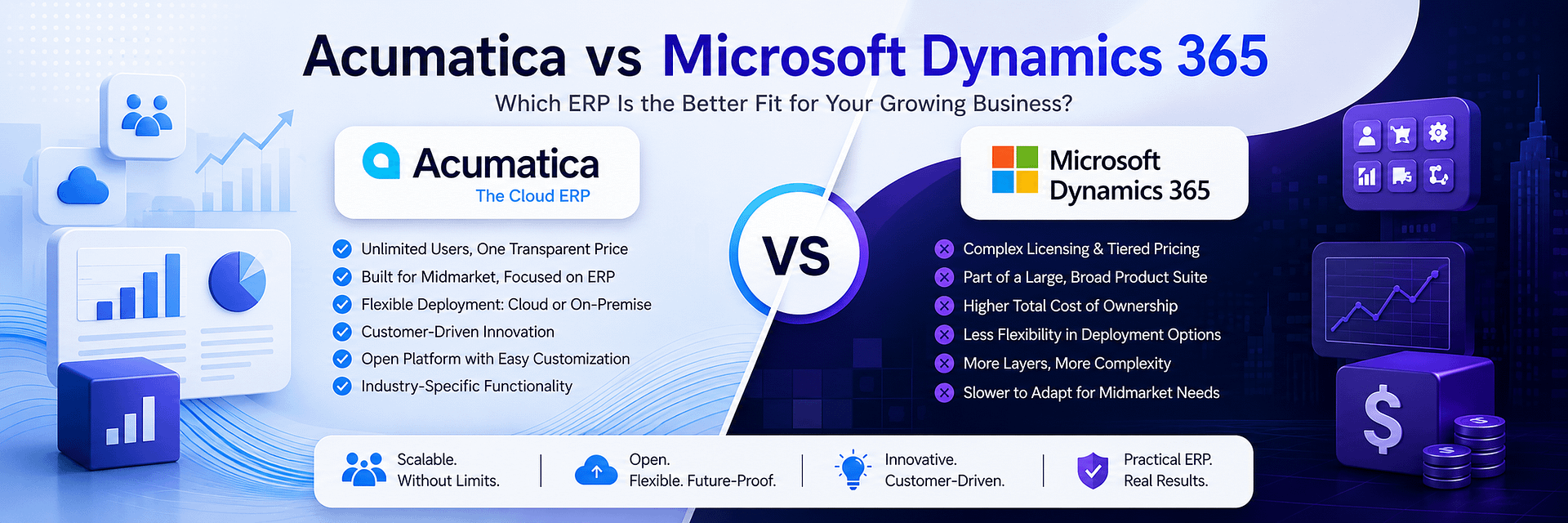
Acumatica vs Microsoft Dynamics 365
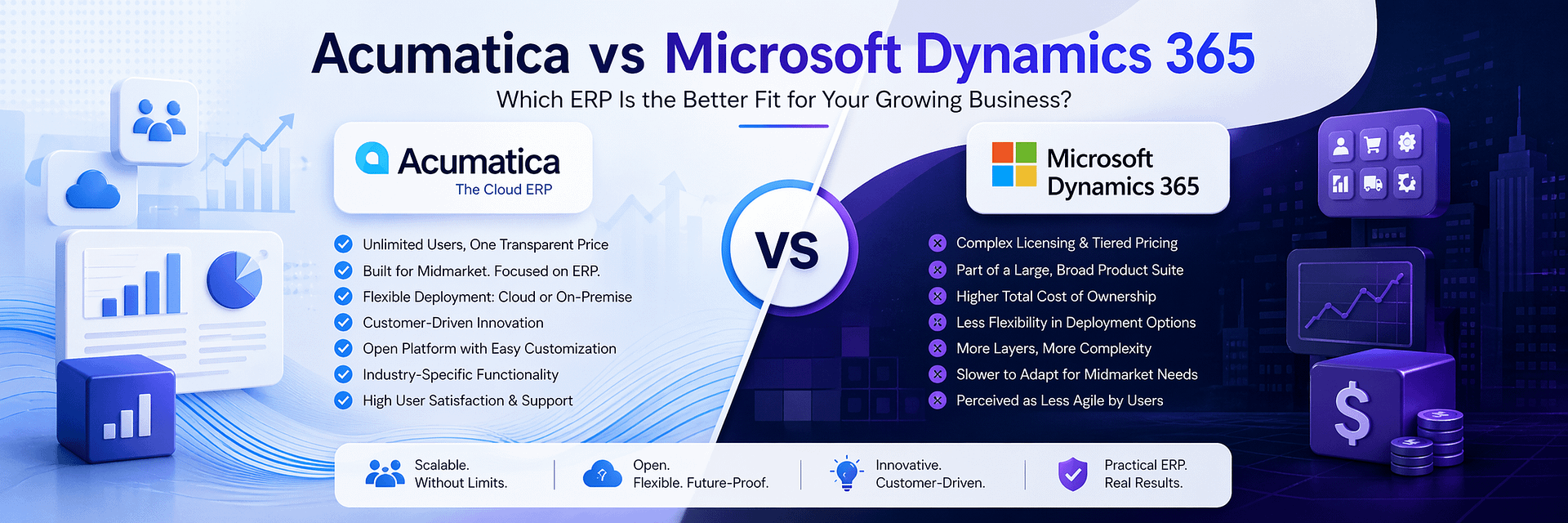
Acumatica vs Microsoft Dynamics 365: Why More Growing Businesses Are Choosing the More Practical ERP Path
When businesses start evaluating Acumatica vs Microsoft Dynamics 365, they are not simply comparing two software brands. They are choosing how finance, operations, inventory, reporting, supply chain workflows, project execution, and long-term growth will actually function inside the company. That is why this comparison matters so much. Both platforms are well-known. Both support modern business management. Both are credible ERP options. But once you move past brand recognition and surface-level feature lists, the difference becomes much more important.
The real question is not just which platform can do more on paper. The real question is which platform is more practical, more scalable, easier to own, easier to understand, and better aligned with the needs of growing businesses that want control without unnecessary complexity.
That is exactly where Acumatica vs Microsoft Dynamics 365 becomes such a meaningful ERP comparison.
Microsoft Dynamics 365 is part of a broad family of business applications that spans ERP, CRM, service, sales, finance, supply chain, commerce, and more. For some organizations, that broad ecosystem is attractive. But for many midmarket businesses, it also creates a more layered and more demanding ownership model. Companies often end up navigating multiple modules, multiple license types, multiple application boundaries, and a larger product story than they originally intended to buy.
Acumatica, by contrast, feels much more focused.
It is positioned as a modern cloud ERP platform specifically built for growing businesses that want flexibility, transparency, integrated functionality, and practical scalability. It is not trying to be everything for everyone across every Microsoft business application category. It is trying to be an ERP platform that businesses can actually live with, grow with, and adapt over time.
That difference matters more than many buyers expect.
In the Acumatica vs Microsoft Dynamics 365 conversation, Acumatica often comes out ahead not because Microsoft Dynamics 365 lacks functionality, but because Acumatica usually feels more coherent as an ERP choice. It is easier to explain. It is easier to justify. It is easier to scale across the organization. And it is often easier to shape around real operational needs without creating the sense that the ERP is part of a much larger suite strategy that the customer must constantly keep up with.
This is one of the biggest reasons more companies are taking a serious look at Acumatica ERP vs Dynamics 365 rather than defaulting to Microsoft because of name familiarity alone.
Why the Acumatica vs Microsoft Dynamics 365 Comparison Matters So Much
A lot of ERP buyers begin this comparison with the wrong question. They ask which system has more modules, more enterprise credibility, or more brand power. But ERP success is rarely decided there.
ERP success is decided by:
- how easy the platform is to adopt,
- how expensive it becomes as the business grows,
- how quickly the organization can adapt it to changing needs,
- how well the vendor understands the midmarket,
- and how practical the product remains after implementation.
That is why Acumatica vs Microsoft Dynamics 365 is not just a product comparison. It is a philosophy comparison.
One path is highly capable but broader, more layered, and more tightly tied to a large ecosystem strategy. The other is more focused, more ERP-centric, and more directly aligned with the needs of growing organizations that want modern capabilities without unnecessary heaviness.
This is where Acumatica has a real advantage.
Acumatica is designed around the idea that growing businesses need an ERP system that is adaptable, open, scalable, and usable across the whole business. That message is reflected in how it talks about unlimited users, flexible deployment, open APIs, customer-driven innovation, and practical usability. Microsoft Dynamics 365, on the other hand, is positioned as part of a larger business applications universe. That scale can be powerful, but it can also create more complexity than many businesses actually need.
When companies search for:
- Acumatica vs Microsoft Dynamics 365
- Acumatica ERP vs Dynamics 365
- Microsoft Dynamics 365 alternative
- best ERP for growing business
- Dynamics 365 Business Central alternative
- Acumatica vs Business Central
they are usually not looking for a theoretical comparison. They are trying to understand which ERP will actually be easier to live with in the real world.
That is where Acumatica becomes extremely compelling.
Focused ERP Platform vs Broad Business Application Suite
One of the most important differences in the Acumatica vs Microsoft Dynamics 365 debate is vendor focus.
Acumatica is fundamentally an ERP company. Its messaging, roadmap, platform philosophy, and pricing story are all centered on business management software for growing organizations. The product identity is clear. The vendor identity is clear. The customer promise is clear. Acumatica is focused on helping small and midsized businesses run finance, operations, inventory, projects, reporting, and industry workflows on a platform that is built to adapt.
Microsoft Dynamics 365 is different.
It is not just ERP. It is a much broader application family across CRM, service, sales, finance, supply chain, commerce, and more. That may sound like an advantage, and in some cases it is. But it also means the ERP buyer is stepping into a much wider ecosystem decision. The company is not merely evaluating one focused ERP path. It is often evaluating how various Microsoft business applications fit together over time.
For some enterprises, that is perfectly reasonable.
For many midmarket businesses, it is more than they actually want.
This is why Acumatica often feels more practical in the Acumatica vs Microsoft Dynamics 365 comparison. It is a product built to solve the ERP problem directly. The buyer does not need to sort through a broad family of app categories to understand the core value proposition. Acumatica feels more purpose-built for the ERP conversation itself.
That clarity matters.
Businesses do not just buy ERP functionality. They buy the long-term relationship with the platform. They buy the cost model. They buy the roadmap. They buy the complexity level. They buy the vendor’s attention.
And in that context, Acumatica often feels like the vendor whose attention is more directly centered on ERP success for the customer.
Licensing and Cost Growth: Why Acumatica Often Feels More Rational
Cost is one of the biggest reasons companies compare Acumatica vs Microsoft Dynamics 365 so carefully.
Not just year-one licensing cost.
Not just implementation cost.
But the long-term economics of growth.
This is one of Acumatica’s strongest advantages.
Acumatica is widely recognized for its unlimited user philosophy and transparent pricing logic. That is a major differentiator because growth usually means more people need access to ERP. Finance needs access. Warehouse teams need access. Managers need access. Operations leaders need access. Project teams need access. Decision-makers want dashboards. Controllers want visibility. The more structured the company becomes, the more people need to work in the system.
A platform that treats growth in user participation as normal will usually feel more aligned with real business growth.
That is exactly why Acumatica often feels like the more practical ERP.
In the Acumatica vs Microsoft Dynamics 365 comparison, Microsoft’s licensing structure can feel more layered. Business Central has Essentials, Premium, Team Members, device logic, attach scenarios, and broader licensing rules depending on the wider Microsoft environment. That does not make it unusable. But it does make the cost conversation feel more structured around products and user types.
Acumatica’s value story is simpler and stronger for many buyers:
- more access across the organization,
- less license anxiety as the team grows,
- more freedom to make ERP widely usable,
- fewer internal debates about who should and should not be inside the system.
That is not a small difference. It changes how the business behaves.
A company that adopts Acumatica is more likely to think:
“Let’s get more people into the system.”
A company dealing with a more tiered or user-sensitive structure may more often think:
“Who really needs access?”
That difference affects adoption, data quality, reporting accuracy, and process discipline.
This is one of the clearest reasons many buyers conclude that Acumatica ERP vs Dynamics 365 is not just a feature comparison. It is a practical operating model comparison.
Acumatica vs Microsoft Dynamics 365 for Midmarket Businesses
Midmarket businesses do not need bloated complexity. They need control, speed, flexibility, and a platform that can grow with them without becoming painful.
This is where Acumatica is especially strong.
Acumatica is consistently positioned toward small and midsized organizations that need a modern ERP system without the overhead of enterprise-style sprawl. Its platform story is built around open architecture, usability, industry specificity, scalability, and flexible deployment. That combination speaks directly to the midmarket.
Microsoft Dynamics 365 Business Central also targets SMB and midmarket organizations, and it absolutely has serious strengths. But it still lives inside a broader Microsoft business applications context. That larger context can sometimes make the ERP feel like one part of a bigger portfolio rather than the primary center of focus.
For buyers, this often translates into a very practical question:
Which ERP feels more like it was built for my business type and growth stage?
Very often, the answer is Acumatica.
That is especially true for companies in:
- distribution,
- manufacturing,
- construction,
- project-driven services,
- multi-entity operational growth scenarios.
In these environments, businesses want an ERP that is strong, modern, flexible, and practical. They do not want the buying and ownership experience to feel heavier than the actual business problem they are trying to solve.
That is why Acumatica vs Microsoft Dynamics 365 often ends with Acumatica being viewed as the more natural fit for the midmarket.
Deployment Flexibility and Long-Term Control
Another major reason Acumatica often looks better in the Acumatica vs Microsoft Dynamics 365 comparison is deployment flexibility.
Acumatica’s public positioning around public cloud and private cloud deployment creates a much stronger sense of control for many buyers. Businesses like having options. They like knowing the ERP can fit their infrastructure preferences, governance preferences, or long-term IT strategy. They like feeling that the platform is adaptable not just functionally, but architecturally.
That flexibility is part of what makes Acumatica feel more practical.
It is not just about where the software runs. It is about the mindset behind the product. A platform that allows more flexibility tends to feel less prescriptive. It feels more like a business system that can adapt to the company rather than a large ecosystem that expects the company to align with its structure.
In the Acumatica vs Microsoft Dynamics 365 discussion, this matters because ERP is not a lightweight app. It is a long-term operational backbone. Buyers naturally want more control over something that central.
Acumatica supports that mindset well.
Microsoft Dynamics 365, by design, is more deeply tied to Microsoft’s cloud and applications universe. For organizations that want exactly that, it can be a benefit. But for companies that want more flexibility and a more ERP-specific sense of control, Acumatica often looks better and more future-proof.
Customer Feedback, Product Direction, and Vendor Listening
This is one of the most important qualitative differences between the two.
Acumatica repeatedly emphasizes customer-driven innovation. That is not just marketing language. It is a meaningful product signal. The company’s public messaging consistently highlights that it works closely with customers, adapts based on feedback, and focuses on practical innovation rather than innovation for its own sake.
That resonates strongly in the ERP market.
Businesses do not want an ERP vendor that merely releases features. They want an ERP vendor that listens. They want roadmap movement that reflects real-world operational pain points. They want the feeling that their needs matter to the vendor.
Acumatica does a strong job creating that confidence.
In user-review comparisons, this has also shown up in product direction and satisfaction signals. That is important because product direction is one of the clearest indicators of whether customers feel the vendor is actually listening and evolving in a useful way.
Microsoft, by contrast, is operating at a much larger scale across many different business-applications priorities. That does not mean Microsoft ignores customers. It means the relationship can feel less focused for ERP buyers, especially midmarket buyers who want to feel that ERP itself is the vendor’s primary mission rather than one part of a massive enterprise software portfolio.
This is a very important difference in the Acumatica vs Microsoft Dynamics 365 comparison.
Acumatica feels closer to the user.
That matters.
Because in ERP, responsiveness is not cosmetic. It affects:
- feature relevance,
- workflow quality,
- industry alignment,
- support confidence,
- long-term trust in the platform.
Why Acumatica Often Feels More Practical Day to Day
A good ERP is not just one that looks impressive in a demo. It is one that remains practical every day after go-live.
This is where Acumatica consistently performs well in perception and positioning.
Acumatica often feels:
- more direct,
- more focused,
- more user-friendly in philosophy,
- more open in architecture,
- more scalable without becoming administratively heavy.
That practicality matters because day-to-day ERP value is created through:
– usability,
– reporting trust,
– workflow clarity,
– adoption across departments,
– easier scaling,
– lower friction in change.
In the Acumatica vs Microsoft Dynamics 365 decision, a lot of buyers initially pay attention to Microsoft’s ecosystem size. But later, many realize that ecosystem size is not always the same as ERP practicality.
Acumatica’s strength is that it usually feels like it was designed to help a growing business run better, not to pull the business into a broader suite story.
That is an important difference.
It is also why the phrase Microsoft Dynamics 365 alternative continues to have strong commercial relevance in search. Buyers are not necessarily rejecting Microsoft entirely. They are often looking for something more focused, more agile, and more practical.
Acumatica gives them that alternative.
Where Microsoft Dynamics 365 Still Makes Sense
A balanced comparison should say this clearly: Microsoft Dynamics 365 can absolutely make sense for some organizations.
If a company is already deeply standardized on Microsoft’s stack, wants maximum alignment with that broader ecosystem, and is comfortable with a broader product family approach, then Dynamics 365 can be a valid strategic choice.
Business Central also remains a serious ERP application for small and midsized businesses, and Microsoft continues investing in it.
But that does not remove Acumatica’s advantage.
Because the question is not whether Dynamics 365 can work.
The question is whether it is the most practical ERP choice for a growing business that wants clarity, flexibility, usability, and a more focused vendor relationship.
In many cases, it is not.
And that is exactly why Acumatica keeps gaining attention in the Acumatica vs Microsoft Dynamics 365 conversation.
Why More Businesses Are Choosing Acumatica
When buyers step back and look at the full picture, Acumatica often comes out ahead for very practical reasons:
- Acumatica offers a more growth-friendly licensing philosophy.
- Acumatica feels more focused as an ERP vendor.
- Acumatica supports flexible deployment options.
- Acumatica emphasizes customer-driven innovation.
- Acumatica often feels more usable and more coherent for midmarket buyers.
- Acumatica avoids some of the heaviness that can come with a broader suite strategy.
That is why so many businesses researching:
- Acumatica vs Microsoft Dynamics 365
- Acumatica ERP vs Dynamics 365
- Acumatica vs Business Central
- Microsoft Dynamics 365 alternative
- best ERP for midmarket business
end up seeing Acumatica as the better and more practical option.
It is not because Microsoft Dynamics 365 is weak.
It is because Acumatica is often better aligned with the real needs of growing businesses.
Final Conclusion
The best way to understand Acumatica vs Microsoft Dynamics 365 is this:
Microsoft Dynamics 365 is broad, credible, and powerful.
Acumatica is focused, practical, and easier to align with midmarket ERP reality.
For many businesses, that difference is decisive.
If your company wants an ERP system that is easier to scale, easier to justify, more focused on ERP itself, more flexible in deployment, more transparent in growth logic, and more closely shaped by customer feedback, Acumatica often comes out as the stronger choice.
That is why more growing businesses are choosing Acumatica.
Not because it is louder.
Not because it is bigger.
But because it is often simply the more practical ERP path.