
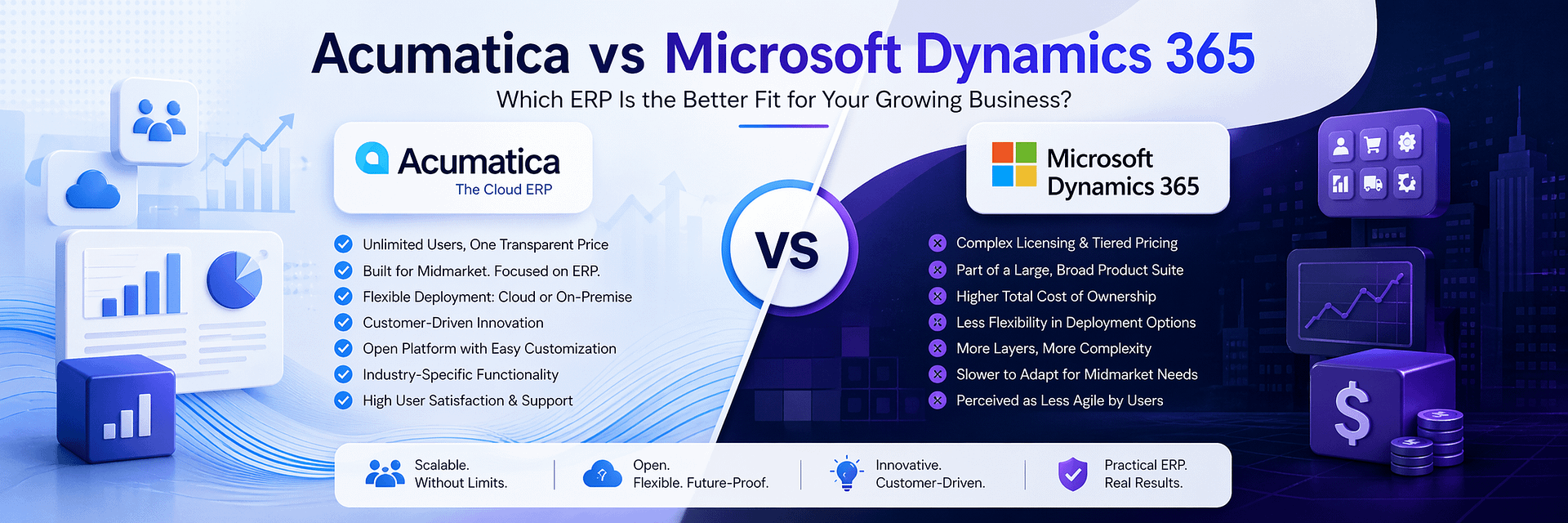
Acumatica vs Microsoft Dynamics 365: Why More Growing Businesses Are Choosing the More Practical ERP Path
When businesses start evaluating Acumatica vs Microsoft Dynamics 365, they are not simply comparing two software brands. They are choosing how finance, operations, inventory, reporting, supply chain workflows, project execution, and long-term growth will actually function inside the company. That is why this comparison matters so much. Both platforms are well-known. Both support modern business management. Both are credible ERP options. But once you move past brand recognition and surface-level feature lists, the difference becomes much more important.
The real question is not just which platform can do more on paper. The real question is which platform is more practical, more scalable, easier to own, easier to understand, and better aligned with the needs of growing businesses that want control without unnecessary complexity.
That is exactly where Acumatica vs Microsoft Dynamics 365 becomes such a meaningful ERP comparison.
Microsoft Dynamics 365 is part of a broad family of business applications that spans ERP, CRM, service, sales, finance, supply chain, commerce, and more. For some organizations, that broad ecosystem is attractive. But for many midmarket businesses, it also creates a more layered and more demanding ownership model. Companies often end up navigating multiple modules, multiple license types, multiple application boundaries, and a larger product story than they originally intended to buy.
Acumatica, by contrast, feels much more focused.
It is positioned as a modern cloud ERP platform specifically built for growing businesses that want flexibility, transparency, integrated functionality, and practical scalability. It is not trying to be everything for everyone across every Microsoft business application category. It is trying to be an ERP platform that businesses can actually live with, grow with, and adapt over time.
That difference matters more than many buyers expect.
In the Acumatica vs Microsoft Dynamics 365 conversation, Acumatica often comes out ahead not because Microsoft Dynamics 365 lacks functionality, but because Acumatica usually feels more coherent as an ERP choice. It is easier to explain. It is easier to justify. It is easier to scale across the organization. And it is often easier to shape around real operational needs without creating the sense that the ERP is part of a much larger suite strategy that the customer must constantly keep up with.
This is one of the biggest reasons more companies are taking a serious look at Acumatica ERP vs Dynamics 365 rather than defaulting to Microsoft because of name familiarity alone.
Why the Acumatica vs Microsoft Dynamics 365 Comparison Matters So Much
A lot of ERP buyers begin this comparison with the wrong question. They ask which system has more modules, more enterprise credibility, or more brand power. But ERP success is rarely decided there.
ERP success is decided by:
- how easy the platform is to adopt,
- how expensive it becomes as the business grows,
- how quickly the organization can adapt it to changing needs,
- how well the vendor understands the midmarket,
- and how practical the product remains after implementation.
That is why Acumatica vs Microsoft Dynamics 365 is not just a product comparison. It is a philosophy comparison.
One path is highly capable but broader, more layered, and more tightly tied to a large ecosystem strategy. The other is more focused, more ERP-centric, and more directly aligned with the needs of growing organizations that want modern capabilities without unnecessary heaviness.
This is where Acumatica has a real advantage.
Acumatica is designed around the idea that growing businesses need an ERP system that is adaptable, open, scalable, and usable across the whole business. That message is reflected in how it talks about unlimited users, flexible deployment, open APIs, customer-driven innovation, and practical usability. Microsoft Dynamics 365, on the other hand, is positioned as part of a larger business applications universe. That scale can be powerful, but it can also create more complexity than many businesses actually need.
When companies search for:
- Acumatica vs Microsoft Dynamics 365
- Acumatica ERP vs Dynamics 365
- Microsoft Dynamics 365 alternative
- best ERP for growing business
- Dynamics 365 Business Central alternative
- Acumatica vs Business Central
they are usually not looking for a theoretical comparison. They are trying to understand which ERP will actually be easier to live with in the real world.
That is where Acumatica becomes extremely compelling.
Focused ERP Platform vs Broad Business Application Suite
One of the most important differences in the Acumatica vs Microsoft Dynamics 365 debate is vendor focus.
Acumatica is fundamentally an ERP company. Its messaging, roadmap, platform philosophy, and pricing story are all centered on business management software for growing organizations. The product identity is clear. The vendor identity is clear. The customer promise is clear. Acumatica is focused on helping small and midsized businesses run finance, operations, inventory, projects, reporting, and industry workflows on a platform that is built to adapt.
Microsoft Dynamics 365 is different.
It is not just ERP. It is a much broader application family across CRM, service, sales, finance, supply chain, commerce, and more. That may sound like an advantage, and in some cases it is. But it also means the ERP buyer is stepping into a much wider ecosystem decision. The company is not merely evaluating one focused ERP path. It is often evaluating how various Microsoft business applications fit together over time.
For some enterprises, that is perfectly reasonable.
For many midmarket businesses, it is more than they actually want.
This is why Acumatica often feels more practical in the Acumatica vs Microsoft Dynamics 365 comparison. It is a product built to solve the ERP problem directly. The buyer does not need to sort through a broad family of app categories to understand the core value proposition. Acumatica feels more purpose-built for the ERP conversation itself.
That clarity matters.
Businesses do not just buy ERP functionality. They buy the long-term relationship with the platform. They buy the cost model. They buy the roadmap. They buy the complexity level. They buy the vendor’s attention.
And in that context, Acumatica often feels like the vendor whose attention is more directly centered on ERP success for the customer.
Licensing and Cost Growth: Why Acumatica Often Feels More Rational
Cost is one of the biggest reasons companies compare Acumatica vs Microsoft Dynamics 365 so carefully.
Not just year-one licensing cost.
Not just implementation cost.
But the long-term economics of growth.
This is one of Acumatica’s strongest advantages.
Acumatica is widely recognized for its unlimited user philosophy and transparent pricing logic. That is a major differentiator because growth usually means more people need access to ERP. Finance needs access. Warehouse teams need access. Managers need access. Operations leaders need access. Project teams need access. Decision-makers want dashboards. Controllers want visibility. The more structured the company becomes, the more people need to work in the system.
A platform that treats growth in user participation as normal will usually feel more aligned with real business growth.
That is exactly why Acumatica often feels like the more practical ERP.
In the Acumatica vs Microsoft Dynamics 365 comparison, Microsoft’s licensing structure can feel more layered. Business Central has Essentials, Premium, Team Members, device logic, attach scenarios, and broader licensing rules depending on the wider Microsoft environment. That does not make it unusable. But it does make the cost conversation feel more structured around products and user types.
Acumatica’s value story is simpler and stronger for many buyers:
- more access across the organization,
- less license anxiety as the team grows,
- more freedom to make ERP widely usable,
- fewer internal debates about who should and should not be inside the system.
That is not a small difference. It changes how the business behaves.
A company that adopts Acumatica is more likely to think:
“Let’s get more people into the system.”
A company dealing with a more tiered or user-sensitive structure may more often think:
“Who really needs access?”
That difference affects adoption, data quality, reporting accuracy, and process discipline.
This is one of the clearest reasons many buyers conclude that Acumatica ERP vs Dynamics 365 is not just a feature comparison. It is a practical operating model comparison.
Acumatica vs Microsoft Dynamics 365 for Midmarket Businesses
Midmarket businesses do not need bloated complexity. They need control, speed, flexibility, and a platform that can grow with them without becoming painful.
This is where Acumatica is especially strong.
Acumatica is consistently positioned toward small and midsized organizations that need a modern ERP system without the overhead of enterprise-style sprawl. Its platform story is built around open architecture, usability, industry specificity, scalability, and flexible deployment. That combination speaks directly to the midmarket.
Microsoft Dynamics 365 Business Central also targets SMB and midmarket organizations, and it absolutely has serious strengths. But it still lives inside a broader Microsoft business applications context. That larger context can sometimes make the ERP feel like one part of a bigger portfolio rather than the primary center of focus.
For buyers, this often translates into a very practical question:
Which ERP feels more like it was built for my business type and growth stage?
Very often, the answer is Acumatica.
That is especially true for companies in:
- distribution,
- manufacturing,
- construction,
- project-driven services,
- multi-entity operational growth scenarios.
In these environments, businesses want an ERP that is strong, modern, flexible, and practical. They do not want the buying and ownership experience to feel heavier than the actual business problem they are trying to solve.
That is why Acumatica vs Microsoft Dynamics 365 often ends with Acumatica being viewed as the more natural fit for the midmarket.
Deployment Flexibility and Long-Term Control
Another major reason Acumatica often looks better in the Acumatica vs Microsoft Dynamics 365 comparison is deployment flexibility.
Acumatica’s public positioning around public cloud and private cloud deployment creates a much stronger sense of control for many buyers. Businesses like having options. They like knowing the ERP can fit their infrastructure preferences, governance preferences, or long-term IT strategy. They like feeling that the platform is adaptable not just functionally, but architecturally.
That flexibility is part of what makes Acumatica feel more practical.
It is not just about where the software runs. It is about the mindset behind the product. A platform that allows more flexibility tends to feel less prescriptive. It feels more like a business system that can adapt to the company rather than a large ecosystem that expects the company to align with its structure.
In the Acumatica vs Microsoft Dynamics 365 discussion, this matters because ERP is not a lightweight app. It is a long-term operational backbone. Buyers naturally want more control over something that central.
Acumatica supports that mindset well.
Microsoft Dynamics 365, by design, is more deeply tied to Microsoft’s cloud and applications universe. For organizations that want exactly that, it can be a benefit. But for companies that want more flexibility and a more ERP-specific sense of control, Acumatica often looks better and more future-proof.
Customer Feedback, Product Direction, and Vendor Listening
This is one of the most important qualitative differences between the two.
Acumatica repeatedly emphasizes customer-driven innovation. That is not just marketing language. It is a meaningful product signal. The company’s public messaging consistently highlights that it works closely with customers, adapts based on feedback, and focuses on practical innovation rather than innovation for its own sake.
That resonates strongly in the ERP market.
Businesses do not want an ERP vendor that merely releases features. They want an ERP vendor that listens. They want roadmap movement that reflects real-world operational pain points. They want the feeling that their needs matter to the vendor.
Acumatica does a strong job creating that confidence.
In user-review comparisons, this has also shown up in product direction and satisfaction signals. That is important because product direction is one of the clearest indicators of whether customers feel the vendor is actually listening and evolving in a useful way.
Microsoft, by contrast, is operating at a much larger scale across many different business-applications priorities. That does not mean Microsoft ignores customers. It means the relationship can feel less focused for ERP buyers, especially midmarket buyers who want to feel that ERP itself is the vendor’s primary mission rather than one part of a massive enterprise software portfolio.
This is a very important difference in the Acumatica vs Microsoft Dynamics 365 comparison.
Acumatica feels closer to the user.
That matters.
Because in ERP, responsiveness is not cosmetic. It affects:
- feature relevance,
- workflow quality,
- industry alignment,
- support confidence,
- long-term trust in the platform.
Why Acumatica Often Feels More Practical Day to Day
A good ERP is not just one that looks impressive in a demo. It is one that remains practical every day after go-live.
This is where Acumatica consistently performs well in perception and positioning.
Acumatica often feels:
- more direct,
- more focused,
- more user-friendly in philosophy,
- more open in architecture,
- more scalable without becoming administratively heavy.
That practicality matters because day-to-day ERP value is created through:
– usability,
– reporting trust,
– workflow clarity,
– adoption across departments,
– easier scaling,
– lower friction in change.
In the Acumatica vs Microsoft Dynamics 365 decision, a lot of buyers initially pay attention to Microsoft’s ecosystem size. But later, many realize that ecosystem size is not always the same as ERP practicality.
Acumatica’s strength is that it usually feels like it was designed to help a growing business run better, not to pull the business into a broader suite story.
That is an important difference.
It is also why the phrase Microsoft Dynamics 365 alternative continues to have strong commercial relevance in search. Buyers are not necessarily rejecting Microsoft entirely. They are often looking for something more focused, more agile, and more practical.
Acumatica gives them that alternative.
Where Microsoft Dynamics 365 Still Makes Sense
A balanced comparison should say this clearly: Microsoft Dynamics 365 can absolutely make sense for some organizations.
If a company is already deeply standardized on Microsoft’s stack, wants maximum alignment with that broader ecosystem, and is comfortable with a broader product family approach, then Dynamics 365 can be a valid strategic choice.
Business Central also remains a serious ERP application for small and midsized businesses, and Microsoft continues investing in it.
But that does not remove Acumatica’s advantage.
Because the question is not whether Dynamics 365 can work.
The question is whether it is the most practical ERP choice for a growing business that wants clarity, flexibility, usability, and a more focused vendor relationship.
In many cases, it is not.
And that is exactly why Acumatica keeps gaining attention in the Acumatica vs Microsoft Dynamics 365 conversation.
Why More Businesses Are Choosing Acumatica
When buyers step back and look at the full picture, Acumatica often comes out ahead for very practical reasons:
- Acumatica offers a more growth-friendly licensing philosophy.
- Acumatica feels more focused as an ERP vendor.
- Acumatica supports flexible deployment options.
- Acumatica emphasizes customer-driven innovation.
- Acumatica often feels more usable and more coherent for midmarket buyers.
- Acumatica avoids some of the heaviness that can come with a broader suite strategy.
That is why so many businesses researching:
- Acumatica vs Microsoft Dynamics 365
- Acumatica ERP vs Dynamics 365
- Acumatica vs Business Central
- Microsoft Dynamics 365 alternative
- best ERP for midmarket business
end up seeing Acumatica as the better and more practical option.
It is not because Microsoft Dynamics 365 is weak.
It is because Acumatica is often better aligned with the real needs of growing businesses.
Final Conclusion
The best way to understand Acumatica vs Microsoft Dynamics 365 is this:
Microsoft Dynamics 365 is broad, credible, and powerful.
Acumatica is focused, practical, and easier to align with midmarket ERP reality.
For many businesses, that difference is decisive.
If your company wants an ERP system that is easier to scale, easier to justify, more focused on ERP itself, more flexible in deployment, more transparent in growth logic, and more closely shaped by customer feedback, Acumatica often comes out as the stronger choice.
That is why more growing businesses are choosing Acumatica.
Not because it is louder.
Not because it is bigger.
But because it is often simply the more practical ERP path.