

Acumatica AI Assistant in 2026 R2: Use Cases, AI Units, GI Security, and Governance

Acumatica AI Assistant in 2026 R2: Use Cases, AI Units, GI Security, and Governance
A practical guide to governed reporting, AI Units, Generic Inquiry security, and rollout controls.
Why AI Assistant governance is an operating issue
AI Assistant makes ERP reporting more conversational: a user can ask a business question in ordinary language and receive a text answer, table, chart, or pivot table. That convenience can remove a real bottleneck for finance, operations, and project teams that otherwise wait for a report or build a one-off inquiry. It also changes the operating model. The quality, relevance, and visibility of answers are shaped by the Generic Inquiries that administrators choose to expose, the descriptions that make those inquiries understandable, and the roles assigned to users. Governance is therefore not an after-the-fact security review. It is the design work that determines what the assistant can reliably answer and who can use it.
For a 2026 R2 organization, the practical question is not whether natural-language access to ERP data is valuable. It is whether the business can introduce it with a defined data boundary, an accountable owner, a measured usage model, and a review path for decisions that matter. This guide explains how to set that foundation. It focuses on reporting and analysis, where an assistant can accelerate discovery while people remain responsible for interpretation, approval, and action.
What Acumatica AI Assistant is and is not
Acumatica AI Assistant is a natural-language interface embedded in Acumatica. In the documented 2026 R2 experience, it can answer questions using Generic Inquiries configured by an administrator, preserve context within a conversation, and display information as text, lists, tables, charts, or pivot tables. A useful governance principle follows directly from that design: the assistant is not a general, unrestricted search engine over the ERP database. Its useful data scope is the intentionally exposed inquiry set.
It is also important not to overstate what it does. The official FAQ describes AI Assistant as limited to querying data through configured and exposed Generic Inquiries; it does not update records or perform actions. That boundary makes the first rollout easier to contain, but it does not eliminate the need for oversight. A response may still be misunderstood, based on an inappropriately broad inquiry, or used as the basis for a decision without the correct business context. Treat AI Assistant as a governed analysis interface, not as an autonomous decision maker.
What changed for AI Assistant in 2026 R2
Acumatica states that AI Assistant became generally available with the 2026 R2 release for customers on 2026 R1 and later, subject to obtaining it through the customer subscription process. The 2026 R2 materials also describe context-aware assistance, a self-aware capability that can state its limits, a Help Agent informed by Beacon content, and the ability to turn a question into a dashboard widget. These changes make the assistant more visible to business users, which is exactly why role design and operational ownership should be settled before broad enablement.
General availability should not be read as a signal to enable everything at once. Availability, licensing, entitlement, and actual behavior should be checked in the target tenant before publication or rollout. A controlled pilot lets the organization validate the version, enabled features, user experience, inquiry results, and AI Unit consumption on its own data. That evidence is more useful than assumptions drawn from another customer, another edition, or an earlier release.
Start with business questions rather than with a feature list
The best first questions are narrow, repeatable, and already familiar to the business. A controller might want to review open receivables by aging band and customer class. A purchasing manager might want to identify overdue purchase orders with a material impact on customer commitments. A project leader might want to compare actual cost with budget for active projects. Each question has a clear owner, a recognizable source of truth, and a result that a person can validate against an existing report or inquiry.
Avoid beginning with questions that combine confidential data, undefined metrics, or many competing exceptions. “Which customers are risky?” sounds useful, but it depends on a governed definition of risk, appropriate data access, and human judgment about how the result will be used. Start by documenting the question, expected output, intended audience, data owner, and a simple acceptance test. If a result cannot be reconciled to a trusted baseline, the inquiry or its descriptions need work before more users depend on it.
Make Generic Inquiry exposure a deliberate data boundary
Generic Inquiries are the central governance control for AI Assistant. Acumatica documentation explains that an administrator can select Expose to AI Assistant on a published inquiry, add descriptions for the inquiry, fields, and parameters, and process the descriptions through AI Assistant Data Processing. The assistant then works from that approved set. An exposed inquiry is not merely a reporting artifact; it becomes a curated interface between users’ natural-language questions and business data.
Use a small, reviewable inventory. For every candidate inquiry, record the business purpose, owner, audience, sensitive fields, key filters, expected refresh behavior, and review date. Remove experimental inquiries from the initial set. Prefer purpose-built inquiries over broad “everything” inquiries, and test them with representative users. When an inquiry changes materially, re-evaluate its exposure and reprocess its AI description. This limits accidental scope expansion and gives the organization a clear answer when someone asks what the assistant is allowed to use.
Design roles and access before enabling users
The official FAQ says AI Assistant inherits access rights defined on each Generic Inquiry, so users see only data they are authorized to view. It also notes that administrators initially have access and additional users need the AI Assistant User role. Inherited security is valuable, but it is not a substitute for reviewing whether the underlying inquiry itself expresses the intended business boundary. A user who legitimately has broad inquiry access may still not be the right audience for a broadly exposed conversational analysis experience.
Map access in three layers: application roles, inquiry access, and the AI Assistant User assignment. Ask who should ask questions, which inquiries they should be able to use, and who can change the inquiry definitions. Separate ordinary business users from people who administer exposed inquiries. Test with non-administrator pilot accounts, including edge cases such as regional managers, temporary staff, and users with mixed finance and operations responsibilities. Document removals as carefully as grants, because a role change may be the fastest way to reduce exposure when an issue is found.
Write descriptions that improve answers without revealing more data
AI descriptions help the assistant associate business language with the right inquiry, field, and parameter. They should explain what a measure means, the period it covers, the intended use, and any important caveat. For example, an “open invoice balance” field description can clarify whether it excludes disputed documents, whether the amount is in base currency, and which date drives aging. Clear descriptions reduce ambiguous questions and make it easier for users to recognize whether an answer fits the decision at hand.
Descriptions should not become a secondary data store. Do not put credentials, private customer notes, hidden operating procedures, or sensitive assumptions into a description simply because it is convenient. Use a review checklist that includes accuracy, business terminology, security sensitivity, and ownership. If a query depends on a parameter, write a clear instruction for that parameter so users understand the boundary rather than receiving a plausible-looking result built on an accidental default.
Establish an AI Units budget and monitoring routine
AI Units are Acumatica’s measure of AI Assistant consumption. Acumatica describes them as reflecting a blend of model input, output, and cache tokens, and identifies the AI Unit Consumption screen and License Monitoring Console as places to monitor usage. If the monthly allocation is exhausted, the assistant is unavailable until the allocation resets or additional units are obtained. That makes consumption monitoring both a financial and a continuity control.
Set a monthly owner and an escalation threshold before launch. During a pilot, measure consumption by use case rather than only in aggregate: recurring executive questions, exploratory analysis, training activity, and repeated retries can have very different patterns. Review sudden changes in use as an operational signal. A spike may reflect strong adoption, confusing descriptions, an overly broad prompt pattern, or a process that should be served by a saved dashboard instead. Publish a simple user guideline: ask concise, specific questions; review the proposed result; and use established dashboards for routine monitoring where that is a better fit.
Create a human review policy for decisions and exceptions
A conversational answer can be a useful starting point, but it should not silently replace a controlled business decision. Define categories that always require source verification or a second reviewer: payment holds, credit decisions, payroll-related analysis, pricing exceptions, vendor selection, project write-offs, and anything involving regulated or confidential data. The policy can be brief, but it should tell users when an AI Assistant response is informational, when it must be reconciled, and where the authoritative record remains.
For every pilot use case, decide what evidence a user should retain. In some cases a link to the inquiry result and a saved report is sufficient. In others, a supervisor approval or an exported reconciliation may be appropriate. The goal is not to create bureaucracy around simple questions. It is to ensure that a polished chart or summary does not conceal an unverified interpretation, a stale filter, or a missing exception.
Treat data sensitivity as a design input
Data classification should influence which inquiries are exposed, how they are filtered, and which roles receive access. Financial figures, customer information, employee data, health information, project margins, and personally identifiable data do not all have the same handling requirements. Start with the classifications already used by the organization, then evaluate the fields included in each proposed inquiry. If an inquiry mixes useful operational data with highly sensitive fields, consider a separate, least-privilege inquiry for the AI use case.
Acumatica states that AI Assistant temporarily stores a user prompt and a record that a tool call succeeded, rather than the underlying data itself, to support follow-up questions; it also states that customer data is not used to train foundational models. Those statements are helpful, but a rollout team should still review the current contractual terms, regional requirements, retention expectations, and internal policies with the appropriate security and legal stakeholders. Do not turn a product statement into a blanket compliance conclusion.
Use a pilot that can prove or disprove the rollout assumptions
A pilot should be small enough to observe and broad enough to surface real differences in language, roles, and workflows. Select a cross-functional group such as a finance analyst, operations manager, project manager, IT administrator, and the business owner of each inquiry. Give them a short set of tested questions, then allow additional questions that they record for review. Capture whether the assistant selected the appropriate inquiry, whether the result reconciled to an existing source, whether the wording was clear, and whether the user knew what to do next.
Define entry and exit criteria. Entry criteria might include published and reviewed inquiries, completed role tests, named owners, a consumption threshold, and user training. Exit criteria might include an agreed accuracy rate for the approved question set, no unresolved access issues, a documented support path, and a decision about the next inquiry group. A pilot is successful when it produces trustworthy evidence, not merely when participants say the experience is impressive.
Measure quality, safety, adoption, and business value together
Do not reduce governance to a security checklist. Track four categories: quality, safety, adoption, and value. Quality can include reconciliation success for approved questions and the percentage of answers that required inquiry changes. Safety can include access-test results, sensitive-data incidents, and completed reviews of exposed inquiries. Adoption can include active users, repeat use by role, and the types of questions users ask. Value can include time saved in recurring reporting, fewer manual report requests, or faster exception identification where the business can credibly measure it.
Use the measures to decide what to improve. Low adoption might mean training is weak, but it can also mean the first inquiries are not valuable. High use with low trust is a warning sign, not a victory. A modest set of reliable, owned questions usually creates more lasting value than a large set of ambiguous inquiries that users cannot explain or reconcile.
Plan for changes to data, roles, models, and releases
Governance is ongoing because the system changes. New customizations can add fields and tables. An inquiry can be revised. A person’s role can change. Acumatica can release an update that affects availability or behavior. Establish a lightweight change process: identify the changed asset, assess whether it is exposed to AI Assistant, re-test the relevant question set, reprocess descriptions where required, and update the inventory. Schedule periodic access reviews and a quarterly review of active inquiries, usage, and unresolved user feedback.
Release planning deserves special attention. Before an upgrade, validate the AI Assistant feature state, role assignments, exposed inquiries, data-processing status, key outputs, integrations around reporting, and the current contractual or entitlement details. Keep the test evidence with the upgrade record. This turns AI Assistant from an untracked convenience into a managed part of the ERP reporting estate.
How Biz Tech AI Analyst fits into the conversation
Biz-Tech AI Analyst is separate from Acumatica AI Assistant. According to Biz-Tech product documentation, it is an Acumatica customization package that lets business users describe a reporting need in plain language. It can propose a new report or Generic Inquiry, explain its intended columns, tables, filters, and grouping, and build it only after the user approves the proposal. It can also propose changes to existing reports and inquiries, while preserving versions for reports and offering an undo path. It is designed to help business users create or refine reporting artifacts without writing SQL or BQL.
The distinction matters for governance. Acumatica AI Assistant is a governed question-and-answer experience over administrator-exposed Generic Inquiries. Biz-Tech AI Analyst is intended to help users create or change report and inquiry definitions within their assigned Acumatica rights and approval flow. Its documentation states that it does not insert, change, or delete business data; it creates or changes report and inquiry definitions. Organizations considering both should define separate owners, access policies, approval expectations, and token or licensing controls rather than treating them as interchangeable tools.
A practical 30 day governance roadmap
Days 1 through 5: name an executive sponsor, operational owner, technical administrator, inquiry owners, and security reviewer. Confirm the target version and entitlement. Inventory candidate inquiries and classify their data. Days 6 through 10: choose five to ten high-value questions, review inquiry exposure and descriptions, and build a role matrix. Days 11 through 15: process descriptions, assign pilot roles, test non-administrator access, and define consumption thresholds and support routing.
Days 16 through 22: run the controlled pilot, reconcile answers, capture feedback, and correct inquiry design rather than asking users to work around bad results. Days 23 through 30: review usage, evidence, access results, and unresolved risks. Decide whether to expand to another audience, add a small set of inquiries, improve training, or pause until a control is strengthened. Repeat the cycle whenever material data, roles, or release conditions change.
Common rollout mistakes to avoid
The first mistake is exposing broad inquiries because they are already available to an administrator. The second is assuming inherited access means no review of inquiry scope is necessary. The third is measuring only demonstrations and not reconciliation quality. Other frequent problems include failing to explain parameters, neglecting AI Unit thresholds, allowing a pilot to become a silent production rollout, and using AI output as a substitute for a controlled approval or financial review.
A more reliable approach is intentionally modest: a limited question set, a small user group, named owners, tested roles, and evidence that results match trusted sources. That discipline makes expansion easier because every new inquiry and audience has a clear route through the same governance process.
Conclusion and next step
Acumatica AI Assistant can make governed ERP information easier to reach, but it does not create governance by itself. The organization creates it by curating Generic Inquiries, assigning roles deliberately, monitoring AI Units, testing answers, and keeping people accountable for decisions. The strongest rollout is one where users can explain what the assistant can use, why they can see the answer, and how they would verify it.
Begin with a short AI reporting and security workshop: select the initial business questions, review the underlying inquiries and access model, define pilot success measures, and document the owner for each control. Biz-Tech Services can help organizations assess reporting design, Generic Inquiry exposure, security roles, custom development, and the practical path from pilot evidence to an operational rollout.
Frequently Asked Questions
Is Acumatica AI Assistant generally available in 2026 R2?
Acumatica states that, as of the 2026 R2 release, the managed-availability program concluded and AI Assistant is generally available to customers on 2026 R1 and later. Confirm entitlement and configuration for the target tenant before rollout.
What data can AI Assistant use?
It works through Generic Inquiries that an administrator has configured and exposed to AI Assistant. The organization should maintain an inventory of those inquiries and review their purpose, scope, and ownership.
Does AI Assistant respect Acumatica security?
Acumatica says it inherits access rights defined on each Generic Inquiry. Organizations should still test actual role combinations with non-administrator pilot accounts and review the inquiry scope itself.
Can AI Assistant change ERP records?
The official FAQ describes it as limited to querying configured Generic Inquiries; it cannot perform actions or update records.
What are AI Units?
AI Units measure AI Assistant consumption. Monitor them in the AI Unit Consumption screen and License Monitoring Console, set thresholds, and plan for the possibility that the monthly allocation may be exhausted.
Why do Generic Inquiry descriptions matter?
Descriptions help the assistant interpret business language and parameters. They should define measures and constraints clearly without storing sensitive information that does not belong in a description.
How is Biz Tech AI Analyst different?
Biz-Tech AI Analyst is a separate customization that proposes and, after user approval, creates or changes reports and Generic Inquiries within a user’s rights. It does not change business data.
What is the safest first rollout?
Start with a small pilot of high-value, reconcilable questions; validate roles, exposed inquiries, usage, and user understanding before expanding.
Sources
- Acumatica AI Assistant FAQ
- Exposing Generic Inquiries to AI Assistant
- Working with AI Assistant general information
- Acumatica artificial intelligence overview
- Acumatica on AI ERP evaluation and governed access
- Biz Tech AI Analyst product documentation — Internal Biz-Tech product documentation, September 2026

Modern UI Migration Readiness
Modern UI Migration Readiness
Prepared for Biz-Tech Services | Last verified 13 October 2026
Acumatica Modern UI migration readiness is the discipline of proving that your people, processes, customizations, and dependencies can operate safely in the modern interface before a production upgrade makes it the default. This guide explains what to inventory, test, train, remediate, and measure so the migration supports the work that matters most.
Table of Contents
- Why Modern UI readiness is now a business priority
- What changes with Acumatica 2026 R2
- Build a Modern UI inventory before changing settings
- Assess customizations and custom screens
- Audit integrations, ISV products, and embedded experiences
- Decide the future of dashboards, pivot tables, and inquiries
- Map end-to-end workflows by role
- Set up a safe, representative test environment
- Create a role-based testing strategy
- Plan user adoption around recurring work
- Protect security, personalization, and controls
- Measure performance and accessibility in real conditions
- Sequence remediation and make tradeoffs explicit
- Run a rehearsal and production cutover
- Define readiness metrics and the next practical step
- A practical four phase migration plan
- How finance operations should validate the new experience
- How operations teams should validate warehouses and production
- Common readiness mistakes and how to avoid them
- Modern UI migration readiness checklist
- Frequently Asked Questions
- Sources Used
Why Modern UI readiness is now a business priority
Modern UI migration readiness is no longer a cosmetic ERP initiative. It determines whether people can complete the work that creates invoices, receives goods, closes jobs, posts time, releases payments, and answers customers. Acumatica 2026 R2 makes Modern UI the default experience and removes the normal ability to switch an otherwise available form back to Classic UI. Acumatica also states that Classic-only forms are planned to become unavailable in 2027 R1. The practical implication is simple: an organization that still depends on Classic-only assets must treat them as a visible operating risk, not as a future enhancement backlog.
The leadership question is not whether users prefer a familiar layout. It is whether every business-critical path has a supported, tested Modern UI route. The migration affects finance, operations, IT, reporting, internal controls, external integrations, and adoption. A good program gives each of those groups a role: business owners define the essential outcomes, IT validates technical compatibility, developers remediate UI-specific work, and executive sponsors decide which risks are acceptable.
This guide is a readiness framework, not a claim that every Acumatica tenant has the same gaps. Feature coverage, custom packages, ISV products, deployment model, version, and business process all matter. Use it to create an evidence-based inventory and a go/no-go decision before a release window is fixed.
What changes with Acumatica 2026 R2
In 2026 R2, Modern UI is the standard user experience. When a form has a Modern UI version, Acumatica opens it in Modern UI. The ordinary UI-selection options are no longer presented in the installer, system menu, Site Map, or Site Preferences. Administrators can temporarily enable legacy behavior through a web.config setting, but that is a troubleshooting measure, not a migration strategy.
The release still allows access to some Classic-only functionality, but it warns that the capability is being retired. Acumatica specifically identifies unmigrated dashboards and pivot tables, wizard forms, the Customization Editor Layout Editor, custom forms that have not been converted, and other Classic-only forms. Teams should record each of these items, identify its business owner, and decide whether to migrate, replace, retire, or defer it with documented risk acceptance.
Do not confuse an interface transition with a data conversion. Acumatica describes the switch as an interface change: records, transaction history, and configurations remain in the same application. However, an unsupported UI customization can make data difficult to view, enter, or act on. Readiness therefore focuses on business behavior and usability, not on moving master data between systems.
Build a Modern UI inventory before changing settings
Start with discovery, not conversion. Build one inventory covering standard forms, custom and customized forms, dashboards, pivot tables, generic inquiries, reports, mobile projects, embedded links, personalization, browser scripts, code-behind files, third-party extensions, and documented workarounds. Include the screen ID, purpose, business process, frequency, criticality, owner, current UI behavior, dependencies, and proposed disposition.
Use a tiering model that reflects operational consequence. Tier one includes steps that affect cash, shipment, production, safety, statutory reporting, customer commitments, or an active project billing cycle. Tier two covers important management, analysis, and supervisory work. Tier three includes occasional or replaceable conveniences. Tiering prevents a long list of minor layout issues from obscuring a single payment, warehouse, or compliance blocker.
Inventory evidence must be observable. A screenshot, a saved test case, a package name, an ISV confirmation, a user interview, or a record of usage provides better evidence than a spreadsheet cell that says ready. Ask super users where they leave Acumatica, reopen old bookmarks, use a browser favorite, or ask another user to complete a task. Those informal detours often reveal the Classic UI dependencies that configuration lists miss.
Assess customizations and custom screens
Most backend business logic does not automatically become a Modern UI problem. The higher-risk items are the portions of a customization that assume Classic UI page markup, control IDs, JavaScript behavior, fixed dimensions, code-behind files, or browser-side manipulation. Acumatica notes that forms with inline JavaScript or ASPX.CS code may require additional migration work; Modern UI recalculates controls according to its design guidelines and screen size rather than preserving Classic UI size calculations.
Run compatibility validation on a copy of each package in a sandbox that matches the intended target version. Treat a successful validation as the beginning of testing, not sign-off. For every package, record the validator result, conversion work performed, published version, affected screens, source repository reference, regression cases, test owner, and remaining limitations. Do not rely on an old package file or a verbal statement that it worked on another tenant.
The Customization Project Editor includes a Convert to Modern UI command for selected screens. It can generate source files for custom screens or extension files for customized screens. Use tooling to accelerate analysis, then review the generated result against the actual workflow. Conversion cannot decide whether a legacy dialog, layout, or client-side behavior remains the right interaction for a modern responsive application.
Audit integrations, ISV products, and embedded experiences
A Modern UI project can fail through a dependency that is not visually obvious. ISV solutions can open a custom form, inject a toolbar action, rely on legacy behavior, or publish a customization package at upgrade time. External systems may target a screen, launch an embedded page, parse an exported view, or depend on an operator following an old navigation route. Give every vendor and internal product owner a concrete compatibility questionnaire and a due date.
Request the exact supported version, prerequisite patches, installation order, Modern UI limitations, known issues, test guidance, support contact, and cutover coverage. Ask whether the vendor has tested your target Acumatica build rather than asking whether the product supports Modern UI in general. Record the answer and test the most consequential transaction in the sandbox. A statement of compatibility without a repeatable test is incomplete evidence.
Review bookmarks, deep links, browser extensions, iframe content, scanning and printing workflows, and automated browser steps. Replace brittle screen-driven automation with supported integration patterns where possible. When a dependency cannot be modernized before the release, document the business impact, temporary procedure, monitoring, owner, and date for removal. This makes technical debt a managed decision rather than an invisible production dependency.
Decide the future of dashboards, pivot tables, and inquiries
Dashboards and pivot tables often contain operational knowledge that is not captured in a formal customization project. In 2026 R2, existing Classic dashboards and pivot tables can still be accessed while teams migrate what they need, but new Classic dashboards and pivot tables cannot be created when Classic UI is disabled. The useful question is not whether every artifact should be copied; it is which decision or daily action each one supports.
Classify each asset as keep and migrate, redesign, replace with a generic inquiry or report, consolidate, or retire. Then test it with the audience who uses it. Check security, filters, saved views, export, drill-down behavior, shared versus personal settings, and performance at realistic volume. A modernized dashboard that loads but provides the wrong role with the wrong slice of information has not met its purpose.
Use this work to reduce duplication. When five teams maintain similar inquiries with slightly different calculations, establish a governed owner and a clear definition. Modern UI migration is an opportunity to improve information architecture, but it should not become an unbounded analytics redesign. Keep required operational assets in the critical path and schedule broader reporting rationalization as a separate, owned initiative.
Map end-to-end workflows by role
Screen-level testing is necessary but insufficient. A user experiences an order, purchase, work order, project, or close as a chain of steps across screens, approvals, attachments, reports, devices, and integrations. For each tier-one workflow, map the trigger, inputs, roles, decision points, exception paths, outputs, control evidence, and downstream system effects. This establishes what “ready” means in business terms.
Finance should trace payables, receivables, cash, tax, period close, approvals, and financial reporting. Distribution should trace promise dates, allocation, warehouse execution, shipment, invoice, return, and inventory adjustment. Manufacturers should trace planning, release, material, labor, completion, quality, and cost. Project and construction teams should trace commitments, changes, time, billing, retainage, and compliance. Use your actual configuration rather than a vendor demonstration path.
Include exceptions deliberately: an approval rejection, a partial shipment, an expired lot, a failed payment, a missing attachment, a late timecard, a reopened project, or a duplicate integration message. Exception handling exposes navigation, permissions, messages, and recovery work that happy-path demos leave untouched. It also gives the business a way to decide whether a changed interaction is acceptable before it happens under pressure.
Set up a safe, representative test environment
A productive migration sandbox resembles production in version, configuration, packages, security, tenant structure, report definitions, data volume, and devices without creating real-world transactions. Refresh responsibly, protect sensitive data, and isolate email, payment, carrier, tax, commerce, and file-transfer endpoints. Test credentials and certificates with nonproduction endpoints wherever the provider offers them.
Establish a baseline before changing anything. Capture key financial totals, inventory quantities and valuation, open orders and commitments, scheduled jobs, integration queues, user counts, response times, and critical report output. Record filters and time stamps. The same evidence becomes the comparison pack after an upgrade or customization publication. A total without the date, branch, company, ledger, or report parameters is difficult to audit.
Promote packages in a controlled sequence and preserve source control references. Use a clean test run after each major remediation wave. If an error is discovered, log the exact build, package version, role, browser, inputs, expected result, actual result, evidence, and owner. Reproducing a defect is far less expensive than rediscovering it at cutover.
Create a role-based testing strategy
Write test cases in the language of work. “Open the screen” is a smoke test; “receive a serialized item, resolve a quantity exception, print the label, release the receipt, and confirm inventory and AP consequences” is a meaningful business test. Each test should name the role, preconditions, data, steps, expected result, evidence, and pass/fail owner.
Separate technical checks from business acceptance. Technical checks cover publication, login, permissions, performance, errors, supported browsers, and dependent services. Business acceptance confirms that a role can complete its recurring work and that results are accurate. Both are needed. A developer should not be the only person to certify a controller’s close workflow, and an end user should not be asked to diagnose a package publication error.
Set entry and exit criteria. A tier-one test must pass in the target version; severity-one defects must be resolved or formally rejected; reconciliations must meet agreed tolerances; vendors must confirm essential components; and training must be complete for affected roles. Use defect severity based on business impact, not on how quickly an issue seems fixable. This prevents false readiness caused by optimistic labels.
Plan user adoption around recurring work
People do not need a catalogue of every design change. They need to know how to complete their own work, recognize a changed behavior, and get help without inventing an uncontrolled workaround. Build short role-based learning paths around daily tasks: navigation, search, inquiries, entering and releasing documents, working with attachments, approvals, personal settings, and exception recovery.
Use current screenshots from the approved target environment. A job aid copied from Classic UI is itself a migration defect. Give super users hands-on practice before their teams and assign them a clear escalation route. Their feedback should distinguish a genuine defect from a preference, a training gap, a configuration decision, and a process problem. Each category needs a different response.
Stage communication by business rhythm. Finance may need dedicated practice ahead of close, warehouse users ahead of a peak shipping window, and project teams ahead of billing. Publish the planned switch, what users will see, the support channel, any temporary limitations, and the decision owner. Adoption becomes manageable when people see a direct connection between the training and the work waiting on their desk.
Protect security, personalization, and controls
Modern UI readiness must preserve least privilege. Re-test role access, branch restrictions, approval maps, workflow states, sensitive fields, attachments, report access, inquiry visibility, and exported information. Do not assume a screen that renders correctly respects the same operational boundary. Use separate roles to prove both allowed and denied behavior.
Personalization deserves deliberate governance. Users may tailor screens, fields, tabs, and layouts, but critical controls must remain discoverable and consistent. Define what is centrally managed, what is role-specific, what can be personalized, and how a user requests a correction. Preserve the evidence needed for audit and make sure job aids point to the approved workflow rather than a particular individual’s personalized view.
Review browser policies, multifactor authentication, session timeouts, shared-device behavior, and attachment handling. Work with compliance and security leads when data is exposed through embedded services, analytics, automation, or customer-facing experiences. A migration that simplifies navigation while weakening a segregation-of-duties control is not ready for production.
Measure performance and accessibility in real conditions
Modern UI is responsive by design, so test the real mix of workstations, display sizes, browsers, warehouse devices, and network conditions. Observe load time, search behavior, scrolling, filters, grids, popups, file upload, printing, and keyboard use during normal volume. Fixed-size Classic UI assumptions frequently surface when a screen is used on a smaller display or with a different zoom level.
Measure a small set of representative tasks instead of relying only on an overall page-load impression. For example, time how long it takes to find an order, enter a receipt, open an inquiry, approve a bill, attach a document, and release a transaction. Compare the user experience with baseline expectations, and investigate whether a gap is caused by data, configuration, customization, network, browser policy, or a third party.
Accessibility and usability are operational quality concerns. Check readable labels, focus order, error messages, keyboard navigation, contrast, responsive reflow, and the clarity of actions. Invite users who work at different experience levels to perform realistic tasks. The best migration is one in which a new user can understand the next correct action without depending on a legacy layout.
Sequence remediation and make tradeoffs explicit
Use the inventory and test evidence to create a risk-ranked backlog. Fix tier-one blockers first, then high-frequency pain points, then strategic enhancements. For every item, state the decision: migrate, redesign, replace, retire, defer, or accept risk. Include an owner, target date, test case, dependency, estimate, and a measurable completion condition.
Avoid a big-bang scope that combines interface conversion, an ERP version upgrade, new AI functionality, report redesign, data cleanup, process reengineering, and a new commerce connector unless there is a compelling business reason. A stable base release makes later improvement safer. Where a combined release is unavoidable, give each component its own disable path, owner, and acceptance evidence.
Escalate uncertainty early. Missing vendor confirmation, a legacy script without source, a failing high-volume inquiry, or an untested device integration is not a minor observation. It is a decision point. Executive sponsors should resolve scope, funding, timing, or risk acceptance while alternatives remain available rather than after a production window has begun.
Run a rehearsal and production cutover
A timed rehearsal turns a plan into evidence. Use the intended upgrade route, target packages, configuration steps, integration holds, communications, smoke tests, reconciliations, and support model. Record actual duration, deviations, dependencies, and decisions. Improve the runbook until each task has an owner, start condition, expected duration, evidence, and fallback.
The production runbook should include user communication, backup and restore verification, interface pause or queue management, the upgrade, package publication, authentication checks, smoke tests, business-process validation, reconciliation, release of integrations, and monitoring. Define exactly who can declare a hold, who can authorize rollback, and what triggers that decision. A successful installer message is not a go-live decision.
During stabilization, monitor business outcomes as well as technical telemetry. Review errors, job failures, queue backlog, failed sign-ins, support tickets, print and email activity, payment and banking flows, performance, and critical document counts. Hold short cross-functional triage sessions. Make every emergency fix traceable, tested where possible, and visible to the people responsible for the affected workflow.
Define readiness metrics and the next practical step
A useful dashboard reports evidence, not optimism. Track the percentage of tier-one workflows passed, number of unresolved blockers, customization and ISV confirmation status, training completion, reconciliation differences, rehearsal duration, support coverage, and known exceptions. Pair each metric with an owner and a threshold. “Green” should mean that a documented condition has been met, not that a meeting felt positive.
After release, measure adoption and value separately from readiness. Look at task completion, support demand by role, workaround use, close duration, inquiry response time, transaction exceptions, and the business measures the migration was intended to protect. Review at 30, 60, and 90 days. This prevents the organization from declaring success at cutover while recurring users struggle with a slow or inconsistent process.
The next practical step is a facilitated readiness assessment that produces a screen and workflow inventory, risk-ranked backlog, test plan, training plan, and cutover decision criteria. Biz-Tech Services can help teams assess Modern UI coverage, customizations, integrations, ISV dependencies, business processes, and adoption risks—then turn the findings into an executable migration plan.
A practical four phase migration plan
Phase one is discovery and alignment. Confirm the target Acumatica version and the reason for the migration; nominate process owners; inventory screens, packages, dashboard assets, ISVs, integrations, and user groups; and tier the workflows. The output is a shared fact base, not a promise that all issues are easy. Leadership should approve the critical workflow list and the decision rules before conversion work begins.
Phase two is remediation and sandbox validation. Convert or redesign screen-specific work, obtain partner and vendor confirmations, replace unsupported behavior, and run technical regression tests. Keep a daily list of new defects and decisions. Where a remediation affects a workflow, give the business owner an early opportunity to see it; waiting until the final user-acceptance session makes even a small design decision feel like a surprise.
Phase three is role-based acceptance and rehearsal. Train super users, execute the tier-one test pack, reconcile data and documents, run the cutover script end to end, and verify the support model. Phase four is production and stabilization: communicate clearly, execute the approved runbook, monitor the agreed indicators, triage issues visibly, and turn deferred improvements into an owned release plan. The phases may overlap, but each needs explicit exit evidence.
How finance operations should validate the new experience
Finance should establish a baseline that makes discrepancies observable. Capture trial balances by company, branch, ledger, and period; AP and AR aging; cash positions; tax reports; inventory valuation where relevant; unreleased batches; and selected financial statements. Preserve the report parameters and as-of time. This provides a stable comparison after sandbox migrations and again after production cutover.
Test complete control chains. For procure-to-pay, enter and approve a bill, process payment, handle a void or adjustment, and reconcile the result. For order-to-cash, include credit review, shipment, invoice, payment, adjustment, refund, and aging. Exercise approval paths, multiple branches, currencies, tax settings, and restricted roles that reflect production. Confirm not only that a document saves, but also that it posts and appears correctly in the reports that people rely on.
The controller or a named delegate should sign a concise acceptance pack. It should show control totals, exceptions, selected transaction evidence, payment and bank-interface outcomes, and a list of any accepted differences with an owner and due date. This is a better go-live control than a generic confirmation that finance users could sign in.
How operations teams should validate warehouses and production
Distribution and warehouse teams should follow inventory from demand to fulfillment and return. Test availability, allocations, purchasing, receiving, replenishment, picks, packing, shipment, invoicing, returns, transfers, cycle counts, and valuation with real item classes, warehouses, units, kits, serial or lot controls, and partial shipments. Validate labels, printers, scanners, carrier connections, and actual workstations rather than only a developer laptop.
Manufacturing teams should connect planning, scheduling, execution, material movement, labor, completion, quality, and costing. Use representative calendars, work centers, alternate resources, bills of material, routings, scrap rules, subcontract steps, and backflush behavior. A work order that looks correct on one screen may fail in the shift-level sequence that operators use, so involve the people who record labor, issue material, and resolve exceptions.
For both teams, write a manual fallback for the few processes where an external device or service could fail during cutover. Define who records the temporary transaction, how it is reconciled, and when the fallback ends. A contingency that cannot be reconciled is simply deferred risk.
Common readiness mistakes and how to avoid them
One common mistake is treating a compatibility check as full acceptance. Validators and converters are valuable, but they cannot prove that a role can complete an exception-heavy process or that a custom report still supports a decision. Avoid the mistake by linking each technical artifact to one or more business tests and naming a business owner who can accept the result.
Another mistake is trying to preserve every legacy interaction exactly as it was. Some behavior was designed around fixed Classic UI layouts and no longer makes sense in a responsive interface. Instead, identify the underlying business need, then choose a design that meets it in Modern UI. This reduces rework and produces a process that is easier to maintain than a screen full of special cases.
A third mistake is scheduling training after the production change. Users discover real process gaps when they practice their own work, and those discoveries need time for remediation. Begin targeted super-user practice early, use final target-version screens in materials, and reserve time between user acceptance and production for corrections.
Modern UI migration readiness checklist
Before approving a production move, confirm that the target version and build are recorded; Classic-only assets are identified; tier-one workflows have named owners; customizations and ISV packages have target-build evidence; integrations have been tested for normal and exception behavior; dashboards, pivots, inquiries, reports, and mobile experiences have a documented disposition; and security roles have been revalidated.
Confirm that representative sandbox data and safe endpoints are available; pre- and post-change reconciliations are defined; role-based test cases have passed; defects are categorized and either resolved or accepted; user aids and training are current; production support coverage is scheduled; a cutover rehearsal has been timed; rollback criteria and authority are known; and communications say what changes and where users get help.
Finally, make the decision explicit. The executive sponsor, IT lead, and affected business owners should review the evidence and record go, no-go, or conditional go. A conditional decision must name the condition, owner, verification method, and deadline. This last step keeps readiness from becoming an ambiguous feeling and makes the migration accountable.
Frequently Asked Questions
Is Modern UI mandatory in Acumatica 2026 R2?
Modern UI is the default experience in 2026 R2 and ordinary switching options are removed. Classic-only assets can still be accessed temporarily with warnings, but Acumatica says they will no longer be available beginning with 2027 R1.
Will switching to Modern UI change our Acumatica data?
The UI transition does not convert or remove business records. The risk is operational: a customization, screen, report, or workflow may need work before users can interact with data correctly in the new experience.
Do all customizations need to be rewritten?
No. Backend logic can often remain intact. Review and test UI-specific customizations, especially JavaScript, ASPX.CS code-behind, fixed layout behavior, custom screens, and client-side manipulation.
How should we test Modern UI?
Test complete role-based workflows in a representative sandbox. Include normal and exception paths, permissions, integrations, reports, devices, reconciliations, and business-owner acceptance.
What should we do with Classic dashboards and pivot tables?
Inventory them, identify the decision they support, and choose to migrate, redesign, replace, consolidate, or retire each one. Existing Classic assets remain temporarily available in 2026 R2, but new Classic dashboards and pivot tables cannot be created when Classic UI is disabled.
Can we rely on EnableLegacyUI as our long-term solution?
No. Treat it as a short-term diagnostic or transition option. A sustainable plan removes reliance on Classic-only functionality before it becomes unavailable.
Who should own the migration?
IT owns environment and technical compatibility; business owners own workflow acceptance; developers own remediation; change leads own adoption; and an executive sponsor owns priorities, risk acceptance, and the final go/no-go decision.
What should block a production cutover?
A failed tier-one workflow, unsupported dependency, unresolved security issue, material reconciliation difference, unproven recovery procedure, missing vendor support, or incomplete business acceptance should block release.
How long does Modern UI migration take?
The answer depends on the number and complexity of customizations, third-party products, workflows, users, environments, and unresolved legacy dependencies. A discovery inventory and timed rehearsal provide a more reliable estimate than a generic timeline.
What is the most important first step?
Build a risk-ranked inventory of business-critical screens, customizations, dashboards, integrations, ISV products, and workflows. Then verify every tier-one item in a target-version sandbox.
Sources Used
- Acumatica 2026 R2 Classic UI retirement guidance
- Acumatica announcement: Classic UI deprecation in 2026 R2
- Acumatica 2026 R2 release announcement
- Migrating custom frontend code to the Modern UI
- Acumatica Customization Project Editor: Screens
- Acumatica 2025 R2 release announcement
- Modern UI features overview 2025 R2 announcement
- Acumatica support and documentation portal

Acumatica 2026 R2 Upgrade Guide: Changes, Risks, and a 30-Day Readiness Plan
Prepared for Biz-Tech Services | Last verified 12 October 2026
Acumatica 2026 R2 is now generally available, but the decision to upgrade should be based on operational readiness rather than release-day enthusiasm. The publicly listed launch build was 26.200.0334.37177 when this guide was verified. That number is a point-in-time reference, not a permanent production target. Recheck the download page, release notes, known issues, edition coverage, and licensed services before every sandbox refresh and again before the production window. [1] [3]
For executives, the central question is not whether the release contains useful features. It is whether the organization can adopt the platform changes without interrupting cash, shipping, production, project billing, reporting, customer service, or regulatory controls. Modern UI is the default. Infrastructure requirements have moved forward. Mobile definitions, commerce extensions, payment plug-ins, reports, integrations, and ISV products may need targeted work. A disciplined upgrade therefore combines technical validation with business-process ownership, evidence-based testing, training, reconciliation, and a timed rollback decision.
This Acumatica 2026 R2 upgrade guide translates the release into actions for CEOs, CFOs, COOs, operations leaders, application owners, developers, and QA teams. It covers the highest-impact changes, implications for finance and industry workflows, customization and integration risk, a 30-day readiness plan, minimum test coverage, cutover controls, and the measures leaders should review during stabilization. Feature availability varies by edition, deployment model, geography, configuration, license, and third-party agreement, so confirm entitlement before building a business case around any single capability.
Table of Contents
- Executive summary of the highest impact changes
- The business case for upgrading to Acumatica 2026 R2
- Release facts and assumptions to verify
- What Acumatica 2026 R2 means for executive sponsors
- Finance and accounting impact
- Distribution and commerce impact
- Manufacturing impact
- Construction and project operations impact
- IT data and platform impact
- Modern UI readiness and Classic UI risk
- Infrastructure and deployment prerequisites
- Customization and ISV risk inventory
- Integration API commerce and payment risk
- AI analytics and data governance
- The 30 day Acumatica upgrade plan
- Testing strategy and acceptance evidence
- Training adoption and change management
- Cutover rollback and stabilization
- Executive scorecard and post upgrade value
- Ten changes to review before moving to 2026 R2
- Supporting 2026 R2 article roadmap
- Frequently Asked Questions
- Book a Biz Tech readiness assessment
- Sources used to prepare this article
Executive summary of the highest impact changes
Acumatica positions 2026 R2 around embedded AI, governed analytics, a modern platform, easier portal and payment experiences, and deeper industry workflows. Those themes are useful for discovery, but they do not define the upgrade plan. The plan should begin with the changes that can stop work or invalidate controls: Modern UI coverage, supported infrastructure, customization compatibility, ISV certification, integration behavior, data reconciliation, and restore readiness. Optional capabilities should enter scope only after an owner, entitlement, expected outcome, and test capacity are confirmed. [2]
Modern UI is the default in 2026 R2 and ordinary interface switching is removed. Classic-only assets remain temporarily accessible with warnings, and administrators have a limited legacy option for troubleshooting. Acumatica says Classic-only functionality is scheduled to become unavailable with 2027 R1. That makes 2026 R2 a transition release: organizations can finish migration work while there is still a fallback, but they should not design operating procedures that depend on that fallback. [5]
Customer-managed environments also face a clear platform gate. Current requirements list Microsoft SQL Server 2022 or 2025, Windows Server 2019 or 2022, IIS 10, and an Integrated application pool. SQL Server 2019 is not supported for 2026 R2. On the application side, older mobile MSDL definitions may need new Modern UI view and DAC names, obsolete commerce APIs have been removed, and payment integrations can require rebuilt assemblies because processing interfaces have changed. [6] [9] [10] [11]
- Treat the target build as a governed decision and verify it again immediately before cutover.
- Separate the core technical upgrade from optional AI, portal, analytics, and workflow rollouts unless a business deadline requires one combined release.
- Require evidence for every go-live claim: test result, reconciliation, vendor confirmation, rehearsal duration, or named risk acceptance.
- Give business owners authority to stop go-live when an essential workflow or financial control fails, even if the software installation itself succeeds.
The business case for upgrading to Acumatica 2026 R2
An upgrade creates value when it removes operational friction, improves decisions, protects supportability, or prepares the organization for growth. Build the case around measurable constraints in the current environment. Examples include slow inquiry performance, dependence on Classic UI, manual promise-date calculations, limited shop-floor access, fragmented vendor communication, delayed reporting, high integration support effort, or the need for governed AI access. A feature without a current business problem is a candidate for later optimization, not a reason to expand the critical path.
Executives should distinguish three investments. The first is mandatory readiness: supported infrastructure, compatibility work, security, testing, and cutover controls. The second is adoption: redesigned roles, job aids, training, and process ownership. The third is optimization: new automation, dashboards, portals, AI scenarios, or industry features. Combining all three into one budget can hide the true cost of keeping the platform supportable and make it difficult to measure returns. A clearer business case shows the baseline upgrade cost separately from optional initiatives and assigns benefits to the owners who can actually produce them.
Define success in business terms before the sandbox is built. A distributor may target fewer promise-date exceptions and faster pick confirmation. A manufacturer may focus on schedule adherence, labor capture, and planning time. A construction firm may prioritize vendor-document turnaround and project forecast accuracy. Finance may require an unchanged close duration and zero unexplained reconciliation differences. IT may target fewer unsupported components, shorter deployment time, and faster defect diagnosis. These measures keep the project centered on operational outcomes instead of a generic claim that the company is now on the latest version.
Release facts and assumptions to verify
Freeze a release-facts sheet before formal testing and refresh it before production approval. Record the source version, target build, publication date, deployment model, database and operating-system versions, installed modules, tenants, branches, localizations, ISV products, customization packages, mobile projects, endpoints, and licensed services. Link each fact to an official page or written vendor response. The sheet prevents teams from testing one build, buying services for another, and approving a third because a newer package appeared during the project.
The October 1, 2026 general-availability announcement and community launch post establish the release timing and public launch build, while the release overview describes the product themes. They do not replace the release notes, known-issues list, or solution-specific documentation. Treat marketing summaries as a navigation aid. When a claim affects production scope, licensing, data access, supported infrastructure, or an integration contract, confirm it in the official technical source that governs that decision. [1] [2] [3]
Pay special attention to words such as available, embedded, included, supported, preview, and generally available. A capability may exist in the release but still need enablement, a specific edition, an additional subscription, a supported region, a compatible connector, or a role assignment. Capture those dependencies in the scope register. If entitlement cannot be confirmed before testing begins, classify the feature as conditional and keep it out of the launch benefit forecast.
What Acumatica 2026 R2 means for executive sponsors
The executive sponsor owns the conditions for a safe decision, not every technical detail. The most valuable contribution is to define what cannot be compromised: financial integrity, customer commitments, production continuity, payroll, payment processing, project billing, data protection, and the ability to restore service. The sponsor should also resolve priority conflicts. When a new feature competes with remediation of a critical customization, supportability and operating continuity should win unless the business consciously accepts the risk.
A useful steering review is short and evidence based. Ask whether infrastructure is supported, whether every critical package and ISV product is certified for the target build, whether all tier-one workflows have passed, whether reconciliations are within approved tolerances, whether the cutover has been rehearsed, whether the restore has been proven, and whether users have completed role-based practice. Red, amber, and green labels are useful only when the evidence and decision owner sit behind them.
Avoid turning go-live into a referendum on sunk cost. The closer the cutover date becomes, the harder it is for teams to report uncomfortable results. Set stop criteria at the start and state that a delayed go-live can be a successful control decision. This protects the organization from forcing an upgrade through after a material reconciliation difference, an unsupported component, an unresolved authentication problem, or a critical process failure has already been identified.
- Approve the target outcome, risk appetite, budget boundary, and business owners.
- Review blockers weekly and require a date, owner, evidence, and fallback for each one.
- Protect testing time from last-minute scope additions that do not affect supportability.
- Require a final written go or no-go decision from both IT and the affected business leaders.
Finance and accounting impact
Finance should own the control baseline because many upgrade defects first appear as small differences in balances, aging, taxes, allocations, or document status. Capture trial balances by company, branch, ledger, and period; AP and AR aging; cash balances; fixed assets; deferred revenue; tax reports; inventory valuation; unreleased batches; and selected financial statements. Record the report parameters and as-of time so the same evidence can be produced before and after the upgrade. A total without filters is not a reliable control.
Test complete transaction chains, not isolated screens. For procure-to-pay, include vendor entry, purchase receipt, invoice, approval, payment, void, and bank reconciliation. For order-to-cash, include credit review, shipment, invoice, payment, adjustment, refund, and aging. Exercise multiple branches, currencies, tax zones, periods, approval paths, and payment methods that reflect production. Review generated entries and downstream reports, because a document can save successfully while posting logic, classification, or reporting behavior is wrong.
New AI-assisted analysis, dashboards, matching behavior, approvals, payroll changes, or 1099 changes should be tested as separate capabilities with their own permissions and acceptance criteria. Finance must know which data is exposed, which suggestion is advisory, who approves the result, and how exceptions are documented. Do not let a successful core upgrade become implicit approval for an automation that has not been tested against control requirements. [2]
Finance acceptance evidence
The finance sign-off pack should contain pre- and post-upgrade control totals, screenshots or exports of critical reports, a sample of posted transactions, payment and bank-interface results, open-item aging, and a list of accepted differences. The controller or delegate should sign the evidence, not simply confirm that users logged in. Keep the pack with the cutover record so later questions can be answered without reconstructing the project from email.
Distribution and commerce impact
Distribution testing should follow inventory from demand through fulfillment and return. Cover sales-order entry, availability, allocation, promise dates, purchasing, receiving, replenishment, wave or batch processes, picking, packing, shipment, invoicing, returns, transfers, cycle counts, and valuation. Use real item classes, warehouses, units of measure, kits, lot or serial controls, backorders, and partial shipments. A demonstration with one stocked item cannot prove that warehouse operations will survive the cutover.
Available-to-Promise and other 2026 R2 distribution improvements can affect customer commitments, so compare system dates with current policy and planner expectations. Validate supply and demand sources, calendars, lead times, allocation rules, transfer assumptions, and exceptions. Decide who may override a proposed date and how the reason will be captured. If customer service, purchasing, and warehouse teams use different definitions of available stock, the upgrade will expose the conflict rather than resolve it. [2]
Commerce connectors need transaction-level reconciliation. Test catalog changes, inventory and price synchronization, orders, tax, discounts, payments, cancellations, partial fulfillment, refunds, returns, and retry behavior. Acumatica removed obsolete commerce APIs in 2026 R2, so custom connector extensions must be reviewed against the documented replacements. Monitor queues and duplicates during the first production sync; an integration that appears healthy at the endpoint can still omit or replay business documents. [10]
Shipping and warehouse devices deserve a physical rehearsal. Validate scanners, labels, printers, scales, carrier services, packaging logic, and user permissions on the actual network where possible. Measure response time during representative load. When a process depends on a local device or external service, document the manual fallback and how transactions will later be reconciled. This is especially important when the cutover occurs before a high-volume shipping day.
Manufacturing impact
Manufacturers should test planning, scheduling, execution, material movement, labor, completion, quality, and costing as one connected operating model. Include realistic calendars, constraints, work centers, alternate resources, bills of material, routings, engineering changes, subcontract steps, scrap, backflush rules, lot or serial tracking, and production close. Planning results should be compared with known demand and capacity situations so the team can explain why recommendations changed.
Optimized APS and expanded Shop Floor Kiosk capabilities may offer meaningful gains, but they also introduce adoption and configuration work. Treat a planning-engine change as an operational initiative, not a checkbox within the platform upgrade. Establish a baseline for schedule generation time, late-order count, constraint utilization, and planner overrides. Run the old and proposed planning approach against the same scenario, document differences, and involve the planners who will defend the schedule on the floor. [2]
For kiosk use, validate device placement, shared-device security, badge or credential behavior, shift changes, clock-in and clock-out, labor moves, material issue, completion, downtime, rework, offline contingencies, and supervisor correction. Confirm that transactions post to the expected employee, operation, production order, branch, and financial period. A fast kiosk experience is valuable only when the resulting labor and cost data can be trusted.
Manufacturing reconciliation should include open production orders, component allocations, work in process, completed quantity, labor, overhead, material variances, and inventory value. Review MRP or DRP messages and critical schedules immediately after cutover. If planning runs are long, include their full duration in the cutover and stabilization schedule rather than assuming they will finish after users arrive.
Construction and project operations impact
Construction and project teams should organize testing around the contract and project lifecycle: estimate or budget, commitment, change, subcontract, time and expense, progress, billing, retainage, revenue recognition, forecasting, compliance documents, vendor access, and closeout. Include parent-child project structures, multiple branches, taxes, cost codes, equipment, and security restrictions that mirror the production design. Project profitability reports must tie to financial control totals after representative transactions are posted.
Vendor Portal and document-center improvements can reduce email and manual follow-up, but external access changes the risk model. Test invitation, identity, role, project visibility, upload and download, document status, expiration, rejection, resubmission, and termination of access. Use test accounts that represent different vendor relationships. Confirm that one vendor cannot see another vendor's documents or projects, and that internal users can identify who changed a record and when. [2]
Project billing deserves focused regression testing because small differences can affect revenue, cash, and customer confidence. Validate time and material, progress billing, retainage, taxes, change orders, reversals, adjustments, and invoice presentation. Compare billed-to-date, cost-to-date, committed cost, forecast, and margin before and after the upgrade. If a report was customized, validate the calculation and layout separately from the underlying transaction.
IT data and platform impact
IT should treat the upgrade as a controlled change to an application ecosystem, not a single website. The inventory must include application instances, databases, operating systems, SQL versions, IIS settings, certificates, identity providers, email, file locations, scheduled processing, webhooks, endpoints, monitoring, backup tools, replication, reporting, data warehouses, devices, and network dependencies. Map each component to an owner and a recovery action. Unknown ownership is itself a production risk.
Build the sandbox from a production-like backup using approved data-handling controls. Redirect or disable outbound email, payment, commerce, tax, shipping, webhooks, and file transfers before users enter the environment. Use separate credentials where possible and make the sandbox visually distinct. A good test environment is representative enough to expose scale and configuration defects but isolated enough that testing cannot create real financial or customer transactions.
Measure performance by business task. Record login time, screen load, inquiry execution, report generation, batch release, import, API throughput, planning, and scheduled-job duration using repeatable data and concurrency. Compare median and slow cases, not a single best run. If performance changes, capture the query, filters, row count, role, browser, time, and server metrics so the problem can be reproduced. Modern UI adoption, optimized Generic Inquiries, and grouped-table behavior can change where performance bottlenecks appear. [2]
Modern UI readiness and Classic UI risk
Create a role-by-role Modern UI inventory. Start with menus and workspaces, then trace the tasks people actually perform. Include data entry, lookups, selectors, filters, attachments, approvals, mass actions, imports, exports, report parameters, printing, dashboards, pivot tables, inquiries, favorites, mobile steps, keyboard use, and accessibility needs. A screen-opening test is insufficient because the highest-risk defects often occur in secondary actions or uncommon states.
Identify Classic-only forms, custom screens, layout-editor changes, JavaScript or CSS assumptions, dashboards, and documentation that still depends on the old interface. Classify each item as migrate, replace, retire, or temporarily accept. Give every accepted item an owner and deadline before 2027 R1. The legacy setting may help diagnose an issue during transition, but it should not be the normal operating procedure or the basis for postponing redesign. [5]
Training should use the final Modern UI configuration, security roles, navigation, and terminology. Ask users to complete realistic work without an instructor directing every click. Capture where they hesitate, choose the wrong action, or cannot find a record. These observations reveal navigation and job-aid gaps that technical test scripts will miss. Where a process changes, update the standard operating procedure and control narrative, not just the screenshot.
Infrastructure and deployment prerequisites
For customer-managed deployments, verify the platform against the current installation guide before scheduling the cutover. The requirements reviewed for this article include SQL Server 2022 or 2025, Windows Server 2019 or 2022, IIS 10, and an Integrated application pool. SQL Server 2019 and Classic application-pool mode are not supported for 2026 R2. Confirm browser, database compatibility, storage, memory, certificates, service accounts, and any separate reporting or integration hosts as part of the same review. [6]
Do not combine an operating-system, database, infrastructure, and Acumatica upgrade in one production window unless the integrated change has been rehearsed end to end. Separating layers can reduce diagnosis time, but sequencing depends on the supported source and target combinations. Document the chosen order, intermediate support state, downtime, backup points, and rollback boundary. If a managed hosting provider controls a layer, obtain written confirmation of its schedule and responsibilities.
Prove that backups can be restored within the recovery objective. A successful backup job is not the same as a recoverable environment. Test database restore, application configuration, encryption or certificate dependencies, file attachments, and connection changes in a safe environment. Record the duration and the person authorized to begin rollback. This evidence should be current enough to reflect the target architecture and the planned cutover sequence.
Customization and ISV risk inventory
Create one authoritative register for customization projects, compiled libraries, graph extensions, DAC extensions, custom screens, reports, inquiries, workflows, mobile definitions, site files, import and export scenarios, business events, notifications, and external packages. Record business purpose, technical owner, source control location, dependency order, target-build status, validation result, test evidence, rollback method, and retirement candidate. A customization with no owner and no source is a blocker until its importance is understood.
Run Acumatica compatibility validation against the exact target build in a development environment. Review graph and method overrides, base graphs, DAC fields, event handlers, return types, assembly references, and obsolete APIs. Passing validation reduces risk but does not prove the business outcome. Publish projects in their documented order and exercise the process that depends on each package. Preserve logs and the final package set used in the approved sandbox. [8]
For every ISV product, request a written statement that identifies the supported Acumatica release or build, compatible product version, required upgrade steps, license or configuration changes, known limitations, and support contact for the cutover. Do not rely on a generic statement that the vendor supports 2026 R2. The installed combination matters, particularly when multiple products interact with the same screen, event, endpoint, or database object.
- Blocker: prevents an essential process, control, security boundary, publication, or recovery path.
- Required before go-live: material defect with an agreed fix and retest date.
- Accepted risk: understood impact, named owner, documented workaround, and executive approval.
- Follow-on improvement: useful change that does not affect safe operation of the upgraded baseline.
Integration API commerce and payment risk
Inventory every inbound and outbound path: REST and SOAP clients, OData feeds, commerce connectors, EDI, tax, shipping, WMS, CRM, banks, payment gateways, payroll, expense, reporting, data warehouses, files, imports, exports, webhooks, scheduled jobs, and robotic automation. Record direction, endpoint, authentication, data owner, schedule, volume, retry behavior, idempotency method, monitoring, reconciliation, and business fallback. Pay special attention to integrations that run infrequently because they may not appear during a short test cycle.
Test more than the successful create path. Include update, delete or cancel, partial completion, reversal, return, refund, duplicate, timeout, invalid data, expired credentials, unavailable downstream service, replay, and out-of-order delivery. Confirm HTTP behavior, status polling, response handling, and endpoint versions. Reconcile source and target totals at the business-document level. Logs should connect a technical message to the order, invoice, payment, shipment, or employee that operations understands.
Mobile customizations created for earlier versions may use WSDL names that no longer match Modern UI views and DAC fields. Acumatica provides an MSDL adaptation path, but generated changes still require code review and task-based testing. For commerce, obsolete APIs have been removed and custom extensions should use documented replacements. For payments, synchronous adapters remain in some scenarios, yet assemblies compiled against changed return types may still need rebuilding and complete authorization, capture, void, refund, settlement, and failure testing. [9] [10] [11]
Define transaction recovery before production. During cutover, decide which interfaces are paused, which messages remain queued, which upstream systems may continue, and how duplicates will be prevented when processing resumes. Set an owner for each queue and a maximum acceptable backlog. The recovery procedure should explain how to identify the last confirmed transaction, replay safely, reconcile gaps, and communicate to business teams when normal processing has resumed.
AI analytics and data governance
Acumatica AI Assistant is generally available for 2026 R1 and later, but use depends on subscription enablement, security roles, approved Generic Inquiries, and AI Unit consumption. MCP access in the documented release is read-only against approved inquiries. Those controls are not setup trivia; they define what data the assistant can retrieve and what the organization can monitor. Confirm current commercial and technical terms before positioning AI as an included benefit of the upgrade. [12]
Begin with a narrow, reviewable use case. Examples include explaining a governed inquiry, summarizing approved operational data, or helping a manager investigate an exception. Document the decision the user will make, the permitted data sources, excluded fields, expected accuracy, human review, escalation, retention, and usage budget. Test correct answers, incomplete data, ambiguous questions, unauthorized requests, and adversarial prompts. An impressive demonstration is not a production control.
Generic Inquiries deserve the same governance as reports and APIs. Review row-level access, branch restrictions, personal or financial data, joins, filters, calculated fields, refresh behavior, and performance. Assign an owner who approves changes and periodically confirms that the inquiry still represents the intended business definition. Monitor AI Units and usage patterns so cost and adoption remain visible. If users export data to another tool, make that boundary explicit in policy and training.
In many environments the safer sequence is to stabilize 2026 R2 first, then enable AI and advanced analytics through a separate release. This preserves a clean baseline and makes performance, security, and adoption issues easier to diagnose. A combined launch may be reasonable when there is a firm business deadline, but it requires dedicated testing capacity and a rollback option that can disable the new capability without reversing the core upgrade.
The 30 day Acumatica upgrade plan
This plan assumes that a representative sandbox can be prepared quickly and that major infrastructure changes have already been identified. A heavily customized, multi-tenant, or highly integrated environment may need more than 30 days. Keep the gates and extend the calendar instead of compressing validation. The purpose of the sequence is to create progressively stronger evidence while there is still time to remediate or reschedule.
| Timing | Focus | Required work | Exit evidence |
|---|---|---|---|
| Days 30 to 26 | Inventory and scope | Confirm target build, infrastructure, modules, tenants, Classic assets, customizations, ISVs, interfaces, reports, owners, entitlements, and business measures. | Signed scope, release-facts sheet, risk register, and sandbox plan |
| Days 25 to 21 | Sandbox upgrade | Refresh safe production-like data, isolate external services, apply the target build, adapt packages, publish in order, redirect endpoints, and capture logs. | Repeatable upgrade steps and complete initial defect list |
| Days 20 to 14 | End-to-end testing | Run tier-one business processes with representative roles, volumes, devices, interfaces, reports, and reconciliation controls. | Passed scripts, control totals, performance results, and named defect owners |
| Days 13 to 8 | Remediation and adoption | Fix and retest defects, confirm ISV versions, finish Modern UI job aids, train users, and test manual fallbacks. | Critical defects closed and users complete guided practice |
| Days 7 to 4 | Cutover rehearsal | Time backup, lockout, upgrade, package publication, interface restart, smoke tests, reconciliation, communication, and rollback. | Approved runbook with actual durations and dependencies |
| Days 3 to 1 | Go or no-go | Recheck build and known issues, freeze changes, prove backups, review blockers, confirm staffing, and obtain business and IT approval. | Written decision and controlled production package set |
| Day 0 and week 1 | Cutover and stabilize | Execute the runbook, reconcile early, monitor queues and jobs, triage daily, record changes, and defer optional activation. | Stable operations, transparent issue queue, and handoff to support |
Days 30 to 21 scope and sandbox
Name one owner for each business process and one technical owner for each platform component. Rank processes by operational consequence and frequency. Create the production baseline, sanitize the test copy as required, redirect external connections, and document the first upgrade attempt in enough detail that another person can repeat it. The first sandbox run is for discovery; the second should prove that remediation and sequencing are controlled.
Days 20 to 8 testing and remediation
Run tier-one scenarios first so serious defects surface while developers and vendors still have time to respond. Hold brief defect reviews with severity, business impact, reproducibility, owner, target date, build, and retest evidence. Train super users in the same environment after the core configuration stabilizes. Their questions often identify missing roles, navigation, reports, and exception paths before broad training begins.
Days 7 to 0 rehearsal and decision
Rehearse the cutover with the same sequence, accounts, package set, scripts, and evidence owners planned for production. Record actual durations and the last safe rollback time. In the final days, freeze changes, review new release information, confirm vendor coverage, and verify backups. The go or no-go meeting should decide against published criteria, not optimism about fixing issues during the window.
Testing strategy and acceptance evidence
Organize testing by end-to-end process and risk tier. Tier one includes processes that stop cash, shipping, production, project billing, payroll, financial close, security, or legal compliance. Tier two includes important work with a temporary manual fallback. Tier three covers low-frequency or convenience functions. This ranking helps the team spend its limited time on consequences rather than counting test cases. Every script needs an owner, prerequisites, steps, expected result, evidence location, status, and retest reference.
Use production-like roles and data conditions. Test more than administrators, because elevated access can hide security defects. Include branches, companies, currencies, tax zones, warehouses, projects, item types, devices, browsers, and record states that matter. Run negative cases and exception paths. Confirm that unauthorized users are blocked, approvals route correctly, duplicates are prevented, invalid data produces an understandable response, and recovery works after a partial failure.
Build a reusable reconciliation pack: trial balances, AP and AR aging, cash, inventory quantity and value, open sales and purchase orders, open production and project documents, pending integration records, scheduled jobs, and critical report totals. Record filters, as-of time, tolerance, reviewer, and reason for any difference. Run the same pack before and after sandbox upgrades, immediately before production cutover, and after production opens.
| Test stream | Minimum scenarios |
|---|---|
| Finance | AP, AR, GL, taxes, cash, payments, financial statements, allocations, and selected close steps |
| Distribution | Order, promise, allocation, picking, shipment, invoice, return, inventory, barcode, printing, and carrier services |
| Manufacturing | Planning, scheduling, release, material, labor, completion, costing, quality, and Shop Floor Kiosk |
| Construction | Commitments, changes, billing, retainage, vendor access, compliance, security, forecasting, and project reports |
| Integrations | Success, exception, timeout, retry, duplicate prevention, credentials, schedules, and cross-system reconciliation |
| Platform | Sign-in, roles, branches, attachments, approvals, email, mobile, jobs, events, reports, backup, restore, and performance |
Training adoption and change management
Training should be role based, task based, and timed close enough to go-live that users remember the work. Begin with what changes in the user's day: where to navigate, how to find records, which step changed, which approval or control remains, and where to get help. Avoid presenting the release as a tour of every new feature. Most users need confidence in a small set of recurring tasks and the ability to recognize exceptions.
Use short job aids with final screenshots, navigation paths, decision points, and recovery steps. For critical roles, require hands-on practice in the approved sandbox and record completion. Super users should test the help process by raising realistic questions before go-live. Update operating procedures, onboarding material, control narratives, and support scripts where the process or interface changes. Old documentation that directs users to Classic UI is a migration risk.
Plan support coverage by business rhythm. Finance may need extra help during payment runs or close; distribution during carrier pickup; manufacturing during shift changes and planning runs; construction during billing; and IT during scheduled integration windows. Publish one intake route, severity definitions, expected response, and status-update cadence. A visible support model reduces informal workarounds and helps the team detect patterns early.
Cutover rollback and stabilization
The production runbook should list every step, owner, prerequisite, start time, expected duration, evidence, decision point, and fallback. Include user lockout, interface pause, backup, infrastructure change, application and database upgrade, package publication, endpoint update, cache or index work, service restart, smoke tests, reconciliation, interface release, communication, and monitoring. Use the standard Configuration Wizard upgrade path described by Acumatica; separate website-only or database-only approaches do not provide the same customization compatibility validation. [7]
Define rollback authority, triggers, and the latest safe decision time before the window. Triggers commonly include an upgrade failure, inability to publish a critical package, essential authentication failure, a material unexplained reconciliation difference, loss of a required integration, or inability to meet the recovery-time objective. Rollback is not simply restoring a database; it must account for transactions created in connected systems, queued messages, files, credentials, and user communication.
During the first 24 hours, monitor login failures, scheduled jobs, business events, integration queues, payments, banking, email, printing, reports, planning, dashboards, and response time. Reconcile high-value controls before volume grows. Hold short triage meetings with business and technical owners, record every production change, and publish known workarounds. Do not allow urgent fixes to bypass source control, testing, or documentation unless the incident process explicitly authorizes the exception.
During the first week, review issues by pattern rather than treating every ticket as isolated. Separate training questions, security gaps, configuration defects, code defects, data issues, performance problems, and third-party failures. Confirm that daily and weekly schedules have run, backlogs are cleared, and manual fallbacks are reconciled. Close the project only after ownership transfers to support and the next optimization backlog has been prioritized.
Executive scorecard and post upgrade value
A useful scorecard connects readiness, stability, adoption, and value. Report a small set of measures with a baseline, target, owner, and review date. Avoid a single completion percentage because it can hide one unresolved blocker among dozens of low-risk tasks. During readiness, the scorecard supports the go-live decision. After cutover, it shows whether the organization has returned to normal and whether optional 2026 R2 capabilities are producing the intended improvement.
| Dimension | Measures | Primary owner |
|---|---|---|
| Readiness | Tier-one pass rate, open blockers, ISV confirmations, infrastructure support, rehearsal duration | Upgrade lead and process owners |
| Integrity | Financial differences, inventory differences, document-count differences, duplicate or missing integration records | Controller and data owners |
| Stability | Severity-one incidents, failed jobs, queue backlog, login failures, response time, support volume | IT operations |
| Adoption | Training completion, Modern UI task success, workaround use, help requests by role | Business change lead |
| Value | Close time, promise accuracy, pick time, schedule adherence, billing cycle, inquiry performance, manual touches | Executive benefit owners |
Set a stability threshold before declaring success. For example, critical integrations have completed two normal cycles, financial and inventory reconciliations are approved, no severity-one incident remains open, backlogs are within normal range, and business owners confirm that essential tasks can be completed without unapproved workarounds. Then schedule 30-, 60-, and 90-day reviews for adoption and value. Benefits that are not owned and measured usually remain release-note promises.
Ten changes to review before moving to 2026 R2
These ten points are written as an executive recap and can also be adapted into the LinkedIn carousel titled 10 changes to review before moving to 2026 R2. Keep the social version concise and link it back to this guide so readers can reach the operational detail, source links, and readiness plan.
- Modern UI is now the default, so test complete role-based tasks and retire dependence on Classic UI before 2027 R1.
- The target build can change, so verify release notes, known issues, edition coverage, and rollout timing before every approval gate.
- Customer-managed infrastructure must meet current 2026 R2 requirements, including supported SQL Server, Windows Server, IIS, and application-pool settings.
- Every customization package needs compatibility validation plus functional testing against the exact target build.
- Every essential ISV solution needs written version compatibility, upgrade instructions, known limitations, and cutover support details.
- Mobile MSDL definitions may need adaptation to Modern UI view and DAC names, followed by review on the real device workflow.
- Commerce API removals and payment interface changes require targeted code review, rebuilds where applicable, and exception-path testing.
- AI and analytics require entitlement, approved data sources, security roles, governance, human review, and consumption monitoring.
- Go-live depends on process evidence, reconciliations, a rehearsed cutover, and a proven restore, not on a successful installer message.
- The first week needs daily monitoring, transparent triage, controlled fixes, and delayed activation of optional features until the baseline is stable.
Supporting 2026 R2 article roadmap
Use this article as the central Acumatica 2026 R2 hub. Each focused article below should answer one narrower implementation question, link back to this guide, and be linked from the relevant section here when published. Do not add placeholder URLs to the live page; update each title with its canonical link after publication.
- Acumatica 2026 R2 Modern UI Migration Checklist Before Classic UI Fallback Ends
- Acumatica AI Assistant in 2026 R2 Use Cases AI Units GI Security and Governance
- Acumatica Classic UI and Chromium XSLT Patch and Test Before November 17 2026
- Acumatica AI Agents and Agent Actions A Governed Automation Playbook
- Acumatica Modern UI Performance Troubleshooting After an Upgrade
- Faster Generic Inquiries in Acumatica 2026 R2 Grouped Tables Query Design and Dashboard Performance
- Available to Promise in Acumatica 2026 R2 Setup Sales Order Behavior and Pitfalls
- Handling Acumatica REST Long Running Operations 202 Location Polling 204 and 409
- Using AI to Validate Acumatica Customizations Before an Upgrade Safely
- Converting Acumatica Custom Screens to Modern UI Extension vs New Screen Decision Guide
- Acumatica Construction Vendor Portal in 2026 R2 Document Center Security and Rollout
- Optimized APS vs Classic APS in Acumatica When Manufacturers Should Migrate
- Acumatica Shop Floor Kiosk Rollout Checklist Devices Labor Capture Permissions and Adoption
- Acumatica Exchange Sync Microsoft Graph Upgrade Checklist for the October 2026 Requirement
- BILL vs AvidXchange in Acumatica 2026 R2 AP Workflow Fit Controls and Integration Questions
- How Acumatica Calculates Demand Forecasts for Inventory Planning
- Acumatica REST API vs OData Choosing the Right Integration Pattern in 2026
Frequently Asked Questions
Is Acumatica 2026 R2 available now
Yes. Acumatica announced general availability on October 1, 2026. The publicly listed launch build was 26.200.0334.37177 when this guide was verified. Confirm the current build, release notes, and known issues immediately before sandbox and production work.
What are the most important Acumatica 2026 R2 changes
For upgrade planning, the highest-impact changes are Modern UI becoming the default, the approaching end of Classic-only functionality, updated infrastructure requirements, mobile MSDL adaptation, removed commerce APIs, payment-interface changes, and governance requirements for AI and analytics. Industry features should be evaluated against specific business outcomes.
Does Classic UI still work in Acumatica 2026 R2
Partly. Modern UI is the default and ordinary switching is removed. Classic-only functions may still open with warnings in 2026 R2, and administrators have a temporary legacy option. Acumatica states that Classic-only functionality will be unavailable starting in 2027 R1.
Is an Acumatica 2026 R2 upgrade mandatory immediately
There is no universal immediate date for every customer. Timing depends on deployment model, edition, upgrade program, contract, support lifecycle, customizations, ISVs, and business calendar. Confirm the supported schedule with your Acumatica partner and hosting provider.
Will every customization need to be rewritten
No. Some packages may validate with limited changes, while others require Modern UI work, API replacements, rebuilt assemblies, or redesigned logic. Compatibility validation is only the first step; the dependent business process still needs functional and regression testing.
How long does an Acumatica upgrade take
There is no reliable universal duration. Infrastructure, database size, source version, customizations, integrations, ISV readiness, data volume, testing, training, remediation, and the business calendar determine the schedule. Use a timed sandbox upgrade and cutover rehearsal to forecast the production window.
What is the minimum acceptable test environment
Use a current, production-like sandbox with representative configuration, packages, roles, data volumes, devices, and safe versions of every important endpoint. Isolate outbound services so testing cannot send real payments, orders, emails, shipments, or files.
Should AI be enabled during the same project
Only when entitlement, data access, governance, owners, budget, and test capacity are ready. Many organizations should stabilize the core upgrade first and launch AI through a separate controlled release. A combined launch needs its own disable path so the base upgrade can remain in service if the optional capability is withdrawn.
What should block go live
Unsupported infrastructure, a critical package that cannot publish, missing ISV support, failed financial or inventory reconciliation, an essential workflow or integration failure, a serious security defect, an untested restore, or lack of business approval should stop the cutover.
What belongs on an Acumatica upgrade checklist
Include release and build verification, infrastructure, backups and restore, Modern UI coverage, customizations, ISVs, integrations, roles, reports, devices, reconciliations, performance, training, cutover steps, rollback triggers, support coverage, and post-go-live monitoring. Every item should have an owner and evidence.
Book a Biz Tech readiness assessment
The safest next step is a scoped readiness assessment before the production date becomes fixed. Biz-Tech Services can inventory Modern UI gaps, infrastructure, customizations, ISV products, integrations, reports, security, and critical workflows; then convert the findings into a risk-ranked remediation, testing, and cutover plan. The goal is a defendable go-live decision and a stable platform for the improvements that follow.
Ready to establish the facts and the critical path? Book a Biz-Tech 2026 R2 readiness assessment.
Sources used to prepare this article
1. Acumatica 2026 R2 general availability press release
2. Acumatica 2026 R2 release overview
3. Acumatica Community launch announcement and build
4. Acumatica 2026 R2 virtual launch overview
5. Beacon Classic UI transition guidance for 2026 R2
6. Beacon system requirements for Acumatica ERP
7. Beacon general upgrade process
8. Beacon customization compatibility validation guidance
9. Beacon MSDL adaptation guidance for Modern UI
10. Beacon removal of obsolete commerce APIs
11. Beacon asynchronous credit card processing changes
12. Acumatica AI Assistant FAQ

Acumatica Agentic ERP 2026: AI Automation Guide
Acumatica Agentic ERP 2026 Guide to AI Automation and Data
Understanding
Agentic ERP in Acumatica
Acumatica Agentic ERP in 2026 gives growing businesses a
practical way to combine ERP data, AI automation, conversational analysis, and
intelligent workflows inside governed business processes. Acumatica 2026 R2,
generally available on October 1, 2026, adds capabilities that can interpret
business context, work with approved data, apply defined instructions, and take
a constrained action. In this guide, agentic ERP describes a direction rather
than a separate Acumatica product name. The released capabilities come from AI Assistant, AI Automation, AI Anomaly
Detection, AI Studio, and Model Context Protocol. Combined with
Generic Inquiries, endpoints, Business Events, import scenarios, and workflows,
these tools move AI beyond a detached chatbot and into governed ERP work.
Acumatica
Ascent and AI Readiness
We are pleased to have earned the 2026 Inaugural ASCENT
Badge, reflecting our commitment to staying current with Acumatica’s AI
direction and applying that knowledge to real-world ERP solutions. Acumatica Ascent 2026
included an AI readiness session covering Acumatica’s built-in AI tools, AI
Studio with external large language models, and the broader role of integrated
AI agents. That partner education is valuable because the important question is
whether AI can use the right operational context, stay within approved
boundaries, and produce an outcome that users can review and trust.
The Governed
Data Foundation
The data foundation begins with Acumatica’s existing
business structure. An agent does not need unrestricted database access to be
useful. On the Agents form in 2026 R2, Acumatica can provide tools that
retrieve the current record, update editable fields or detail lines, and
retrieve supporting information from published Generic Inquiries. The endpoint
selected for the target form determines which fields the current-record tools
can see and change. A Generic Inquiry can add the supporting context needed for
a decision, such as expected prices, open invoices, inventory availability,
project status, or exception data.
AI Assistant
for Conversational ERP
AI Assistant provides the conversational layer for questions
and analysis. Administrators decide which published Generic Inquiries are
exposed, then describe the inquiry, fields, and parameters in business language
so the assistant can connect a user’s wording to the correct data source. Users
can ask operational questions in everyday language, follow links to the
underlying records, and receive results as text, tables, charts, or pivot-style
views. The assistant can use the open form or record as context for
product-help questions, retain follow-up context in a chat, and turn useful
results into widgets that users can add to dashboards. Acumatica’s 2026 R2 documentation
positions AI Assistant as the place to explore and understand authorized data;
record updates belong to the separate AI Automation capability.
AI Automation
and Controlled Execution
AI Automation adds controlled execution. Acumatica agents
can retrieve the current record with the get_current tool, use one or more
published Generic Inquiries for supporting data, apply the instructions defined
for the agent, and write permitted results through the patch_current tool. The
result might be a summary, a classification, a fixed status value, a note, or
an update to an editable field or detail line. Acumatica documents examples
such as recognizing expense receipts, tagging files, summarizing service cases,
and comparing sales-order prices with expected values. A user can start an
activated agent from the target form, but the same agent action can also be
called by a configured process.
Agentic
Workflows and Business Events
That process control is what makes the workflow agentic. A
record change, schedule, user action, import, or other configured event can
start the sequence. The process invokes the agent, the agent writes its result,
and a later Business Event or workflow step can evaluate that result before
running another agent, sending a notification, creating a task, or invoking
another configured action. Beacon describes this sequence as an
agentic workflow. The boundaries are explicit: an agent works with
the current record on its target form, can update only fields and detail lines
exposed through the endpoint and editable on that form, and cannot create a new
record on the target form or invoke arbitrary form actions. The surrounding
workflow supplies those steps.
Anomaly
Detection and Exception Management
AI Anomaly Detection strengthens this pattern by identifying
unusual values before an agent or employee decides what to do. Acumatica can
analyze configured Generic Inquiry data, learn expected patterns for dimensions
such as vendors, items, or customers, and rank exceptions by severity. One
documented scenario combines anomaly results with an AI Automation agent that
compares sales-order unit prices with expected values and writes a summary back
to the order. The practical benefit is management by exception: employees spend
less time searching every transaction and more time investigating the records
that merit attention.
Native Data
Warehouse and Analytics
Acumatica 2026 R2 also expands the platform underneath
reporting and AI. The Native Data Warehouse
provides a dedicated, performance-optimized copy of ERP data for reporting and
analytics, reducing competition with order entry, invoicing, approvals, and
other transactional work. Acumatica describes this as a foundation that will
continue to expand. InsightXL connects live Acumatica data to Excel, while
dashboards, financial statements, AI Assistant, and external AI tools provide
other ways to work with governed information. These capabilities support a
consistent data strategy even though each surface serves a different task.
Model Context
Protocol and External AI
Model Context Protocol extends selected Acumatica data to
compatible external AI clients and custom applications. An administrator
configures an MCP server and exposes published Generic Inquiries as callable
tools. The tool definition, input parameters, output fields, filters, sorting,
field selection, and pagination come from the inquiry. External clients
authenticate through OAuth 2.0, each request runs on behalf of the signed-in
Acumatica user, and access rights are checked when tools are discovered and again
when they are called. MCP tool calls are logged in Acumatica.
In the current 2026 R2 design, MCP tools retrieve data from published Generic
Inquiries; they do not provide a general-purpose path for an external model to
write freely into ERP records.
Data
Governance Security and Monitoring
Governance depends on deliberate data design. Acumatica
recommends that each Generic Inquiry return exactly the information the model
needs and no more. Required columns should be active, descriptive captions
should explain unfamiliar fields, conditions and parameters should narrow the
records, and Select Top limits should control volume. Totals, averages, date
differences, and other calculations should be performed in the inquiry when
possible instead of asking a language model to calculate across a large result
set. For AI Automation, masking applied to values from the current-record tool
does not automatically mask sensitive columns returned by a Generic Inquiry
tool. Sensitive columns therefore need to be removed, filtered, or otherwise
protected in the inquiry itself.
Testing and monitoring complete the control model. Teams can
test an agent against an example record before activation and review the tools
called, call order, messages, timing, token consumption, results, and errors in
the processing log. Production executions appear in AI Automation History.
Reusable Agent System Instructions can centralize security, safety, and
governance guidance. These controls do not guarantee a correct result, so
implementation should define a human review point wherever an agent affects
pricing, credit, payments, regulatory information, customer commitments, or
other material business decisions.
Practical
Implementation Roadmap
A sound rollout starts with one narrow workflow whose input,
output, owner, and review criteria are already understood. A finance team might
begin with an exception summary for unusual vendor invoices. A distributor
might use an agent to explain sales-order price deviations. A service
organization might summarize a long case history before a representative
responds. The team can then measure accuracy, review time, exception volume,
user adoption, token use, and the frequency of manual corrections before adding
more records, more tools, or more autonomous steps. This staged approach keeps
the business process visible while the organization learns where AI judgment is
reliable and where deterministic rules remain the better choice.
By combining deep Acumatica experience with practical AI
capabilities, we help businesses improve automation, gain better insights,
streamline operations, and create greater value from their ERP environment.
Biz-Tech Services can help identify suitable use cases, design focused Generic
Inquiries, configure endpoints and agent instructions, align access rights,
establish review controls, and test the complete workflow before production
use. The goal is a useful agentic capability grounded in the company’s own
processes and governed Acumatica data.
The phrase agentic ERP is useful when it describes a
connected operating model rather than a marketing label. A general-purpose
assistant may produce a plausible answer from a prompt, but an ERP agent must
understand which company, branch, warehouse, customer, vendor, project, or
transaction is in scope. It must also know what the user is allowed to see and
what the process permits it to change. Acumatica’s approach keeps those
questions close to the configuration that already governs daily work. Forms,
endpoints, Generic Inquiries, access rights, workflows, and Business Events
become the practical guardrails around the model. The result is not
unrestricted autonomy. It is a bounded service that can reason over selected
business context and return a result to a process that people already
recognize.
Generic Inquiries are especially important because they turn
operational data into a reusable contract. The inquiry designer defines the
tables, joins, filters, parameters, calculated fields, sorting, and output
columns. That definition can be reviewed by a functional expert who understands
the business question. When the same inquiry is used for a dashboard, an AI
Assistant question, an MCP tool, or an AI Automation agent, the organization
has a clearer opportunity to compare the result with the report users already
trust. It also becomes easier to improve the data source without rewriting
every prompt. A focused inquiry with clear field captions is usually more
valuable than a broad extract that forces the model to infer relationships from
columns that were never intended for conversation.
The quality of an AI answer therefore begins before a
language model is selected. A team should first state the question in business
terms, identify the record or population that answers it, and decide how much
context is enough. For example, an inquiry that supports an invoice exception
review may need the vendor, document number, date, amount, currency, approval
status, due date, and exception reason. It may not need every address field,
internal key, or historical note. When the input is constrained, the model has
fewer opportunities to confuse unrelated values, and the user has a more direct
path from the response to the source record. This is a data design decision as
much as an AI decision.
AI Assistant administration reflects the same principle. An
inquiry should be published, exposed deliberately, and described in language
that reflects how employees ask questions. Descriptions can explain what the
inquiry returns, which filters matter, what a parameter means, and when a user
should choose another source. Field captions should be understandable without
requiring the user to know database terminology. Access rights remain the
foundation: exposing an inquiry to the assistant does not replace the
permissions that control the underlying Acumatica data. The assistant can help
users find and interpret authorized information, but it should not become a
shortcut around role design or row-level business rules.
AI Automation requires an additional distinction between
understanding and execution. The language model can interpret instructions and
select an action, but Acumatica still determines which form is targeted, which
endpoint is used, and which fields are editable. The agent’s system
instructions can define the task, expected output, escalation behavior, and
restrictions. The form supplies the current record, while Generic Inquiries
supply carefully selected context. If a result must be written, the target field
should be chosen because it is a meaningful part of the business process, not
because it happens to be technically available. This keeps the outcome visible
to employees and compatible with existing approvals, inquiries, and downstream
reporting.
The workflow around an agent deserves as much attention as
the agent itself. A Business Event can watch for a defined condition, a
schedule can run a review at a controlled interval, or a user can start an
action from a form. The agent may classify or summarize the current record,
then a deterministic workflow can route the result. For example, a fixed result
value can trigger a notification or create a review task, while a different
value can leave the record untouched. This separation makes the process easier
to explain and test. It also avoids asking a model to perform a series of
unrelated side effects when ordinary Acumatica configuration can perform them
predictably.
This is why the documented limits on agents are useful
design constraints. An agent cannot create a new record on the target form or
invoke arbitrary actions simply because a prompt requests it. It works within
the current record and the editable fields or detail lines exposed by the
configured endpoint. If a business process needs a new record, a release, an
approval, or another formal action, the implementation can place that step in a
workflow, import scenario, or Business Event with its own permissions and audit
trail. The model contributes interpretation where it is helpful; the ERP
process remains responsible for controlled state changes.
Anomaly Detection adds another practical signal. Many teams
do not need an AI system to decide every transaction; they need help finding
the small percentage that deserves attention. A configured Generic Inquiry can
provide the dimensions and values used to learn expected patterns. The
resulting anomalies can be ranked, displayed, and passed to an automation agent
for explanation or comparison. This can support reviews of prices, unusual
quantities, unexpected expense values, or other operational measures. The
important outcome is not a mysterious score. It is a traceable exception that
points an employee toward the record, the relevant values, and the next
decision.
Data sensitivity must be considered at every handoff.
Current-record masking and inquiry design solve different problems. A value
hidden in the current record may still be returned if the same information is
included as a column in a Generic Inquiry tool. For that reason, sensitive data
should be excluded from the inquiry, limited by conditions, or made available
only through a role and process that require it. The same review applies to
external MCP tools. A published inquiry becomes part of a tool definition that
another client can discover and call, so its name, description, parameters,
output columns, and access rights should be treated as an intentional public
interface within the organization’s trusted AI environment.
MCP is most useful when it connects an external assistant to
a small set of well-designed, read-oriented business questions. A tool that
returns open receivables by customer, orders awaiting approval, or inventory
below a planning threshold can be clear and testable. A tool that exposes
dozens of loosely related columns across many joins is harder to secure and
harder for a model to use correctly. Acumatica’s OAuth 2.0 flow and per-user
authorization help establish identity, while tool logging helps administrators
understand what was requested and returned. Teams should still control the
number of tools, use stable names and descriptions, and review whether each
tool has a real business owner.
The Native Data Warehouse can support a complementary
pattern for analytics at scale. Transactional screens are optimized for people
entering and approving work, while a performance-optimized copy can support
broader reporting and historical analysis. That separation helps protect the
responsiveness of daily ERP operations when a dashboard or analytical question
scans a larger population. It also creates a common place to align definitions
for measures and dimensions used in financial statements, InsightXL,
dashboards, and future AI experiences. The warehouse is not a replacement for a
transactional inquiry when an agent must work with the current record, but it
can be a strong foundation for trend analysis, planning, and management
insight.
A responsible implementation also distinguishes managed
capabilities from configurable ones. Acumatica provides built-in AI experiences
such as AI Assistant and AI Anomaly Detection, while AI Studio and AI
Automation support configuration that may involve an external large language
model provider. The available model, data path, retention terms, and
administrative controls should be reviewed with the organization’s security and
compliance stakeholders. The safest claim is not that every model will behave
identically. The safer approach is to configure the process so that the model
receives only the context it needs, produces an observable result, and cannot
bypass the controls that would apply to a human user.
Testing should include ordinary records, edge cases,
incomplete values, contradictory values, and records that the user cannot
access. An example record helps a team check whether the agent calls the right
tools and writes the expected field. The processing log can reveal unnecessary
calls, excessive context, unexpected token use, or a sequence that does not
match the intended process. AI Automation History provides a place to review
production executions. These records are valuable for improving instructions
and inquiries, but they are also part of operational accountability. A team
should agree in advance who reviews failures, how corrections are made, and
when an agent is paused.
The first production use case should be narrow enough to
measure. A finance team could begin with a daily list of unusual invoice values
and a short explanation for each exception. A distribution team could compare
order prices against an approved expectation and route only deviations. A
service team could create a concise case summary for a representative while
preserving the full history in Acumatica. A project team could review budget or
commitment anomalies before a manager’s meeting. Each example starts with a
data source, a clear output, and a human who can confirm whether the result is
useful. That makes it possible to improve the process without pretending that
every ERP decision can be automated at once.
Measures should reflect business value as well as model
behavior. Useful indicators include the time required to review an exception,
the percentage of results accepted without correction, the number of records
routed for human attention, the rate of false positives, the number of tool
calls, and the cost or token use associated with a run. Adoption matters too:
if users do not trust the explanation or cannot reach the source record, a
technically accurate answer may still fail in practice. Feedback should flow
back into the Generic Inquiry, the agent instructions, the workflow, or the
role design rather than being handled only as a prompt change.
Human oversight is not a weakness in an agentic ERP design.
It is a way to place judgment where it has the greatest business value.
Deterministic rules remain appropriate for calculations, approvals, required
fields, and repeatable routing. An AI agent is useful when language, context,
and comparison make the work difficult to express as a fixed rule. The
strongest solutions combine both: the model interprets a case, the ERP
validates permitted values, and a person reviews decisions that carry material financial,
customer, or regulatory consequences. This balance creates room for automation
while keeping responsibility visible.
For Biz-Tech Services, the practical opportunity is to help
customers move from an interesting demonstration to a durable ERP capability.
That means mapping a business question to the right Acumatica data, designing a
focused inquiry, configuring the agent and endpoint, checking roles and
sensitive fields, testing ordinary and exceptional records, and documenting the
review path. It also means explaining what the agent cannot do and where a
workflow or human approval remains necessary. The Ascent experience reinforces
the importance of current Acumatica knowledge, but the outcome customers need
is concrete: less manual searching, faster exception handling, clearer insight,
and more consistent execution across the process.
A useful discovery workshop asks a few direct questions.
Which decision takes too long today? Which records are reviewed repeatedly?
What evidence does a reviewer need before acting? Which values are
confidential? What should happen when the data is incomplete? The answers
define the first inquiry and the first agent more reliably than a generic
request to add AI. They also expose whether the current process is ready. If
users disagree about the definition of an exception, the organization may need
to clarify the business rule before introducing a model. If the needed fields
are not available through a stable form or inquiry, data preparation is part of
the project rather than a problem to hide in a prompt.
Prompts and instructions should be written as operational
guidance. They can tell an agent what to compare, how to describe a result,
which values are acceptable, and when to ask for human review. They should not
rely on hidden assumptions about abbreviations, local jargon, or a user’s
memory of an earlier conversation. A good instruction also explains what to do
when no matching record is found, when more than one record qualifies, or when
the supporting inquiry returns conflicting values. These details make testing
repeatable and reduce the risk that a fluent answer will conceal an unresolved
data question.
The target endpoint deserves a functional review because it
defines the boundary between a useful suggestion and a permitted update. Teams
should confirm which fields are editable, whether detail lines are exposed, how
values are validated, and how the updated record appears to a person opening
the form. A field that looks suitable for a note may not be suitable for a
workflow condition. A calculated value may be visible but not writable. An
agent should write to fields that have a clear meaning in the process and
should preserve the auditability that employees expect from ordinary Acumatica
changes.
External model connectivity should be evaluated with the
same care as any other integration. The implementation team should document
which data leaves the ERP boundary, which provider processes it, how
authentication is managed, and how failures are handled. Where a managed
Acumatica capability is sufficient, it may reduce configuration and operational
overhead. Where an external provider is needed, the project should define the
permitted data, retention expectations, regional requirements, and monitoring responsibilities
before activation. The best architecture is the one that meets the business
need with the smallest necessary exposure.
An agentic workflow can improve employee experience without
removing employee visibility. A user may see the original record, the relevant
inquiry results, the agent’s explanation, and the field or status that changed.
A notification can link directly to the item needing review. A dashboard can
show the volume and age of exceptions rather than only the number of successful
model calls. This makes the capability part of daily work instead of a separate
AI destination. When employees can understand the source and correct an output,
feedback becomes a practical source of continuous improvement.
The same design can support different roles while preserving
their responsibilities. A clerk may receive a concise exception explanation, a
supervisor may see the supporting values and approve a route, and an
administrator may review the processing log or adjust a Generic Inquiry.
Role-specific access should be designed intentionally rather than assuming that
a single broad agent is appropriate for everyone. Published data sources,
target forms, and workflow actions can be aligned with the responsibilities already
represented in Acumatica roles. This helps the organization scale use without
turning a helpful assistant into an uncontrolled shared credential.
Agentic ERP is therefore best understood as a disciplined
extension of Acumatica configuration. The data source is explicit, the model
task is bounded, the action is limited, and the result is placed back into a
process that can be reviewed. As the organization learns, it can add another
inquiry, another agent action, or another workflow branch while keeping each
change understandable. That incremental path is more durable than attempting to
automate an entire department in one step. It lets business owners, security
teams, and technical specialists evaluate the same evidence and decide where
the next investment will create value.
Documentation should travel with the configuration. For each
inquiry and agent, record the business purpose, owner, source fields,
parameters, permissions, expected result, review point, and fallback procedure.
Note whether the result is advisory or whether it writes to a field that drives
another process. A short runbook can explain how to pause an agent, inspect a
failed execution, correct a source inquiry, and communicate a change to users.
This information protects the investment when the original implementer is not
available and gives auditors or security reviewers a clear account of why the
capability exists.
Change management matters because agentic features alter how
people divide work with the ERP. Training should show the data source behind an
answer, the difference between a recommendation and a saved update, and the way
a user can challenge or correct a result. Teams should agree on language for
uncertainty and exceptions instead of encouraging employees to accept a
confident response automatically. A small pilot group can provide examples of
confusing field captions, missing parameters, or unnecessary notifications.
Those observations often improve the process faster than adding a more
elaborate prompt.
The long-term value comes from repetition and learning. Once
a narrow use case is stable, its inquiry may support a dashboard, an AI
Assistant question, an MCP tool, and an automation step without creating
separate definitions for every interface. Its measures can be compared over
time, and its exceptions can reveal where the underlying business process needs
attention. That compounding effect is the promise of a data-capable agentic
ERP: practical AI work remains connected to the same governed records, roles,
and operational decisions that run the business.
Use Cases
Across Business Operations
For finance leaders, agentic ERP can shorten the distance
between an exception and a defensible response. An assistant can retrieve an
authorized population of invoices, payments, journal entries, or customer
balances through a focused inquiry and explain what makes a record unusual. An
automation agent can write a concise conclusion or review status to the current
record, while established approval rules determine what happens next. This
approach can help teams prepare for period-end reviews, prioritize collections,
investigate price or cost deviations, and summarize supporting context. The
accounting control still belongs to Acumatica and the responsible employee; the
agent reduces research time and makes the evidence easier to consume.
Distribution companies can apply the same pattern to orders,
inventory, purchasing, and fulfillment. A Generic Inquiry can present the exact
combination of item, warehouse, availability, promised date, price, customer,
and shipment information needed for a decision. An agent can explain why an
order appears at risk, identify a mismatch between an entered price and an
expected value, or summarize the records associated with an allocation problem.
A workflow can then notify the correct role or place the order into a review
state. Because the inquiry and endpoint define the available data, the
implementation can be specific to the distributor’s policies instead of relying
on a broad model assumption about inventory management.
Manufacturers can focus agents on the moments where variance
information becomes actionable. Production inquiries can organize completed
operations, labor results, material usage, expected values, and actual costs.
Anomaly Detection can identify unusual observations within the configured
population, while an automation agent can translate the relevant values into a
concise explanation for a production manager. The goal is not to let a model
redesign a bill of material or schedule on its own. The goal is to surface a
credible exception earlier, connect it to the supporting production data, and
help the responsible person decide whether the variance reflects a one-time
event or a process issue.
Construction and project-centric businesses can use governed
inquiries to bring together budget, commitment, cost, billing, and change
information for review. A project manager might need to understand why a cost
category is moving away from plan, which commitments remain open, or whether
unapproved changes are affecting the current forecast. An agent can summarize
the relevant records when they are represented in an inquiry designed for that
purpose. Formal budget changes, approvals, billing decisions, and contractual
commitments should continue through the configured project controls. The agent
helps the manager reach those controls with better context and less manual
navigation.
Service organizations can use AI Automation to condense long
case histories, identify the latest customer request, classify the next type of
attention needed, or prepare a representative before contact. The source should
include only the case details that matter, and the output should be written to
a field or note that employees can review. If the result is intended to trigger
escalation, a fixed category is often more dependable than a long free-form
paragraph because a Business Event or workflow can evaluate it consistently.
The full activity history remains available for verification, so the summary
accelerates work without becoming the only record of the customer interaction.
Designing
Reliable AI Tools
The role of natural language should also be defined
carefully. AI Assistant is valuable when users know the business question but
do not know the exact inquiry, field caption, or filter sequence. It can make
authorized ERP information easier to explore and can preserve conversational
context for follow-up questions. However, the assistant should not be treated
as a substitute for well-designed reports, statutory statements, or
reconciliations. When an answer must be repeated exactly, a controlled inquiry,
report, or calculation remains the source of record. Natural language is
strongest as an access and explanation layer over governed data.
Good inquiry design improves performance as well as
accuracy. Returning thousands of unnecessary records increases processing time,
token consumption, and the chance that the model will focus on irrelevant
details. Parameters can require a date range, customer, vendor, project,
branch, warehouse, or status. Conditions can exclude records that are already
closed or otherwise outside the decision. Select Top can cap the result, and
calculated fields can provide totals or differences before the data reaches the
model. These are familiar Acumatica reporting techniques, but they become even
more important when an inquiry is used as an AI tool.
Field descriptions and tool descriptions should use the
vocabulary of the business. A column called RemainingAmount is easier to
interpret when the inquiry description explains whether it represents an open
document balance, an unbilled project amount, or a remaining commitment.
Parameters should say whether they are required and what date or status they
constrain. If two inquiries answer similar questions, their descriptions should
make the difference clear. This metadata helps a model choose the correct tool,
but it also helps administrators and functional consultants review the design
without reading every join and formula.
Reusable system instructions can provide a shared baseline
for multiple agents. They can define expectations for confidentiality, handling
missing data, refusing unsupported actions, writing concise results, and
escalating uncertainty. Agent-specific instructions can then concentrate on the
business task. Centralizing common guidance reduces inconsistent wording and
makes policy changes easier to apply. It does not remove the need to test each
agent, because a shared instruction can interact differently with different
tools and data. The processing log remains the place to confirm how the
instructions were applied in a real execution.
Token usage should be treated as an operational measure
rather than an abstract technical statistic. A high token count may indicate
that an inquiry returns too many columns, that the agent repeatedly calls the
same tool, or that instructions include material unrelated to the decision.
Reviewing token details alongside execution time and result quality can reveal
whether the process should be simplified. Cost control is therefore connected
to data design: a smaller, clearer context usually supports a faster and more
predictable agent. Teams should establish an acceptable range during testing
and investigate material changes after an inquiry or instruction update.
Deployment
Upgrade and Operations
Upgrade planning is important for organizations that used
earlier LLM prompt capabilities. The verified 2026 R2 release information
states that agents use tool calling to read and update record data and that
existing legacy prompts are not automatically converted. A team upgrading from
2025 R2 or 2026 R1 should review and test previously activated prompts before
users rely on them in 2026 R2. The target form, endpoint, tools, instructions,
and expected update should all be confirmed. This is a functional validation
exercise as well as a technical one because a process that completes without an
error may still produce no useful change if its earlier assumptions no longer
match the tool-based design.
Mobile use requires its own configuration review. When an
agent action is added to a form, Acumatica can expose the corresponding action
through the More menu. If the action must be available in the mobile
application, it needs to be exposed through the customization project. The
mobile experience should be tested with realistic record states and role
permissions, especially when employees initiate reviews from a warehouse, job
site, or service location. A concise result field and a clear confirmation path
are particularly valuable on a smaller screen.
Agent outputs should be designed for downstream use. A
narrative summary is helpful for a person, but a fixed value such as Review
Required, Within Policy, or Insufficient Data is easier for a workflow
condition to evaluate. Many implementations benefit from both: a short
controlled result in one field and an explanation in a note or description
field. The controlled value supports routing, while the explanation helps the
reviewer understand the reason. The permitted values should be documented,
tested against edge cases, and validated by Acumatica wherever possible.
Failure handling should be visible and proportionate to the
process. A model call can fail, a tool can return no records, an endpoint can
reject an update, or the available data can be ambiguous. The agent
instructions should specify a safe response, and the surrounding process should
avoid treating a missing result as approval. Administrators need a practical
method to review the processing log and AI Automation History, correct the
configuration, and rerun or manually complete the work. High-impact workflows
may also need a notification when an agent cannot complete its task within an
expected time.
Security review should cover identities, permissions, data
sources, and destinations. Internal Acumatica agents operate through configured
forms, endpoints, inquiries, and user access. External MCP clients authenticate
through OAuth 2.0 and operate on behalf of the signed-in user. The inquiry
still controls which data is offered as a tool, and Acumatica checks access as
tools are discovered and invoked. Security teams should review the external
client, the authorization scope, the published inquiry, logging, and the model
provider’s data practices as one end-to-end design rather than approving each
component in isolation.
Enterprise
Architecture and Long Term Governance
MCP can support valuable read-oriented scenarios outside the
Acumatica user interface. A compatible assistant may retrieve a customer’s open
documents, summarize orders awaiting attention, or answer a question from an
authorized inquiry without requiring a custom API for each conversation. This
does not mean that every inquiry should become an MCP tool. The strongest tool
sets are small, clearly named, stable, and owned. Pagination, filters, field
selection, and result limits should be tested with realistic questions. Tool
logs can then show which capabilities are actually used and where descriptions
need improvement.
The data warehouse, InsightXL, dashboards, Generic
Inquiries, AI Assistant, AI Automation, and MCP are complementary surfaces
rather than interchangeable features. The warehouse supports analytical
workloads and a growing foundation for historical reporting. InsightXL supports
live analysis in a familiar Excel environment. Dashboards present monitored
indicators. Generic Inquiries shape reusable operational datasets. AI Assistant
provides conversational exploration, AI Automation connects reasoning to a bounded
current-record action, and MCP gives approved external clients a
standards-based way to retrieve selected inquiry data. A coherent architecture
assigns each requirement to the surface that best fits its latency, volume,
control, and user-experience needs.
A mature governance cycle reviews agents after launch.
Business owners should examine accepted and corrected results, administrators
should review failures and usage, and the implementation team should monitor
changes to endpoints, inquiries, roles, workflows, and provider settings. A new
field or changed caption can affect the context seen by a model. A revised
inquiry condition can change the population used for anomaly detection or an
MCP tool. Versioning the configuration and recording test cases makes these
changes easier to assess. Governance is therefore an ongoing product-management
practice, not a one-time security checklist.
The strongest business case is usually built from avoided
effort and improved response time. A team can estimate how many records are
reviewed, how long a manual investigation takes, how often an exception is
found, and what delay costs the organization. After implementation, the same
measures can show whether the agent reduces search time, improves consistency,
or simply moves work to a different queue. This evidence helps leaders decide
whether to refine the use case, expand it, or keep the process primarily
deterministic. It also keeps the conversation focused on operational value
instead of the novelty of AI.
Acumatica’s agentic direction is significant because it
builds on the platform’s existing strengths: configurable business logic,
role-based access, open integration, and adaptable reporting. AI can add
interpretation and natural-language interaction, but the underlying ERP still
supplies the transactions, permissions, workflows, and audit context.
Organizations that invest in clean master data, meaningful statuses, focused
inquiries, and disciplined process ownership are better positioned to benefit.
The technology does not eliminate the fundamentals of ERP implementation; it
increases the return on getting those fundamentals right.
Frequently
Asked Questions
What is agentic ERP in Acumatica?
Agentic ERP describes a governed
way for AI to interpret selected business context, use approved tools, and
contribute a constrained result to an ERP process. In Acumatica 2026 R2, the
practical building blocks include AI Assistant, AI Automation agents, Generic
Inquiries, endpoints, workflows, Business Events, Anomaly Detection, AI Studio,
and MCP. It is a capability pattern rather than a separate product that
operates outside Acumatica controls.
Is Acumatica Agentic ERP fully
autonomous?
No. Acumatica agents operate
within configured boundaries. They work with a target form, the current record,
endpoint fields, and approved Generic Inquiry tools. They cannot create a new
record on the target form or invoke arbitrary actions merely because a model
requests them. Workflows, Business Events, import scenarios, permissions, and
human review provide the surrounding control.
What is the difference between AI
Assistant and AI Automation?
AI Assistant is designed for
conversational questions, analysis, product help, and exploration of authorized
information. AI Automation is designed to run a defined agent against a current
record and, when permitted, write a result through the configured endpoint. AI
Assistant helps a user understand data; AI Automation connects a bounded AI
task to an operational process.
Why are Generic Inquiries important
for Acumatica AI?
Generic Inquiries define the
records, columns, calculations, filters, parameters, sorting, and limits
available to the AI experience. They can serve as approved data tools for AI
Assistant, AI Automation, Anomaly Detection, and MCP. A focused inquiry improves
relevance, performance, security review, and repeatability because it gives the
model a deliberate business dataset instead of broad database access.
Can an Acumatica agent update
records?
An AI Automation agent can
update permitted fields or detail lines of the current record through the
patch_current tool when those elements are exposed by the selected endpoint and
editable on the target form. The implementation should choose meaningful output
fields, validate allowed values, test the update, and use a workflow or human
review for material decisions.
Can an Acumatica agent create
records or release documents?
Not directly through the
current-record agent tools described for 2026 R2. If a process requires record
creation, release, approval, notification, or another formal action, that step
should be implemented through the appropriate Acumatica workflow, Business
Event, import scenario, or other configured action with its own controls.
How does Acumatica protect sensitive
data used by agents?
Protection begins with user
access rights, endpoint design, published inquiry design, and the
model-provider configuration. Masked fields configured for current-record tools
do not automatically protect the same values if they are returned by a Generic
Inquiry. Sensitive inquiry columns should therefore be removed, filtered, or
restricted deliberately.
What does MCP add to Acumatica?
Model Context Protocol lets
compatible external AI clients discover and call selected published Generic
Inquiries as tools. Clients authenticate through OAuth 2.0, operate on behalf
of the signed-in user, and remain subject to Acumatica access checks. In the
current design, this is primarily a governed retrieval pattern, not
unrestricted external write access to ERP records.
How should a company choose its
first agentic ERP use case?
Choose a narrow, repeated
workflow with a clear data source, owner, expected result, and review point.
Good candidates involve time-consuming research or explanation, such as invoice
exceptions, price deviations, service-case summaries, file tagging, or operational
anomaly review. Avoid beginning with a decision that has unclear rules, missing
data, or irreversible consequences.
How should an Acumatica AI agent be
tested?
Test ordinary records, edge
cases, missing values, conflicting values, access restrictions, and failure
conditions. Review the processing log for tool calls, call order, inputs,
outputs, errors, timing, and token usage. Confirm the saved result in the target
form and verify every downstream workflow condition. Production executions
should continue to be monitored through AI Automation History.
What should be measured after
deployment?
Measure result accuracy,
correction rate, review time, exception volume, false positives, user adoption,
tool calls, execution time, token use, and business outcomes such as faster
response or reduced backlog. These measures show whether the process creates
value and whether the next improvement belongs in the inquiry, instructions,
workflow, permissions, or training.
How can Biz-Tech Services help?
Biz-Tech Services can help
identify viable use cases, design focused Generic Inquiries, configure agents
and endpoints, align access rights, connect agent results to workflows,
establish review controls, test the complete process, and prepare users for production.
The objective is a practical Acumatica capability that improves work while
remaining grounded in governed company data.
Sources
Acumatica 2026 R2 Release With Embedded
AI
Acumatica Artificial Intelligence
Acumatica Ascent 2026 Partner Readiness
Working With AI Assistant General
Information
Use of Agent Actions in Agentic
Workflows
Configuring MCP Servers General
Information
Acumatica
ERP 2026 R2 Release Notes, AI Studio and Agentic Workflow sections
Acumatica expertise. AI-driven solutions. Real business
value.
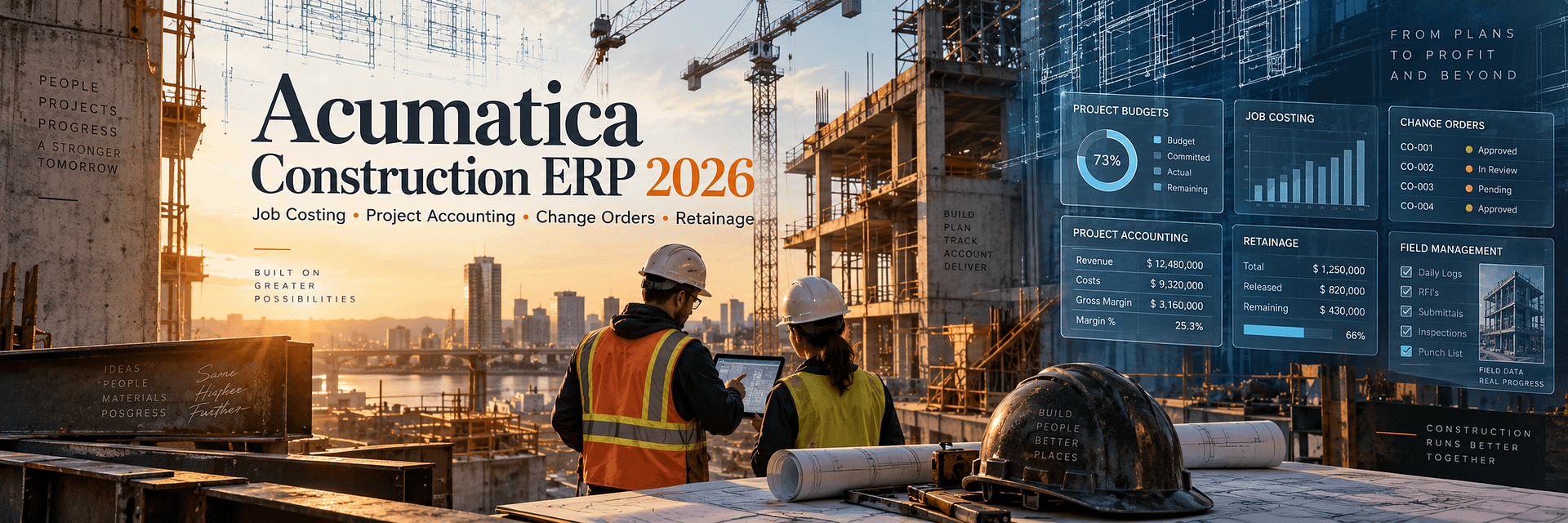
Acumatica Construction ERP 2026: Complete Guide to Job Costing, Project Accounting, Change Orders & Retainage
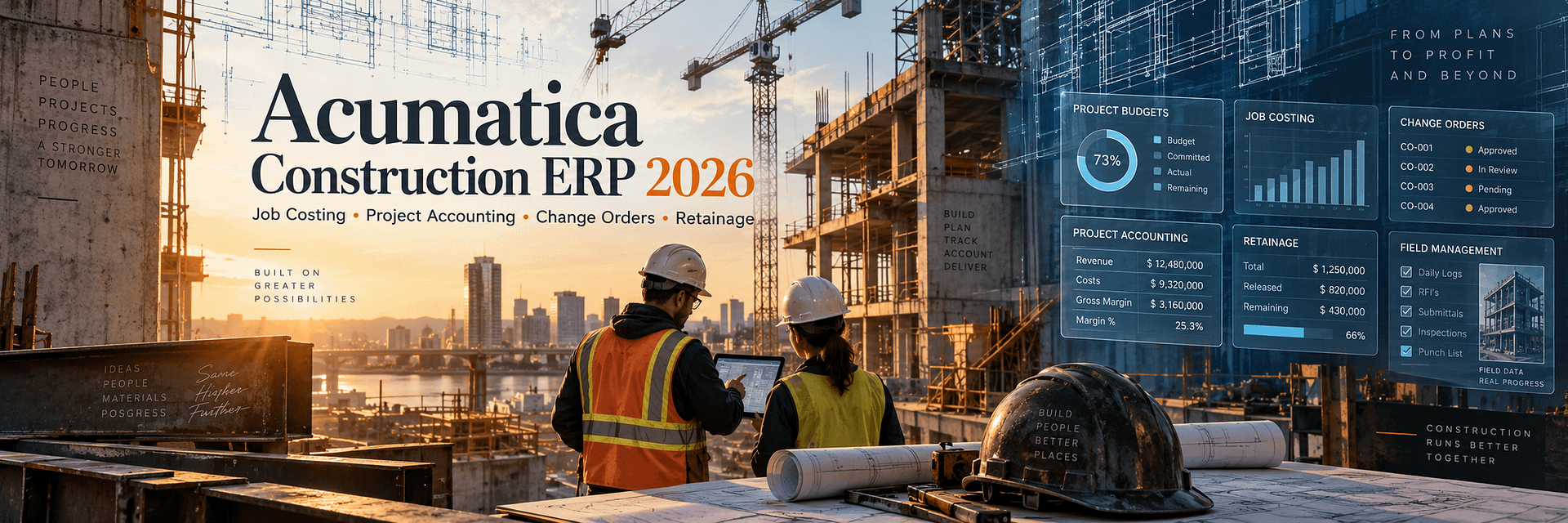
Acumatica Construction ERP 2026: The Complete Guide to Job Costing, Project Accounting, Change Orders, Retainage, Subcontracts, and Field Management
Construction companies do not lose margin only because a project was estimated incorrectly. Margin can disappear gradually through labor overruns, material price changes, unapproved scope, slow billing, unmanaged commitments, missing field information, retainage, subcontractor issues, and cost information that arrives too late to influence the project.
That is why modern construction ERP cannot simply be accounting software with a project number attached to every transaction.
A serious construction management platform must connect:
- project budgets;
- job costs;
- commitments;
- subcontracts;
- purchase orders;
- change requests;
- change orders;
- materials;
- labor;
- progress billing;
- retainage;
- accounts payable;
- accounts receivable;
- compliance;
- field activity;
- project documents;
- cash flow;
- financial reporting.
Acumatica Construction ERP is designed around that connected model.
Acumatica Construction Edition combines financial management, project accounting, job costing, construction project management, purchasing, subcontract management, inventory, field activity, reporting, CRM, mobile access, integrations, and workflow automation in one cloud ERP platform.
The objective is not merely to record the cost of a project after the cost has already happened.
The objective is to make project information visible early enough for management to act.
A construction ERP should not only tell you whether a project made money. It should help you understand whether the project is likely to make money while there is still time to change the outcome.
That difference becomes increasingly important as construction firms grow.
A contractor managing five projects can sometimes survive with accounting software, Excel, paper files, emails, and experienced employees who know where everything is.
A contractor managing fifty, one hundred, or several hundred active projects cannot scale that model safely.
Information becomes fragmented.
Finance knows one version of the project.
The project manager knows another.
The superintendent has information from the field.
The estimator has the original assumptions.
The subcontractor has another set of numbers.
The owner may be waiting for a change-order decision.
By the time all of those versions are reconciled, the cost may already be committed.
Acumatica Construction Edition is designed to reduce that fragmentation.
In Acumatica 2026 R1, the construction platform has expanded further with capabilities focused on earlier risk detection, more precise cost forecasting, streamlined change management, better project/entity alignment, and project materials management.
Construction organizations can use Acumatica to manage the complete lifecycle:
As an Acumatica Gold Partner, BizTech works with implementation, integrations, custom development, automation, financial reporting, ERP, CRM, EDI, warehouse management, and business process technology.
This is particularly important in construction because construction ERP rarely operates alone.
A contractor may need to connect Acumatica with:
- estimating software;
- payroll;
- time tracking;
- document management;
- field applications;
- CRM;
- supplier systems;
- payment platforms;
- BI tools;
- custom project portals;
- specialized construction applications.
This guide explores Acumatica Construction ERP from project setup and job costing through field execution, retainage, compliance, cash flow, implementation, migration, and long-term optimization.
What Is Acumatica Construction Edition?
Acumatica Construction Edition is a cloud ERP platform designed for construction organizations that need financial accounting, project accounting, job costing, project management, procurement, subcontract control, change management, field visibility, compliance, billing, and reporting in one connected environment.
It can be relevant to:
- general contractors;
- specialty contractors;
- subcontractors;
- restoration contractors;
- roofing contractors;
- electrical contractors;
- mechanical contractors;
- HVAC contractors;
- plumbing contractors;
- commercial contractors;
- construction developers;
- multi-entity construction groups.
Construction Edition can combine:
Financial Management
General Ledger, Accounts Payable, Accounts Receivable, cash, banking, financial reporting, multi-company operations, and related controls.
Project Accounting
Projects, tasks, account groups, cost codes, revenue budgets, cost budgets, actual costs, commitments, billing, and profitability.
Construction Management
Change requests, change orders, retainage, subcontracts, compliance, joint payments, project materials, and construction-specific workflows.
Field Management
Daily field reports, project issues, photo logs, drawing logs, submittals, mobile access, expenses, and site information.
The value is in the integration between these areas.
A subcontract commitment is not merely a project-management note.
It can influence the project budget and forecast.
A vendor bill is not merely accounts payable.
It can become a job cost.
A change request is not merely correspondence.
It can become a future cost, commitment, revenue change, and eventually a change order.
A material purchase can be tied directly to the project.
Retainage influences accounts payable, accounts receivable, project billing, and cash flow.
When construction and accounting live in the same ERP, those relationships become much easier to control.
What’s New in Acumatica Construction 2026 R1?
Acumatica 2026 R1 focuses heavily on construction cost control, project risk, project materials, and the relationship between operational project data and financial accounting.
Quantity and Unit-Rate Cost Forecasting
Construction forecasts become more useful when they are based on operational quantities rather than only dollar totals.
For example, a contractor may have:
- 1,000 feet of pipe budgeted;
- 600 feet installed;
- a revised unit rate;
- 400 feet remaining.
A quantity-driven forecast can provide a stronger basis for estimating the remaining cost than simply assuming that historical spending will continue at the same percentage.
2026 R1 improves forecasting around specific quantities and unit rates.
This can help project teams identify potential budget pressure earlier.
Faster Cost-Side Change Order Workflows
Construction companies often experience a timing mismatch.
A field condition may create additional subcontractor or material cost immediately, while customer approval for additional revenue may take days or weeks.
2026 R1 allows construction teams to move cost-side changes forward without necessarily waiting for final approval of the revenue side.
This can create a more realistic view of project exposure.
Project and Branch Alignment
Multi-entity construction companies need costs and commitments to reach the correct legal entity.
2026 R1 improves alignment of project and branch information in financial documents.
This can reduce errors where a project belongs to one branch or company but a related financial transaction is accidentally posted elsewhere.
Project Materials Management
Project Materials Management is one of the most important 2026 R1 construction enhancements.
Construction companies can increasingly manage materials directly around the project lifecycle.
The process can include:
- planning project materials;
- reserving stock;
- purchasing materials;
- delivering materials directly to project sites;
- issuing inventory to projects;
- tracking materials against project budget lines.
This helps eliminate unnecessary workarounds where materials had to flow through unrelated sales-order structures simply to reach a project.
AI-Driven Project Intelligence
Acumatica positioned the 2026 R1 construction release around earlier risk detection and more proactive project intelligence.
The strategic direction is clear:
construction ERP should surface problems before they become financial surprises.
From Opportunity to Project Closeout: The Construction Lifecycle in Acumatica
A construction ERP should follow the economic lifecycle of a project.
1. Opportunity and Estimate
The company identifies a potential job and estimates cost and revenue.
2. Contract and Project Setup
The awarded work becomes a project with:
- project tasks;
- budget;
- cost codes;
- revenue structure;
- cost structure;
- billing rules.
3. Commitments
Purchase orders and subcontracts create commitments against the project.
4. Field Execution
Labor, materials, subcontract work, expenses, and site activity begin creating real project costs.
5. Change Management
Potential changes can be tracked using change requests before becoming approved change orders.
6. Billing
Revenue may be billed according to progress, contract rules, project activity, or other configured billing methods.
7. Retainage
Part of vendor payments or customer billings may remain retained until contractual requirements are completed.
8. Forecasting
Management compares:
- original budget;
- revised budget;
- actual cost;
- committed cost;
- future forecast;
- expected final cost.
9. Closeout
Final billing, retainage release, compliance, subcontract closeout, and final project profitability can be completed in a controlled process.
Acumatica Construction Project Accounting
Project accounting provides the financial structure underneath Construction Edition.
Every major project transaction must eventually answer:
- Which project?
- Which task?
- Which cost category?
- Which cost code?
- Which account group?
- Which branch?
- Which vendor or subcontractor?
- Which budget line?
A strong project-accounting structure helps project managers and finance teams speak the same financial language.
Projects
The project represents the overall job, contract, development, or work scope being tracked.
Project Tasks
Tasks allow projects to be divided into meaningful work areas, phases, locations, or other structures.
Account Groups
Account groups provide a project-accounting classification for revenue, cost, assets, liabilities, and other project-related transactions.
Cost Codes
Cost codes add another level of construction-specific classification.
Budgets
Acumatica supports revenue and cost budgets so users can compare the planned economics of a project with its actual and committed performance.
Acumatica Job Costing: Understanding the Real Cost of Every Construction Project
Acumatica Job Costing is one of the central reasons construction companies evaluate Construction Edition.
Job costing answers a deceptively simple question:
How much is this project really costing us?
The answer can include:
- direct labor;
- materials;
- equipment;
- subcontracts;
- purchased services;
- expenses;
- overhead;
- other project costs.
But job costing becomes far more powerful when it also includes commitments.
If a subcontractor has not yet submitted an invoice, the cost may not be in the general ledger.
That does not mean the project has not economically committed to the cost.
A project manager evaluating only posted actuals can therefore believe that the project has more budget remaining than it really does.
Actual Cost
Costs that have already been posted against the project.
Committed Cost
Future costs represented by purchase orders, subcontracts, or other commitments.
Forecast Cost
The latest expected future cost based on current project information.
Cost to Complete
The expected additional cost required to finish the remaining project work.
Estimated Cost at Completion
A management view of the expected total project cost when the work is complete.
The more quickly a project manager can compare actual cost + committed cost + expected future cost against the revised project budget, the sooner the company can identify margin erosion.
Acumatica Cost Codes for Construction
Cost codes provide a construction-specific way to classify revenue and cost.
They can be used across project transactions including:
- project budgets;
- purchase orders;
- AP bills;
- change requests;
- change orders;
- project transactions;
- time and labor;
- expenses.
A contractor might use cost codes such as:
- Site Work;
- Concrete;
- Structural Steel;
- Electrical;
- Plumbing;
- HVAC;
- Doors;
- Windows;
- Finishes.
More detailed companies may use hundreds or thousands of cost codes.
Why Cost-Code Design Matters
Poor cost-code design can create either of two problems:
Too little detail: management cannot understand where the project lost money.
Too much detail: employees spend excessive time coding transactions and project reporting becomes difficult to interpret.
The implementation should therefore balance operational usefulness with usability.
Construction Project Budget Management
The project budget is both a financial plan and a control structure.
Acumatica can maintain:
- revenue budget;
- cost budget;
- original budget values;
- revised budget values;
- actual values;
- committed values;
- change-order values;
- potential change values;
- forecast information.
Original Budget
The original approved plan establishes the project’s baseline.
Revised Budget
Approved changes modify the current expected project economics.
Budget Control
Depending on configuration, Acumatica can help control whether certain transactions may exceed project budget values.
Potential Changes
Potential change orders can be visible before they become formally incorporated into the revised budget.
This is useful because project risk exists before paperwork is completely approved.
Construction Cost Forecasting, Quantity Forecasting, and Cost to Complete
Budget reporting explains what was originally expected.
Forecasting explains what management currently expects to happen.
Those are not the same thing.
Why Forecasting Matters
A project can still be technically under budget today while clearly heading toward an overrun.
Examples:
- labor productivity is lower than planned;
- material prices increased;
- more quantity remains than originally estimated;
- a subcontractor scope changed;
- rework is required;
- schedule extension creates additional overhead.
Quantity and Unit-Rate Forecasting in 2026 R1
Acumatica 2026 R1 strengthens project cost forecasting using quantities and unit rates.
This is especially valuable in construction because many costs are driven by measurable production quantities.
Examples include:
- feet of conduit;
- square feet of flooring;
- cubic yards of concrete;
- tons of steel;
- labor hours;
- number of fixtures;
- units installed.
Rather than forecasting only from percentages, the project can use operational production information to estimate remaining cost.
Construction Commitments in Acumatica
A commitment represents project cost that the organization expects to incur but which may not yet be reflected as an actual AP expense.
Commitments can come from:
- purchase orders;
- subcontracts;
- change orders;
- other committed project obligations.
Commitment visibility is critical for accurate job costing.
Example
A project may have a $1,000,000 electrical budget.
Only $200,000 has been invoiced by the electrical subcontractor.
But a $900,000 subcontract has already been executed.
Looking only at actual cost could suggest $800,000 of budget remains.
Looking at commitments shows that most of the budget has already been economically consumed.
Acumatica Subcontract Management
Subcontractors are central to the economics of many construction projects.
Acumatica supports subcontract workflows that can connect:
- vendor;
- project;
- project task;
- cost code;
- commitment;
- subcontract value;
- change orders;
- AP billing;
- retainage;
- payments;
- compliance.
Subcontract Creation
Subcontract documents establish committed scope and cost.
Subcontract Billing
Vendor bills can reduce the outstanding commitment while creating actual cost.
Subcontract Changes
Approved scope changes can modify the commitment through project change-management processes.
Retainage
Part of subcontractor billing can remain retained according to contractual rules.
Compliance
Subcontractor documentation can be managed alongside financial processes.
Acumatica Change Requests
Construction projects change constantly.
The dangerous part is not change itself.
The dangerous part is unmanaged change.
A Change Request can represent a potential change before final approval.
A request may include:
- project task;
- cost code;
- inventory item;
- quantity;
- unit cost;
- unit price;
- estimated cost;
- estimated revenue;
- vendor;
- potential commitment;
- markups.
Why Potential Change Visibility Matters
Suppose a superintendent discovers a field condition that will probably cost $50,000.
The formal owner approval may take a week.
Management should not have to pretend the potential cost does not exist during that week.
Change Requests allow potential cost and revenue impacts to become visible earlier.
Acumatica Change Orders
An approved change can move into a Change Order.
Change Orders can update:
- cost budgets;
- revenue budgets;
- quantities;
- commitments;
- project economics.
Two-Tier Change Management
Acumatica supports a two-tier process:
- Potential changes are captured as Change Requests.
- One or more Change Requests can be grouped into an approved Change Order.
This provides more visibility than waiting until every change is formally approved before entering it into the ERP.
Cost-Only Changes
Not every project cost change creates additional customer revenue.
Some changes may be cost-only.
Examples include:
- contractor error;
- rework;
- unrecoverable field condition;
- internal scope decision.
These costs still need to reach the forecast and project budget.
2026 R1 Cost-Side Release
Acumatica 2026 R1 provides additional flexibility where cost exposure needs to be recognized before final approval of related revenue.
This helps the cost forecast remain closer to project reality.
Construction Markups in Change Requests
Construction change pricing often includes more than raw cost.
Change Requests can include several markup concepts.
Price Markup
An item-specific markup can help transform estimated cost into a customer-facing unit price.
Line Markup
An additional markup can be applied to individual estimation lines.
Document-Level Markups
Document-level calculations can support:
- percentage markups;
- cumulative percentage markups;
- flat fees.
This can be useful for:
- overhead;
- profit;
- insurance;
- administrative fees;
- other contractually allowed add-ons.
Progress Billing, Construction Billing, and AIA Billing
Construction revenue often does not follow simple product invoicing.
Contractors may bill according to:
- progress;
- percent complete;
- project milestones;
- time and materials;
- contract schedules;
- schedule-of-values structures.
Progress Billing
Progress billing allows contractors to invoice customers as work progresses rather than waiting until project completion.
Schedule of Values
Projects can require billing to be broken into specific phases, tasks, cost areas, or contract lines.
AIA-Style Billing
Acumatica Construction Edition supports construction billing and reporting requirements used in AIA-style workflows.
For U.S. construction companies, this is particularly relevant where billing is expected to resemble the familiar:
- G702 Application and Certificate for Payment;
- G703 Continuation Sheet
structure.
2026 R1 Revenue Percentage Improvements
2026 R1 also includes improvements around automated revenue percentage calculations intended to support more accurate progress billing.
Acumatica Retainage: AP, AR, Project Billing, and Retainage Release
Retainage is one of the construction-specific financial processes that generic accounting systems often handle poorly.
A construction company may operate on both sides of retainage.
AP Retainage
The contractor may retain part of a subcontractor or vendor bill until contractual work is completed.
Acumatica can process AP bills with retained amounts and track retainage at the document-line level when retainage functionality is enabled.
AR Retainage
The project owner may retain part of the contractor’s invoice.
Acumatica can track the retained portion separately and later release it through retainage documents.
Partial Retainage Release
Retainage does not always need to be released in one final amount.
Businesses may release a percentage or amount as contractual requirements are met.
Consolidated Retainage
For qualifying AR scenarios, Acumatica can consolidate retainage from multiple original documents related to the same customer and project.
Retainage Cap
Construction contracts may stop additional retainage once the retained amount reaches an agreed cap.
Acumatica supports project billing scenarios with retainage caps.
Retainage rules can have significant accounting, contractual, tax, and cash-flow consequences. Configuration should be validated against the company’s actual contracts and accounting requirements.
Joint Payments and Joint Checks
Construction payment relationships can involve more than one payee.
A subcontractor may owe money to a supplier.
The general contractor or owner may need to issue a payment jointly to:
- the vendor;
- the vendor’s supplier;
- another subcontractor participating in the project.
Acumatica Construction Edition supports joint-payment scenarios associated with project AP documents.
This can help construction companies manage payment risk and subcontractor/supplier relationships more systematically.
Construction Compliance Documents and Lien Waivers
Construction firms must often verify that vendors and subcontractors have the required documentation before payment or continued work.
Compliance can involve:
- insurance certificates;
- licenses;
- bond information;
- certifications;
- lien waivers;
- other contractual documents.
Compliance Document Types
Acumatica allows organizations to define compliance-document requirements and custom attributes according to their own processes.
Expiration and Status
Compliance information can help warn users about missing or outstanding documents.
Lien Waivers
Acumatica supports lien-waiver generation and configuration as part of construction compliance workflows.
This can reduce the risk of managing waiver documentation exclusively through email, shared folders, and spreadsheets.
Acumatica Project Materials Management 2026
Project Materials Management expands the relationship between Construction Edition and inventory.
Materials can represent a major percentage of project cost.
Examples include:
- electrical components;
- pipe;
- fixtures;
- hardware;
- glass;
- insulation;
- roofing materials;
- equipment;
- finishes.
Construction firms may:
- purchase materials specifically for a project;
- hold common materials in a warehouse;
- transfer materials between locations;
- deliver materials directly to a site;
- issue stock to a project.
2026 R1 provides a more centralized project material workflow.
Reserve Inventory
Available stock can be identified for project needs.
Purchase for the Project
Material requirements can trigger procurement.
Deliver to Project Site
Acumatica supports project drop-ship purchasing where materials can be delivered directly to the project site.
Issue Materials to the Project
Inventory consumption can become project cost.
This connects physical inventory movement with job costing.
Construction Procurement: From Budget to Purchase Order and Subcontract
Construction procurement should remain connected to project budget and commitments.
A typical process may be:
The financial impact should remain traceable throughout the process.
This helps prevent a common construction problem:
the project manager believing budget remains available even though purchasing has already committed the funds.
Daily Field Reports
Construction happens in the field.
Accounting happens in the office.
The longer information takes to move between them, the more likely project decisions are based on outdated data.
Daily Field Reports provide a structured way to capture what happened on site.
They can include:
- progress worksheets;
- labor time and activity;
- change orders;
- change requests;
- subcontractor activity;
- project issues;
- weather;
- site visitors.
Subcontractor Activity
Daily reports can capture:
- which subcontractor was on site;
- number of workers;
- hours worked;
- cost codes related to the work.
Progress Worksheets
Field progress can update quantity information related to project budget lines.
Change Management from the Field
Change requests and change orders can be associated with daily field activity.
This helps preserve the operational context explaining why the project changed.
Construction Photo Logs
Photos are part of modern construction documentation.
They may document:
- work completed;
- site conditions;
- damage;
- progress;
- quality issues;
- pre-existing conditions;
- closeout.
Acumatica’s construction project-management capabilities include photo logs associated with projects.
This can help move project imagery away from individual employees’ phones and disconnected folders into a more controlled project record.
Construction Drawing Logs
Drawings change throughout a project.
Teams must know:
- which drawing is current;
- which revision is valid;
- what changed;
- which project it belongs to;
- who needs access.
Drawing logs provide project teams with a structured method for managing drawing information within the broader construction ERP environment.
Acumatica Construction Submittals
A submittal may include:
- shop drawings;
- product data;
- equipment information;
- cut sheets;
- material samples;
- other documents requiring approval before fabrication or installation.
Submittal delays can become schedule delays.
Construction Edition provides structured submittal processing including:
- creation;
- status;
- revisions;
- project linkage;
- approval-related tracking.
Construction Project Issues
Not every field problem immediately becomes a change order.
Projects can experience:
- quality problems;
- schedule issues;
- coordination issues;
- site conditions;
- missing information;
- design questions;
- safety-related concerns.
Tracking issues in the project environment makes it easier to connect operational problems with later financial or schedule consequences.
Construction Project Cash Flow
A profitable project can still create cash-flow problems.
Construction companies frequently pay:
- employees;
- suppliers;
- subcontractors;
- equipment costs
before receiving equivalent cash from the project owner.
Retainage increases the timing mismatch further.
Important Cash-Flow Components
- billed revenue;
- unbilled revenue;
- customer payments;
- vendor bills;
- paid AP;
- unpaid AP;
- unreleased retainage;
- commitments.
Acumatica 2026 R1 includes extended project financial information such as Project AP Details that can be used to review paid, unbilled, and unreleased-retainage information and support Project Cash Flow analysis.
Construction Inventory and Warehouse Management
Not every contractor needs sophisticated inventory management.
But many specialty contractors do.
Examples include:
- electrical contractors;
- plumbing contractors;
- HVAC companies;
- glass contractors;
- roofing contractors;
- maintenance contractors;
- companies with central material yards.
Inventory can include:
- materials;
- parts;
- equipment;
- consumables;
- project-specific stock.
The relationship between Inventory Management and Project Accounting can help ensure materials issued to a project become visible in job cost.
Field-to-Office Connectivity and Mobile Access
Construction ERP fails if the information is accurate only in the accounting office.
Project managers and field teams need access to current information.
Depending on role and configuration, mobile/cloud access can support:
- project information;
- expenses;
- approvals;
- field reporting;
- project documents;
- financial visibility;
- photo uploads.
The value is not simply convenience.
It reduces the delay between what happens on site and what management knows.
Construction Reporting, WIP, Dashboards, and Project Status
Construction businesses generate enormous amounts of data.
The reporting system should convert that data into decisions.
Project Status
Acumatica’s Project Status functionality can bring together project-related information including:
- financials;
- cost and revenue budgets;
- change requests;
- change orders;
- cost projections;
- pro forma invoices;
- subcontracts;
- purchase orders;
- daily field reports;
- project issues;
- drawing logs;
- photo logs;
- submittals;
- compliance documents.
Work in Progress Reporting
WIP reporting is essential for many contractors.
Management may need to understand:
- contract value;
- cost incurred;
- estimated total cost;
- percent complete;
- earned revenue;
- billings;
- overbilling;
- underbilling.
Executive Dashboards
Useful construction KPIs can include:
- project margin;
- forecast margin;
- budget variance;
- open commitments;
- unapproved changes;
- AR aging;
- AP aging;
- cash;
- retainage;
- project backlog;
- project cash flow.
Who Can Use Acumatica Construction ERP?
Project budgets, subcontractors, procurement, change management, compliance, field information, billing, and project profitability.
Detailed job costing, inventory, labor, retainage, field teams, compliance, and subcontractor/vendor processes.
Labor, materials, inventory, purchasing, cost codes, service, project billing, and warehouse stock.
Construction project accounting combined with parts inventory, service, equipment, and field operations.
High project volume, field mobility, document-heavy workflows, approvals, CRM, billing, and cash flow.
Project costing, field crews, material purchasing, subcontractors, change management, and project documentation.
Project accounting, labor, materials, job profitability, retainage, compliance, and specialized integrations.
Project budgets, procurement, commitments, multi-entity structures, project financials, and reporting.
Multiple companies, branches, intercompany workflows, consolidated reporting, shared management, and scalable ERP access.
Acumatica Construction Integrations
No modern construction ERP exists in isolation.
A contractor may already use specialized software for:
- estimating;
- project collaboration;
- time tracking;
- payroll;
- equipment;
- CRM;
- document management;
- field service;
- business intelligence;
- payments;
- supplier networks.
The goal should not automatically be to replace every application.
The goal is to establish a clear system architecture.
System of Record
The implementation should define where authoritative data belongs.
For example:
- Acumatica may own project financials;
- a specialist field platform may own specific site workflows;
- a payroll platform may own payroll processing;
- Acumatica can receive the resulting financial information.
API Integration
Acumatica’s API architecture allows external applications to exchange project and financial information.
BizTech Integration Development
BizTech provides:
- custom API integration;
- business workflow automation;
- EDI;
- CRM integration;
- warehouse integration;
- reporting integration;
- custom Acumatica development.
This is particularly useful when a construction company has a specialized technology stack that cannot be replaced with a generic connector.
Real Construction Results with Acumatica
Published customer stories provide useful examples of Acumatica Construction Edition in production.
These are company-specific results, not guarantees of future performance.
Alpha Insulation & Waterproofing
time savings in Work-in-Progress calculations reported in the published case study
real-time visibility across a multi-location specialty contractor
needed to create reports according to the case study
Alpha Insulation & Waterproofing uses Acumatica Construction Edition with Advanced Financial Management, Expense Management, Inventory Management, Warehouse Management, and Payroll.
The organization reduced WIP calculations from approximately 1.5 days to around ten minutes and gave field teams real-time access to project information.
IOC Construction
reassigned from manual data-entry responsibilities
spreadsheet formatting eliminated
paper project folders eliminated
IOC Construction consolidated several previously disconnected entities and processes into Acumatica Construction Edition.
Roberts Glass & Service
increase reported following implementation while maintaining profitability
labor-cost reporting delay eliminated
project updates through mobile access
Roberts Glass integrated Acumatica Construction Edition with ExakTime to improve labor-cost accuracy and project visibility.
American Asphalt
of paper project files eliminated annually
real-time field access
annual growth maintained according to the published case
Phoenix Renovation and Restoration
Phoenix Renovation manages more than 1,000 annual projects and uses Construction Edition for financial and project visibility.
The published case highlights:
- real-time field access;
- improved project transparency;
- automated workflows;
- improved cash-flow management;
- AIA invoicing and WIP functionality.
How to Implement Acumatica Construction ERP
A construction implementation should begin with the project’s economic lifecycle, not with software screens.
Phase 1: Construction Discovery
Document:
- business entities;
- project types;
- contract types;
- estimating process;
- project setup;
- job-cost structure;
- cost codes;
- subcontracts;
- purchase orders;
- change management;
- billing;
- retainage;
- payroll;
- field workflows;
- compliance;
- integrations;
- reporting.
Phase 2: Project Accounting Architecture
Design:
- companies;
- branches;
- projects;
- tasks;
- account groups;
- cost codes;
- budget levels;
- revenue structure;
- financial accounts.
Phase 3: Budget and Job Cost Design
Define:
- original budget;
- revised budget;
- actual cost;
- commitments;
- forecasting;
- WIP;
- cost to complete.
Phase 4: Procurement and Subcontracts
Configure:
- purchase orders;
- subcontracts;
- commitments;
- approvals;
- receipts;
- AP bills;
- payments.
Phase 5: Change Management
Define:
- change requests;
- change-order classes;
- cost-only changes;
- revenue changes;
- markups;
- approvals.
Phase 6: Billing and Retainage
Configure:
- project billing;
- progress billing;
- AIA-style reporting;
- AR retainage;
- AP retainage;
- retainage releases;
- retainage caps.
Phase 7: Field Management
Configure:
- Daily Field Reports;
- photo logs;
- drawing logs;
- submittals;
- issues;
- mobile access.
Phase 8: Compliance
Define:
- compliance document types;
- required attributes;
- expiration rules;
- lien-waiver workflows;
- payment controls.
Phase 9: Integration
Connect required third-party systems.
Phase 10: Testing
Test complete construction scenarios.
For example:
- Create a project.
- Load budget.
- Create a subcontract.
- Create a purchase order.
- Enter project material.
- Post labor and expense.
- Create change request.
- Approve change order.
- Enter AP bill with retainage.
- Bill customer.
- Release retainage.
- Review WIP and forecast margin.
Acumatica Construction Data Migration
Construction data migration is often more difficult than migrating generic financial data.
The business may have hundreds or thousands of projects with different statuses.
Master Data
Potentially migrated records include:
- customers;
- vendors;
- subcontractors;
- employees;
- inventory;
- cost codes;
- accounts;
- project templates.
Projects
For each open project, migration may require:
- project ID;
- customer;
- tasks;
- budget;
- cost codes;
- actual cost;
- commitments;
- billing;
- retainage;
- change orders;
- documents.
Open Commitments
Purchase orders and subcontracts must remain economically visible after go-live.
Open AR and AP
Project-related invoices, vendor bills, credits, and retainage must reconcile with the general ledger.
Historical Projects
The company should decide whether to:
- migrate full history;
- migrate selected active/recent projects;
- migrate summary history;
- keep completed projects in a legacy archive.
Documents
Construction documents may represent one of the largest migration datasets.
The company needs a strategy for:
- contracts;
- drawings;
- photos;
- submittals;
- compliance documents;
- project correspondence;
- attachments.
How Much Does Acumatica Construction ERP Cost?
There is no universal fixed Acumatica Construction price.
Software and implementation cost can depend on:
- Acumatica applications;
- resource requirements;
- deployment;
- number of companies;
- number of branches;
- active projects;
- project history;
- construction project management;
- payroll;
- inventory;
- field service;
- data migration;
- integrations;
- custom development;
- reporting;
- training;
- support.
| Cost Area | Typical Construction Scope |
|---|---|
| Acumatica Software | Construction Edition, financials, project functionality, optional applications and resource level |
| Discovery | Job cost, budgets, subcontracts, retainage, field processes, payroll, reporting and integrations |
| Data Migration | Financials, projects, commitments, subcontracts, retainage, open documents and history |
| Construction Configuration | Cost codes, project structure, change management, compliance, billing and field workflows |
| Integrations | Payroll, time, estimating, field systems, CRM, document systems and custom applications |
| Reporting | WIP, project status, cash flow, profitability, executive dashboards and custom reports |
| Training | Accounting, project managers, field staff, procurement, executives and administrators |
| Support | Go-live stabilization, optimization, new workflows and integrations |
How Long Does Acumatica Construction Implementation Take?
There is no universal implementation duration.
Timeline depends on:
- number of legal entities;
- number of active projects;
- job-cost complexity;
- cost codes;
- subcontracts;
- retainage;
- billing;
- payroll;
- field management;
- inventory;
- data migration;
- project documents;
- integrations;
- custom development;
- training;
- testing.
A small specialty contractor replacing QuickBooks has a very different implementation from a multi-entity general contractor migrating hundreds of active jobs, historical WIP, subcontracts, compliance, payroll, and multiple integrations.
Common Acumatica Construction Implementation Mistakes
Mistake 1: Poor Cost-Code Design
Too much or too little detail can make project reporting difficult.
Mistake 2: Copying the Legacy Chart of Accounts Exactly
The new ERP may allow a cleaner project/account/subaccount/cost-code structure.
Mistake 3: Ignoring Project-to-Branch Relationships
Multi-company contractors must ensure financial transactions reach the correct legal entity.
Mistake 4: Migrating Actual Costs but Forgetting Commitments
A project without open commitments can appear artificially profitable immediately after migration.
Mistake 5: Incorrect Retainage Migration
Retained AP and AR balances must reconcile with project and financial records.
Mistake 6: Designing the System Only with Accounting
Project managers, superintendents, procurement, and field users must participate.
Mistake 7: Recreating a Bad Change-Order Process
Migration is an opportunity to improve how potential and approved changes are tracked.
Mistake 8: Migrating Every Historical Project in Full Detail
Historical migration should create value, not merely consume budget.
Mistake 9: Leaving Integrations Until the End
Payroll, time, estimating, document systems, and field applications affect core ERP design.
Mistake 10: No Post-Go-Live Optimization
Real project data often reveals improvements impossible to identify during initial configuration.
How to Measure Construction ERP ROI
Construction ERP ROI should be measured across the entire project lifecycle.
Accounting
Track:
- month-end close;
- WIP preparation time;
- invoice processing;
- duplicate entry;
- financial report preparation.
Project Management
Track:
- time spent preparing job reports;
- forecast accuracy;
- budget overruns identified early;
- change-order cycle time;
- unapproved changes;
- project manager administrative hours.
Field
Track:
- paper forms eliminated;
- data-entry delay;
- mobile usage;
- daily report completion;
- photo/document retrieval time.
Procurement
Track:
- commitment visibility;
- purchase-order processing time;
- material waste;
- emergency purchasing;
- project material availability.
Cash
Track:
- days to invoice;
- days sales outstanding;
- retainage outstanding;
- AP timing;
- project cash flow;
- working-capital requirements.
Profitability
Track:
- original margin;
- forecast margin;
- final margin;
- margin erosion;
- cost variance;
- change recovery.
Why Work with BizTech for Acumatica Construction Implementation?
Construction ERP implementation requires a combination of accounting knowledge, project-process knowledge, data expertise, integration experience, reporting, and technical development.
BizTech is an Acumatica Gold Partner and a business technology consulting company providing ERP, accounting, CRM, EDI, warehouse management, financial reporting, implementation, and integration services.
BizTech reports more than 500 successful integrations, 15+ solutions, and work across more than 35 countries.
Acumatica Implementation
BizTech can support:
- business discovery;
- financial configuration;
- project accounting;
- job-cost structure;
- data migration;
- reporting;
- testing;
- training;
- go-live;
- post-go-live optimization.
Custom Development
Where standard functionality does not cover a real construction requirement, BizTech can develop:
- Acumatica customizations;
- custom APIs;
- automated workflows;
- custom inquiries;
- dashboards;
- specialized integrations.
Integration Architecture
BizTech can help construction companies connect Acumatica with:
- CRM;
- payroll;
- time tracking;
- field software;
- document management;
- supplier systems;
- EDI;
- BI tools;
- custom applications.
Source-System Experience
BizTech is also a Sage Certified Gold Development Partner.
This can be particularly useful for contractors migrating from Sage environments into Acumatica because the migration team can understand both the legacy system and the new ERP platform.
Construction ERP should connect the job site, project manager, accounting department, procurement team, subcontractors, project documents, and executive reporting. The implementation partner must understand all of those relationships—not only General Ledger configuration.
Acumatica Construction ERP Implementation Checklist
Organization
- Legal entities are documented.
- Branches are documented.
- Project types are documented.
- Business lines are documented.
- Security requirements are documented.
Project Accounting
- Project structure is approved.
- Task structure is approved.
- Account groups are approved.
- Cost codes are approved.
- Revenue budget structure is approved.
- Cost budget structure is approved.
Job Costing
- Labor costs are defined.
- Material costs are defined.
- Equipment costs are defined.
- Subcontract costs are defined.
- Committed costs are included.
- Forecast methodology is defined.
Change Management
- Change Request workflow is defined.
- Change Order classes are configured.
- Cost-only changes are tested.
- Revenue changes are tested.
- Markups are configured.
- Approvals are configured.
Subcontracts
- Subcontract workflow is defined.
- Commitment reporting is tested.
- AP billing is tested.
- Change Orders are tested.
- Compliance is tested.
- Retainage is tested.
Retainage
- AP retainage rules are configured.
- AR retainage rules are configured.
- Retainage release is tested.
- Partial release is tested.
- Retainage cap requirements are validated.
Billing
- Billing rules are approved.
- Progress billing is tested.
- AIA-related reporting is validated where required.
- Revenue recognition requirements are validated.
Compliance
- Compliance document types are defined.
- Required attributes are defined.
- Expiration tracking is tested.
- Lien-waiver process is tested.
- Joint-payment process is tested where required.
Materials
- Project material process is defined.
- Warehouses are configured.
- Project purchases are tested.
- Project drop-ship is tested where required.
- Material issue to project is tested.
Field
- Daily Field Reports are configured.
- Photo Logs are tested.
- Drawing Logs are tested.
- Submittals are tested.
- Project Issues are tested.
- Mobile access is tested.
Data Migration
- Customers are cleaned.
- Vendors are cleaned.
- Subcontractors are cleaned.
- Projects are mapped.
- Budgets are reconciled.
- Actual costs are reconciled.
- Commitments are reconciled.
- AR is reconciled.
- AP is reconciled.
- Retainage is reconciled.
- Open Change Orders are validated.
- Historical strategy is approved.
Integrations
- Every integration has an owner.
- Authentication is configured.
- Data ownership is defined.
- Cross-references are defined.
- Error handling is tested.
- Retry logic is tested.
- Monitoring is enabled.
Go-Live
- Opening financials reconcile.
- Project balances reconcile.
- Open commitments reconcile.
- Retainage reconciles.
- Users are trained.
- Dashboards are approved.
- Critical reports are approved.
- Field users are ready.
- Support coverage is active.
Final Conclusion: Why Acumatica Construction ERP Matters in 2026
Construction profitability is determined project by project.
That makes visibility unusually important.
Executives need to understand:
- which projects are profitable;
- which projects are losing margin;
- what has already been spent;
- what has already been committed;
- what costs are still expected;
- which changes are not yet approved;
- what has been billed;
- what cash has been collected;
- what retainage remains outstanding.
Project managers need to understand:
- budget remaining;
- subcontract status;
- material requirements;
- change exposure;
- field progress;
- compliance;
- project documentation.
Finance needs reliable numbers.
The field needs access to current project information.
Those requirements are difficult to satisfy when accounting, project management, field data, procurement, change orders, retainage, and compliance live in disconnected systems.
Acumatica Construction ERP provides a different model.
It connects:
- financial management;
- project accounting;
- job costing;
- project budgets;
- commitments;
- subcontracts;
- procurement;
- change management;
- billing;
- retainage;
- compliance;
- field reporting;
- project materials;
- cash flow;
- reporting.
Acumatica 2026 R1 strengthens this architecture with quantity and unit-rate forecasting, more flexible change-order processing, better branch/project alignment, Project Materials Management, and a stronger emphasis on proactive project intelligence.
The potential result is not simply faster accounting.
It is earlier visibility into project risk.
That is much more valuable.
But successful Construction ERP depends on implementation quality.
Cost codes must make sense.
Budgets must be structured correctly.
Commitments must be captured.
Retainage must reconcile.
Field teams must use the system.
Integrations must be reliable.
Legacy project data must be migrated intelligently.
That is where the implementation partner matters.
BizTech combines Acumatica Gold Partner expertise with ERP implementation, financial reporting, custom development, integrations, automation, EDI, CRM, warehouse management, data migration, and long-term support.
For construction organizations searching for:
- Acumatica Construction ERP;
- Acumatica Construction Edition;
- Construction ERP Software;
- Construction Accounting Software;
- Acumatica Job Costing;
- Acumatica Project Accounting;
- Acumatica Change Orders;
- Acumatica Retainage;
- Acumatica Subcontract Management;
- Acumatica AIA Billing;
- Acumatica Construction Implementation Partner;
- BizTech Acumatica Construction;
the next step is not simply purchasing construction software.
The next step is designing how the project lifecycle should operate inside one connected ERP.
Planning an Acumatica Construction ERP Implementation?
BizTech can assess your project accounting, job costing, cost codes, budgets, change orders, retainage, subcontracts, materials, field workflows, compliance, integrations, migration requirements, reporting, and Acumatica architecture before implementation begins.
FAQ: Acumatica Construction ERP
What is Acumatica Construction Edition?
Acumatica Construction Edition is a cloud ERP platform for construction organizations that connects financial management, project accounting, job costing, project budgets, commitments, subcontracts, purchasing, change management, billing, retainage, compliance, field information, reporting, and integrations.
What is new in Acumatica Construction 2026 R1?
Major 2026 R1 construction enhancements include quantity- and unit-rate-based cost forecasting, more flexible change-order workflows, improved project and branch alignment in financial documents, Project Materials Management, and additional project intelligence designed to identify financial risk earlier.
Does Acumatica support job costing?
Yes. Acumatica Construction Edition supports detailed project and job costing with actual costs, commitments, budgets, cost codes, forecasts, and project profitability information.
Does Acumatica support cost codes?
Yes. Cost codes can provide an additional construction-specific classification for project budgets, AP bills, purchase orders, change requests, change orders, project transactions, labor, and other costs.
What is the difference between actual cost and committed cost?
Actual cost represents cost already posted to the project. Committed cost represents future project obligations such as purchase orders and subcontracts that may not yet have become posted AP expenses.
Does Acumatica support construction project budgets?
Yes. Projects can contain cost and revenue budgets, original and revised values, actuals, commitments, potential change-order values, approved changes, and forecast information.
Does Acumatica support change requests?
Yes. Change Requests can track potential project cost and revenue changes before final approval and can later be grouped into Change Orders.
Does Acumatica support cost-only change orders?
Yes. Acumatica supports construction change-management scenarios where a project cost changes without corresponding additional customer revenue.
Does Acumatica support subcontract management?
Yes. Construction Edition supports subcontract workflows including commitments, subcontract billing, project costs, changes, retainage, vendor relationships, and related construction financial processes.
Does Acumatica support AP retainage?
Yes. When retainage functionality is enabled, AP bills can contain retained amounts that remain payable after contractual requirements are met.
Does Acumatica support AR retainage?
Yes. Customer invoices can include retained amounts that can later be released through retainage documents.
Does Acumatica support a retainage cap?
Yes. Acumatica supports project billing scenarios where contract retainage is subject to an agreed cap.
Does Acumatica support AIA billing?
Acumatica Construction Edition supports construction progress billing and reporting used in AIA-style workflows, including construction-oriented schedule-of-values and retainage requirements.
Does Acumatica support joint payments?
Yes. Construction Edition supports project AP scenarios where payments are issued jointly to a vendor and another supplier or subcontractor associated with project work.
Does Acumatica support lien waivers?
Yes. Construction compliance functionality can support lien-waiver generation and related compliance processes.
Can Acumatica track subcontractor compliance?
Yes. Compliance Documents can be used to track required documentation and custom compliance attributes for vendors, subcontractors, projects, and related entities.
Does Acumatica have Daily Field Reports?
Yes. Daily Field Reports can capture progress, labor, subcontractor activity, change requests, change orders, project issues, weather, visitors, and other job-site information.
Can Acumatica store construction photos?
Yes. Construction Project Management includes Photo Logs for project-related photographs and associated project documentation.
Does Acumatica support drawing logs?
Yes. Construction Project Management includes drawing-log functionality for tracking project drawings and related information.
Does Acumatica support construction submittals?
Yes. Construction Edition includes structured submittal processing, including revisions, status, project association, and related approval workflows.
What is Acumatica Project Materials Management?
Project Materials Management, expanded in 2026 R1, helps construction companies plan, purchase, reserve, deliver, and issue materials directly to projects while maintaining relationships with project budget lines.
Can materials be purchased directly to a project site?
Yes. Acumatica supports project drop-ship purchasing workflows where ordered materials can be delivered directly to a project site, including scenarios where receipt confirmation is required.
Does Acumatica support project cash-flow reporting?
Acumatica provides project financial information for analyzing items such as AP amounts, paid amounts, unbilled amounts, unreleased retainage, and related Project Cash Flow data.
Can Acumatica integrate with other construction software?
Yes. Acumatica provides APIs and integration capabilities for external construction, payroll, estimating, field, document, CRM, BI, and custom business applications.
How much does Acumatica Construction ERP cost?
There is no universal fixed price. Cost depends on required Acumatica applications, resource usage, entities, projects, construction functionality, data migration, integrations, customization, reporting, training, and support.
How long does Acumatica Construction implementation take?
Implementation time depends on the number of entities and projects, project-accounting complexity, cost codes, subcontracts, retainage, payroll, materials, field processes, migration, integrations, reports, testing, and user availability.
Can BizTech implement Acumatica Construction Edition?
Yes. BizTech is an Acumatica Gold Partner providing ERP implementation, data migration, custom development, integrations, workflow automation, financial reporting, testing, training, and ongoing support.
Why choose BizTech for Acumatica Construction implementation?
BizTech combines Acumatica implementation expertise with accounting, financial reporting, ERP, CRM, EDI, warehouse management, custom development, API integration, data migration, automation, and post-go-live support. BizTech is also a Sage Certified Gold Development Partner, which can be useful for construction organizations migrating from legacy Sage environments.

Acumatica Distribution ERP 2026: Complete Guide to Inventory, Warehousing, DRP & Omnichannel Distribution

Acumatica Distribution ERP 2026: The Complete Guide to Inventory, Warehousing, DRP, Order Management, Fulfillment, and Omnichannel Distribution
Distribution is no longer a simple process of buying products, placing them in a warehouse, and shipping them when customers call. Modern distributors operate across warehouses, eCommerce stores, marketplaces, retail partners, EDI networks, drop-ship suppliers, global vendors, multiple currencies, and increasingly demanding customer expectations.
The distributor that wins is usually not the company with the largest warehouse.
It is the company that can see what is happening across its supply chain and respond faster.
That requires accurate answers to questions such as:
- What inventory do we actually have?
- Where is it located?
- What is already allocated?
- What inventory is in transit?
- What should we reorder?
- Which purchase orders are late?
- Which warehouse should fulfill the order?
- Which customers are profitable?
- Which channels are creating margin?
- Which products are moving too slowly?
- Which orders are at risk of missing delivery expectations?
This is where Acumatica Distribution ERP becomes valuable.
Acumatica Distribution Edition brings financial management, inventory control, purchasing, order management, warehouse management, demand planning, distribution requirements planning, CRM, reporting, automation, commerce, and integrations into one connected cloud ERP environment.
The objective is not simply to replace spreadsheets.
The objective is to connect the complete distribution lifecycle.
A customer order can create demand.
Inventory availability can determine whether the order can be fulfilled immediately.
Distribution Requirements Planning can identify future shortages.
Purchasing can respond to supply requirements.
The warehouse can receive and put away stock.
Orders can move into picking, packing, and shipping workflows.
Tracking can flow back to customers or marketplaces.
Invoices can update accounts receivable and financial reporting.
Management can monitor inventory, margins, fulfillment performance, sales, purchasing, and cash from the same platform.
The value of a modern distribution ERP is not one warehouse feature. It is the ability to connect supply, demand, inventory, orders, fulfillment, finance, eCommerce, and decision-making in one operating system.
Acumatica 2026 R1 extends this model with new capabilities for distributors, including more flexible picking, recommended put-away, inventory-adjustment approvals, multi-currency requisitions, shipping-document automation, and improved print queue management.
Acumatica has also introduced APEX for Distribution, a right-sized offering designed for smaller distribution businesses with up to 50 employees that need modern financial, inventory, warehouse, and operational capabilities without beginning with a larger ERP footprint.
For BizTech, Distribution Edition is especially important because distribution businesses are often integration-heavy.
A modern distributor may simultaneously operate:
- Amazon;
- Shopify;
- WooCommerce;
- Magento;
- retail partner networks;
- EDI;
- ShipHero;
- ShipStation;
- CommerceHub;
- DSCO;
- Salesforce;
- payment platforms;
- custom warehouse systems.
BizTech is an Acumatica Gold Partner and develops proprietary Acumatica integrations and operational enhancements for many of these scenarios.
This guide explains Acumatica Distribution Edition from the inventory item all the way through purchasing, warehouse operations, eCommerce, fulfillment, profitability, implementation, and integration.
What Is Acumatica Distribution Edition?
Acumatica Distribution Edition is a cloud ERP platform built for wholesale distributors and inventory-focused businesses that need to connect financial management with inventory, purchasing, order management, warehouse operations, demand planning, CRM, commerce, reporting, and external systems.
Distribution Edition can serve as the operational core for companies that buy products from manufacturers or suppliers and then sell those products to:
- retailers;
- dealers;
- other distributors;
- manufacturers;
- commercial customers;
- consumers;
- marketplaces;
- eCommerce customers.
A distribution company may use Acumatica to manage:
- general ledger;
- accounts payable;
- accounts receivable;
- cash management;
- inventory;
- sales orders;
- purchase orders;
- warehouses;
- replenishment;
- DRP;
- customer pricing;
- CRM;
- shipping;
- returns;
- eCommerce;
- marketplaces;
- EDI;
- reporting.
The major advantage is the relationship between these areas.
Purchasing does not need to maintain one spreadsheet while sales maintains another.
Warehouse operations do not need to live completely outside accounting.
Management does not need to wait for several applications to be reconciled before understanding inventory or profitability.
What’s New for Distributors in Acumatica 2026 R1?
Acumatica 2026 R1 introduces several distribution improvements focused on warehouse flexibility, inventory control, global procurement, and shipping operations.
Change Picking Locations During the Picking Process
Real warehouses do not always behave exactly as the ERP expected.
An item may have been moved.
A bin may be temporarily inaccessible.
The expected location may not have enough quantity.
Acumatica 2026 R1 improves warehouse flexibility by allowing picking-location adjustments while the picking process is already underway.
This can reduce:
- warehouse interruptions;
- manual corrections;
- unnecessary supervisor intervention;
- delays caused by real-world inventory movement.
Recommended Put-Away Guidance
Receiving inventory is only half the job.
The product must also be placed in an appropriate warehouse location.
Recommended put-away guidance can help warehouse employees determine where received inventory should go.
This can improve:
- warehouse organization;
- travel efficiency;
- stock placement consistency;
- future picking efficiency.
Approval Workflows for Inventory Adjustments
Inventory adjustments can affect both operational stock and financial value.
Acumatica 2026 R1 strengthens governance by allowing configurable approval processes for inventory adjustments.
This is useful where companies want additional control over:
- write-offs;
- quantity corrections;
- cost adjustments;
- inventory discrepancies.
Multi-Currency Requisition Management
Global procurement often requires distributors to buy inventory from suppliers operating in different currencies.
2026 R1 strengthens multi-currency requisition workflows, making the feature particularly relevant for international sourcing and multi-entity organizations.
Automated Shipping Paperwork
Shipping operations can generate significant paperwork.
2026 R1 introduces improvements designed to reduce manual effort around shipping documents.
Improved Print Queue Management
High-volume warehouses may generate:
- pick lists;
- packing documents;
- shipping labels;
- customer documents;
- warehouse paperwork.
Print queue improvements help reduce administrative friction around those processes.
Acumatica APEX for Distribution: A Right-Sized Option for Smaller Distributors
In 2026, Acumatica introduced APEX for Distribution.
The offering is designed specifically for smaller businesses with up to approximately 50 employees that need modern distribution ERP capabilities but may not require the full breadth of a larger implementation on day one.
This is important because smaller distributors face many of the same operational problems as larger businesses:
- inventory accuracy;
- warehouse visibility;
- order fulfillment;
- purchasing;
- financial reporting;
- multi-user collaboration.
The problem is often that traditional ERP projects feel too large or expensive for the organization’s current stage.
APEX creates another entry point into the Acumatica ecosystem.
For a smaller distributor, the ERP decision is no longer necessarily “basic accounting software or a massive ERP project.” Acumatica now offers a more graduated path.
How Acumatica Distribution Works: From Customer Demand to Cash
The strongest way to understand Distribution Edition is through an end-to-end workflow.
1. Customer Demand Arrives
Demand may come from:
- a salesperson;
- customer service;
- an eCommerce store;
- Amazon;
- EDI;
- CommerceHub;
- DSCO;
- a B2B portal;
- another integrated channel.
2. Acumatica Evaluates Inventory
The system can evaluate inventory according to warehouses, availability rules, allocations, and open supply.
3. Inventory Is Allocated or Supply Is Planned
If sufficient inventory exists, the order can continue toward fulfillment.
If inventory is insufficient, planning and purchasing processes can help address future demand.
4. Warehouse Execution Begins
Orders can move into:
- picking;
- packing;
- shipping.
5. Shipment Information Is Captured
Carrier, tracking, package, and shipment information can be associated with the transaction.
6. Customer and Channel Are Updated
Where integrations are configured, fulfillment information can flow back to the source sales channel.
7. Financial Documents Are Created
Invoices and payments update financial records.
8. Management Can Analyze the Result
Executives can evaluate:
- revenue;
- margin;
- inventory;
- warehouse performance;
- customer profitability;
- channel performance;
- cash.
What Types of Distributors Can Use Acumatica?
Acumatica Distribution Edition is used across a wide range of wholesale and product-centric businesses.
Parts, equipment, tools, maintenance products and industrial supplies.
Serial-controlled products, global sourcing, technical components and equipment.
Multi-warehouse product distribution combined with field service and contractor customers.
Lumber, masonry, fixtures, hardscape, hardware and construction supplies.
Healthcare supplies, safety products, regulated inventory and lot-controlled goods.
High-SKU consumer products, retailers, eCommerce and marketplace channels.
Matrix items, styles, colors, sizes, seasonal products and high SKU counts.
Furniture, décor, lighting, flooring, kitchen, bath and home products.
Lot control, expiry considerations, multiple currencies and complex fulfillment.
Parts distribution combined with service, installation and multi-location operations.
DTC, B2B, marketplace, wholesale and retail distribution from one inventory pool.
Commercial, professional, construction and specialized equipment.
Acumatica Inventory Management for Distribution
Inventory is the financial and operational center of most distribution businesses.
If inventory is wrong, everything else becomes less reliable.
Sales may promise unavailable goods.
Purchasing may order unnecessary stock.
Warehouses may waste time searching for products.
Customer service may provide incorrect information.
Finance may struggle to trust inventory valuation and margin.
Acumatica Inventory Management can help distributors manage:
- stock items;
- non-stock items;
- warehouses;
- warehouse locations;
- availability;
- allocations;
- cost;
- lots;
- serial numbers;
- replenishment;
- transfers;
- adjustments;
- physical inventory.
Inventory by Location
Distributors can track stock across several locations rather than relying on one company-wide quantity.
Inventory Transfers
Stock can move between warehouses based on operational requirements.
Inventory Adjustments
Adjustments can correct discrepancies and, in 2026 R1, can be subject to stronger approval controls.
Inventory Availability and Allocation
“On hand” does not always mean “available to sell.”
A distributor may have 100 units physically in the warehouse, but:
- 60 are already allocated to sales orders;
- 10 are being transferred;
- some are unavailable due to operational status;
- some may belong to specific fulfillment logic.
This is why distribution ERP needs several inventory perspectives.
The business must distinguish concepts such as:
- on hand;
- available;
- allocated;
- available for shipment;
- on purchase order;
- in transit.
Reliable availability helps improve:
- sales promises;
- order allocation;
- customer service;
- eCommerce synchronization;
- replenishment decisions.
Acumatica Distribution Requirements Planning (DRP)
Distribution Requirements Planning is one of the most strategically important capabilities for distributors.
DRP provides time-phased planning across the supply chain.
Instead of asking only:
“How much inventory do we have today?”
DRP helps answer:
“When will we run short based on future supply and demand?”
Demand Can Include
- sales orders;
- forecasts;
- transfer demand;
- other time-based requirements.
Supply Can Include
- on-hand stock;
- purchase orders;
- transfer supply;
- inventory already in transit.
Date-Specific Planning
Timing matters.
Having 1,000 units arriving next month does not solve a shortage tomorrow.
DRP evaluates supply and demand by date to provide more useful planning recommendations.
Exception Messages
Planning can identify issues such as supply arriving too late to satisfy demand.
This helps planners focus attention on exceptions rather than manually reviewing every item.
Inventory Replenishment
Replenishment controls how inventory is restored when stock falls below the desired level.
A distributor may replenish inventory through:
- purchasing;
- warehouse transfers;
- other configured supply methods.
Good replenishment design can reduce both extremes:
- stockouts;
- excess inventory.
The implementation should carefully define:
- lead times;
- minimum order quantities;
- safety stock;
- reorder points;
- vendor relationships;
- warehouse-specific requirements.
Bad planning parameters create bad replenishment recommendations no matter how powerful the ERP is.
Acumatica Purchasing and Procurement
Purchasing is not simply the act of creating a purchase order.
A distributor needs to manage:
- demand;
- vendors;
- cost;
- lead time;
- currency;
- quantity;
- delivery dates;
- approvals;
- receipts;
- vendor performance.
Purchase Orders
Purchase orders connect supply requirements with vendors and inbound inventory.
Requisitions
Procurement processes may begin with internal requisitions rather than direct POs.
Vendor Bidding
For relevant procurement scenarios, requisitions can support comparison of suppliers and bids.
Multi-Currency Procurement
Global distributors may purchase goods in several currencies.
Acumatica 2026 R1 strengthens multi-currency requisition management for international and multi-entity procurement.
Acumatica Warehouse Management System (WMS)
Distribution ERP becomes much more valuable when inventory records and physical warehouse activity stay aligned.
Acumatica WMS supports warehouse processes with mobile and barcode-oriented workflows.
A connected WMS can help with:
- receiving;
- put-away;
- inventory movement;
- picking;
- packing;
- shipping;
- barcode scanning.
Why Embedded Warehouse Management Matters
When ERP and WMS operate as completely disconnected systems, companies often struggle with:
- delayed inventory updates;
- duplicate data;
- shipment reconciliation;
- receipt reconciliation;
- inventory discrepancies.
An integrated approach reduces the number of synchronization points.
Receiving and Put-Away
Warehouse efficiency begins before picking.
Inbound inventory must be received accurately and placed correctly.
Receiving
Warehouse employees may receive products against purchase orders and other inbound documents.
Accurate receiving updates:
- inventory;
- purchase orders;
- vendor-related records;
- future availability.
Put-Away
Put-away determines where inventory should physically live.
Acumatica 2026 R1’s recommended put-away guidance helps warehouse workers choose appropriate storage locations.
Why Put-Away Affects Picking
Poor stock placement increases:
- warehouse travel;
- search time;
- picking errors;
- congestion.
Receiving and fulfillment should therefore be treated as one connected warehouse design.
Picking, Packing, and Shipping
The fulfillment process converts an ERP sales order into a physical customer delivery.
Picking
The system directs warehouse employees toward inventory required for an order.
2026 R1 improves flexibility by allowing location changes during the picking process when real warehouse conditions differ from the original plan.
Packing
Packing confirms what is being shipped and can associate package information with the shipment.
Shipping
Shipping completes the physical fulfillment event and can capture:
- carrier;
- service;
- tracking number;
- package information;
- shipment documents.
Shipping Paperwork
2026 R1 introduces automation aimed at reducing manual shipping-document work.
Acumatica Sales Order Management
Sales Order Management sits at the center of the distribution order-to-cash process.
Sales orders may originate from:
- internal salespeople;
- customer service;
- CRM;
- eCommerce;
- marketplaces;
- EDI;
- other integrations.
Order Processing
An order may include:
- customer;
- shipping address;
- items;
- quantities;
- prices;
- discounts;
- taxes;
- warehouse;
- shipping method;
- payment information;
- customer PO reference.
Allocation
Inventory can be allocated against demand so that salespeople and warehouse employees understand what stock is committed.
Backorders
Where available stock cannot satisfy the entire order, backorder processes can help manage remaining demand.
Customer-Specific Pricing, Discounts, and Distribution Sales
Wholesale distribution pricing can become extremely complex.
A distributor may have:
- list pricing;
- customer pricing;
- customer-class pricing;
- quantity-based pricing;
- promotional pricing;
- contract pricing;
- channel-specific pricing.
ERP should help centralize pricing rather than forcing sales teams to maintain separate spreadsheets.
Margin Protection
Pricing should also be evaluated in relation to:
- cost;
- freight;
- discounts;
- customer profitability;
- channel economics.
Drop Shipping
Distribution companies increasingly use drop shipping to fulfill orders directly from suppliers.
Drop-ship scenarios can reduce:
- warehouse handling;
- inventory ownership;
- shipping steps.
But they introduce coordination challenges.
The ERP must connect:
- customer order;
- supplier purchase order;
- vendor fulfillment;
- tracking;
- customer communication;
- financial posting.
Distribution Edition is designed to support environments where warehouse fulfillment and drop-ship fulfillment operate together.
Returns and RMA Management
Distribution operations do not end when an order ships.
Returns can influence:
- inventory;
- customer credit;
- warehouse activity;
- quality;
- vendor returns;
- profitability.
A controlled return process should distinguish between:
- resalable inventory;
- damaged inventory;
- vendor-return inventory;
- customer credit;
- replacement orders.
Matrix Items for Apparel, Footwear, and Variant-Rich Distribution
Some distributors manage products with large numbers of variations.
Examples include:
- size;
- color;
- style;
- material;
- packaging.
Acumatica matrix-item functionality can help manage variant-rich product catalogs without treating every variation as an entirely unrelated product.
This is particularly relevant for:
- fashion;
- footwear;
- apparel;
- consumer products.
Lot and Serial Number Tracking
Lot and serial tracking can be essential for distributors of:
- electronics;
- medical products;
- food;
- beauty products;
- industrial equipment;
- regulated products.
Lot Tracking
Lot-controlled inventory helps identify groups of products that share production or receipt history.
Serial Tracking
Serial numbers identify individual units.
Business Benefits
Traceability supports:
- warranty;
- customer service;
- recalls;
- compliance;
- quality control.
Kits, Bundles, and BizTech Kit Processing
Distributors often sell combinations of products as bundles or kits.
This can be straightforward when the kit is always identical.
It becomes more complex when components may vary.
BizTech has developed a Kit Processing solution for Acumatica that can extend kit workflows for more advanced business scenarios.
Kit-related requirements may include:
- component visibility;
- kit configuration;
- serialized components;
- component changes;
- purchasing;
- fulfillment;
- inventory control.
Consignment Inventory
Consignment creates a unique ownership and inventory problem.
Physical inventory may be located at a customer or partner location while ownership remains with the distributor until consumption or sale.
BizTech has developed Consignment Processing functionality for Acumatica.
The process can include:
- consignment warehouses;
- customer-to-warehouse relationships;
- inventory transfers;
- consignment sales orders;
- invoicing;
- returns;
- inventory visibility.
Multi-Warehouse and Multi-Location Distribution
As distributors grow, inventory often becomes geographically distributed.
The same SKU may exist in:
- East Coast warehouse;
- West Coast warehouse;
- regional distribution center;
- retail location;
- 3PL;
- consignment location.
Multi-location distribution creates questions around:
- availability;
- transfer planning;
- freight;
- customer proximity;
- replenishment;
- order routing;
- inventory carrying cost.
Acumatica’s warehouse, branch, inventory, DRP, and transfer capabilities can provide one ERP foundation for these operations.
Global Distribution and Multi-Currency Procurement
International distributors may:
- buy from Asia;
- hold inventory in the United States;
- sell into Canada;
- operate a European entity;
- report in a consolidated currency.
This requires ERP support for:
- multiple currencies;
- multiple entities;
- global purchasing;
- currency rates;
- intercompany accounting;
- consolidation.
2026 R1’s multi-currency requisition improvements are particularly relevant to global procurement.
Acumatica Distribution ERP for eCommerce and Omnichannel Sales
Many distributors are no longer purely wholesale businesses.
They may sell simultaneously through:
- sales representatives;
- dealer networks;
- B2B portals;
- Shopify;
- WooCommerce;
- Magento;
- Amazon;
- retailers;
- marketplaces;
- EDI.
This creates a central inventory problem.
All channels may be selling against the same physical stock.
If channel inventory is not synchronized reliably:
- overselling increases;
- stockouts increase;
- customer cancellations increase;
- warehouse exceptions increase;
- reporting becomes fragmented.
Acumatica as the Operational Center
Acumatica can serve as the core system for:
- items;
- inventory;
- orders;
- customers;
- payments;
- warehouses;
- fulfillment;
- financials.
Amazon FBA and FBM for Distributors
Amazon creates two very different distribution models.
Fulfillment by Merchant
With FBM, the distributor controls:
- inventory;
- warehouse;
- picking;
- packing;
- shipment;
- tracking.
Fulfillment by Amazon
With FBA, Amazon handles fulfillment from Amazon-controlled inventory locations, while the distributor still needs internal financial and inventory visibility.
BizTech Amazon Connector
The BizTech Amazon Connector supports workflows including:
- Amazon order import;
- FBA and FBM operations;
- PO acknowledgements;
- fulfillment events;
- tracking;
- inventory synchronization;
- refunds;
- warehouse mapping.
EDI, DSCO, CommerceHub, and Retail Partner Networks
Wholesale distribution often involves large retailers.
These relationships may require structured electronic exchange of:
- purchase orders;
- acknowledgements;
- inventory;
- shipments;
- tracking;
- invoices;
- cancellations.
DSCO
BizTech’s DSCO integration can automate the flow between retail partner orders and Acumatica.
CommerceHub
The BizTech CommerceHub Connector supports retail-network exchange through controlled order, inventory, shipment, and invoice workflows.
Why ERP-Centered EDI Matters
The ERP should remain aware of every retail order.
Otherwise, operations may become fragmented between:
- retailer portals;
- EDI middleware;
- warehouse systems;
- accounting.
Shipping, Carriers, and Logistics
Shipping is one of the largest cost and customer-experience variables in distribution.
The ERP environment may need to coordinate:
- carrier selection;
- service levels;
- package information;
- labels;
- tracking;
- freight cost;
- customer notifications.
ShipStation
BizTech’s ShipStation Connector can help synchronize order and fulfillment data between Acumatica and shipping operations.
ShipHero
The BizTech ShipHero integration can connect Acumatica with warehouse and fulfillment activity including:
- orders;
- shipments;
- purchase orders;
- receipts;
- inventory movements;
- returns.
Webhook-based processing can allow relevant warehouse activity to update Acumatica quickly.
Financial Management for Distribution
A distribution ERP should connect warehouse activity to financial truth.
Every operational decision eventually affects:
- cash;
- inventory asset value;
- COGS;
- gross margin;
- accounts receivable;
- accounts payable;
- freight expense;
- customer profitability.
Accounts Receivable
Customer invoices, payments, credits, and collections connect directly to sales activity.
Accounts Payable
Vendor bills connect purchasing and inventory acquisition with financial obligations.
Inventory Valuation
Inventory accuracy is therefore not only an operational problem.
It is a balance-sheet problem.
Margin
Distribution executives should understand margin by:
- product;
- product category;
- customer;
- channel;
- warehouse;
- salesperson.
Acumatica Distribution Reporting, Dashboards, and KPIs
A modern distributor should not wait until month-end to understand what happened.
Inventory KPIs
- inventory value;
- inventory turns;
- days on hand;
- slow-moving inventory;
- dead stock;
- stockouts;
- fill rate.
Warehouse KPIs
- orders picked;
- lines picked;
- orders shipped;
- picking errors;
- receiving throughput;
- order cycle time.
Purchasing KPIs
- purchase volume;
- late purchase orders;
- vendor lead time;
- vendor performance;
- purchase price variance;
- open commitments.
Sales KPIs
- revenue;
- gross margin;
- average order value;
- customer profitability;
- channel profitability;
- salesperson performance.
Cash and Finance KPIs
- AR aging;
- AP aging;
- cash position;
- working capital;
- inventory-to-cash cycle.
Acumatica Distribution Integrations
Distribution is one of the most integration-heavy ERP industries.
The technology stack may contain:
- eCommerce;
- marketplaces;
- EDI;
- WMS;
- 3PL;
- shipping;
- CRM;
- payments;
- tax;
- BI;
- customer portals;
- vendor portals;
- custom applications.
BizTech Integration Portfolio
BizTech develops Acumatica solutions for:
- Amazon;
- Shopify;
- WooCommerce;
- Magento;
- PayPal;
- ShipHero;
- ShipStation;
- DSCO;
- CommerceHub;
- Salesforce;
- ServiceTitan;
- EDI;
- custom APIs.
The objective is not simply to connect systems.
The objective is to design reliable operational flows including:
- authentication;
- mapping;
- cross-references;
- error handling;
- retry logic;
- logging;
- monitoring;
- reconciliation.
Real Distribution Results with Acumatica
Published Acumatica customer stories provide useful examples of Distribution Edition in production.
These are company-specific results and should not be interpreted as universal guarantees.
NuvoH2O
reduction in software costs in the first year after switching to Acumatica
faster month-end close, from 15 days to 5 days
business and transaction volume
NuvoH2O uses Acumatica Distribution Edition with Inventory Control, Order Management, Warehouse Management, CRM, BigCommerce, Amazon, and SPS Commerce.
Its published case study also reports that fulfillment throughput quadrupled and shipping costs declined by up to 8%.
Digital Planet
faster order processing
reduction in warehouse procurement processing time
increase in finance team productivity
Digital Planet uses Distribution Edition with inventory, order management, WMS, CRM, and related financial functions.
Global Beauty Care
reduction in order processing time reported in the case study
saved per order entry
retail stores in the company’s global sales footprint
Timebomb Trading
unified web stores, shipping, ordering and ERP operations
time saved connecting systems
seasonal SKUs no longer requiring manual entry
A Priori Specialty Foods
saved weekly by the fulfillment team
time saved processing price changes
saved weekly by the sales team
These examples show why Distribution ERP ROI should be evaluated across the entire company rather than only the accounting department.
How to Implement Acumatica Distribution ERP
Distribution implementation should begin with business processes, not software screens.
Phase 1: Distribution Discovery
Document:
- products;
- warehouses;
- sales channels;
- customers;
- vendors;
- pricing;
- inventory planning;
- purchasing;
- warehouse workflows;
- shipping;
- returns;
- integrations;
- reporting.
Phase 2: ERP Architecture
Design:
- companies;
- branches;
- warehouses;
- warehouse locations;
- item classes;
- customer classes;
- vendor classes;
- order types;
- security;
- financial structure.
Phase 3: Master Data
Prepare:
- items;
- customers;
- vendors;
- prices;
- warehouses;
- UOMs;
- lots;
- serials;
- cross-references.
Phase 4: Order-to-Cash
Configure and test:
- sales orders;
- availability;
- allocation;
- warehouse fulfillment;
- shipping;
- invoicing;
- payments;
- returns.
Phase 5: Procure-to-Pay
Configure:
- requisitions;
- purchase orders;
- receiving;
- vendor invoices;
- payments.
Phase 6: Inventory Planning
Configure:
- DRP;
- replenishment;
- forecasts;
- lead times;
- safety stock;
- order quantities;
- transfer logic.
Phase 7: Warehouse Management
Configure:
- receiving;
- put-away;
- locations;
- mobile devices;
- barcoding;
- picking;
- packing;
- shipping.
Phase 8: Integrations
Connect commerce, marketplaces, EDI, WMS, shipping, CRM, payments, and custom systems.
Phase 9: Reporting
Build dashboards and reports for finance, purchasing, sales, operations, warehouse, and management.
Phase 10: Testing
Test complete workflows rather than isolated screens.
Phase 11: Training
Train each role according to its actual process.
Phase 12: Go-Live
Migrate final data, reconcile inventory and financial balances, activate integrations, and begin production use.
Acumatica Distribution Data Migration
Distribution data migration is frequently more complex than a financial conversion because inventory and open operational documents must remain accurate.
Items
Potential fields include:
- SKU;
- description;
- item class;
- UOM;
- cost;
- price;
- vendor;
- lot/serial rules;
- replenishment parameters;
- attributes.
Inventory
Migrate and reconcile:
- warehouse;
- location;
- quantity;
- cost;
- lot;
- serial;
- allocated quantity;
- open supply;
- open demand.
Open Sales Orders
Partially fulfilled orders need special review.
Open Purchase Orders
Partially received orders also require careful mapping.
Historical Transactions
The company should decide whether it needs:
- full detailed history;
- selected detailed history;
- summary history;
- opening balances and open documents only.
How Much Does Acumatica Distribution ERP Cost?
There is no single fixed Acumatica Distribution price.
Total cost depends on:
- Acumatica product level;
- applications;
- resource consumption;
- deployment;
- warehouses;
- entities;
- WMS;
- DRP;
- data migration;
- integrations;
- customization;
- reporting;
- training;
- support.
A distributor implementing core financials, inventory and order management has a different project from a multinational distributor implementing:
- ten warehouses;
- WMS;
- Amazon;
- Shopify;
- EDI;
- DSCO;
- CommerceHub;
- multiple currencies;
- custom pricing;
- historical migration.
How Long Does Acumatica Distribution Implementation Take?
Implementation duration depends on scope.
Key timeline drivers include:
- number of warehouses;
- number of entities;
- inventory data quality;
- customer pricing complexity;
- WMS;
- DRP;
- eCommerce channels;
- EDI;
- custom development;
- historical data;
- testing;
- training.
The correct implementation timeline should be based on discovery and complexity rather than a generic promise.
Common Acumatica Distribution Implementation Mistakes
Mistake 1: Migrating Dirty Inventory
If the old inventory is wrong, moving it into Acumatica will not fix it.
Mistake 2: Configuring DRP Before Cleaning Lead Times
Planning is only as reliable as the underlying parameters.
Mistake 3: Treating Every Warehouse the Same
Different locations may require different:
- replenishment;
- put-away;
- picking;
- customer allocation;
- shipping rules.
Mistake 4: Ignoring Customer Pricing Complexity
Pricing should be designed before migration rather than recreated after go-live.
Mistake 5: Implementing WMS Without Warehouse Employees
Warehouse users must participate in design and testing.
Mistake 6: Ignoring eCommerce and EDI Until the End
External sales channels affect item, customer, order, warehouse, tax, payment, and fulfillment architecture.
Mistake 7: Rebuilding Every Legacy Customization
Use standard Acumatica functionality first.
Mistake 8: Testing Screens Instead of Complete Orders
Test:
Order → Allocation → Pick → Pack → Ship → Invoice → Payment → Return.
Mistake 9: No Exception Handling for Integrations
An integration is not complete simply because successful records synchronize.
It must also handle failures.
Mistake 10: No Post-Go-Live Optimization
Real warehouse and customer activity frequently reveals improvements that were impossible to see during implementation.
How to Measure Distribution ERP ROI
ROI should be measured across operations, not only accounting.
Inventory
Track:
- inventory value;
- inventory turns;
- carrying cost;
- stockouts;
- obsolete inventory;
- write-offs;
- inventory accuracy.
Warehouse
Track:
- receiving time;
- put-away time;
- pick time;
- orders per employee;
- picking errors;
- shipment throughput.
Orders
Track:
- order-entry time;
- order cycle time;
- fill rate;
- on-time shipment;
- backorders;
- returns.
Purchasing
Track:
- planner hours;
- emergency purchases;
- supplier lead time;
- purchase price;
- late purchase orders.
Financial
Track:
- gross margin;
- month-end close;
- working capital;
- AR;
- AP;
- inventory-to-cash cycle.
IT and Administration
Track:
- manual integrations;
- spreadsheet work;
- duplicate data entry;
- support hours;
- number of disconnected applications.
Why Work with BizTech for Acumatica Distribution Implementation?
Distribution ERP implementation is not simply a financial-system project.
It crosses:
- inventory;
- sales;
- purchasing;
- warehouse;
- shipping;
- eCommerce;
- EDI;
- payments;
- finance;
- reporting.
BizTech is an Acumatica Gold Partner specializing in ERP implementation, integration, customization, automation, reporting, and custom Acumatica solutions.
Distribution Implementation
BizTech can help configure:
- inventory;
- warehouses;
- sales orders;
- purchase orders;
- allocation;
- replenishment;
- WMS;
- pricing;
- returns;
- financials;
- reporting.
Integration Development
BizTech’s existing solutions include:
- Amazon FBA/FBM;
- Shopify;
- WooCommerce;
- Magento;
- PayPal;
- ShipHero;
- ShipStation;
- DSCO;
- CommerceHub;
- Salesforce;
- ServiceTitan;
- EDI;
- custom integrations.
Custom Distribution Solutions
BizTech also develops specialized Acumatica functionality such as:
- Kit Processing;
- Consignment Processing;
- Gift Card Processing;
- custom warehouse workflows;
- custom marketplace workflows;
- custom API integrations.
Experience Across the Complete ERP Lifecycle
BizTech can support:
- discovery;
- implementation;
- data migration;
- customization;
- integration;
- testing;
- training;
- go-live;
- post-go-live support.
For a distributor, the best ERP implementation partner is not simply the company that can configure the accounting module. It is the company that understands how orders, inventory, warehouses, integrations, and financials operate as one system.
Acumatica Distribution ERP Implementation Checklist
Business and Organization
- Companies are documented.
- Branches are documented.
- Warehouses are documented.
- Sales channels are documented.
- Customer segments are documented.
- Vendor structure is documented.
Inventory
- Item master is cleaned.
- Item classes are approved.
- Units of measure are approved.
- Costing method is approved.
- Lot and serial rules are approved.
- Warehouse quantities are reconciled.
- Replenishment parameters are reviewed.
Planning
- DRP requirements are defined.
- Forecast requirements are defined.
- Lead times are validated.
- Safety stock is validated.
- Minimum order quantities are validated.
- Transfer logic is defined.
Purchasing
- Vendor terms are configured.
- Purchase approval process is defined.
- Requisition requirements are defined.
- Multi-currency requirements are defined.
- Receiving workflows are tested.
Warehouse
- Warehouse locations are configured.
- Receiving is tested.
- Put-away is tested.
- Picking is tested.
- Packing is tested.
- Shipping is tested.
- Barcode devices are tested.
- Inventory adjustments are controlled.
Sales
- Order types are configured.
- Pricing is approved.
- Discounts are approved.
- Allocation logic is tested.
- Backorders are tested.
- Drop shipping is tested.
- Returns are tested.
Integrations
- Every sales channel is documented.
- Every warehouse integration is documented.
- EDI partners are documented.
- Authentication is configured.
- Cross-references are defined.
- Error handling is tested.
- Retries are tested.
- Monitoring is enabled.
- Inventory sync is tested.
- Orders are tested.
- Fulfillment is tested.
- Refunds are tested.
Finance
- Chart of accounts is approved.
- Opening balances reconcile.
- AR reconciles.
- AP reconciles.
- Cash reconciles.
- Inventory valuation reconciles.
Go-Live
- Final inventory count is approved.
- Open sales orders are validated.
- Open purchase orders are validated.
- Users are trained.
- Dashboards are approved.
- Reports are approved.
- Integrations are active.
- Support coverage is active.
Final Conclusion: Why Acumatica Distribution ERP Matters in 2026
Distribution has become a technology business.
The physical product still matters.
The warehouse still matters.
The supplier relationship still matters.
But competitive advantage increasingly depends on information.
The strongest distributors know:
- what is in stock;
- where it is located;
- what has been allocated;
- what is arriving;
- what needs to be reordered;
- which warehouse should fulfill an order;
- which purchase orders are late;
- which products are profitable;
- which channels are growing;
- which customers create margin;
- where working capital is trapped.
A disconnected combination of accounting software, spreadsheets, warehouse tools, marketplace portals, shipping platforms, and manual reports makes these questions difficult to answer.
Acumatica Distribution ERP provides a different model.
It connects:
- financials;
- inventory;
- sales orders;
- purchasing;
- DRP;
- replenishment;
- warehouses;
- shipping;
- CRM;
- eCommerce;
- marketplaces;
- EDI;
- reporting.
Acumatica 2026 R1 strengthens that distribution model through more flexible picking, recommended put-away, stronger inventory adjustment controls, global procurement enhancements, and additional shipping automation.
For smaller distributors, APEX for Distribution also creates a new path to modern ERP without beginning with an oversized implementation.
But software alone does not create distribution efficiency.
Inventory data must be accurate.
Warehouse workflows must match reality.
Replenishment parameters must be trustworthy.
Customer pricing must be designed correctly.
External sales channels must be integrated.
Employees must use the system.
That is why implementation quality matters.
BizTech combines Acumatica Gold Partner expertise with distribution ERP implementation, warehouse workflows, eCommerce, marketplaces, EDI, payment integrations, logistics integrations, custom development, automation, data migration, reporting, and support.
For businesses searching for:
- Acumatica Distribution ERP;
- Acumatica Distribution Edition;
- Wholesale Distribution ERP;
- Distribution ERP Software;
- Acumatica Inventory Management;
- Acumatica DRP;
- Acumatica Warehouse Management;
- Acumatica WMS;
- Acumatica Order Management;
- Acumatica eCommerce Integration;
- Acumatica Distribution Implementation Partner;
- BizTech Acumatica Distribution;
the next step is not simply purchasing a Distribution Edition license.
The next step is designing how Acumatica should operate across the real supply chain.
Planning an Acumatica Distribution ERP Implementation?
BizTech can assess your inventory, warehouses, purchasing, DRP, customer pricing, fulfillment, eCommerce, EDI, shipping, integrations, migration requirements, reporting, and Acumatica architecture before implementation begins.
FAQ: Acumatica Distribution ERP
What is Acumatica Distribution Edition?
Acumatica Distribution Edition is a cloud ERP solution for wholesale distributors and inventory-focused businesses. It connects financial management, inventory, order management, purchasing, warehouse operations, planning, CRM, reporting, commerce, and integrations.
What is new for distributors in Acumatica 2026 R1?
Acumatica 2026 R1 adds improvements including real-time picking-location changes, recommended put-away guidance, approval workflows for inventory adjustments, multi-currency requisitions, automated shipping paperwork, and print queue enhancements.
What is Acumatica APEX for Distribution?
APEX for Distribution is an Acumatica offering introduced for smaller distribution businesses, particularly organizations with up to approximately 50 employees that need modern ERP capabilities in a right-sized package.
Does Acumatica support Distribution Requirements Planning?
Yes. Acumatica DRP provides time-phased inventory planning based on supply, demand, forecasts, purchase orders, transfers, existing inventory, and related planning information.
What is the difference between DRP and MRP?
Both use time-phased supply and demand planning. DRP is designed for distribution planning, while MRP extends the planning model to include production orders and manufacturing requirements.
Does Acumatica have warehouse management?
Yes. Acumatica Warehouse Management supports mobile and barcode-oriented warehouse workflows including receiving, inventory movement, picking, packing, and shipping.
Can Acumatica manage several warehouses?
Yes. Acumatica supports multi-warehouse and multi-location inventory operations, transfers, inventory visibility, planning, and warehouse-specific processes.
Can Acumatica manage lot and serial numbers?
Yes. Lot and serial tracking can support traceability, warranty, compliance, recalls, customer service, and inventory control.
Does Acumatica support matrix items?
Yes. Matrix-item functionality can help manage variant-rich products such as apparel and footwear with dimensions like size, color, and style.
Can Acumatica support drop shipping?
Yes. Distribution workflows can support direct fulfillment from vendors where customer demand and supplier purchasing need to remain connected.
Does Acumatica support eCommerce?
Yes. Acumatica can serve as the ERP behind eCommerce and marketplace operations. BizTech develops connectors for Amazon, Shopify, WooCommerce, Magento, and other commerce platforms.
Can Acumatica integrate with Amazon FBA and FBM?
Yes. BizTech’s Amazon Connector supports Amazon FBA and FBM workflows including orders, acknowledgements, inventory synchronization, fulfillment, tracking, refunds, and warehouse mapping.
Can Acumatica integrate with DSCO?
Yes. BizTech provides DSCO integration capabilities for retailer orders, acknowledgements, inventory, fulfillment, invoicing, and related automation.
Can Acumatica integrate with CommerceHub?
Yes. BizTech’s CommerceHub Connector can support order, inventory, shipment, invoice, and retail-network workflows between CommerceHub and Acumatica.
Can Acumatica integrate with ShipHero?
Yes. BizTech’s ShipHero integration can synchronize orders, shipments, purchase orders, receipts, transfers, returns, and inventory activity with Acumatica.
Can Acumatica integrate with ShipStation?
Yes. BizTech provides a ShipStation Connector for Acumatica supporting order and fulfillment-related workflows.
Does Acumatica support consignment inventory?
Consignment can be supported through configured workflows and specialized solutions. BizTech has developed Consignment Processing functionality for Acumatica.
Does Acumatica support kits?
Yes. Acumatica supports kit scenarios, and BizTech has developed additional Kit Processing functionality for more specialized kit and component workflows.
How much does Acumatica Distribution ERP cost?
There is no universal fixed price. Cost depends on Acumatica applications, resource requirements, deployment, warehouses, WMS, planning functionality, integrations, migration, customization, reporting, training, and support.
How long does Acumatica Distribution implementation take?
Implementation time depends on the number of entities, warehouses, items, customers, pricing rules, DRP requirements, WMS, integrations, eCommerce channels, EDI, migration complexity, testing, and user availability.
Can BizTech implement Acumatica Distribution Edition?
Yes. BizTech is an Acumatica Gold Partner providing implementation, data migration, custom development, eCommerce and marketplace integrations, warehouse integrations, EDI, automation, reporting, testing, training, and ongoing support.
Why choose BizTech for Acumatica Distribution implementation?
BizTech combines Acumatica implementation expertise with proprietary solutions for Amazon, Shopify, WooCommerce, Magento, ShipHero, ShipStation, DSCO, CommerceHub, PayPal, Salesforce, ServiceTitan, EDI, consignment, kits, and custom business systems. This is particularly valuable for distributors operating across many connected sales and fulfillment channels.

Acumatica Manufacturing ERP 2026: Complete Guide to MRP, Production, BOM, Scheduling & Shop Floor

Acumatica Manufacturing ERP 2026: The Complete Guide to Production, MRP, Scheduling, Shop Floor Management, and Manufacturing Automation
Manufacturing ERP is no longer just an accounting system with a production module attached. Modern manufacturers need one connected platform that can coordinate customer demand, engineering, materials, purchasing, production, capacity, labor, inventory, warehouses, costing, fulfillment, finance, and reporting in real time.
That is exactly where Acumatica Manufacturing ERP becomes interesting.
Acumatica Manufacturing Edition combines manufacturing functionality with Acumatica Cloud ERP’s financial management, distribution, inventory, purchasing, order management, CRM, warehouse management, project accounting, reporting, automation, mobile access, APIs, and integration framework.
The result is not simply software for creating production orders.
It is an ERP environment designed to connect the entire manufacturing lifecycle.
A sales order can create demand.
Demand can influence Material Requirements Planning (MRP).
MRP can identify material shortages and supply requirements.
Production planning can evaluate inventory, purchase orders, transfers, forecasts, and production requirements.
Advanced Planning and Scheduling (APS) can evaluate finite capacity across work centers, machines, and production resources.
Shop-floor employees can capture labor, production quantities, material usage, and scrap.
Those transactions can update production progress, inventory, work in process, manufacturing cost, and eventually the general ledger.
Management can compare planned costs to actual costs.
Purchasing can see material requirements.
Sales can see inventory and production information.
Finance can see the financial effect of manufacturing activity.
The real value of Acumatica Manufacturing Edition is not one manufacturing feature. It is the connection between demand, engineering, production, inventory, supply chain, costing, sales, and finance.
This matters because manufacturing companies rarely operate only as manufacturers.
A modern manufacturer may also be:
- a distributor;
- an eCommerce seller;
- a field service company;
- a project-based engineering business;
- a wholesale supplier;
- a retailer;
- an Amazon seller;
- a B2B portal operator;
- a multi-company organization.
ERP must support this convergence.
Acumatica Manufacturing Edition is particularly notable because it supports multiple manufacturing models, including make-to-stock, make-to-order, assemble-to-order, configure-to-order, engineer-to-order, job shop, repetitive manufacturing, batch process manufacturing, project-driven manufacturing, and mixed-mode manufacturing.
Acumatica 2026 R1 also expands the manufacturing platform with a new Shop Floor Kiosk, more precise production timing, and improved planning with in-transit inventory visibility.
As an Acumatica Gold Partner, BizTech helps companies implement, integrate, customize, automate, migrate, report on, and support Acumatica environments.
For manufacturers, that work can include:
- BOM and routing setup;
- production order configuration;
- MRP;
- work centers;
- shop-floor processes;
- inventory migration;
- warehouse integration;
- eCommerce integration;
- EDI;
- custom workflows;
- reporting;
- API integrations;
- post-go-live optimization.
This guide is designed to be a complete introduction to Acumatica Manufacturing ERP in 2026—from the first customer demand signal to finished goods, shipment, cost analysis, and executive reporting.
What Is Acumatica Manufacturing Edition?
Acumatica Manufacturing Edition is a cloud ERP solution designed to connect production management with financial management, inventory, distribution, purchasing, sales, customer management, warehouse operations, reporting, projects, and external business systems.
It supports manufacturers with relatively simple production flows as well as organizations with more advanced requirements.
Typical Acumatica Manufacturing ERP users may include:
- industrial equipment manufacturers;
- electronics manufacturers;
- metal fabrication businesses;
- furniture manufacturers;
- consumer product companies;
- food and batch manufacturers;
- textile manufacturers;
- job shops;
- custom product manufacturers;
- engineer-to-order businesses;
- project-centric manufacturers;
- mixed-mode manufacturers.
The platform can combine:
- Bill of Materials and Routing;
- Production Management;
- Material Requirements Planning;
- Master Production Scheduling;
- Advanced Planning and Scheduling;
- Engineering Change Control;
- Product Configurator;
- Estimating;
- Shop Floor Kiosk;
- Manufacturing Data Collection;
- Inventory Management;
- Warehouse Management;
- Purchasing;
- Order Management;
- Project Accounting;
- CRM;
- Financial Management;
- dashboards and reporting;
- API integrations.
This breadth is important because production does not exist in isolation.
A production schedule is only useful when it reflects customer demand, available materials, purchase orders, warehouse stock, machine capacity, labor, and delivery commitments.
What’s New for Manufacturing in Acumatica 2026 R1?
Acumatica 2026 R1 introduces several manufacturing improvements focused on production visibility, data accuracy, and planning.
New Shop Floor Kiosk
The Acumatica Shop Floor Kiosk provides a simplified interface specifically designed for production employees.
Workers can record:
- labor;
- production quantities;
- materials;
- scrap;
- production activity and progress.
The objective is to reduce the amount of complex ERP navigation required on the factory floor.
Instead of waiting until the end of a shift for a supervisor to enter production information, transactions can be captured much closer to when the work actually happens.
Seconds-Level Production Time Tracking
Acumatica 2026 R1 improves production-time precision by supporting seconds-level tracking.
This can be especially useful for:
- high-speed manufacturing;
- repetitive manufacturing;
- short-cycle operations;
- environments where minute-level rounding materially affects labor costing.
More precise time data can improve both production analysis and cost calculation.
In-Transit Inventory in MRP and DRP
Acumatica 2026 R1 improves planning by allowing MRP and DRP to consider inventory already moving between locations.
This matters in multi-site manufacturing.
If materials are already in transit from Warehouse A to Plant B, planning should not automatically create another supply recommendation as though that inventory did not exist.
Considering in-transit inventory can help reduce:
- duplicate transfers;
- unnecessary purchasing;
- excess inventory;
- poor multi-site recommendations.
Core and Optional Acumatica Manufacturing Capabilities
It is important not to assume that every manufacturing capability is included automatically in every Acumatica license.
Acumatica’s current product-edition structure distinguishes between core Manufacturing Edition functionality and additional manufacturing capabilities that may be optional depending on licensing and edition.
| Capability | Role in Manufacturing | Typical Availability |
|---|---|---|
| Bill of Materials & Routing | Defines operations, materials, work centers, tools, machines and production structure | Core Manufacturing Edition capability |
| Production Management | Production orders, execution, labor, material and production transactions | Core Manufacturing Edition capability |
| Material Requirements Planning | Time-phased supply and demand planning | Core Manufacturing functionality; exact edition availability should be confirmed |
| Product Configurator | Rules-based configuration of custom products | Optional capability |
| Estimating | Manufacturing estimates for labor, material, machines, tools and overhead | Optional capability |
| Advanced Planning & Scheduling | Finite capacity planning and resource scheduling | Optional capability |
| Engineering Change Control | ECR/ECO and controlled BOM/routing revisions | Optional capability |
| Shop Floor Kiosk | Simplified factory-floor production reporting | Optional capability |
| Manufacturing Data Collection | Barcode/mobile shop-floor data capture | Optional capability |
| Arena Connector | PLM connectivity | Optional integration |
Exact licensing, product level, and feature availability can change. Manufacturing scope should be confirmed with the Acumatica partner during discovery.
From Sales Demand to Finished Goods: How Acumatica Manufacturing Works
The easiest way to understand Acumatica Manufacturing ERP is to follow information through the business.
1. Demand Enters the System
Demand can come from:
- sales orders;
- forecasts;
- master production schedules;
- internal replenishment;
- project requirements;
- other planning signals.
2. MRP Evaluates Supply and Demand
MRP evaluates materials against:
- on-hand inventory;
- open sales demand;
- forecasts;
- purchase orders;
- transfer orders;
- production supply;
- in-transit inventory;
- planning parameters.
3. Supply Requirements Are Identified
The system can identify whether supply should come from:
- purchasing;
- production;
- inventory transfer;
- existing stock.
4. Production Orders Drive Manufacturing Execution
A production order references the required:
- finished item;
- quantity;
- BOM;
- routing;
- operations;
- materials;
- labor;
- tools;
- machines;
- overhead.
5. Scheduling Determines When Work Can Happen
APS can consider finite resource constraints and help determine realistic production schedules.
6. Shop-Floor Transactions Capture Reality
Employees report:
- work performed;
- labor time;
- quantities produced;
- materials consumed;
- scrap;
- operation progress.
7. Costs and Inventory Update
Manufacturing transactions contribute to actual production costs and inventory movements.
8. Finished Goods Become Available for Fulfillment
Production activity ultimately connects back to sales orders, warehouses, shipment, invoicing, and financial reporting.
Manufacturing Models Supported by Acumatica
One of Acumatica’s strongest manufacturing characteristics is its support for multiple production methodologies.
Produce finished goods based on forecasts and expected demand before customer orders are received.
Production begins in response to a specific customer demand or order.
Stock components and assemble finished products after customer demand is known.
Create product configurations from predefined options and business rules.
Engineer products around customer-specific requirements before or during production.
Manage lower-volume, variable production with job-specific routing, estimating and costing.
Manage formula or batch-oriented production processes and scalable quantities.
Support recurring production where the same or similar products are produced repeatedly.
Connect manufacturing activity with projects, tasks, costs and customer billing.
Combine several manufacturing approaches inside the same company.
Why Mixed-Mode Support Matters
Real companies rarely fit into only one manufacturing category.
A manufacturer may:
- make standard products to stock;
- configure premium products to order;
- engineer special projects;
- perform light assembly;
- run batch production for another product family.
Using a common ERP platform across those processes can reduce duplicate data and disconnected systems.
Acumatica Bills of Material and Routing
The Acumatica Bill of Materials is one of the foundations of Manufacturing Edition.
A BOM defines far more than a list of components.
It can define:
- operations;
- work centers;
- materials;
- production steps;
- labor expectations;
- overhead;
- tools;
- machines;
- routing information.
BOM and Routing Maintenance
A controlled BOM helps answer critical production questions:
- What must be produced?
- Which materials are required?
- In what quantities?
- Which operations must occur?
- Which work centers perform the work?
- How long should each operation take?
- Which machines are required?
- Which tools are required?
- What costs should be expected?
Indented and Multi-Level BOMs
Manufacturers with subassemblies can represent multi-level product structures rather than maintaining disconnected spreadsheets.
Routing
The routing describes the production path.
Typical routing elements can include:
- setup time;
- run time;
- work center;
- labor requirements;
- machine requirements;
- operation sequence;
- outside processing.
Acumatica Planning BOMs
A Planning BOM is particularly valuable when the exact final product configuration is not yet known.
This is common in:
- configure-to-order;
- assemble-to-order;
- product families;
- forecast-driven environments.
A planning bill can represent likely component demand before the final configuration is selected.
This allows MRP and forecasting to plan materials earlier.
Example
Suppose a manufacturer sells industrial cabinets with ten possible configurations.
The exact combination of:
- door style;
- electrical panel;
- color;
- cooling system;
- mounting configuration
may not be known until the customer places the order.
Planning BOMs can help the company forecast common raw materials even though the final configuration is unknown.
Work Centers, Machines, Tools, and Manufacturing Resources
Manufacturing planning requires more than material availability.
A company may have enough steel, plastic, electronics, or packaging to build a product but still be unable to deliver on time because the required machine is fully scheduled.
Acumatica can model:
- work centers;
- machines;
- tools;
- labor;
- capacity;
- production calendars.
Work Centers
Work centers can represent manufacturing areas such as:
- cutting;
- welding;
- assembly;
- painting;
- packaging;
- quality inspection.
Machines
Machine availability can influence:
- production scheduling;
- capacity;
- production cost;
- delivery commitments.
Tools
Tools can also be associated with production operations and included in production costing.
Acumatica Production Management
Acumatica Production Management connects the planned manufacturing structure with actual execution.
Production Orders
A production order contains the information required to manufacture a specific quantity.
It can connect:
- finished goods;
- materials;
- operations;
- routing;
- work centers;
- labor;
- machines;
- tools;
- costing.
Material Allocation
Acumatica can evaluate availability and allocation of materials for production-related documents.
Production Progress
As work is performed, transactions can update:
- quantities completed;
- operation progress;
- materials issued;
- labor consumed;
- scrap;
- production cost.
Acumatica Material Requirements Planning (MRP)
Material Requirements Planning is one of the most important capabilities in any manufacturing ERP.
Without reliable MRP, purchasing and production teams often operate from spreadsheets, intuition, or safety stock that is intentionally inflated because nobody trusts the planning system.
What MRP Does
MRP analyzes demand and supply to determine future inventory requirements.
Demand may include:
- sales orders;
- forecasts;
- production requirements;
- transfer demand;
- planning requirements.
Supply may include:
- on-hand inventory;
- purchase orders;
- production supply;
- transfer orders;
- in-transit stock.
Why MRP Matters
Effective MRP can help reduce:
- material shortages;
- emergency purchasing;
- excess inventory;
- duplicate replenishment;
- production delays;
- manual planning.
2026 R1 and In-Transit Inventory
The 2026 R1 enhancement is particularly useful for companies operating multiple locations.
Inventory already dispatched between warehouses can be recognized in planning, reducing the risk of generating unnecessary additional supply.
Master Production Schedule and Forecast-Based Planning
A Master Production Schedule helps translate higher-level production plans into time-phased manufacturing demand.
MPS is particularly useful where manufacturers need to plan:
- finished goods;
- product families;
- seasonal demand;
- forecast demand;
- longer-lead-time materials.
MPS and planning BOMs can work together when final configurations are not yet known.
Acumatica Advanced Planning and Scheduling (APS)
MRP answers an important question:
What materials do we need?
APS answers another:
When can we realistically produce the order with the resources we actually have?
Acumatica Advanced Planning and Scheduling supports:
- finite capacity scheduling;
- rough-cut capacity planning;
- work center scheduling;
- work center utilization;
- machine scheduling;
- machine utilization;
- tool scheduling and usage;
- visual production scheduling.
Finite Capacity Scheduling
Infinite capacity planning assumes the factory can produce unlimited work at the same time.
Real factories cannot.
Finite capacity planning considers resource limitations.
Production Schedule Board
The Production Schedule Board provides a graphical scheduling environment where production orders can be viewed over time.
Manufacturers can analyze:
- scheduled orders;
- unscheduled orders;
- work centers;
- machines;
- available capacity;
- scheduled capacity.
Acumatica Shop Floor Kiosk 2026
The Shop Floor Kiosk is one of the most important manufacturing additions in Acumatica 2026 R1.
It is designed to simplify ERP interaction for production workers.
Workers Can Record
- labor time;
- production quantities;
- materials;
- scrap;
- production activities;
- progress.
Why a Kiosk Matters
Manufacturing ERP often fails at the final ten meters.
The planning system may be excellent, but if shop-floor transactions are entered hours later from paper travelers, production data is already stale.
A dedicated kiosk can reduce that lag.
Push and Pull Workflows
The kiosk can support different ways of selecting work.
Workers may use:
- work in process;
- work centers;
- production orders;
- recent activity.
Multiple Kiosk Portals
Manufacturers with several plants or operational areas can deploy separate kiosk portals and associate them with appropriate branches.
Acumatica Manufacturing Data Collection
Manufacturing Data Collection supports shop-floor data capture using mobile and scanning workflows.
Typical scenarios include:
- barcode scanning;
- material movement;
- labor transactions;
- clock-in and clock-out;
- inventory updates;
- production transaction capture.
The general objective is the same as the Shop Floor Kiosk:
capture production data closer to the moment the work actually occurs.
Acumatica Manufacturing Costing
Manufacturing profitability cannot be understood from raw material cost alone.
A product may also consume:
- direct labor;
- indirect labor;
- machines;
- tools;
- overhead;
- outside processing.
Acumatica Manufacturing Edition can track planned and actual cost drivers.
Material Cost
Materials can include:
- raw materials;
- purchased components;
- subassemblies;
- non-stock manufacturing materials where applicable.
Labor Cost
Labor costs can represent both direct and indirect labor.
Machine Cost
Machine usage can contribute to product cost.
Tool Cost
Tools associated with operations can also be included in manufacturing costing.
Overhead
Acumatica supports both fixed and variable overhead concepts.
Planned vs Actual Cost
One of the most useful manufacturing analyses is the comparison of what production should have cost against what production actually cost.
This can help identify:
- material variance;
- labor variance;
- machine inefficiency;
- unexpected scrap;
- overhead issues;
- poor routing assumptions.
Acumatica Manufacturing Estimating
Manufacturers often need to understand cost before a production order exists.
Acumatica’s estimating functionality can use manufacturing master data to estimate:
- materials;
- labor;
- machines;
- tools;
- overhead.
This is especially valuable for:
- job shops;
- custom manufacturing;
- engineer-to-order;
- new product quotations.
Acumatica Engineering Change Control
Manufacturing master data changes.
Engineering revises components.
A customer requirement changes.
A supplier becomes unavailable.
A material becomes obsolete.
A routing changes because a new machine is installed.
Without controlled engineering change processes, these changes can create serious production risk.
Engineering Change Control helps manage revisions to bills of material and routings.
Engineering Change Request (ECR)
An ECR can initiate and document a proposed change.
Engineering Change Order (ECO)
An approved change can then move through a controlled change-order process.
Effectivity
Revision and effectivity control matters because changes can influence:
- material planning;
- costing;
- scheduling;
- production instructions;
- product compliance.
Acumatica Product Configurator
The Acumatica Product Configurator is a rules-based system for configuring custom products to order.
Instead of creating a separate item and BOM for every possible product combination, a manufacturer can define:
- features;
- options;
- attributes;
- rules;
- pricing;
- configuration logic.
Benefits
Product configuration can help:
- respond to customer inquiries faster;
- reduce configuration errors;
- enable sales teams without deep engineering knowledge;
- avoid creating thousands of unnecessary item/BOM combinations;
- calculate configuration-dependent pricing;
- connect configuration to production.
Where Configuration Can Be Used
Configured products can be relevant in:
- opportunities;
- sales orders;
- production;
- costing.
Outside Processing and Manufacturing Subcontractors
Many manufacturers outsource specific production operations.
Examples include:
- heat treatment;
- painting;
- coating;
- machining;
- plating;
- specialized assembly;
- packaging.
Acumatica Manufacturing Edition supports outside processing workflows.
The system can help track:
- subcontractor vendors;
- materials sent to subcontractors;
- purchase orders for subcontract services;
- warehouse or location movements;
- additional subcontract costs;
- production-order progress.
Manufacturing Inventory and Warehouse Management
Manufacturing ERP and inventory management cannot be separated.
Production depends on accurate raw material, component, subassembly, and finished-goods inventory.
Multi-Warehouse Inventory
Manufacturers can manage inventory across:
- raw material warehouses;
- production locations;
- finished goods warehouses;
- distribution centers;
- subcontractor inventory locations;
- multiple plants.
Lot and Serial Tracking
Lot and serial traceability can be important for:
- quality;
- warranty;
- regulatory requirements;
- recalls;
- customer service.
Warehouse Management
Acumatica WMS can extend manufacturing operations into:
- receiving;
- put-away;
- picking;
- packing;
- shipping;
- inventory movement;
- barcode scanning.
Purchasing and Supply Chain Management for Manufacturers
MRP is only useful if purchasing can act on the resulting supply requirements.
Manufacturing purchasing may involve:
- raw materials;
- components;
- subcontract services;
- packaging;
- tools;
- maintenance-related supplies.
ERP integration between planning and purchasing can help buyers understand:
- what is needed;
- when it is needed;
- what is already on order;
- what is in transit;
- where shortages may occur.
Manufacturing, Sales Orders, and eCommerce
Manufacturing demand increasingly comes from multiple channels.
A modern manufacturer may receive orders through:
- direct sales;
- B2B portals;
- Shopify;
- WooCommerce;
- Magento;
- Amazon;
- EDI;
- retail partners;
- distributors.
The ERP should connect this commercial activity to production and inventory.
Why This Matters
Without integration:
- production may not see demand quickly;
- inventory may be oversold;
- orders may require manual entry;
- customer delivery dates may be unreliable;
- channel profitability may be unclear.
Project-Driven and Engineer-to-Order Manufacturing
Some manufacturers cannot manage work only by SKU.
They manufacture around:
- customer projects;
- engineering milestones;
- installation;
- custom contracts;
- project billing;
- field service.
Acumatica’s manufacturing capabilities can operate alongside Project Accounting.
This can help connect:
- production;
- project tasks;
- project cost;
- purchasing;
- inventory;
- customer billing;
- financial reporting.
Multi-Site Manufacturing
Multi-site manufacturing creates additional planning complexity.
Materials may be available—but at the wrong plant.
Another warehouse may already be sending the stock.
A machine may be overloaded at one facility but available at another.
A multi-site ERP strategy should define:
- companies;
- branches;
- plants;
- warehouses;
- transfers;
- in-transit inventory;
- intercompany processes;
- site-specific shop-floor access.
The 2026 R1 in-transit planning enhancement and ability to deploy multiple Shop Floor Kiosk portals are particularly relevant here.
Acumatica Manufacturing Reporting and Dashboards
Manufacturing creates enormous amounts of operational data.
The challenge is converting it into actionable information.
Useful Manufacturing KPIs
Dashboards may include:
- production orders by status;
- late production orders;
- material shortages;
- work center utilization;
- machine utilization;
- planned vs actual labor;
- planned vs actual material;
- planned vs actual overhead;
- scrap;
- production variances;
- inventory turns;
- on-time delivery;
- WIP;
- purchase shortages;
- profitability by product;
- profitability by customer.
Generic Inquiries
Acumatica Generic Inquiries allow companies to build flexible operational views without treating every request as a software-development project.
Financial Reporting
Manufacturing activity ultimately affects:
- inventory assets;
- WIP;
- COGS;
- manufacturing variance;
- gross margin;
- cash flow.
Acumatica Manufacturing Integrations
No serious manufacturing ERP exists alone.
The manufacturing technology environment may include:
- CAD;
- PLM;
- quality management;
- MES;
- WMS;
- EDI;
- shipping;
- CRM;
- eCommerce;
- marketplaces;
- payment systems;
- BI;
- custom engineering software.
PLM and CAD
Engineering-driven companies may require product-definition synchronization between engineering tools and ERP.
Acumatica also provides an Arena connector option for PLM-related scenarios.
Quality Management
Manufacturers with formal quality programs may integrate specialist QMS platforms.
EDI
Manufacturers supplying large retailers or distributors may require:
- purchase orders;
- acknowledgements;
- advance shipping notices;
- invoices;
- inventory feeds.
BizTech Commerce and Marketplace Integrations
BizTech develops Acumatica solutions including:
- Amazon FBA/FBM Connector;
- Shopify Connector;
- WooCommerce Connector;
- Magento Connector;
- PayPal Integration;
- ShipHero;
- ShipStation;
- DSCO;
- CommerceHub;
- Salesforce;
- ServiceTitan;
- EDI;
- custom API integrations.
This matters for manufacturers that sell directly to consumers, distributors, retailers, marketplaces, and B2B customers simultaneously.
Real Manufacturing Results with Acumatica
Published Acumatica customer cases provide useful examples of how Manufacturing Edition is used in practice.
These are company-specific results and should not be treated as guarantees.
CoachComm
reduction in inventory carrying costs reported by the customer
manual spreadsheet work eliminated through MRP automation
connected environment for operational visibility
CoachComm uses Acumatica Manufacturing Edition with Inventory Control, MRP, CRM, and Field Service.
Portacool
faster month-end close
faster inventory count completion
manual data entry
Portacool uses Manufacturing Edition together with Warehouse Management, Inventory Management, Engineering Change Control, and Project Accounting.
Sheoga Hardwood Flooring
lower shop-floor inventory carrying costs
faster order entry
access to material availability
Triode
Triode uses:
- Product Configurator;
- Planning and Scheduling;
- Estimating;
- Engineering Change Control;
- Warehouse Management.
Its published case study reports 20% annual sales growth and a three-month implementation for that specific project.
AFF Group
AFF Group uses Manufacturing Edition with Inventory Management, Order Management, Warehouse Management, MRP, and Product Configurator.
The case study reports:
- millions saved in labor cost;
- production doubled with the same staff;
- significant reduction in paper processes.
Q-PAC
Q-PAC uses Manufacturing Edition with CRM, Inventory, Order Management, and MRP.
The published case reports:
- 30–40% annual growth;
- 45 minutes saved per order-status search;
- 5–10x production scalability.
How to Implement Acumatica Manufacturing ERP
Manufacturing implementation is more complex than implementing financial management alone.
The ERP partner needs to understand how information moves across:
- sales;
- engineering;
- planning;
- purchasing;
- inventory;
- production;
- warehouse;
- finance.
Phase 1: Manufacturing Discovery
Document:
- products;
- manufacturing models;
- BOM complexity;
- routing;
- work centers;
- machines;
- tools;
- material planning;
- production scheduling;
- shop-floor processes;
- costing;
- quality;
- warehouses;
- integrations.
Phase 2: Manufacturing Architecture
Design:
- companies;
- branches;
- warehouses;
- item classes;
- BOM structure;
- routing standards;
- production order types;
- work centers;
- planning settings;
- costing;
- security.
Phase 3: Master Data
Prepare and migrate:
- items;
- units of measure;
- BOMs;
- routing;
- work centers;
- machines;
- tools;
- vendors;
- customers.
Phase 4: Planning
Configure MRP and, where required:
- forecasting;
- MPS;
- planning BOMs;
- APS;
- inventory planning parameters.
Phase 5: Shop Floor
Configure:
- Shop Floor Kiosk;
- Manufacturing Data Collection;
- labor codes;
- employee access;
- scanning workflows;
- production reporting.
Phase 6: Costing
Validate:
- material cost;
- labor cost;
- machine cost;
- tool cost;
- overhead;
- planned vs actual reporting.
Phase 7: Integration
Connect required systems.
Phase 8: End-to-End Testing
Test complete scenarios:
- Create customer demand.
- Run planning.
- Create purchasing requirements.
- Create production.
- Issue materials.
- Record labor.
- Report production.
- Move finished inventory.
- Ship the customer order.
- Validate cost and financial posting.
Acumatica Manufacturing Data Migration
Manufacturing data migration is not simply an item import.
Items
Migrate:
- SKUs;
- descriptions;
- item classes;
- UOMs;
- costs;
- prices;
- vendors;
- lot/serial rules.
BOMs
Validate:
- components;
- quantities;
- subassemblies;
- operations;
- revision;
- effectivity.
Routing
Migrate:
- operations;
- work centers;
- setup time;
- run time;
- machines;
- tools;
- outside processing.
Open Production Orders
Open work is one of the hardest migration areas.
The team must determine:
- what has already been consumed;
- what has been completed;
- what remains in WIP;
- what cost has already been posted;
- whether production should be completed in the old system or transferred into Acumatica.
How Much Does Acumatica Manufacturing ERP Cost?
There is no single universal Acumatica Manufacturing price.
Software and implementation cost depend on:
- applications;
- resource consumption;
- deployment;
- manufacturing functionality;
- optional capabilities;
- companies;
- plants;
- warehouses;
- data migration;
- integrations;
- customization;
- training;
- support.
For a detailed breakdown of the overall Acumatica cost model, see BizTech’s guide:
Acumatica Implementation Cost 2026: Pricing, Timeline, Integrations, and Total Cost of Ownership.
How Long Does Acumatica Manufacturing Implementation Take?
There is no universal implementation duration.
A manufacturer with:
- one entity;
- one warehouse;
- simple BOMs;
- no custom integrations
will have a different project from a manufacturer with:
- five plants;
- several companies;
- thousands of BOMs;
- APS;
- Product Configurator;
- Shop Floor Kiosk;
- eCommerce;
- EDI;
- PLM;
- WMS;
- historical migration.
The implementation schedule should be based on scope, not on a generic promise.
Common Acumatica Manufacturing Implementation Mistakes
Mistake 1: Starting with Software Instead of the Manufacturing Process
The implementation team should first understand how the factory actually works.
Mistake 2: Migrating Bad BOMs
Incorrect component relationships cause planning, costing, and production errors.
Mistake 3: Ignoring Routing Quality
Bad routing data produces bad scheduling and bad cost estimates.
Mistake 4: Turning on MRP Before Cleaning Planning Parameters
MRP is only as reliable as:
- lead times;
- order quantities;
- safety stock;
- inventory accuracy;
- BOMs;
- open orders.
Mistake 5: Implementing APS Without Reliable Capacity Data
Finite capacity scheduling requires realistic:
- work center capacity;
- machine capacity;
- calendars;
- run times;
- setup times.
Mistake 6: Treating Shop-Floor Employees as an Afterthought
Production workers must participate in workflow design and testing.
Mistake 7: Over-Customizing Too Early
Use standard Acumatica functionality first.
Mistake 8: Ignoring Integrations Until the End
eCommerce, EDI, WMS, PLM, shipping, quality, and CRM affect ERP architecture.
Mistake 9: Testing Individual Screens Instead of Complete Manufacturing Scenarios
The full production lifecycle must be tested.
Mistake 10: No Post-Go-Live Optimization
Real manufacturing data often reveals opportunities that were invisible during implementation.
How to Measure Acumatica Manufacturing ERP ROI
Manufacturing ERP ROI should be measured with operational metrics.
Inventory
Track:
- inventory value;
- inventory turns;
- stockouts;
- excess inventory;
- carrying cost.
Production
Track:
- throughput;
- cycle time;
- production order lead time;
- schedule adherence;
- scrap;
- rework.
Labor
Track:
- direct labor efficiency;
- manual data entry;
- administrative time;
- production reporting delay.
Planning
Track:
- material shortages;
- expedited purchase orders;
- emergency transfers;
- planner hours;
- forecast accuracy.
Customer Performance
Track:
- on-time delivery;
- order lead time;
- delivery-date accuracy;
- customer service response time.
Financial Performance
Track:
- gross margin;
- manufacturing variance;
- COGS accuracy;
- month-end close;
- product profitability.
Why Work with BizTech for Acumatica Manufacturing Implementation?
Manufacturing implementation requires more than installing a manufacturing module.
The implementation partner must understand how production interacts with:
- financials;
- inventory;
- warehouses;
- purchasing;
- sales;
- eCommerce;
- integrations;
- reporting.
BizTech is an Acumatica Gold Partner providing implementation, integration, customization, data migration, workflow automation, reporting, testing, training, and ongoing support.
Implementation
BizTech can help configure:
- manufacturing master data;
- BOMs;
- production orders;
- materials;
- work centers;
- routing;
- inventory;
- warehouses;
- reporting.
Custom Development
Where standard functionality does not meet a real business requirement, BizTech can build:
- Acumatica customizations;
- custom APIs;
- specialized workflows;
- custom dashboards;
- integration services.
Integration
BizTech’s existing Acumatica solutions can connect manufacturing ERP with:
- Amazon;
- Shopify;
- WooCommerce;
- Magento;
- PayPal;
- ShipHero;
- ShipStation;
- Salesforce;
- ServiceTitan;
- DSCO;
- CommerceHub;
- EDI;
- custom systems.
Migration from Legacy ERP
BizTech also publishes detailed migration guidance for companies replacing:
This is particularly relevant for manufacturers whose production master data must be migrated from legacy ERP.
Acumatica Manufacturing Implementation Checklist
Business Model
- Manufacturing modes are documented.
- Products and product families are documented.
- Plants are documented.
- Warehouses are documented.
- Demand sources are documented.
Items and Inventory
- Item master is clean.
- UOMs are approved.
- Item classes are approved.
- Cost methods are approved.
- Lot and serial requirements are defined.
- Warehouses are configured.
- Opening inventory is reconciled.
BOM and Routing
- BOMs are validated.
- Subassemblies are validated.
- Routing is validated.
- Work centers are configured.
- Machines are configured.
- Tools are configured.
- Setup times are validated.
- Run times are validated.
Planning
- MRP settings are approved.
- Lead times are validated.
- Safety stock is validated.
- Order quantities are validated.
- Forecast process is defined.
- MPS requirements are defined.
- APS requirements are defined.
Shop Floor
- Employee access is configured.
- Shop Floor Kiosk requirements are defined.
- MDC requirements are defined.
- Labor codes are configured.
- Material reporting is tested.
- Scrap reporting is tested.
Costing
- Material costing is validated.
- Labor costing is validated.
- Machine costing is validated.
- Tool costing is validated.
- Overhead is validated.
- Planned vs actual reporting is tested.
Engineering
- Revision requirements are defined.
- ECR/ECO process is defined.
- PLM/CAD integration requirements are documented.
- Configurator requirements are documented.
Integrations
- Every integration has an owner.
- Authentication is configured.
- Cross-references are defined.
- Error handling is tested.
- Monitoring is enabled.
- Production-impacting integrations are included in UAT.
Go-Live
- Inventory is reconciled.
- Open sales orders are validated.
- Open purchase orders are validated.
- Open production orders have an approved migration strategy.
- Users are trained.
- Reports are approved.
- Dashboards are approved.
- Support coverage is active.
Final Conclusion: Why Acumatica Manufacturing ERP Matters in 2026
Manufacturing is becoming more connected, more data-driven, and less tolerant of delays between the shop floor and the ERP.
Manufacturers need to answer questions in real time:
- What should we produce?
- What material do we need?
- What material is already on the way?
- Which work center has capacity?
- Which machine is overloaded?
- Which production orders are late?
- What is our actual product cost?
- Where is inventory?
- Can we promise the customer this delivery date?
- Which products actually make money?
A disconnected collection of spreadsheets, accounting software, production tools, eCommerce platforms, and warehouse systems makes those questions difficult to answer.
Acumatica Manufacturing ERP is designed to bring those processes together.
It connects:
- demand;
- MRP;
- purchasing;
- BOMs;
- routing;
- production;
- scheduling;
- shop-floor reporting;
- inventory;
- warehouses;
- costing;
- sales;
- finance;
- reporting.
Acumatica 2026 R1 strengthens that model further with Shop Floor Kiosk, more precise production timing, and improved inventory planning.
For manufacturers, the result can be a more connected operating environment where information captured on the shop floor becomes useful to planners, buyers, warehouse employees, finance teams, salespeople, and executives.
But manufacturing ERP success depends on implementation quality.
BOMs must be accurate.
Routing must be realistic.
MRP parameters must be clean.
Inventory must be trusted.
Capacity data must reflect reality.
Shop-floor users must adopt the system.
Integrations must work reliably.
That is why the implementation partner matters.
BizTech combines Acumatica Gold Partner expertise with ERP implementation, custom development, data migration, automation, reporting, eCommerce, marketplace, warehouse, payment, and API integration capabilities.
For businesses searching for:
- Acumatica Manufacturing ERP;
- Acumatica Manufacturing Edition;
- Manufacturing ERP Software;
- Cloud ERP for Manufacturing;
- Acumatica MRP;
- Acumatica BOM;
- Acumatica Production Management;
- Acumatica APS;
- Acumatica Shop Floor Kiosk;
- Acumatica Manufacturing Costing;
- Acumatica Product Configurator;
- Acumatica Manufacturing Implementation Partner;
- BizTech Acumatica Manufacturing;
the next step is not simply buying Manufacturing Edition.
The next step is designing how Acumatica should operate inside the real factory.
Planning an Acumatica Manufacturing Implementation?
BizTech can assess your manufacturing processes, BOMs, routing, inventory, MRP, shop-floor requirements, integrations, migration scope, reporting, and Acumatica architecture before implementation begins.
FAQ: Acumatica Manufacturing ERP
What is Acumatica Manufacturing Edition?
Acumatica Manufacturing Edition is a cloud ERP solution that connects production management with financials, inventory, purchasing, sales, warehouses, MRP, manufacturing planning, costing, reporting, projects, CRM, and external integrations.
What types of manufacturing does Acumatica support?
Acumatica supports multiple manufacturing models including make-to-stock, make-to-order, assemble-to-order, configure-to-order, engineer-to-order, job shop, repetitive, batch process, project-driven, and mixed-mode manufacturing.
Does Acumatica have MRP?
Yes. Acumatica Manufacturing Edition includes Material Requirements Planning capabilities for analyzing demand, supply, inventory, purchase orders, production, transfers, forecasts, and related planning data.
What changed in Acumatica Manufacturing 2026 R1?
Important 2026 R1 manufacturing enhancements include the new Shop Floor Kiosk, seconds-level production time tracking, and improved MRP/DRP planning with in-transit inventory visibility.
What is the Acumatica Shop Floor Kiosk?
The Shop Floor Kiosk is a simplified manufacturing interface designed for shop-floor employees. It supports recording labor, production quantities, materials, scrap, and production progress without requiring workers to navigate the complete ERP interface.
Does Acumatica support BOMs and routing?
Yes. Bills of material and routing are core manufacturing capabilities. BOM structures can contain operations, work centers, materials, production steps, overhead, tools, and machines.
What is an Acumatica Planning BOM?
A Planning BOM is used for forecasting and MRP where the final product configuration is not yet known. It is particularly useful for product families and configure-to-order environments.
Does Acumatica support finite capacity scheduling?
Yes. Acumatica Advanced Planning and Scheduling supports finite capacity scheduling, rough-cut capacity planning, work center utilization, machine utilization, tool scheduling, and visual production scheduling.
Does Acumatica support manufacturing costing?
Yes. Manufacturing costing can include materials, direct and indirect labor, machines, tools, fixed and variable overhead, and other production-related costs. Planned and actual costs can be compared by production order and operation.
Does Acumatica have Engineering Change Control?
Yes. Engineering Change Control can manage ECR/ECO processes, BOM and routing revisions, approvals, and effectivity dates that influence production, planning, costing, and scheduling.
Does Acumatica have a Product Configurator?
Yes. Acumatica Product Configurator is a rules-based optional manufacturing capability for configuring custom products based on features, options, attributes, rules, pricing, and BOM logic.
Can Acumatica handle outside processing?
Yes. Acumatica Manufacturing Edition supports outside processing and can track subcontractors, materials, purchase orders, subcontract costs, inventory movements, and production progress.
Can Acumatica Manufacturing integrate with eCommerce?
Yes. Acumatica can be connected to eCommerce and marketplace systems. BizTech develops Acumatica integrations for Amazon, Shopify, WooCommerce, Magento, and other commerce platforms.
Can Acumatica integrate with PLM or CAD?
Yes. Engineering-oriented manufacturers can integrate Acumatica with PLM and CAD environments. Acumatica also offers an Arena connector option for PLM-related workflows.
Is Acumatica suitable for job shops?
Yes. Acumatica supports job-shop manufacturing and provides estimating, production costing, routing, work centers, MRP, scheduling, and related functionality that can support variable job-based production.
Is Acumatica suitable for make-to-order manufacturing?
Yes. Make-to-order is one of the manufacturing models supported by Acumatica Manufacturing Edition.
Is Acumatica suitable for engineer-to-order manufacturing?
Yes. Acumatica supports engineer-to-order scenarios and can combine manufacturing with Engineering Change Control, Product Configurator, estimating, project accounting, PLM integrations, purchasing, and production management.
Is Acumatica suitable for batch manufacturing?
Yes. Acumatica supports batch process manufacturing alongside discrete manufacturing approaches.
Can Acumatica support several manufacturing plants?
Yes. Acumatica can support multi-branch and multi-warehouse environments. Shop Floor Kiosk can also be deployed through multiple portals for different plants or production areas.
How much does Acumatica Manufacturing ERP cost?
There is no single universal price. Cost depends on required applications, resource usage, deployment, optional manufacturing capabilities, companies, sites, data migration, integrations, customization, training, and support.
How long does Acumatica Manufacturing implementation take?
Implementation time depends on manufacturing complexity, data quality, BOMs, routing, work centers, MRP, APS, integrations, shop-floor processes, migration scope, testing, and user availability. A discovery process is required for a reliable implementation timeline.
Can BizTech implement Acumatica Manufacturing Edition?
Yes. BizTech is an Acumatica Gold Partner providing implementation, data migration, customization, integrations, automation, reporting, testing, training, and ongoing Acumatica support.
Why choose BizTech for Acumatica Manufacturing implementation?
BizTech combines Acumatica ERP implementation with custom development and integration capabilities. This allows manufacturing projects to include not only core ERP configuration but also eCommerce, marketplaces, warehouses, payments, EDI, CRM, shipping, custom APIs, reporting, and specialized workflows.
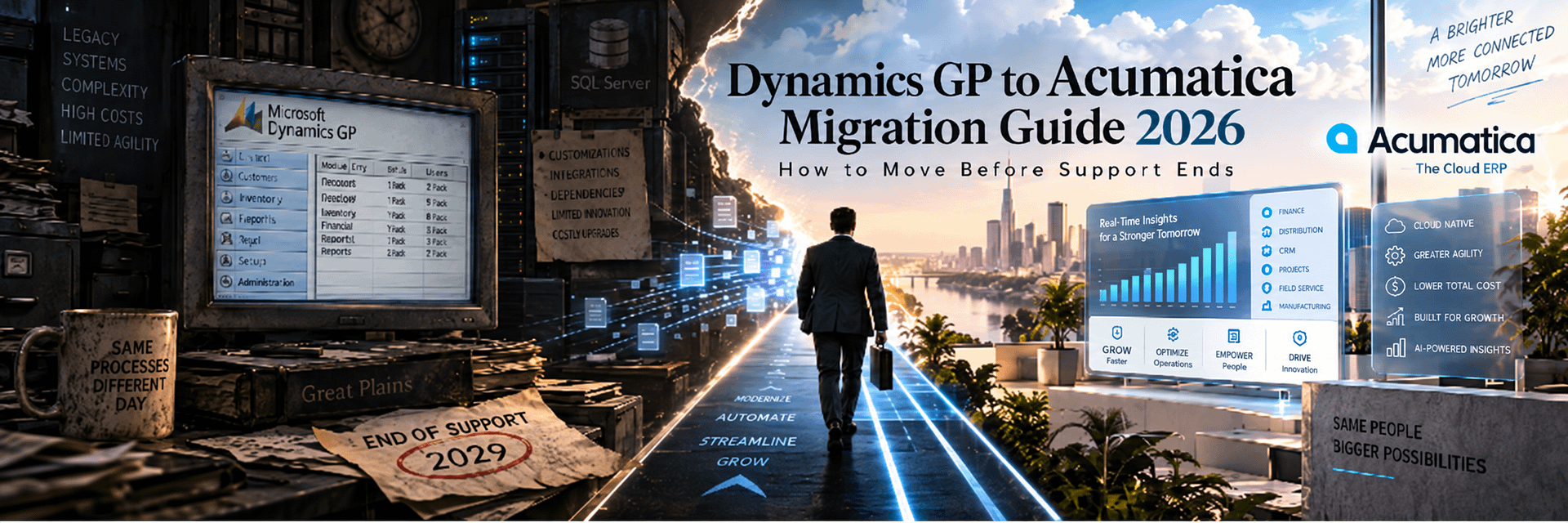
Microsoft Dynamics GP to Acumatica Migration Guide 2026 | Great Plains Replacement
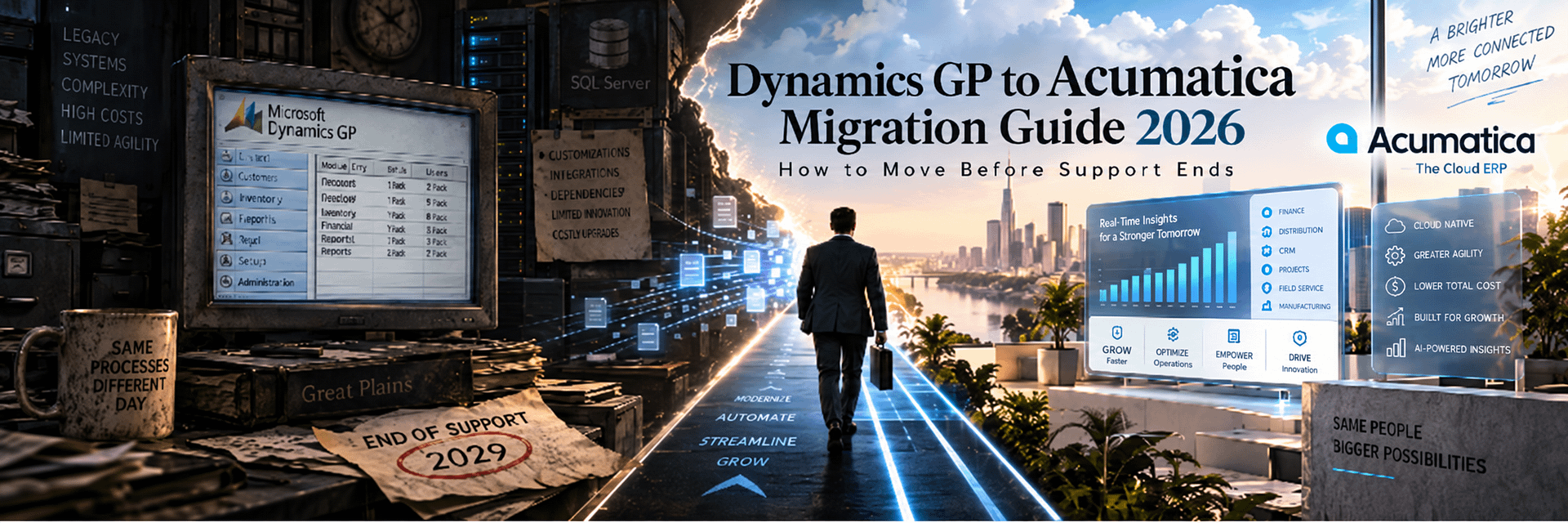
Microsoft Dynamics GP to Acumatica Migration Guide 2026: How to Move Before Support Ends
Microsoft Dynamics GP has powered accounting and business operations for decades. But Microsoft has now established a clear end-of-support roadmap, creating a strategic deadline for organizations still running Dynamics GP or Microsoft Great Plains.
Microsoft has announced that support for Microsoft Dynamics GP will end on December 31, 2029 for product enhancements, regulatory and tax updates, and technical support.
Security updates and patches, if needed, are expected to remain available until April 30, 2031.
For companies still operating Dynamics GP, those dates change the ERP conversation.
The question is no longer simply:
“Should we eventually modernize Great Plains?”
The better question is:
“What should replace Dynamics GP, how long will migration really take, and when should we begin so that the company is not forced into a rushed ERP decision in 2029?”
Microsoft is naturally encouraging Dynamics GP customers toward its Dynamics 365 cloud portfolio, including Business Central.
That is a valid migration path.
But it is not the only path.
A Dynamics GP end-of-support event creates an opportunity to evaluate the ERP market again rather than automatically adopting the next Microsoft product.
For many growing businesses, Acumatica Cloud ERP deserves serious consideration.
Acumatica provides a modern ERP platform designed around cloud access, open integration, industry-specific functionality, broad user participation, configurable workflows, real-time reporting, APIs, automation, and a partner-led implementation ecosystem.
Acumatica itself now actively positions the platform as a replacement for legacy Microsoft Dynamics products, including Dynamics GP, Dynamics SL, and Dynamics NAV.
Several organizations have already made the transition from Microsoft Great Plains to Acumatica.
Recent examples include Arkansas Federal Credit Union, Star One Credit Union, and Eastmen Tire Supplies.
Those migrations are especially useful because they demonstrate that a Great Plains replacement is not simply about moving the general ledger.
Companies are using the transition to modernize:
- accounts payable;
- financial reporting;
- inventory management;
- warehouse operations;
- remote access;
- integrations;
- internal controls;
- eCommerce;
- workflow automation;
- management visibility.
As an Acumatica Gold Partner, BizTech helps businesses design and implement this transition.
BizTech also develops proprietary Acumatica integrations for Amazon, Shopify, WooCommerce, Magento, PayPal, ShipHero, ShipStation, Salesforce, ServiceTitan, DSCO, CommerceHub, EDI, and specialized operational workflows.
This matters because most long-term Dynamics GP customers are not migrating from one application.
They are migrating from an ecosystem.
That ecosystem may contain:
- Microsoft SQL Server databases;
- the Dynamics system database;
- multiple GP company databases;
- SmartLists;
- Management Reporter;
- Report Writer;
- SSRS reports;
- Excel reports;
- Word Templates;
- Dexterity customizations;
- Visual Studio add-ins;
- Integration Manager;
- eConnect;
- Web Services;
- Service Based Architecture;
- ISV products;
- eCommerce integrations;
- warehouse integrations;
- banking and payment systems;
- custom SQL processes.
A successful Dynamics GP to Acumatica migration must identify all of those dependencies before Great Plains is retired.
Microsoft Dynamics GP End-of-Support Dates: What Actually Happens in 2029 and 2031?
There is considerable confusion around the phrase Dynamics GP end of life.
The dates should be understood precisely.
Microsoft ends Dynamics GP product enhancements, regulatory and tax updates, and technical support.
Security updates and patches, if needed, are scheduled to remain available until this date.
Microsoft states that the current Dynamics GP 18.x generation is governed by the Modern Lifecycle Policy.
Until the main support deadline, customers are expected to remain current with Dynamics GP updates in order to stay within supported lifecycle requirements.
After December 31, 2029, organizations should no longer expect normal:
- product enhancements;
- regulatory updates;
- tax updates;
- standard technical support.
The period between January 2030 and April 2031 should therefore not be interpreted as normal full product support.
It is a limited security-update window.
That distinction is important for companies that depend heavily on:
- tax updates;
- payroll;
- regulatory requirements;
- third-party applications;
- supported infrastructure;
- partner expertise.
The 2029 deadline is not the date to start ERP selection. It is the date by which a well-planned replacement should ideally already be complete.
Dynamics GP, Great Plains, Microsoft Great Plains: Why All Three Names Matter
Microsoft Dynamics GP has a long history.
Many long-term customers still refer to it simply as:
- Great Plains;
- Microsoft Great Plains;
- Dynamics Great Plains;
- GP;
- Dynamics GP.
For migration planning, these terms often describe the same product lineage.
This is also important for search.
A CFO may search for:
Dynamics GP replacement
while an accounting manager who has used the software for twenty years may search:
Great Plains replacement
and an IT director may search:
Microsoft Great Plains SQL migration.
This guide uses all of these terms naturally because companies still use all of them in the real world.
Why Companies Should Not Wait Until 2029 to Replace Dynamics GP
Three years may sound like a long time.
For an ERP migration, it is not.
A well-managed Dynamics GP replacement may require:
- ERP evaluation;
- executive approval;
- budgeting;
- implementation partner selection;
- business process discovery;
- data cleansing;
- target architecture;
- integration redesign;
- customization redevelopment;
- report redesign;
- multiple test migrations;
- user acceptance testing;
- training;
- cutover planning;
- post-go-live stabilization.
Waiting creates additional risk.
Partner Capacity Becomes Scarcer
As the support deadline approaches, more Dynamics GP customers will compete for experienced migration consultants, developers, implementation partners, and internal resources.
Your Best Employees May Know GP Better Than Anyone Else
Long-serving accounting, IT, operations, and warehouse employees often possess undocumented knowledge about:
- customizations;
- reports;
- integrations;
- manual workarounds;
- historical data;
- month-end procedures.
If those employees retire or leave before migration, the company can lose critical migration knowledge.
Data Quality Does Not Improve Automatically
Duplicate customers, inactive vendors, obsolete inventory, old GL accounts, custom SQL tables, and inconsistent master data require time to clean.
Integrations Can Be More Complex Than the ERP
A twenty-year Dynamics GP implementation may have accumulated dozens of external dependencies.
These can take longer to redesign than the core financial system.
Microsoft’s Default Path Is Business Central — But It Is Not Your Only Option
Microsoft encourages Dynamics GP customers to migrate toward Dynamics 365 cloud offerings.
Microsoft also provides built-in migration tooling for eligible Dynamics GP environments moving to Business Central online.
Current Microsoft guidance states that these tools support Dynamics GP 2015 and later, subject to specific SQL Server and database compatibility requirements.
That makes Business Central a legitimate option for GP customers.
However, the end of GP support creates an opportunity to conduct a fresh ERP evaluation.
A company should not assume that remaining within the same software vendor automatically creates the best long-term result.
The ERP selection should evaluate:
- industry functionality;
- licensing model;
- user access;
- implementation ecosystem;
- integration requirements;
- customization;
- manufacturing;
- distribution;
- construction;
- project accounting;
- reporting;
- future acquisitions;
- five-to-ten-year TCO.
For many organizations, Acumatica should be on that shortlist.
Why Consider Acumatica as a Dynamics GP Replacement?
Acumatica is not simply a cloud-hosted accounting application.
It is a modern ERP platform designed for companies that need financial and operational management in one connected environment.
Modern Cloud Architecture
Dynamics GP was designed as a traditional client-server ERP and can be hosted in environments such as Azure virtual machines or accessed through web-client architecture.
Acumatica was designed around browser and cloud access from the beginning.
Broad User Access
Acumatica’s consumption-oriented licensing philosophy is designed to reduce the direct seat-count friction associated with more traditional ERP licensing models.
This can make it easier to give ERP access to:
- warehouse teams;
- project managers;
- field users;
- sales;
- purchasing;
- customer service;
- executives.
Open APIs
Acumatica provides modern REST APIs, webhooks, business events, import/export scenarios, and customization tools.
Industry-Specific Functionality
Acumatica provides editions and applications for:
- distribution;
- manufacturing;
- construction;
- retail;
- professional services;
- general business;
- field service.
Modern Reporting
Acumatica combines:
- financial reporting;
- Generic Inquiries;
- role-based dashboards;
- reports;
- business events;
- BI integration.
Acumatica vs Dynamics GP in 2026
| Area | Microsoft Dynamics GP | Acumatica Cloud ERP |
|---|---|---|
| Support roadmap | Core product support ends December 31, 2029 | Active cloud ERP roadmap and ongoing development |
| Architecture | Traditional Windows/client-server ERP with SQL Server; web and hosted deployment options exist | Browser-oriented modern cloud ERP platform |
| Database | Microsoft SQL Server | Managed modern ERP platform architecture |
| User model | Traditional GP licensing arrangements depend on agreement and deployment | Consumption/resource-oriented plans designed around broad user access |
| Remote access | Can require hosting, web client, RDS, VPN, Azure VM, or related infrastructure depending on deployment | Native browser and cloud access |
| Reporting | SmartList, Report Writer, Management Reporter, SSRS, Excel reports | Generic Inquiries, dashboards, financial reports, standard reports, BI integration |
| Customization | Dexterity, Visual Studio Tools, SQL, ISV products and other GP-specific technologies | C#/.NET customization framework, workflows, business events, APIs and low-code tools |
| Integration | eConnect, Web Services, SBA, Integration Manager, SQL and ISV tools | REST APIs, webhooks, business events, import scenarios and connectors |
| Manufacturing | GP manufacturing functionality plus ISV ecosystem | Integrated Manufacturing Edition and related applications |
| Distribution | Established SOP, POP and Inventory modules | Integrated distribution, WMS, inventory, order management, commerce and reporting |
| CRM | Often separate or integrated | Embedded CRM functionality plus external integration options |
| Future support pressure | Increasing as 2029 approaches | No announced equivalent retirement deadline |
Real Companies That Replaced Dynamics GP with Acumatica
Arkansas Federal Credit Union
reduction in accounting and finance processing time reported by the customer
invoice payment frequency increased from once to twice per week
accounts payable unified in one system
Arkansas Federal Credit Union replaced Microsoft Dynamics GP with Acumatica General Business Edition.
The organization had relied on GP for years but faced manual reporting, disconnected AP processes, and limitations in the aging platform.
Acumatica became a centralized environment for:
- financial management;
- fixed assets;
- expense management;
- deferred revenue;
- corporate credit card reporting;
- integration with the credit union’s core processor.
Star One Credit Union
reduction in accounting and financial process times
accounts payable consolidated into one environment
core processor integration
Star One had operated Microsoft Great Plains for almost twenty years.
The company sought better reporting, remote accessibility, stronger controls, and a modern cloud platform.
Eastmen Tire Supplies
increase in shipping volume
reduction in payroll processing time
reduction in inventory processing time
Eastmen Tire Supplies replaced Great Plains with Acumatica Distribution Edition.
The company unified inventory, order management, payroll, intercompany accounting, and omnichannel operations.
These are specific customer results, not universal migration guarantees.
They demonstrate that a GP replacement can improve much more than accounting.
What Data Can Be Migrated from Dynamics GP to Acumatica?
Most core business information can be migrated.
The exact scope depends on:
- GP version;
- installed modules;
- company databases;
- customizations;
- third-party applications;
- historical requirements;
- Acumatica target design.
Financial Data
- chart of accounts;
- account segments;
- general ledger balances;
- journal history;
- bank information;
- budgets;
- fiscal periods;
- multicurrency information;
- intercompany balances.
Customers and Receivables
- customer records;
- addresses;
- contacts;
- payment terms;
- salespeople;
- credit limits;
- tax information;
- open invoices;
- credit memos;
- cash receipts;
- aging information.
Vendors and Payables
- vendor records;
- addresses;
- contacts;
- payment terms;
- tax identifiers;
- open invoices;
- vendor credits;
- payments;
- aging information.
Inventory
- item master;
- sites;
- quantities;
- costs;
- prices;
- units of measure;
- lot numbers;
- serial numbers;
- vendor relationships;
- reorder information.
Sales and Purchasing
- open sales orders;
- open purchase orders;
- backorders;
- partially fulfilled orders;
- partially received purchase orders;
- customer deposits;
- returns.
Other Data
- fixed assets;
- project accounting;
- manufacturing data;
- payroll data where appropriate;
- attachments;
- historical transactions;
- custom tables;
- integration cross-references.
Dynamics GP Environment Audit: What Must Be Documented Before Migration
Long-running GP environments often contain far more than the visible ERP screens.
Before migration, inventory the complete system.
Core Environment
- Dynamics GP version;
- Dynamics GP 18.x build;
- SQL Server version;
- DYNAMICS system database;
- company databases;
- ODBC configuration;
- Windows servers;
- web-client components;
- Azure or hosted infrastructure;
- backup processes.
Modules
- General Ledger;
- Receivables Management;
- Payables Management;
- Sales Order Processing;
- Purchase Order Processing;
- Inventory;
- Bank Reconciliation;
- Fixed Assets;
- Multicurrency;
- Project Accounting;
- Manufacturing;
- Payroll;
- other installed modules.
Reporting
- SmartLists;
- SmartList Designer objects;
- Report Writer reports;
- Management Reporter definitions;
- SSRS reports;
- Excel reports;
- Word Templates;
- Power BI integrations;
- custom SQL reporting.
Development and Integrations
- Dexterity dictionaries;
- chunk files;
- Visual Studio Tools add-ins;
- Integration Manager integrations;
- eConnect;
- Web Services;
- Service Based Architecture;
- custom stored procedures;
- scheduled SQL jobs;
- ISV applications;
- custom APIs;
- third-party middleware.
Dynamics GP SQL Server Migration to Acumatica
Microsoft Dynamics GP relies on Microsoft SQL Server to manage its business databases.
A typical environment contains:
- a Dynamics system database;
- one or more company databases;
- SQL logins and database roles;
- ODBC data sources;
- stored procedures;
- views;
- integration-related database objects;
- third-party tables.
SQL access makes Dynamics GP data technically accessible.
But direct table access does not automatically make migration easy.
A Dynamics GP SQL database is a storage model, not a migration specification.
The migration team must understand the business meaning of:
- work tables;
- open tables;
- historical tables;
- document statuses;
- posting behavior;
- control accounts;
- company-specific setup;
- ISV tables.
A query that successfully extracts ten million rows can still create an incorrect ERP migration if those rows are interpreted incorrectly.
SQL Migration Process
A structured approach may include:
- Back up every GP database.
- Inventory database sizes.
- Identify company databases.
- Inventory custom tables and views.
- Inventory integration tables.
- Identify authoritative source tables.
- Create repeatable extraction queries.
- Validate row counts.
- Transform data into target migration structures.
- Reconcile against GP reports.
- Repeat during test migration.
- Execute final cutover extraction.
Dynamics GP to Acumatica Functional Mapping
| Dynamics GP Concept | Typical Acumatica Target | Migration Approach |
|---|---|---|
| GP Company Database | Acumatica Company / Branch | Architecture must consider legal entity, reporting, tax and operational structure |
| GL Account Segments | Account + Subaccount Segments | Redesign reporting instead of blindly copying every account |
| Receivables Management | Customers + Accounts Receivable | Customers, terms, invoices, credits, payments and balances |
| Payables Management | Vendors + Accounts Payable | Vendors, terms, bills, credits, payments and balances |
| Sales Order Processing | Sales Orders / AR Documents | Open and partially fulfilled orders require special mapping |
| Purchase Order Processing | Purchase Orders / AP | Open and partially received documents require validation |
| Inventory Site | Warehouse | Sites, bins and location logic must be reviewed |
| SmartList | Generic Inquiry / Dashboard / Report | Rebuild according to business purpose |
| Management Reporter | Acumatica Financial Reports / BI | Rebuild reporting definitions against new account structure |
| Report Writer | Acumatica Reports / Forms | Recreate only reports and documents still needed |
| Integration Manager | Import Scenarios / API / Connector | Preserve integration purpose, not GP-specific tooling |
| eConnect / Web Services | REST API / Webhooks / Integration Services | Redesign integrations using target architecture |
| Dexterity Customization | Workflow / Configuration / C# Customization | Analyze business logic before redevelopment |
Migrating Dynamics GP Companies to Acumatica Companies and Branches
GP customers often operate several company databases.
Those databases may represent:
- legal entities;
- subsidiaries;
- operating divisions;
- historical companies;
- acquisitions;
- different currencies.
The target Acumatica structure should distinguish between:
- companies;
- branches;
- warehouses;
- reporting dimensions.
Not every GP company database automatically needs to become a separate Acumatica company.
Questions to Resolve
- Is the entity legally separate?
- Does it have separate tax registration?
- Does it have a different base currency?
- Does it require separate financial statements?
- Does it share customers or vendors?
- Does it transact with other group companies?
- Should inventory be shared?
Dynamics GP Chart of Accounts Migration
Great Plains account structures often encode several dimensions directly into segmented account numbers.
Examples may include:
- natural account;
- department;
- division;
- location;
- product group.
Acumatica offers accounts, subaccounts, branches, and reporting structures that may allow a cleaner design.
The migration should evaluate whether every GP segment should remain.
Migration Steps
- inventory active accounts;
- identify inactive accounts;
- identify control accounts;
- map account categories;
- design Acumatica subaccounts;
- map departments and locations;
- define retained earnings;
- prepare opening balances;
- reconcile the trial balance.
Customer and Vendor Migration
Master data should be cleaned before it reaches Acumatica.
Customers
- customer number;
- name;
- addresses;
- contacts;
- payment terms;
- credit limits;
- salespeople;
- tax configuration;
- price level;
- external integration IDs;
- custom fields.
Vendors
- vendor number;
- name;
- addresses;
- contacts;
- payment terms;
- tax identifiers;
- payment information;
- currency;
- custom fields.
Clean Before Migration
Review:
- duplicates;
- inactive records;
- incorrect addresses;
- obsolete contacts;
- duplicate tax IDs;
- old integration references.
Dynamics GP Inventory and Site Migration
Inventory migration requires more than item-master conversion.
The company must reconcile:
- item information;
- sites;
- bins where applicable;
- on-hand quantities;
- allocated quantities;
- available quantities;
- cost;
- valuation;
- lots;
- serial numbers;
- open purchasing;
- open sales demand.
Inventory Reconciliation
Before production cutover compare:
- GP inventory;
- physical inventory;
- WMS data;
- eCommerce inventory;
- general ledger inventory accounts.
If those sources disagree, the company must select an authoritative opening position.
Dynamics GP AR and AP Migration
Open receivables and payables affect cash flow immediately after go-live.
Accounts Receivable
- open invoices;
- credit memos;
- unapplied cash;
- customer deposits;
- due dates;
- remaining balances;
- payment applications.
Accounts Payable
- open vendor invoices;
- vendor credits;
- prepayments;
- unapplied payments;
- due dates;
- remaining balances.
Required Reconciliation
- AR aging to GP;
- AP aging to GP;
- AR to the GL control account;
- AP to the GL control account;
- unapplied payments;
- foreign currency balances.
Dynamics GP Sales Order and Purchase Order Migration
Dynamics GP Sales Order Processing and Purchase Order Processing often contain active business documents that cannot simply disappear at cutover.
Open Sales Orders
Migration may include:
- order number;
- customer;
- customer PO;
- items;
- quantity ordered;
- quantity fulfilled;
- site;
- price;
- discount;
- tax;
- freight;
- shipping method;
- backorder status;
- external channel IDs.
Open Purchase Orders
Migration may include:
- PO number;
- vendor;
- items;
- ordered quantity;
- received quantity;
- site;
- cost;
- expected date;
- related receipts.
Partial Documents
Partially shipped and partially received documents should be tested carefully because document-state logic differs between ERP systems.
Dynamics GP Fixed Assets Migration
Fixed asset migration may include:
- asset ID;
- description;
- asset class;
- acquisition date;
- acquisition cost;
- depreciation method;
- life;
- salvage value;
- accumulated depreciation;
- book values;
- location;
- department;
- retired assets where history is required.
The total asset cost and accumulated depreciation must reconcile to the general ledger.
Dynamics GP Multicurrency Migration
Companies operating internationally may need to migrate:
- currency definitions;
- rate types;
- exchange rates;
- customer currencies;
- vendor currencies;
- open foreign-currency documents;
- historical exchange-rate information;
- revaluation balances.
The target Acumatica currency strategy should be designed before transaction migration begins.
Dynamics GP Project Accounting Migration
Project-based organizations may need to migrate:
- projects;
- contracts;
- budgets;
- cost categories;
- billing information;
- open commitments;
- unbilled costs;
- project history;
- employee expenses and time where relevant.
Project structures often require redesign because Acumatica Project Accounting uses a different data model and workflow.
Dynamics GP Manufacturing Migration
Manufacturing environments may contain both native Dynamics GP functionality and third-party ISV products.
The first step is identifying exactly where the manufacturing truth lives.
Data may include:
- bills of material;
- routing;
- work centers;
- manufacturing orders;
- labor;
- overhead;
- WIP;
- planning parameters;
- quality data;
- engineering changes;
- shop-floor information.
These structures should be mapped to the target Acumatica Manufacturing architecture rather than imported table-for-table.
How Much Dynamics GP History Should Be Migrated?
Historical data is one of the largest migration cost drivers.
Option 1: Full Transaction History
Advantages:
- one ERP for historical research;
- less dependency on GP;
- better direct comparison;
- customer and vendor history stays accessible.
Disadvantages:
- higher cost;
- longer migration;
- more reconciliation;
- more risk of importing legacy problems.
Option 2: Limited Detailed History
For example:
- current fiscal year;
- current year plus one comparative year;
- selected operational history.
Option 3: Summary History
Period balances may be enough for comparative financial reporting.
Option 4: Opening Balances and Open Documents
Acumatica begins cleanly while GP remains available as a historical archive for a defined period.
Dynamics GP SmartList Migration to Acumatica
SmartList is one of the most widely used GP tools.
Users rely on it for:
- ad hoc queries;
- customer research;
- vendor analysis;
- inventory analysis;
- sales lists;
- work queues;
- Excel exports;
- management reporting.
SmartLists should be inventoried before migration.
A SmartList May Become:
- an Acumatica Generic Inquiry;
- a dashboard;
- a standard inquiry;
- a report;
- a business event;
- a Power BI dataset;
- an automated notification.
Do not recreate every SmartList. Recreate the business question the SmartList answers.
Dynamics GP Management Reporter Migration
Management Reporter is still part of many Dynamics GP financial reporting environments.
A company may depend on:
- row definitions;
- column definitions;
- report trees;
- financial statement groups;
- departmental reporting;
- consolidated financials.
The definitions cannot simply be imported into Acumatica unchanged.
Migration Process
- Inventory every active financial report.
- Identify the report owner.
- Document account ranges.
- Document departments and dimensions.
- Identify calculated lines.
- Identify consolidation logic.
- Map the report to the new Acumatica chart.
- Rebuild and validate.
Some Management Reporter outputs may become:
- Acumatica financial reports;
- Generic Inquiries;
- dashboards;
- Velixo reports;
- Power BI reports;
- other BI solutions.
Dynamics GP Report Writer, SSRS, Excel Reports, and Word Templates
GP customers often have multiple reporting technologies operating simultaneously.
These may include:
- Report Writer;
- Word Templates;
- SSRS;
- Excel reports;
- custom SQL queries;
- Management Reporter.
Every report should be classified.
Classification Questions
- Is the report still used?
- Who owns it?
- Is it operational or analytical?
- Is it customer-facing?
- Is it legally required?
- Can Acumatica already provide the information?
- Would a dashboard be better?
This report rationalization can significantly reduce migration effort.
Dynamics GP Dexterity Customization Migration
Dexterity is historically central to Microsoft Dynamics GP development.
Microsoft documentation describes Dexterity as the development environment used to build Dynamics GP and to create transaction-oriented business applications.
GP customizations may include:
- Dexterity dictionaries;
- chunk files;
- custom forms;
- custom windows;
- custom scripts;
- custom reports;
- third-party Dexterity applications.
Dexterity code cannot simply be copied into Acumatica.
The migration team should document:
- business purpose;
- trigger;
- input data;
- output data;
- users;
- integrations;
- exceptions;
- frequency;
- whether it is still needed.
Possible Acumatica Replacements
- standard functionality;
- configuration;
- workflow;
- business event;
- API integration;
- BizTech connector;
- C#/.NET customization.
The correct migration target is the business requirement, not the Dexterity source code.
Dynamics GP Integration Manager, eConnect, Web Services, and SBA Migration
Dynamics GP provides several integration technologies.
Integration Manager
Integration Manager may be used for:
- data conversion;
- master record imports;
- financial imports;
- distribution integrations;
- recurring external-data imports.
Every active Integration Manager package should be inventoried before migration.
eConnect
eConnect provides API-based access to Dynamics GP back-office transactions.
External systems may depend on eConnect without business users even realizing it.
Web Services and Service Based Architecture
Some integrations may rely on GP web-service or Service Based Architecture endpoints.
Acumatica Replacement Architecture
These integrations may become:
- Acumatica REST API connections;
- webhooks;
- business events;
- import scenarios;
- scheduled services;
- BizTech connectors;
- middleware.
Dynamics GP ISV Add-On Migration
Many GP implementations depend heavily on independent software vendor products.
ISVs may provide:
- manufacturing;
- distribution;
- warehouse management;
- payments;
- EDI;
- payroll;
- document management;
- tax;
- field service;
- industry functionality.
For every ISV product, ask:
- What business function does it provide?
- Does Acumatica provide that function natively?
- Is there an Acumatica marketplace solution?
- Does BizTech already have a solution?
- Should the external product remain?
- How will historical data be preserved?
Migrating External Dynamics GP Integrations to Acumatica
A modern migration project may need to reconnect:
- eCommerce;
- marketplaces;
- CRM;
- WMS;
- 3PL;
- shipping;
- payment processing;
- tax;
- EDI;
- BI;
- banks;
- custom systems.
BizTech Acumatica Integration Portfolio
BizTech develops solutions including:
- Amazon FBA/FBM Connector;
- Shopify Connector;
- WooCommerce Connector;
- Magento Connector;
- PayPal Integration;
- ShipHero;
- ShipStation;
- DSCO;
- CommerceHub;
- Salesforce;
- ServiceTitan;
- EDI;
- custom API integrations.
Existing Acumatica-native connectors can reduce redevelopment effort compared with rewriting every GP integration from zero.
Do Not Rebuild Dynamics GP Inside Acumatica
One of the greatest migration risks is recreating thirty years of legacy ERP decisions inside a modern platform.
Users may ask for:
- the same screen;
- the same report;
- the same SmartList;
- the same Dexterity window;
- the same approval;
- the same manual workaround.
Some should remain.
Many should not.
A stronger priority sequence is:
- Standard Acumatica functionality.
- Configuration and workflow.
- Generic Inquiry, dashboard, business event, or low-code automation.
- Existing BizTech or Acumatica ecosystem solution.
- External specialized platform integration.
- Custom development only where it produces clear business value.
Preserve the business requirement. Do not preserve legacy complexity just because it is familiar.
Complete Dynamics GP to Acumatica Migration Process
Phase 1: Business Case
Define why GP is being replaced and what outcomes must improve.
Phase 2: GP Environment Audit
Inventory databases, modules, reports, SmartLists, customizations, integrations, ISVs, infrastructure, and users.
Phase 3: Acumatica Fit-Gap Analysis
Classify each requirement as:
- standard Acumatica;
- configuration;
- workflow;
- integration;
- existing BizTech solution;
- custom development;
- retirement.
Phase 4: Target Architecture
Design companies, branches, accounts, subaccounts, customers, vendors, inventory, warehouses, projects, manufacturing, reporting, security, and integrations.
Phase 5: Extraction Design
Define repeatable SQL, reporting, SmartList, API, and source-system extraction methods.
Phase 6: Data Cleansing
Deduplicate, standardize, reconcile, and remove obsolete data.
Phase 7: Acumatica Configuration
Configure target modules and workflows.
Phase 8: Reporting Migration
Rebuild critical SmartLists, Management Reporter reports, Report Writer documents, dashboards, and analytics.
Phase 9: Integration Development
Implement APIs, BizTech connectors, webhooks, middleware, and required custom integrations.
Phase 10: Customization Development
Rebuild only approved GP-specific business logic.
Phase 11: Test Migration
Run a realistic production-sized conversion rehearsal.
Phase 12: Reconciliation
Validate GL, AR, AP, inventory, cash, fixed assets, sales orders, purchase orders, projects, and other material balances.
Phase 13: User Acceptance Testing
Users execute real end-to-end workflows.
Phase 14: Training
Training should be role-specific and based on the configured production environment.
Phase 15: Final Cutover
Freeze Dynamics GP transactions, perform final extraction, migrate, reconcile, activate integrations, and approve production use.
Phase 16: Stabilization
Monitor users, integrations, reports, workflows, errors, and performance after launch.
How Much Does Dynamics GP to Acumatica Migration Cost?
There is no universal price.
Cost depends on:
- number of GP companies;
- SQL database size;
- modules;
- historical data;
- inventory;
- manufacturing;
- projects;
- SmartLists;
- Management Reporter;
- custom reports;
- Dexterity;
- Integration Manager;
- eConnect;
- ISV products;
- integrations;
- Acumatica modules;
- testing;
- training;
- cutover requirements.
| Cost Area | Typical Scope |
|---|---|
| Acumatica Software | Applications, resource level, deployment and subscription |
| Discovery | GP environment audit, process analysis, fit-gap |
| Data Migration | SQL extraction, transformation, import, reconciliation |
| Reporting | SmartList, Management Reporter, SSRS, Report Writer, dashboards |
| Customization | Dexterity, Visual Studio Tools, custom business logic |
| Integrations | eConnect, Web Services, EDI, WMS, commerce, payment, CRM |
| Testing | Migration validation, UAT, integrations, performance |
| Training | Role-specific user and administrator education |
| Go-Live | Final conversion, reconciliation and stabilization |
What Reduces Cost?
- clean data;
- limited history;
- retiring obsolete SmartLists;
- retiring old Dexterity customizations;
- standard Acumatica workflows;
- existing BizTech connectors;
- clear process owners;
- phased implementation.
What Increases Cost?
- many GP companies;
- large history;
- extensive Dexterity customization;
- large report catalog;
- many ISV products;
- complex manufacturing;
- many integrations;
- poor source data;
- compressed deadlines.
How Long Does Dynamics GP to Acumatica Migration Take?
A small financial migration and a twenty-year multi-company GP environment should not have the same timeline.
Duration depends on:
- scope;
- companies;
- data;
- history;
- reporting;
- customization;
- integrations;
- manufacturing;
- testing;
- user availability.
Focused projects may be completed in months.
Large multi-entity ERP transformations may require a longer phased program.
The objective should be a controlled go-live, not the shortest theoretical timeline.
Dynamics GP Migration Roadmap: 2026 to 2031
The following is a practical BizTech planning framework based on Microsoft’s announced Dynamics GP lifecycle dates.
Ideal planning window. Inventory GP, integrations, reports, customizations, SQL databases and ISVs. Evaluate Acumatica and other ERP platforms.
Comfortable migration window. Complete selection, discovery, data cleanup and implementation with time for controlled testing.
Migration becomes time-sensitive. Organizations with complex GP environments should ideally already be executing the replacement project.
Final year of full Dynamics GP support. December 31, 2029 is the announced end date for product enhancements, regulatory/tax updates and technical support.
Post-support period. Normal technical, regulatory and product support has ended. Remaining security-update availability should not be confused with full ERP support.
April 30, 2031: Microsoft’s announced security update/patch window ends.
Dynamics GP to Acumatica for Financial Services and Credit Unions
Credit unions and financial institutions often use GP primarily as a financial ERP while member or customer operations live in a separate core platform.
A migration may need:
- GL;
- AP;
- fixed assets;
- deferred revenue;
- expenses;
- credit cards;
- core processor integration;
- internal controls;
- auditing;
- management reporting.
Arkansas Federal Credit Union and Star One Credit Union demonstrate this migration pattern.
Dynamics GP to Acumatica for Distribution
Distribution companies often need to migrate far beyond financial data.
The target environment may include:
- inventory;
- multiple warehouses;
- sales orders;
- purchase orders;
- replenishment;
- customer pricing;
- shipping;
- returns;
- EDI;
- eCommerce;
- marketplaces;
- WMS;
- profitability reporting.
Eastmen Tire Supplies is a current example of a distributor replacing Great Plains with Acumatica.
Dynamics GP to Acumatica for Manufacturing
Manufacturers may need:
- BOM migration;
- routing;
- work centers;
- production orders;
- MRP;
- planning;
- WIP;
- lot and serial tracking;
- shop-floor processes;
- quality systems;
- inventory;
- financial costing.
Where GP uses ISV manufacturing applications, the migration must include those databases and integrations in the discovery process.
Dynamics GP to Acumatica for eCommerce
Modern eCommerce operations require the ERP to synchronize:
- products;
- customers;
- prices;
- orders;
- taxes;
- payments;
- inventory;
- warehouses;
- fulfillment;
- tracking;
- returns;
- refunds.
BizTech’s existing Acumatica commerce connectors can help replace integration layers previously built around GP.
Dynamics GP to Acumatica for Multi-Entity Companies
Organizations with several GP company databases should use migration as an opportunity to redesign:
- companies;
- branches;
- intercompany accounting;
- shared master data;
- currencies;
- consolidated reporting;
- security;
- warehouses;
- integrations.
Simply reproducing one Acumatica company for every old GP database may create unnecessary complexity.
Common Dynamics GP to Acumatica Migration Risks
Risk 1: Waiting Until 2029
The company loses time for discovery, testing and controlled implementation.
Risk 2: Assuming SQL Access Makes Migration Easy
SQL tables contain data, but the team must understand GP business logic.
Risk 3: Missing Customizations
Dexterity, Visual Studio Tools and ISV products may contain critical workflows.
Risk 4: Forgetting SmartLists and Reports
Users may rely on these every day even though they are not part of the core migration requirements document.
Risk 5: Ignoring Integration Manager or eConnect
An external system may silently depend on them.
Risk 6: Migrating Bad Inventory
Incorrect opening stock immediately damages trust in the new ERP.
Risk 7: Moving Too Much History
Historical data can dominate cost and timeline.
Risk 8: Rebuilding Every GP Customization
Some should be replaced with standard Acumatica functionality.
Risk 9: Insufficient UAT
Complete business processes must be tested.
Risk 10: No Post-Go-Live Monitoring
Production integrations and real user behavior expose edge cases that test data may not reveal.
Why Work with BizTech for Dynamics GP to Acumatica Migration?
BizTech is an Acumatica Gold Partner specializing in implementation, integrations, custom development, automation, reporting, and business process technology.
The BizTech website reports:
successful integrations
countries served
reported client satisfaction rate
ERP Implementation
BizTech can help with:
- business process discovery;
- Acumatica architecture;
- financial configuration;
- distribution;
- manufacturing;
- projects;
- reporting;
- testing;
- training;
- go-live.
Data Migration
BizTech can help migrate and reconcile:
- GL;
- AR;
- AP;
- customers;
- vendors;
- inventory;
- sales orders;
- purchase orders;
- fixed assets;
- projects;
- historical data.
Custom Development
Legacy Dexterity or GP-specific business logic can be evaluated and redesigned using:
- standard Acumatica functionality;
- workflows;
- business events;
- APIs;
- BizTech solutions;
- custom C# development.
Integration Development
BizTech can redesign GP integrations around Acumatica for:
- Amazon;
- Shopify;
- WooCommerce;
- Magento;
- PayPal;
- ShipHero;
- ShipStation;
- Salesforce;
- ServiceTitan;
- DSCO;
- CommerceHub;
- EDI;
- custom systems.
One Migration Program
Instead of coordinating separate GP consultants, SQL developers, migration vendors, Acumatica consultants, integration developers, reporting specialists and support providers, BizTech can coordinate these disciplines as one connected ERP migration program.
Final Dynamics GP to Acumatica Migration Checklist
Lifecycle and Business Case
- Dynamics GP support deadline is documented.
- Business case for replacement is approved.
- Executive sponsor is assigned.
- Target go-live date is defined.
- Budget is approved.
Dynamics GP Environment
- GP version is documented.
- SQL Server version is documented.
- DYNAMICS database is documented.
- Every company database is documented.
- Modules are inventoried.
- SmartLists are inventoried.
- Management Reporter is inventoried.
- Report Writer reports are inventoried.
- SSRS reports are inventoried.
- Excel reports are inventoried.
- Dexterity customizations are inventoried.
- Integration Manager packages are inventoried.
- eConnect dependencies are inventoried.
- Web Services are inventoried.
- ISV products are inventoried.
- external integrations are inventoried.
Acumatica Design
- Companies are approved.
- Branches are approved.
- Chart of accounts is approved.
- Subaccounts are approved.
- Customers and vendors are structured.
- Warehouses are approved.
- Security roles are approved.
- Reporting strategy is approved.
- Integration architecture is approved.
Data
- Customers are cleaned.
- Vendors are cleaned.
- Items are cleaned.
- GL mapping is approved.
- AR reconciles.
- AP reconciles.
- Inventory reconciles.
- Cash reconciles.
- Fixed assets reconcile.
- Open orders are validated.
- History strategy is approved.
- Test migration is complete.
Integrations
- Every integration has an owner.
- Authentication is configured.
- Cross-references are defined.
- Error handling is tested.
- Retry logic is tested.
- Monitoring is enabled.
- Orders are tested.
- Inventory sync is tested.
- Payments are tested.
- Fulfillment is tested.
- Returns are tested.
- Refunds are tested.
Users and Reports
- Users are created.
- Roles are tested.
- Training is complete.
- Critical SmartLists have replacements.
- Financial reports are approved.
- Operational reports are approved.
- Dashboards are approved.
Cutover
- GP transaction freeze is scheduled.
- SQL backups are complete.
- Final extraction is rehearsed.
- Production migration is rehearsed.
- Reconciliation responsibilities are assigned.
- Go-live criteria are documented.
- Rollback plan is documented.
- Post-go-live support is scheduled.
Final Conclusion: Dynamics GP Support Is Ending — Your ERP Strategy Should Begin Before the Deadline
Microsoft Dynamics GP has played an important role in the history of midmarket ERP.
Many companies have depended on Great Plains for decades.
That history should be respected.
But the future support roadmap is now clear.
December 31, 2029 marks the end of Dynamics GP product enhancements, regulatory and tax updates, and technical support. Security updates and patches, if needed, are scheduled only until April 30, 2031.
Companies therefore have a finite modernization window.
The strongest strategy is not to wait until the final months of 2029.
The strongest strategy is to use the remaining time to:
- understand the existing GP environment;
- clean the data;
- evaluate ERP alternatives;
- redesign outdated processes;
- inventory customizations;
- rebuild integrations intelligently;
- test migration thoroughly;
- train users;
- execute a controlled cutover.
Microsoft Dynamics 365 Business Central is one possible destination.
Acumatica is another—and for many organizations it can be the more practical choice.
Acumatica provides modern cloud access, open integration capabilities, industry editions, flexible workflows, real-time reporting, and a user-access philosophy designed for growing organizations.
Recent companies replacing GP with Acumatica have reported measurable improvements in accounting efficiency, AP processing, inventory operations, shipping capacity, and remote accessibility.
But successful ERP migration does not come from software alone.
It requires:
- migration architecture;
- data expertise;
- financial reconciliation;
- integration development;
- customization redesign;
- reporting strategy;
- testing;
- training;
- support.
As an Acumatica Gold Partner, BizTech helps companies manage that complete transition.
Dynamics GP contains the history of your business. Acumatica can become the platform for its next stage. BizTech helps build the path between them.
Planning a Dynamics GP or Great Plains Replacement?
BizTech can assess your Dynamics GP environment, SQL databases, integrations, reports, customizations, migration requirements, and Acumatica implementation scope before you commit to a replacement strategy.
FAQ: Microsoft Dynamics GP to Acumatica Migration
When does Microsoft Dynamics GP support end?
Microsoft has announced that Dynamics GP support ends December 31, 2029 for product enhancements, regulatory and tax updates, and technical support. Security updates and patches, if needed, are scheduled to remain available until April 30, 2031.
Is Dynamics GP the same as Great Plains?
Microsoft Dynamics GP is the product lineage historically known as Great Plains and Microsoft Great Plains. Many long-term users still refer to Dynamics GP simply as Great Plains.
Should we wait until 2029 to replace Dynamics GP?
For most complex ERP environments, waiting until the final year creates unnecessary migration risk. Data cleanup, ERP selection, integrations, custom development, reporting, testing, training, and cutover can require significant time.
What is Microsoft recommending Dynamics GP customers migrate to?
Microsoft is encouraging GP customers toward Dynamics 365 cloud solutions and provides migration tooling for eligible Dynamics GP environments moving to Business Central online. Organizations should still evaluate whether Business Central or another ERP such as Acumatica is the best long-term fit.
Can Dynamics GP data be migrated to Acumatica?
Yes. Financial data, customers, vendors, inventory, open AR and AP, sales orders, purchase orders, fixed assets, projects, manufacturing information, and selected history can be migrated depending on source configuration and target Acumatica design.
Can Microsoft Great Plains SQL data be migrated to Acumatica?
Yes. Dynamics GP stores business data in Microsoft SQL Server databases. Data can be extracted, transformed, validated, and imported into Acumatica. Direct SQL access must be combined with Dynamics GP functional knowledge so that document statuses and business relationships are interpreted correctly.
Can Dynamics GP SmartLists be migrated to Acumatica?
The business purpose of SmartLists can be migrated. A SmartList may become an Acumatica Generic Inquiry, dashboard, report, business event, BI dataset, or standard inquiry.
Can Management Reporter reports be migrated?
The financial reporting requirements can be migrated, but Management Reporter definitions are normally rebuilt against the new Acumatica chart of accounts, subaccount structure, branches, and dimensions.
Can Dynamics GP Report Writer reports be migrated?
Important forms and reports can be recreated using Acumatica reporting tools. The migration should first determine whether every existing report is still required.
Can Dexterity customizations be migrated to Acumatica?
Dexterity code cannot simply be copied into Acumatica. The business logic should be analyzed and replaced with standard Acumatica functionality, configuration, workflows, APIs, BizTech solutions, or custom C#/.NET development.
What happens to Dynamics GP Integration Manager?
Existing Integration Manager packages should be documented and their business purpose redesigned using Acumatica import scenarios, APIs, connectors, middleware, business events, or other appropriate integration methods.
What happens to Dynamics GP eConnect integrations?
Systems using eConnect must be included in the integration inventory. The integration can then be redesigned around Acumatica REST APIs, webhooks, BizTech connectors, or middleware.
Can open sales and purchase orders be migrated?
Yes. Open orders can be migrated, but partially fulfilled or received documents require careful mapping and testing because document states differ between ERP systems.
Can fixed assets be migrated from Dynamics GP?
Yes. Asset records, acquisition cost, accumulated depreciation, depreciation methods, books, and related data can be migrated and reconciled to the general ledger.
Can Dynamics GP multicurrency data be migrated?
Yes. Currency definitions, exchange rates, customer and vendor currencies, open foreign-currency documents, and related balances can be migrated when the target Acumatica currency structure is defined correctly.
How much Dynamics GP history should we migrate?
The business can migrate full transaction history, selected detailed history, summarized historical balances, or only opening balances and open documents. The right approach depends on audit, reporting, operational, budget, and legacy-access requirements.
How much does Dynamics GP to Acumatica migration cost?
Cost depends on company databases, modules, SQL data volume, history, SmartLists, Management Reporter, reports, Dexterity customizations, ISVs, integrations, Acumatica scope, testing, training, and support.
How long does Dynamics GP to Acumatica migration take?
There is no universal timeline. Focused financial migrations may be completed in months, while large multi-company or highly customized ERP transformations may require a longer phased implementation.
Can BizTech migrate our Dynamics GP integrations to Acumatica?
Yes. BizTech develops Acumatica integrations and proprietary connectors for Amazon, Shopify, WooCommerce, Magento, PayPal, ShipHero, ShipStation, Salesforce, ServiceTitan, DSCO, CommerceHub, EDI, and other platforms.
Why choose BizTech for a Dynamics GP replacement project?
BizTech is an Acumatica Gold Partner with ERP implementation, data migration, custom development, integration, reporting, automation, testing, training, and post-go-live support expertise. This allows the Dynamics GP replacement to be managed as one connected transformation instead of several disconnected technical projects.
Sage 100 to Acumatica Migration Guide 2026: Complete ERP Modernization Guide
Sage 100 to Acumatica Migration Guide 2026: How to Modernize Your ERP Without Losing Your Business Data
Moving from Sage 100 to Acumatica is not simply a software replacement. It is an opportunity to redesign how finance, inventory, sales, purchasing, manufacturing, projects, warehouses, reporting, integrations, and employees work together.
For many companies, Sage 100 has been a dependable business system for years or even decades. It may contain financial history, customer and vendor records, inventory, sales orders, purchase orders, manufacturing data, custom reports, Crystal Reports, Visual Integrator jobs, ODBC connections, third-party add-ons, SQL databases, and business processes that have gradually become part of the organization’s daily routine.
That history is exactly why a Sage 100 to Acumatica migration should never be approached as a simple export-and-import project.
The business is not only moving accounting data.
It is moving institutional knowledge.
A successful Sage 100 migration to Acumatica must determine:
- which Sage 100 data should move;
- which historical information should remain archived;
- how the chart of accounts should evolve;
- how companies and locations should map into Acumatica;
- how inventory quantities and valuation will be reconciled;
- how open AR and AP documents will be migrated;
- how sales and purchasing transactions will continue after cutover;
- how Sage 100 manufacturing structures should map into Acumatica Manufacturing Edition;
- what happens to Crystal Reports and custom reports;
- how Sage customizations and integrations should be replaced;
- how users will learn the new workflows;
- how the business will continue operating during cutover.
Companies searching for Sage 100 alternative, Sage 100 replacement, Sage 100 cloud ERP migration, Acumatica vs Sage 100, or how to migrate Sage 100 to Acumatica are usually facing the same underlying question:
Has our business become more complex than the ERP architecture we originally implemented?
That is a better question than asking whether Sage 100 is “good” or “bad.”
Sage 100 continues to be an actively supported ERP product. In 2026, Sage released Sage 100 2026 and subsequent product updates with new capabilities and enhancements.
The case for moving to Acumatica is therefore not that Sage 100 has disappeared.
The case is that some growing companies need a different operating model: cloud-native access, broader employee participation, real-time data across locations, open integration architecture, industry-specific ERP functionality, modern dashboards, flexible automation, and a platform designed to connect more of the business in one environment.
Acumatica has also created a dedicated See the Difference Migration Plan for Sage 100 customers, allowing organizations to experience Acumatica using their actual data before committing to a full production conversion.
For BizTech, this migration scenario is particularly relevant.
BizTech Services is both a Sage Certified Gold Development Partner and an Acumatica Gold Partner.
That means our team understands both sides of the transition: the Sage ecosystem a company is leaving and the Acumatica platform it is adopting.
BizTech also develops proprietary Acumatica integrations and enhancements for Amazon, Shopify, WooCommerce, Magento, PayPal, ShipHero, ShipStation, DSCO, CommerceHub, Salesforce, ServiceTitan, EDI, inventory workflows, gift cards, kits, consignment, and custom business systems.
This guide explains the complete migration journey—from the first modernization decision to final data reconciliation and post-go-live support.
Important: Sage 100 Is Still Supported in 2026
One of the easiest ways to damage the credibility of an ERP migration article is to claim that Sage 100 is dead, discontinued, or unsupported.
That is not accurate.
Sage continues to develop and support Sage 100.
Sage 100 2026 introduced enhancements including an AI-powered Help Agent, Global Search, expanded lot and serial number fields, and workflow improvements. Sage subsequently released Sage 100 2026.1 with additional enhancements and fixes.
Sage also continues to position Sage 100 as an ERP solution with accounting automation, payroll, inventory optimization, reporting, workflow capabilities, and integrations.
This matters because a Sage 100 to Acumatica migration should be a strategic choice rather than a fear-based decision.
Sage 100 migration in 2026 is generally a modernization decision, not a forced end-of-life migration.
A business should consider moving because the economics, architecture, integrations, user experience, scalability, remote access, reporting, or operating model no longer fit its needs—not because someone incorrectly claimed the software has disappeared.
This distinction also helps management build a better business case.
The decision becomes:
- What does staying on Sage 100 cost us over the next five years?
- What operational constraints are we accepting?
- How much manual work exists around the ERP?
- How many third-party applications are required?
- How much infrastructure and IT support do we maintain?
- How difficult is it to provide access across locations?
- How quickly can we introduce new channels, warehouses, entities, or business models?
- Would Acumatica create enough measurable value to justify migration?
Those are legitimate ERP questions.
Why Businesses Move Beyond Sage 100
Sage 100 can remain operational long after a company begins experiencing ERP friction.
Financials may still post correctly. Invoices may still be created. Purchase orders may still be entered. Reports may still run.
The first problems often appear around the ERP rather than inside the general ledger.
Examples include:
- employees exporting information to Excel for analysis;
- inventory being tracked in another application;
- different locations operating separate processes;
- warehouse teams depending on paper;
- remote employees relying on additional infrastructure;
- eCommerce orders being synchronized through fragile integrations;
- management waiting for manually assembled reports;
- separate CRM, service, manufacturing, or project applications;
- duplicate entry between Sage 100 and external systems;
- increasing dependence on custom code and specialized knowledge.
Over time, the ERP becomes one component in a larger collection of disconnected tools.
That is when the company should evaluate whether continuing to extend the old architecture remains economically rational.
Growth Across Locations
A company that operated from one office may now have:
- multiple warehouses;
- distribution centers;
- manufacturing facilities;
- field teams;
- remote workers;
- international locations;
- several legal entities.
The ERP architecture must evolve with that structure.
Growing Integration Requirements
Modern businesses increasingly need ERP connected to:
- Amazon;
- Shopify;
- WooCommerce;
- Magento;
- Salesforce;
- payment gateways;
- shipping systems;
- warehouse platforms;
- EDI networks;
- tax services;
- BI tools;
- custom applications.
Integration architecture becomes a strategic ERP capability rather than a secondary technical concern.
More Users Need Direct Information
ERP value increases when decision-makers can access current information directly.
Finance, sales, operations, purchasing, customer service, warehouse teams, production managers, project managers, executives, and field employees may all need different views of the same business data.
Acumatica vs Sage 100 in 2026
The most useful comparison is not a list of checkboxes.
Both products can manage important ERP processes.
The more meaningful question is how each platform supports the future operating model.
| Area | Sage 100 | Acumatica Cloud ERP |
|---|---|---|
| Product status | Actively supported and updated, including Sage 100 2026 | Actively developed cloud ERP platform |
| Core architecture | Long-established ERP architecture with Standard, Advanced, and Premium deployment considerations | Modern browser-based cloud ERP architecture |
| Deployment | Deployment model varies by Sage 100 edition and hosting arrangement | SaaS and Private Cloud Subscription options |
| User access | Licensing and access depend on Sage configuration and agreement | Acumatica markets consumption-based plans around broad/unlimited user access; exact entitlements depend on product and licensing method |
| Financial management | Established accounting and financial functionality | Financial management directly connected with modern operational and industry applications |
| Inventory | Inventory and distribution functionality available | Integrated inventory, warehouses, availability, purchasing, sales, WMS, commerce, and reporting |
| Manufacturing | Manufacturing capabilities and third-party ecosystem available | Integrated Manufacturing Edition with BOM, routing, production, MRP, planning, scheduling, engineering changes, and related functions |
| Construction | May rely on industry modules and connected applications depending on environment | Dedicated Construction Edition |
| CRM | Often supplemented with external CRM depending on implementation | Embedded CRM functionality with optional external CRM integration |
| Integration | Visual Integrator, ODBC, Business Objects, third-party integrations and partner development | REST APIs, webhooks, business events, import/export scenarios and customization framework |
| Reporting | Standard reports, Crystal Reports, ODBC, exports and partner tools | Reports, Generic Inquiries, dashboards, business events, analytics and BI integrations |
| Remote access | Depends on deployment and hosting architecture | Designed around browser and cloud access |
| Industry expansion | Capabilities depend on edition, modules and ecosystem | Distribution, Manufacturing, Construction, Retail, Professional Services and General Business editions |
The correct decision depends on business requirements.
For companies that are comfortable with Sage 100, have a stable operating model, and do not need major architectural change, remaining on Sage may be perfectly reasonable.
For companies that need a more connected cloud operating environment, Acumatica can offer a stronger long-term platform.
Acumatica’s Official Sage 100 Migration Program
Acumatica has developed a dedicated migration initiative for Sage 100 customers called the See the Difference Migration Plan.
The program is particularly interesting because it reduces one of the biggest barriers in ERP evaluation:
Businesses usually have to imagine what the new ERP will look like using generic demonstration data.
Under this program, Acumatica can instead create an environment using the company’s actual Sage 100 information.
Core Data Migration in Two to Three Days
Acumatica states that its automated process can move core financial information, customer data, vendor data, and open transactions into the evaluation environment in approximately two to three days.
The purpose is to allow the business to see its own data inside Acumatica quickly.
Six-Month Trial Environment
The program includes six months of software access using the company’s migrated information.
This enables users to evaluate:
- navigation;
- financial reporting;
- customer and vendor information;
- open transactions;
- workflows;
- role-based access;
- fit with future requirements.
Guided Migration Support
Acumatica also positions the program around:
- scoping;
- mapping;
- cutover planning;
- scheduled guidance;
- role-based learning.
A Two-to-Three-Day Trial Migration Is Not the Same as a Complete ERP Implementation
This distinction is critical.
The official migration program can create an evaluation environment with core Sage 100 data quickly.
That does not mean every Sage 100 company can completely replace its production ERP in two or three days.
Core data conversion for evaluation and full production ERP implementation are different projects.
A production implementation may also require:
- business process discovery;
- company and branch design;
- chart of accounts redesign;
- inventory structure;
- warehouse configuration;
- manufacturing setup;
- project or construction configuration;
- historical data strategy;
- custom reports;
- Crystal Reports replacement;
- customization redevelopment;
- eCommerce integrations;
- EDI;
- shipping;
- payment integrations;
- user acceptance testing;
- training;
- final cutover;
- post-go-live support.
The Acumatica migration program is valuable because it lets companies validate the platform using real information before committing to the entire transformation.
That can improve implementation planning because the final scope is based on experience rather than assumptions.
Twelve Signs Your Business May Have Outgrown Sage 100
1. You Depend on Too Many Spreadsheets
If Excel has become the place where inventory, consolidations, project status, forecasts, pricing, or management reports are actually controlled, the ERP is no longer the complete operational system.
2. Employees Enter the Same Data More Than Once
Orders, customers, payments, inventory changes, or shipping information may be copied manually between Sage 100 and external platforms.
3. Several Locations Operate Differently
Different branches may have developed separate spreadsheets, applications, workflows, or reporting routines.
4. Remote Access Requires Additional Complexity
Users need a simpler way to access ERP information from different locations, devices, or working environments.
5. Management Reporting Takes Too Long
If managers wait hours or days while information is exported, consolidated, and reformatted, decision-making is delayed.
6. Inventory Is Not Trusted
Warehouse employees may need to physically verify stock because system quantities do not match operations.
7. Your Business Uses Many Add-On Systems
An expanding stack of inventory, CRM, manufacturing, reporting, EDI, eCommerce, warehouse, and service applications can create integration debt.
8. Adding a New Business Entity Is Difficult
Acquisitions, new divisions, or legal entities may create significant accounting and reporting complexity.
9. Manufacturing Has Outgrown the Current Structure
The company needs stronger planning, scheduling, production management, BOM control, traceability, or shop-floor information.
10. eCommerce and Marketplaces Are Becoming Core Revenue Channels
Amazon, Shopify, WooCommerce, Magento, and retail networks require reliable inventory, order, payment, tax, fulfillment, and refund synchronization.
11. IT Spends Too Much Time Maintaining ERP Infrastructure
The business wants IT resources focused on process improvement and integration rather than servers and legacy dependencies.
12. Technology Is Limiting Business Strategy
The strongest migration signal is when management avoids operational changes because the existing ERP environment makes them too difficult.
What Data Can Be Migrated from Sage 100 to Acumatica?
Most core Sage 100 business data can be migrated.
The exact scope depends on:
- Sage 100 edition;
- version;
- modules;
- data quality;
- custom fields;
- third-party enhancements;
- historical requirements;
- Acumatica target design.
Financial Data
- chart of accounts;
- general ledger balances;
- account history;
- departments or divisions;
- bank accounts;
- currencies;
- financial periods;
- budgets;
- open receivables;
- open payables.
Customers
- customer numbers;
- names;
- addresses;
- contacts;
- terms;
- credit limits;
- salespersons;
- tax information;
- price levels;
- custom fields;
- open balances.
Vendors
- vendor numbers;
- names;
- addresses;
- contacts;
- terms;
- tax identifiers;
- payment information;
- custom fields;
- open balances.
Inventory
- item numbers;
- descriptions;
- product lines;
- units of measure;
- warehouses;
- quantities;
- costs;
- prices;
- lot numbers;
- serial numbers;
- vendor relationships;
- reorder information;
- custom fields.
Sales and Purchasing
- open sales orders;
- open purchase orders;
- quotes where required;
- customer invoices;
- vendor invoices;
- credits;
- payments;
- open commitments.
Manufacturing
Depending on the installed Sage modules and target Acumatica Manufacturing design:
- assemblies;
- bills of material;
- components;
- routing information;
- work centers;
- production-related data;
- inventory relationships;
- manufacturing costs;
- planning data.
Historical Information
Historical migration may include:
- GL transactions;
- invoice history;
- payment history;
- purchasing history;
- sales history;
- inventory history;
- manufacturing history;
- project history.
Assessing the Existing Sage 100 Environment
Before exporting anything, BizTech recommends building a complete inventory of the Sage environment.
Document:
- Sage 100 version;
- Standard, Advanced, or Premium edition;
- installed modules;
- companies;
- divisions;
- warehouses;
- users;
- roles;
- custom fields;
- Visual Integrator jobs;
- Crystal Reports;
- ODBC connections;
- Business Objects customizations;
- third-party modules;
- scheduled tasks;
- imports and exports;
- eCommerce integrations;
- EDI;
- warehouse integrations;
- payment systems;
- reporting tools.
This environment inventory is one reason a migration partner with Sage expertise is valuable.
Source-system knowledge reduces the risk of discovering a critical dependency immediately before cutover.
How Sage 100 Data Is Extracted for Migration
Sage 100 provides several ways to access and export information.
The correct method depends on the edition, module, record type, amount of data, and whether extraction needs to be repeated during test migrations.
Visual Integrator
Sage 100 Visual Integrator can import and export data.
It can be useful for controlled migration extracts because export jobs can define:
- source tables;
- selected fields;
- output file types;
- filters;
- data transformations.
For a migration project, reusable export jobs can be valuable because the same extraction logic can be used during test conversion and final cutover.
ODBC
Sage supports ODBC-based data access.
ODBC can be used with tools such as:
- Microsoft Excel;
- Microsoft Access;
- Crystal Reports;
- SQL tools;
- other ODBC-compatible applications.
ODBC is particularly useful when migration data requires table joins, custom selections, or structured queries.
Report Export
Reports can be exported for migration or, more importantly, reconciliation.
Examples include:
- trial balance;
- AR aging;
- AP aging;
- inventory valuation;
- customer listing;
- vendor listing;
- open sales orders;
- open purchase orders.
Lookup Export
Sage 100 lookups can also be configured and exported to Excel or CSV for selected datasets.
Direct SQL Access Where Applicable
Some Sage 100 environments—particularly Sage 100 Premium and SQL-based deployments—use Microsoft SQL Server databases.
In those environments, migration teams may use SQL-based extraction and database backups as part of the source-data process.
The exact method should be determined according to edition, infrastructure, security, and data ownership.
Sage 100 SQL Data Migration to Acumatica
The phrase Sage 100 SQL migration requires clarification.
Not every Sage 100 environment has the same database architecture.
Sage 100 Premium and certain SQL-based environments can involve Microsoft SQL Server, while other Sage 100 installations use Sage data files with ODBC access.
Therefore, the project should first identify the source architecture.
For SQL-Based Sage 100 Environments
The migration process may include:
- database inventory;
- SQL Server version;
- company databases;
- custom tables;
- third-party schemas;
- database backups;
- ODBC configuration;
- query-based extraction;
- record-count validation;
- data transformation pipelines.
Do Not Treat the SQL Database as the Business Model
Direct access to tables does not automatically explain the business meaning of the data.
The migration team still needs Sage functional knowledge to understand:
- document status;
- relationships;
- control totals;
- open versus historical records;
- posting behavior;
- third-party enhancements.
A technically correct SQL export can still produce a bad ERP migration if the business relationships are misunderstood.
Sage 100 Chart of Accounts Migration
The chart of accounts is one of the areas where companies often copy too much from the old system.
A Sage 100 chart may have evolved over many years.
Accounts may contain embedded information representing:
- departments;
- locations;
- business units;
- product lines;
- entities;
- management reporting conventions.
Acumatica offers account, subaccount, branch, and other reporting structures that may allow the company to simplify the chart.
Migration Tasks
- identify active accounts;
- identify obsolete accounts;
- identify control accounts;
- map retained earnings;
- map cash accounts;
- define branches;
- design subaccount segments;
- map departments or divisions;
- prepare opening balances;
- validate the trial balance.
The objective is not to preserve every account number.
The objective is to preserve financial meaning while improving future reporting.
Migrating Sage 100 Companies, Divisions, and Locations
A growing Sage 100 environment may include:
- multiple company codes;
- separate databases;
- divisions;
- warehouses;
- locations;
- different accounting structures.
Acumatica provides companies, branches, warehouses, and related organizational structures.
The migration should determine which Sage structures represent:
- legal entities;
- financial branches;
- physical locations;
- warehouses;
- reporting dimensions.
These concepts should not be mixed automatically.
Multi-Company Consolidation
For companies running several Sage databases, moving to Acumatica may create an opportunity to centralize:
- financial reporting;
- customer data;
- vendor data;
- inventory visibility;
- intercompany processes;
- security;
- management dashboards.
Sage 100 Customer and Vendor Migration
Customer and vendor master data influences nearly every downstream process.
The migration should address data quality before import.
Customer Information
- customer ID;
- name;
- billing addresses;
- shipping addresses;
- contacts;
- terms;
- credit limits;
- salespersons;
- tax information;
- price level;
- email;
- phone;
- custom fields;
- external integration IDs.
Vendor Information
- vendor ID;
- vendor name;
- addresses;
- contacts;
- payment terms;
- tax information;
- payment details;
- currency;
- custom fields;
- item relationships.
Data Cleansing
Review:
- duplicate accounts;
- inactive customers;
- inactive vendors;
- invalid addresses;
- old contacts;
- duplicate tax IDs;
- inconsistent naming conventions.
Migrating dirty master data simply creates a cleaner-looking interface with the same underlying problems.
Sage 100 Inventory Migration to Acumatica
Inventory conversion is frequently one of the most challenging components of the project.
The business must align:
- item master data;
- warehouse quantities;
- inventory valuation;
- costing methods;
- open purchase orders;
- open sales demand;
- lot and serial information;
- physical inventory.
Item Master
Potentially migrated fields include:
- item number;
- description;
- product line;
- item type;
- units of measure;
- costing information;
- sales prices;
- vendors;
- reorder settings;
- lead times;
- custom fields.
Warehouses
For each warehouse, validate:
- on-hand quantity;
- allocated quantity;
- available quantity;
- inventory value;
- lot balances;
- serial numbers;
- in-transit inventory;
- open supply;
- open demand.
Physical Inventory Reconciliation
The ideal cutover should reconcile:
- Sage 100;
- physical inventory;
- warehouse system;
- eCommerce inventory;
- general ledger inventory accounts.
If those values disagree, the company must determine the authoritative opening balance before Acumatica goes live.
Migrating Open Accounts Receivable and Accounts Payable
Open AR and AP require detailed reconciliation because they directly affect cash and working capital.
Accounts Receivable
Potentially migrated documents include:
- open invoices;
- credit memos;
- unapplied cash;
- customer deposits;
- due dates;
- remaining balances;
- document references.
Accounts Payable
Potential data includes:
- open vendor invoices;
- vendor credits;
- prepayments;
- unapplied payments;
- due dates;
- remaining balances;
- document references.
Required Reconciliation
After migration:
- customer aging should equal approved Sage totals;
- vendor aging should equal approved Sage totals;
- AR should reconcile with the general ledger;
- AP should reconcile with the general ledger;
- unapplied documents should remain traceable.
Sage 100 Sales Order and Purchase Order Migration
Open orders need special attention because they continue through operational workflows after go-live.
Sales Orders
The migration may require:
- customer;
- order number;
- order date;
- customer PO;
- items;
- quantity ordered;
- quantity shipped;
- warehouse;
- price;
- discount;
- tax;
- freight;
- salesperson;
- status;
- channel references.
Purchase Orders
The migration may include:
- vendor;
- PO number;
- items;
- ordered quantity;
- received quantity;
- cost;
- warehouse;
- expected delivery;
- status;
- related receipts.
Partially Completed Documents
Partially shipped or partially received documents should be reviewed individually because source and target systems may represent remaining quantities differently.
Sage 100 Manufacturing and BOM Migration
Manufacturing migrations usually require design rather than simple data conversion.
The source environment may contain:
- assemblies;
- BOMs;
- component relationships;
- routing;
- work centers;
- labor;
- overhead;
- production history;
- inventory requirements;
- planning information.
Acumatica Manufacturing Edition may support:
- bill of material and routing;
- production management;
- material requirements planning;
- planning and scheduling;
- engineering change control;
- product configurator;
- shop-floor workflows;
- manufacturing costing.
Do Not Assume One-to-One BOM Conversion
A source BOM may require changes because:
- units differ;
- routing was handled externally;
- phantom assemblies exist;
- labor was tracked differently;
- overhead rules differ;
- revision control needs improvement;
- planning parameters were stored elsewhere.
The target BOM structure should support future production rather than merely preserve historical Sage behavior.
How Much Sage 100 History Should Be Migrated?
There are several valid strategies.
Full Detailed History
Advantages:
- users remain in one ERP;
- historical research is easier;
- comparative analysis can use one source;
- legacy infrastructure may be retired sooner.
Disadvantages:
- higher migration cost;
- longer reconciliation;
- more transformation;
- increased risk of transferring obsolete data.
Limited History
A company may migrate the current year plus one or more comparative periods.
Summary History
Monthly or annual financial summaries can support comparative reporting without recreating every transaction.
Opening Balances and Open Transactions Only
The cleanest production approach is sometimes to begin with approved opening positions and preserve Sage 100 as a controlled historical archive.
How to Decide
Consider:
- audits;
- tax retention;
- warranty requirements;
- customer service;
- vendor history;
- manufacturing traceability;
- project history;
- comparative reporting;
- cost of maintaining Sage access.
Sage 100 Crystal Reports Migration to Acumatica
Crystal Reports is an important part of many Sage 100 environments.
Companies may have accumulated dozens or hundreds of reports over time.
Common report types include:
- financial reports;
- sales reports;
- inventory reports;
- purchase reports;
- customer statements;
- labels;
- operational forms;
- custom management reports.
These should not automatically be recreated one-for-one.
Inventory Every Report
For each Crystal Report, identify:
- business owner;
- frequency of use;
- data source;
- parameters;
- formulas;
- distribution method;
- whether it is still required.
Possible Acumatica Replacements
A Crystal Report may become:
- an Acumatica report;
- a Generic Inquiry;
- a dashboard;
- a financial report;
- a business event;
- a Power BI or Tableau report;
- an automated notification;
- a report that should simply be retired.
Reporting Migration Is a Redesign Opportunity
A report created fifteen years ago may exist because management could not easily access live data.
If Acumatica can surface that information directly on a role-based dashboard, recreating the old PDF may provide little value.
Migrating Sage 100 Customizations and Business Logic
Many long-term Sage 100 customers use customizations created by Sage partners or internal developers.
They may include:
- Business Objects logic;
- Visual Integrator jobs;
- custom fields;
- scripts;
- modified screens;
- custom reports;
- third-party modules;
- scheduled integrations.
The migration team should not begin by asking:
How do we rewrite this in Acumatica?
The correct first question is:
What business problem does this customization solve?
Possible Target Approaches
The requirement may become:
- standard Acumatica functionality;
- a configuration setting;
- an approval workflow;
- a business event;
- a Generic Inquiry;
- an import/export scenario;
- an API integration;
- a BizTech connector;
- a custom Acumatica customization project.
Migrating Sage 100 Integrations to Acumatica
Many Sage 100 customers do not actually run one ERP.
They run an ecosystem.
That ecosystem may include:
- Amazon;
- Shopify;
- WooCommerce;
- Magento;
- CRM;
- EDI;
- shipping software;
- warehouse systems;
- payment processors;
- tax software;
- manufacturing applications;
- reporting databases;
- custom software.
Every integration must be inventoried before the Sage environment is retired.
Integration Inventory
Document:
- system name;
- business owner;
- technical owner;
- data entities;
- direction;
- frequency;
- authentication;
- record matching;
- error handling;
- monitoring;
- transaction volume.
BizTech Acumatica Connectors
BizTech already develops Acumatica solutions for many common integration scenarios.
- Amazon FBA/FBM Connector;
- Shopify Connector;
- WooCommerce Connector;
- Magento Connector;
- PayPal Integration;
- ShipHero Connector;
- ShipStation Connector;
- DSCO Connector;
- CommerceHub Connector;
- Salesforce Integration;
- ServiceTitan Connector;
- EDI workflows;
- custom API integrations.
Using an existing connector can reduce the amount of custom redevelopment required during migration.
Do Not Rebuild Sage 100 Inside Acumatica
This is one of the most important principles of the entire migration.
Users often request familiar screens, fields, reports, and workflows simply because they know them.
But familiarity does not necessarily mean efficiency.
A stronger migration sequence is:
- Use standard Acumatica functionality when it fits.
- Use configuration and low-code tools where possible.
- Use an existing BizTech or ecosystem solution when one already solves the problem.
- Keep specialized external software when it genuinely adds value.
- Develop custom Acumatica functionality only when necessary.
The goal is not to reproduce Sage 100. The goal is to preserve the business while improving the system.
This approach can reduce:
- technical debt;
- custom development cost;
- upgrade risk;
- support requirements;
- implementation time;
- training complexity.
Complete Sage 100 to Acumatica Migration Process
Phase 1: Business Discovery
Define why the company is considering migration and what measurable business problems the project must solve.
Phase 2: Sage Environment Audit
Inventory versions, modules, companies, data, reports, customizations, integrations, users, and infrastructure.
Phase 3: Acumatica Fit-Gap Analysis
Classify requirements into:
- standard Acumatica;
- configuration;
- existing BizTech solution;
- external integration;
- custom development;
- retirement.
Phase 4: Target ERP Architecture
Design:
- companies;
- branches;
- chart of accounts;
- subaccounts;
- customers;
- vendors;
- inventory;
- warehouses;
- manufacturing;
- projects;
- security;
- reporting;
- integrations.
Phase 5: Data Extraction Design
Determine whether each dataset comes from:
- Visual Integrator;
- ODBC;
- reports;
- lookup exports;
- SQL;
- third-party applications.
Phase 6: Data Cleansing and Mapping
Deduplicate, standardize, reconcile, and map source data.
Phase 7: Acumatica Configuration
Configure the approved applications and processes.
Phase 8: Integration and Custom Development
Build only what is required after fit-gap analysis.
Phase 9: Test Migration
Perform at least one realistic conversion rehearsal.
Phase 10: Reconciliation
Validate:
- trial balance;
- AR;
- AP;
- cash;
- inventory;
- sales orders;
- purchase orders;
- manufacturing balances;
- project balances.
Phase 11: User Acceptance Testing
Users test real end-to-end processes.
Phase 12: Training
Training should be role-based and based on the configured client environment.
Phase 13: Final Cutover
Freeze source transactions, complete the final export, migrate production data, reconcile, activate integrations, and approve go-live.
Phase 14: Stabilization and Optimization
Monitor users, integrations, reports, performance, and exceptions after launch.
How Much Does Sage 100 to Acumatica Migration Cost?
There is no universal migration price.
The major cost drivers include:
- Sage 100 edition;
- number of companies;
- modules;
- transaction history;
- data quality;
- inventory complexity;
- manufacturing;
- custom reports;
- Visual Integrator jobs;
- customizations;
- third-party modules;
- integrations;
- Acumatica applications;
- training;
- testing;
- cutover complexity.
| Cost Area | Typical Scope |
|---|---|
| Acumatica Software | Applications, product level, resources, storage, deployment |
| Discovery | Sage audit, process review, fit-gap, target architecture |
| Data Migration | Extraction, cleansing, mapping, imports, reconciliation |
| Reporting Migration | Crystal Reports, financial reports, dashboards, BI |
| Customization | Visual Integrator logic, custom fields, Business Objects, custom workflows |
| Integration Migration | Commerce, WMS, shipping, payments, CRM, EDI, tax, custom APIs |
| Training | Role-based training and documentation |
| Go-Live | Final cutover, reconciliation, stabilization |
| Support | Monitoring, issue resolution, optimization, enhancements |
What Reduces Migration Cost?
- clean source data;
- reconciled financials;
- limited historical migration;
- clear process ownership;
- standard Acumatica functionality;
- existing BizTech connectors;
- retiring unused reports;
- retiring obsolete customizations;
- phased deployment where appropriate.
What Increases Migration Cost?
- many companies;
- many years of detailed history;
- inaccurate inventory;
- large Crystal Reports catalog;
- many third-party modules;
- extensive customization;
- complex manufacturing;
- many integrations;
- compressed implementation schedule;
- poor internal availability.
How Long Does Sage 100 to Acumatica Migration Take?
There is no universal duration.
A Sage 100 migration can range from a focused financial conversion to a full operational transformation involving manufacturing, distribution, construction, inventory, multiple entities, historical data, and integrations.
Published Acumatica customer stories illustrate this variation.
Erickson International’s Sage 100 replacement was implemented in three months for its specific scope.
Other migrations have different timelines based on data, customizations, integrations, user availability, and industry requirements.
Timeline Drivers
- number of companies;
- number of modules;
- data history;
- quality of data;
- manufacturing complexity;
- customization;
- reporting;
- integrations;
- training;
- testing;
- internal decision speed.
Real Sage 100 to Acumatica Migration Results
Actual customer examples provide useful evidence of what organizations have achieved after moving from Sage 100 to Acumatica.
These are specific company results, not universal guarantees.
Erickson International
reduction in IT total cost of ownership reported in the customer case study
connected in one ERP environment
implementation period reported for this specific project
Erickson International replaced Sage 100 and disconnected financial systems with Acumatica.
The company gained real-time inventory visibility across locations and reduced infrastructure complexity.
Eastman Music Company
consolidated into one ERP platform
to run a transaction report that previously required 1–2 days
cut from shipping times according to the published case study
Eastman Music had operated Sage 100 for decades and needed a platform capable of supporting acquisitions and international growth.
Kelly Products
reduction in month-end close time
united on one ERP platform
inventory systems consolidated
Kelly Products moved from disconnected Sage environments to Acumatica Manufacturing Edition.
Dakota Red Corporation
Dakota Red operated Sage 100, Microsoft Access, and spreadsheets across 12 locations and 15 entities.
Its Acumatica case study reports:
- 15 entities consolidated;
- inventory visibility across 12 locations;
- approximately $1.5–$2 million reduction in inventory;
- expansion of ERP access from approximately 10 to 70 users.
Spohn Associates
Specialty contractor Spohn Associates replaced Sage 100 and multiple other applications with Acumatica Construction Edition.
The published case study reports:
- one platform replacing approximately 10 applications;
- hours saved through automation;
- efficient management of more than 350 projects annually.
Quality Material Handling
Quality Material Handling replaced Sage 100 and paper/spreadsheet processes with Acumatica.
The published case study reports:
- report preparation reduced from hours to minutes;
- five sales-tax reports consolidated into one;
- 82% reduction in month-end close time.
AFF Group
AFF Group moved from an outdated Sage environment to Acumatica Manufacturing Edition.
The published case study reports:
- millions saved in labor costs;
- production doubled with the same staff;
- major reductions in paper-based processes.
Sage 100 to Acumatica Migration for Manufacturing
Manufacturers are one of the strongest migration audiences.
A manufacturing company may need:
- financial management;
- inventory;
- BOMs;
- routing;
- production orders;
- MRP;
- planning and scheduling;
- lot and serial traceability;
- quality workflows;
- shop-floor data;
- warehouse management;
- eCommerce;
- EDI;
- CRM;
- financial reporting.
The migration should connect manufacturing and financial data rather than preserve separate operational silos.
Sage 100 to Acumatica Migration for Distribution
Distribution companies often need stronger connectivity across:
- purchasing;
- inventory;
- warehouses;
- sales orders;
- pricing;
- replenishment;
- shipping;
- returns;
- eCommerce;
- EDI;
- customer service;
- margin reporting.
A modern ERP should allow warehouse, sales, purchasing, finance, and management teams to work from the same data.
Sage 100 to Acumatica Migration for Construction
Construction businesses may require:
- project accounting;
- job costing;
- budgets;
- commitments;
- change orders;
- subcontracts;
- billing;
- retainage;
- field access;
- document management;
- project dashboards.
The migration may therefore involve more than financial balances.
Active project structures and open commitments may need detailed design.
Sage 100 to Acumatica Migration for eCommerce
An eCommerce company may have built a large integration ecosystem around Sage 100.
The target Acumatica architecture may include:
- Shopify;
- WooCommerce;
- Amazon;
- Magento;
- payment systems;
- shipping platforms;
- warehouses;
- 3PLs;
- returns;
- refunds;
- channel profitability.
BizTech’s existing connector portfolio can reduce the amount of integration redevelopment required.
Sage 100 to Acumatica Migration for Multi-Company Businesses
Multi-company organizations need to evaluate:
- company structure;
- branches;
- shared master data;
- intercompany accounting;
- consolidated reporting;
- currencies;
- security;
- warehouses;
- entity-specific integrations.
Eastman Music’s consolidation of 14 companies and Dakota Red’s 15-entity environment demonstrate the scale Acumatica can support in this scenario.
Common Sage 100 to Acumatica Migration Risks
Risk 1: Assuming Sage 100 Is the Same for Every Customer
Standard, Advanced, Premium, custom modules, hosting, SQL environments, and third-party enhancements create different migration requirements.
Risk 2: Exporting Data Before Designing Acumatica
Source data cannot be mapped correctly until the target structure exists.
Risk 3: Ignoring Custom Reports
A business may rely on Crystal Reports that nobody remembered to include in the migration scope.
Risk 4: Missing Visual Integrator Jobs
Automated imports and exports may support critical operations.
Risk 5: Migrating Inaccurate Inventory
Incorrect opening inventory immediately damages trust in the new ERP.
Risk 6: Rebuilding Every Customization
Some old customizations should be replaced with standard Acumatica functionality.
Risk 7: Migrating Too Much History
Full transaction history can significantly increase cost without producing proportional value.
Risk 8: Forgetting Third-Party Integrations
Payments, EDI, eCommerce, warehouses, and reporting systems must be included from the beginning.
Risk 9: Insufficient Testing
Individual screens can work while complete business processes fail.
Risk 10: No Post-Go-Live Support
Production transactions reveal edge cases that test data may not expose.
Why BizTech Is Uniquely Positioned for Sage 100 to Acumatica Migration
This migration is one of the scenarios where BizTech’s partner background matters most.
BizTech Services is both a Sage Certified Gold Development Partner and an Acumatica Gold Partner.
This matters because a migration partner should understand both the system being left and the platform being adopted.
Source-System Understanding
BizTech’s Sage development experience can help identify:
- Sage 100 modules;
- data structures;
- ODBC dependencies;
- Visual Integrator jobs;
- Crystal Reports;
- custom development;
- third-party applications;
- integration workflows.
Target-System Expertise
As an Acumatica Gold Partner, BizTech works with:
- Acumatica implementation;
- configuration;
- data migration;
- custom development;
- API integrations;
- automation;
- reporting;
- testing;
- training;
- support.
Proprietary Acumatica Solutions
BizTech also develops solutions for:
- Amazon FBA and FBM;
- Shopify;
- WooCommerce;
- Magento;
- PayPal;
- ShipHero;
- ShipStation;
- DSCO;
- CommerceHub;
- ServiceTitan;
- Salesforce;
- EDI;
- Gift Card Processing;
- Kit Processing;
- Consignment Processing;
- custom warehouse and commerce workflows.
One Migration Partner Instead of Several Disconnected Vendors
A complex Sage 100 replacement might otherwise require:
- one Sage consultant;
- one Acumatica consultant;
- a data migration company;
- an integration developer;
- a reporting consultant;
- a support provider.
BizTech can coordinate these disciplines as one migration program.
Final Sage 100 to Acumatica Migration Checklist
Business Case
- Reasons for migration are documented.
- Success metrics are defined.
- Executive sponsor is assigned.
- Budget is approved.
- Process owners are identified.
Sage 100 Environment
- Version is documented.
- Edition is documented.
- Modules are documented.
- Companies are documented.
- Users and roles are documented.
- Visual Integrator jobs are inventoried.
- Crystal Reports are inventoried.
- ODBC connections are inventoried.
- Customizations are inventoried.
- Third-party modules are inventoried.
- Integrations are inventoried.
Acumatica Design
- Companies are approved.
- Branches are approved.
- Chart of accounts is approved.
- Subaccount structure is approved.
- Customer classes are approved.
- Vendor classes are approved.
- Item classes are approved.
- Warehouses are approved.
- Security roles are approved.
- Workflows are approved.
Data
- Customers are cleaned.
- Vendors are cleaned.
- Items are cleaned.
- Chart of accounts is mapped.
- Trial balance is reconciled.
- AR aging is reconciled.
- AP aging is reconciled.
- Inventory is reconciled.
- Open orders are validated.
- Historical strategy is approved.
- Test migration is completed.
Reports
- Critical Crystal Reports are classified.
- New Acumatica reports are tested.
- Generic Inquiries are tested.
- Executive dashboards are approved.
- Legacy reports to be retired are documented.
Integrations
- Every integration has an owner.
- Credentials are configured.
- Cross-references are defined.
- Error handling is tested.
- Retry logic is tested.
- Monitoring is enabled.
- Orders are tested.
- Inventory synchronization is tested.
- Payments are tested.
- Fulfillment is tested.
- Returns and refunds are tested.
Cutover
- Transaction freeze is scheduled.
- Sage backup is complete.
- Final extraction is scheduled.
- Production migration is rehearsed.
- Reconciliation responsibility is assigned.
- Go-live criteria are defined.
- Contingency plan is documented.
- Support coverage is scheduled.
Final Conclusion: Moving from Sage 100 to Acumatica
Sage 100 remains an actively supported ERP product in 2026.
That makes the migration decision more meaningful—not less.
A company should move because its business has reached a point where a different ERP architecture creates more value.
For some organizations, that point arrives when they need:
- cloud-native access;
- real-time visibility across locations;
- more employees working directly in ERP;
- modern manufacturing functionality;
- construction or project workflows;
- eCommerce and marketplace automation;
- open APIs;
- modern dashboards;
- less dependence on spreadsheets;
- simpler integration architecture;
- better support for acquisitions and multiple companies.
Acumatica provides a modern ERP platform for that next stage.
But successful migration requires more than choosing software.
It requires understanding the existing Sage environment, designing the future Acumatica architecture, cleansing and reconciling data, rebuilding only the customizations that matter, connecting external systems, testing real workflows, training users, and managing cutover carefully.
BizTech is particularly well positioned for this transition because it understands both ecosystems.
BizTech is a Sage Certified Gold Development Partner and an Acumatica Gold Partner.
That combination allows the migration to be managed as one connected business transformation instead of a handoff between unrelated source-system and target-system vendors.
For organizations searching for:
- Sage 100 to Acumatica Migration;
- Sage 100 Replacement;
- Sage 100 Alternative;
- Acumatica vs Sage 100;
- Sage 100 Cloud ERP Migration;
- Sage 100 Data Migration;
- Sage 100 SQL Migration;
- Sage 100 Crystal Reports Migration;
- Sage 100 Manufacturing Migration;
- Acumatica Gold Partner;
- BizTech Sage 100 Migration;
the correct first step is a structured migration assessment.
Sage 100 contains the history of the business.
Acumatica provides the next ERP platform.
BizTech helps build the path between them.
FAQ: Sage 100 to Acumatica Migration
Is Sage 100 discontinued in 2026?
No. Sage 100 remains an actively supported product. Sage released Sage 100 2026 and product update 2026.1. Companies moving to Acumatica are generally making an ERP modernization decision rather than responding to a Sage 100 end-of-life event.
Can Sage 100 data be migrated to Acumatica?
Yes. Financial data, customers, vendors, inventory, open AR and AP, sales orders, purchase orders, warehouses, manufacturing data, and selected historical transactions can be migrated depending on the Sage configuration and Acumatica target design.
How does Acumatica’s Sage 100 migration program work?
Acumatica’s See the Difference Migration Plan can move core financial, customer, vendor, and open transaction data into an Acumatica evaluation environment in approximately two to three days and provides a six-month trial using actual company data.
Does the two-to-three-day migration program mean full Acumatica implementation takes three days?
No. The rapid conversion is designed to create an evaluation environment with core data. A complete production implementation may also require configuration, inventory design, manufacturing, integrations, customizations, reports, historical data, testing, training, and cutover.
Can Sage 100 SQL data be migrated to Acumatica?
Yes. SQL-based Sage 100 environments can be extracted using appropriate database, reporting, ODBC, or export methods. The migration must still preserve the business meaning and relationships of the data rather than simply copying database tables.
Can Visual Integrator jobs be migrated?
Visual Integrator jobs are not normally copied directly into Acumatica. Their business purpose should be documented and replaced using Acumatica import/export scenarios, APIs, business events, integrations, workflows, or custom development as appropriate.
Can Sage 100 Crystal Reports be migrated to Acumatica?
The reporting requirements can be migrated, but old Crystal Reports should be reviewed individually. A report may be recreated as an Acumatica report, Generic Inquiry, dashboard, financial report, BI report, automated notification, or retired if the information is already available natively.
Can Sage 100 manufacturing data be migrated to Acumatica?
Yes, but manufacturing conversion usually requires design work. Bills of material, routing, production, work centers, costing, planning, and inventory relationships must be mapped to the target Acumatica Manufacturing configuration.
Can open AR and AP be migrated?
Yes. Open invoices, credits, vendor invoices, payments, deposits, due dates, and remaining balances can be migrated and reconciled with the Acumatica general ledger.
Can Sage 100 inventory be migrated?
Yes. Items, warehouses, quantities, costs, prices, lot numbers, serial numbers, units of measure, vendors, and other inventory data can be migrated when the source information is accurate and reconciled.
How much Sage 100 history should we migrate?
The company can migrate full detail, limited detailed history, summarized historical data, or only opening balances and open documents. The right option depends on audit requirements, reporting needs, data quality, budget, and legacy-access requirements.
How much does Sage 100 to Acumatica migration cost?
Cost depends on Sage edition, companies, modules, data volume, historical requirements, inventory, manufacturing, Crystal Reports, customizations, integrations, Acumatica applications, testing, training, and support. A detailed assessment is required for a reliable estimate.
How long does Sage 100 to Acumatica migration take?
There is no universal duration. Published Acumatica customer examples include projects completed in approximately three months, while more complex multi-company or highly customized environments may require longer implementations.
Can BizTech migrate our Sage 100 integrations to Acumatica?
Yes. BizTech develops Acumatica integrations and proprietary connectors for Amazon, Shopify, WooCommerce, Magento, PayPal, ShipHero, ShipStation, DSCO, CommerceHub, Salesforce, ServiceTitan, EDI, and other systems.
Why is BizTech a strong partner for Sage 100 to Acumatica migration?
BizTech is both a Sage Certified Gold Development Partner and an Acumatica Gold Partner. This gives the team expertise in the Sage 100 source environment and the Acumatica target platform, including ERP implementation, migration, custom development, integrations, reporting, testing, training, and support.
```
NetSuite to Acumatica Migration Guide 2026: Why Companies Switch and How to Migrate Successfully
NetSuite to Acumatica Migration Guide 2026: Why Companies Switch and How to Migrate Successfully
Moving from Oracle NetSuite to Acumatica is not a normal software upgrade. It is an ERP-to-ERP transformation.
A business making this move is rarely starting with a clean accounting database. A mature NetSuite environment may contain years of financial history, several subsidiaries, multiple currencies, warehouses, open orders, inventory, custom records, custom segments, SuiteScript applications, saved searches, workflows, dashboards, SuiteApps, eCommerce integrations, EDI connections, payment platforms, warehouse systems, shipping tools, CRM applications, tax engines, and business rules that have evolved over many years.
That is why a NetSuite to Acumatica migration must be approached as a complete business transformation rather than a file conversion.
Companies researching Acumatica vs NetSuite usually begin by comparing functionality, usability, integrations, implementation, licensing philosophy, customization, reporting, industry fit, partner ecosystems, and long-term ERP cost.
But once a company decides that its current ERP is no longer the right fit, the question changes.
How do we leave NetSuite without losing the data, integrations, controls, reporting, and business processes our company depends on?
That is the purpose of this guide.
Acumatica has an established migration path for organizations moving away from NetSuite, and multiple businesses have publicly documented successful transitions from NetSuite to Acumatica.
Those migrations demonstrate an important point: companies do not usually replace ERP simply because another platform has a longer feature list. They replace ERP because the relationship between business value, cost, complexity, usability, integrations, support, customization, and future growth has changed.
A successful NetSuite migration to Acumatica should therefore solve more than the immediate reason for leaving NetSuite. It should create a cleaner, more maintainable, more connected ERP environment for the next stage of the company’s growth.
As an Acumatica Gold Partner, BizTech helps businesses plan, implement, customize, integrate, test, migrate, train, and support Acumatica environments.
BizTech also develops proprietary Acumatica connectors and enhancements for eCommerce, marketplaces, payments, warehouses, fulfillment, shipping, CRM, EDI, inventory processing, and specialized business workflows.
That combination is especially relevant for companies leaving NetSuite because a mature NetSuite environment is rarely isolated.
The migration may involve:
- financial data and general ledger history;
- subsidiaries, departments, classes, locations, and reporting dimensions;
- customers, vendors, contacts, and addresses;
- inventory, assemblies, matrix items, prices, lots, and serial numbers;
- open sales orders, purchase orders, invoices, bills, credits, and payments;
- projects, fixed assets, budgets, and historical transactions;
- NetSuite custom fields and custom records;
- SuiteScript business logic;
- SuiteFlow workflows;
- saved searches, reports, and dashboards;
- SuiteApps and third-party applications;
- eCommerce and marketplace integrations;
- warehouse, shipping, EDI, CRM, payment, and tax integrations.
The goal is not to copy every NetSuite object into Acumatica.
The goal is to preserve what creates business value, eliminate unnecessary technical debt, and design a new ERP environment around Acumatica’s strengths.
Why Companies Consider Leaving NetSuite
NetSuite is a mature cloud ERP platform. A serious NetSuite replacement guide should acknowledge that directly.
Companies do not normally replace a mature ERP because it suddenly stops processing transactions. They replace it because the relationship between business value, cost, flexibility, usability, support, technical dependency, and future requirements no longer works for them.
Common reasons organizations begin researching a NetSuite alternative include:
- the commercial model no longer fits the company;
- the organization wants broader ERP access across more employees;
- customization and technical maintenance have become expensive;
- the business depends too heavily on specialized NetSuite developers;
- reporting requires too much custom work;
- integrations are difficult to maintain;
- industry-specific requirements are not being handled efficiently;
- the existing implementation accumulated significant technical debt;
- users find the ERP difficult to adopt;
- support or partner relationships are no longer delivering sufficient value;
- a contract renewal has triggered a broader ERP evaluation;
- the company wants a different licensing, deployment, integration, or support philosophy.
A migration project should not begin with the assumption that every problem was caused by NetSuite itself.
Some issues may be caused by poor original implementation, excessive customization, incorrect processes, outdated integrations, bad data, insufficient user training, or years of uncontrolled changes.
Before migrating, the company should document:
- why NetSuite is being replaced;
- which business problems must be solved;
- which NetSuite functionality must be preserved;
- which processes should be redesigned;
- which third-party applications should remain;
- which customizations should be retired;
- what measurable outcomes Acumatica must deliver.
Without this step, the company risks spending significant money to recreate the same problems inside a different ERP.
Acumatica vs NetSuite After Years of ERP Ownership
An ERP comparison looks different after a company has already lived with ERP for several years.
A first-time buyer may ask whether the system supports inventory, multiple entities, CRM, manufacturing, eCommerce, or project accounting.
An experienced ERP customer asks harder questions:
- How expensive is it to change processes?
- How difficult is it to add users?
- How much specialized development do we need?
- Can we understand our own integrations?
- Can managers create useful reports without development?
- What happens when transaction volume doubles?
- How difficult are upgrades?
- How responsive is the partner ecosystem?
- Can the ERP adapt as our business model changes?
This is where Acumatica often becomes attractive.
Acumatica is designed around:
- open architecture;
- APIs and webhooks;
- configurable workflows;
- low-code and no-code functionality;
- industry-specific editions;
- partner-led implementation;
- growth-friendly user access;
- modern browser-based ERP architecture.
A company migrating from NetSuite can use the project as an opportunity to redesign its ERP around those principles.
What Changes After Moving from NetSuite to Acumatica?
The objective should not be to make Acumatica look exactly like NetSuite. Acumatica has a different platform philosophy.
Unlimited User-Oriented Pricing Philosophy
Acumatica promotes unlimited user access with pricing tailored around applications and resource consumption.
That can change ERP adoption. Instead of designing access primarily around user-seat economics, a company can ask: Who should have direct access to live ERP data?
That may include:
- warehouse users;
- project managers;
- supervisors;
- sales representatives;
- customer service;
- purchasing;
- finance;
- executives;
- field teams.
Broader participation can improve data quality, process discipline, and visibility.
Open Architecture
Acumatica supports:
- REST APIs;
- webhooks;
- business events;
- import and export scenarios;
- configurable workflows;
- customization projects;
- developer extensions.
For integration-heavy organizations, this provides an opportunity to redesign the technology stack around clearer and more maintainable interfaces.
Industry Editions
Acumatica provides industry functionality for:
- distribution;
- manufacturing;
- construction;
- retail and commerce;
- professional services;
- field service;
- project-based organizations.
A migration can therefore be designed around industry workflows instead of building every operational requirement through custom ERP code.
Partner-Led Delivery
Acumatica operates through its partner ecosystem.
The selection of an Acumatica implementation partner therefore becomes central to project success.
The partner normally plays a major role in discovery, configuration, migration, integration, customization, training, and support.
Real Companies That Replaced NetSuite with Acumatica
Published Acumatica customer stories demonstrate that NetSuite-to-Acumatica migration is already a real ERP scenario.
These results belong to specific companies and should not be treated as universal guarantees. They are useful because they show different migration patterns.
Quantum Group: Seven Companies on One Acumatica Platform
Quantum Group is a manufacturing and distribution company that replaced NetSuite with Acumatica Manufacturing Edition.
The business needed to manage financials across seven companies in three physical locations, support multiple users, improve reporting, and reduce problems associated with its previous ERP environment.
The published case study reports:
- seven companies managed on one platform;
- IT cost savings;
- a 30-day migration and implementation for that particular project;
- the ability to add users without additional user license fees.
The important lesson is not that every NetSuite migration takes 30 days.
The case demonstrates that a well-scoped multi-company migration can move to Acumatica without reproducing the commercial and operational model of the old ERP.
NuvoH2O: Omnichannel Operations and Lower Software Costs
NuvoH2O replaced a heavily customized NetSuite environment with Acumatica Distribution Edition.
The published case study reports:
- a 69% reduction in software costs during the first year;
- a 67% faster month-end close, from 15 days to 5 days;
- doubling of business and transaction volume;
- integration with BigCommerce, Amazon, and SPS Commerce;
- implementation in approximately six months for that project.
This case is particularly relevant for distribution and eCommerce companies because the target ERP was designed around inventory, warehouse management, real-time reporting, and open integrations.
cbdMD: NetSuite Replacement in High-Volume Manufacturing
cbdMD moved from NetSuite to Acumatica Manufacturing Edition.
The published case study reports:
- approximately $200,000 in annual software licensing savings;
- 30% faster order fulfillment;
- significantly higher shipment capacity;
- improved inventory cycle counting;
- integration with Shopify and quality-management software.
The architectural lesson is important: the company did not only migrate accounting.
Acumatica became a platform for manufacturing, distribution, warehouse management, CRM, compliance workflows, and integrations.
Shoebacca: Reducing IT Dependency
Online retailer Shoebacca replaced NetSuite and a homegrown warehouse system with Acumatica.
The published case study reports lower IT staffing requirements, concurrent ERP access for more than 40 employees, multiple entities managed on one platform, and greater integration flexibility.
What Can Be Migrated from NetSuite to Acumatica?
Most business-critical NetSuite data can be migrated, but there is rarely a perfect one-to-one object match.
The migration should be organized by business meaning rather than source table alone.
Organization and Financial Structure
- subsidiaries;
- locations;
- departments;
- classes;
- custom segments;
- chart of accounts;
- currencies;
- accounting periods;
- tax settings;
- intercompany relationships;
- consolidation structures.
Customer Data
- customers;
- contacts;
- billing addresses;
- shipping addresses;
- terms;
- credit limits;
- tax registrations;
- sales representatives;
- price levels;
- custom fields;
- customer hierarchy;
- external IDs.
Vendor Data
- vendors;
- contacts;
- addresses;
- payment terms;
- tax identifiers;
- currencies;
- payment information;
- custom fields;
- external IDs.
Inventory and Product Data
- inventory items;
- non-inventory items;
- service items;
- assemblies;
- kits;
- matrix items;
- variants;
- units of measure;
- prices;
- vendors;
- warehouse relationships;
- lot and serial information;
- inventory quantities;
- cost information;
- reorder parameters;
- attributes and custom fields.
Open Transactions
- sales orders;
- purchase orders;
- customer invoices;
- vendor bills;
- credit memos;
- payments;
- deposits;
- returns;
- transfer orders;
- open projects;
- other active operational documents.
Historical Transactions
Depending on the selected strategy:
- general ledger history;
- sales history;
- purchasing history;
- inventory transactions;
- payment history;
- project history;
- fixed asset history;
- bank activity;
- attachments and documents.
Customization Metadata
The migration should also inventory:
- custom fields;
- custom record types;
- custom forms;
- custom segments;
- saved searches;
- workflows;
- SuiteScripts;
- SuiteApps;
- custom reports;
- dashboard configurations.
These customization objects are not normally imported into Acumatica unchanged.
Their business purpose must be assessed and rebuilt using the appropriate Acumatica functionality.
How NetSuite Data Is Extracted for Migration
One of the most technical parts of a NetSuite data migration is extraction.
NetSuite provides several mechanisms for retrieving data.
Full CSV Export
NetSuite includes a Full CSV Export capability.
However, Full CSV Export does not necessarily provide every category of information required to reconstruct a complete ERP environment.
A serious migration should therefore not assume that one export function will create a complete dataset that can simply be imported into Acumatica.
Saved Search Exports
Saved searches are often among the most useful migration tools because the extraction team can define:
- record type;
- criteria;
- results;
- joins;
- internal IDs;
- external IDs;
- filters;
- custom fields.
Saved search results can be exported as CSV files.
Migration-specific searches can be created for customers, vendors, items, locations, transactions, open balances, custom records, and integration cross-references.
Report Exports
NetSuite financial and operational reports can be exported and used as reconciliation control sources.
This is particularly important when validating Acumatica balances after migration.
SuiteAnalytics Connect
For larger datasets, SuiteAnalytics Connect may provide structured access to NetSuite data for repeatable extraction and transformation pipelines.
SuiteTalk Web Services
Web services can be used to query NetSuite records programmatically where structured extraction is required.
SuiteScript-Based Extraction
For specialized environments, SuiteScript may be used to extract information that is not conveniently available through standard exports.
File Cabinet and Attachments
Documents and files require a separate migration or archival strategy.
The company should decide which documents should move to Acumatica, which should remain archived, how files should be linked to migrated records, and which content is subject to retention requirements.
NetSuite Saved Search Migration
Saved searches deserve special attention because many organizations effectively use them as operational applications.
They may control:
- work queues;
- warehouse exceptions;
- customer service processes;
- integration exports;
- management reports;
- collections;
- inventory decisions;
- approval reviews.
For each important saved search, document:
- business owner;
- record type;
- criteria;
- columns;
- formula fields;
- joins;
- scheduled delivery;
- dashboard usage;
- integration dependencies.
A NetSuite saved search may become:
- an Acumatica Generic Inquiry;
- a dashboard widget;
- a financial report;
- a standard report;
- a business event;
- a workflow condition;
- an integration endpoint;
- a Power BI dataset;
- something that is no longer required.
The correct target is determined by business purpose.
NetSuite-to-Acumatica Data Mapping
Extraction produces source data. Mapping determines how that data behaves in Acumatica.
A mapping specification should identify the source object, source field, source identifier, target object, target field, transformation rule, default values, validation, error handling, and reconciliation method.
| NetSuite Concept | Possible Acumatica Target | Design Consideration |
|---|---|---|
| Subsidiary | Company / Branch | Legal entity, currency, tax, reporting, and intercompany structure |
| Location | Branch / Warehouse / Warehouse Location | NetSuite locations may represent several different business concepts |
| Department / Class | Subaccount Segment / Reporting Dimension | Reporting should be redesigned instead of blindly copying source dimensions |
| Customer | Customer | Classes, terms, contacts, addresses, taxes, and external IDs |
| Vendor | Vendor | Terms, currencies, payments, taxes, and contacts |
| Inventory Item | Stock Item | Item classes, UOM, costing, warehouses, lot and serial rules |
| Saved Search | Generic Inquiry / Report / Dashboard / BI | Rebuild according to purpose rather than screen-for-screen |
| SuiteScript | Standard Functionality / Workflow / API / Customization | Preserve business logic rather than source code |
NetSuite Subsidiaries to Acumatica Companies and Branches
Multi-entity migration is one of the most important architectural areas.
A NetSuite OneWorld environment may contain subsidiaries with different base currencies, tax registrations, accounting structures, locations, intercompany relationships, user permissions, and reporting requirements.
Legal Entity Boundaries
The project must determine which subsidiaries represent actual legal entities and which exist primarily for operational or reporting purposes.
Branch Design
A source location may become:
- an Acumatica branch;
- a warehouse;
- a warehouse location;
- a reporting dimension;
- an archived concept.
Intercompany Transactions
The migration must identify:
- due-to and due-from accounts;
- intercompany customers and vendors;
- eliminations;
- cross-entity inventory movement;
- shared services;
- consolidation requirements.
Currency
The design should address base currencies, transaction currencies, exchange rates, historical rates, revaluation, and consolidation.
NetSuite Financial Data Migration to Acumatica
Financial migration is the foundation of the ERP replacement.
The company must be able to prove that Acumatica agrees with the approved NetSuite financial position at cutover.
Chart of Accounts
Review:
- active accounts;
- inactive accounts;
- control accounts;
- bank accounts;
- retained earnings;
- intercompany accounts;
- segment-based reporting;
- duplicate or obsolete accounts.
The chart should not necessarily be copied one-for-one.
Acumatica subaccounts and reporting dimensions may provide a cleaner reporting structure.
Opening Balances
Opening balances may be loaded by account, subaccount, branch, currency, and other approved dimensions.
Historical General Ledger
The company should choose between full transaction history, summarized historical balances, selected comparative periods, or opening balances only.
Financial Reconciliation
At minimum compare:
- trial balance;
- balance sheet;
- income statement;
- cash;
- AR control accounts;
- AP control accounts;
- inventory accounts;
- fixed assets;
- intercompany balances;
- retained earnings.
NetSuite Customer and Vendor Migration
Master data migration should improve quality rather than simply preserve every source record.
Customers
- customer ID;
- company name;
- contacts;
- billing addresses;
- shipping addresses;
- terms;
- credit limits;
- tax settings;
- currency;
- salesperson;
- pricing;
- hierarchy;
- external IDs;
- marketplace identifiers;
- custom attributes.
Vendors
- vendor ID;
- name;
- contacts;
- addresses;
- terms;
- currency;
- tax identifiers;
- payment information;
- item relationships;
- custom attributes;
- external IDs.
Duplicate Management
Duplicates may exist because of subsidiaries, currencies, locations, integrations, historical imports, and separate sales or billing relationships.
They should not be merged automatically without business review.
NetSuite Inventory Migration to Acumatica
Inventory is one of the most complex areas of ERP migration.
A successful transition must align item master data, physical quantities, financial value, warehouse structure, open demand, open supply, and external channel availability.
Item Types
- inventory items;
- non-inventory items;
- service items;
- assemblies;
- kits;
- matrix parents;
- matrix children;
- lot-numbered items;
- serialized items.
Location Mapping
NetSuite locations may map to Acumatica branches, warehouses, warehouse locations, or reporting dimensions.
Opening Inventory
The migration may need:
- on-hand quantity;
- available quantity;
- allocated quantity;
- lot balances;
- serial numbers;
- warehouse locations;
- inventory status;
- cost layers where applicable.
Inventory Reconciliation
Compare:
- NetSuite inventory;
- WMS inventory;
- physical inventory;
- eCommerce availability;
- inventory valuation;
- general ledger inventory accounts.
Migrating Open AR, AP, Sales Orders, and Purchase Orders
Open documents are often more important than closed historical transactions because the business must continue processing them immediately after go-live.
Accounts Receivable
- open invoices;
- credit memos;
- unapplied payments;
- customer deposits;
- remaining balances;
- due dates;
- currency;
- payment applications.
Accounts Payable
- vendor bills;
- vendor credits;
- prepayments;
- unapplied payments;
- remaining balances;
- due dates;
- currency.
Sales Orders
- customer;
- items;
- ordered quantities;
- shipped quantities;
- warehouse;
- prices;
- discounts;
- taxes;
- shipping method;
- customer PO number;
- channel identifiers;
- fulfillment state.
Partially fulfilled orders require special attention.
Purchase Orders
- vendor;
- items;
- ordered quantity;
- received quantity;
- warehouse;
- cost;
- expected date;
- currency;
- related receipts and bills.
NetSuite Historical Data Migration
One of the biggest migration decisions is how much history belongs in Acumatica.
There are several valid strategies.
Full Transaction-Level History
Advantages:
- users research history in one ERP;
- comparative reporting is easier;
- less dependency on the legacy account;
- customer and vendor history remains directly accessible.
Disadvantages:
- higher cost;
- longer testing;
- more data transformation;
- more reconciliation;
- higher risk of importing obsolete structures.
Limited Detailed History
The company migrates a selected time range such as the current fiscal year plus comparative periods.
Summary History
Detailed transactions stay archived while Acumatica receives summarized historical balances.
Opening Balances and Open Documents Only
Acumatica begins cleanly at cutover while legacy information remains accessible through controlled archival methods.
How to Choose
Consider:
- audit requirements;
- tax retention;
- customer service;
- warranty requirements;
- traceability;
- project history;
- comparative reporting;
- legacy system cost;
- migration budget;
- data quality.
NetSuite Custom Records Migration
NetSuite custom records may represent critical business processes, but a custom record should not automatically become a custom Acumatica object.
First identify why it exists.
A custom record may be:
- a genuine business entity;
- an extension of a standard record;
- an integration staging object;
- a reporting workaround;
- a process Acumatica already supports;
- an obsolete customization.
The migration process should:
- Inventory the custom record.
- Document fields and relationships.
- Identify scripts and workflows that use it.
- Identify saved searches and integrations that depend on it.
- Define the business requirement.
- Select the appropriate Acumatica design.
- Migrate data only after the target structure is approved.
NetSuite SuiteScript Migration to Acumatica
SuiteScript is NetSuite’s JavaScript-based customization framework.
A mature account may contain:
- user event scripts;
- client scripts;
- scheduled scripts;
- Map/Reduce scripts;
- RESTlets;
- Suitelets;
- workflow action scripts;
- mass update scripts;
- custom modules.
These scripts cannot simply be copied into Acumatica.
The platforms use different data models, APIs, events, security models, UI frameworks, and customization architectures.
A SuiteScript to Acumatica migration should classify each script by business purpose.
Document:
- what triggers it;
- which records it reads;
- which records it changes;
- which external systems it calls;
- how errors are handled;
- how frequently it runs;
- who depends on it;
- whether the requirement still exists.
A SuiteScript may be replaced by:
- standard Acumatica functionality;
- configuration;
- workflow automation;
- business events;
- import/export scenarios;
- REST APIs;
- webhooks;
- a scheduled integration service;
- a BizTech connector;
- custom Acumatica development.
Preserve business logic, not NetSuite source code.
NetSuite Workflow Migration
NetSuite workflows may control approvals, status changes, field updates, notifications, record creation, validation, routing, and business rules.
For each workflow, document:
- record type;
- trigger;
- states;
- transitions;
- conditions;
- actions;
- approvers;
- notifications;
- exceptions;
- integration dependencies.
Acumatica may support the requirement through standard workflow configuration, approval maps, business events, notifications, or custom logic.
The goal is to preserve the correct business control, not recreate SuiteFlow visually.
Migrating NetSuite Integrations to Acumatica
Integration architecture can be one of the largest components of a NetSuite replacement.
A mature environment may connect NetSuite with:
- Shopify;
- WooCommerce;
- Amazon;
- Magento;
- BigCommerce;
- Salesforce;
- payment gateways;
- banks;
- tax services;
- EDI providers;
- warehouse systems;
- shipping systems;
- 3PLs;
- planning software;
- BI tools;
- custom applications.
Create an integration inventory containing the system, owner, authentication method, entities, direction, frequency, volume, error handling, monitoring, NetSuite dependencies, and target Acumatica architecture.
Existing BizTech Acumatica Connectors
BizTech already develops solutions for many platforms commonly found around NetSuite.
- Amazon Connector;
- Shopify Connector;
- WooCommerce Connector;
- Magento Connector;
- PayPal Integration;
- ShipHero Connector;
- ShipStation Connector;
- DSCO;
- CommerceHub;
- EZCom;
- Salesforce;
- ServiceTitan;
- custom APIs;
- specialized warehouse, EDI, logistics, and CRM systems.
This can significantly reduce the amount of migration code that needs to be built from zero.
Do Not Rebuild NetSuite Inside Acumatica
This is one of the most important principles in the entire migration.
Users naturally ask for familiar behavior.
They may want the same screens, field names, approval steps, reports, scripts, and workarounds.
Some requirements should remain. Others exist only because the old ERP required them.
A stronger migration sequence is:
- Standard Acumatica functionality.
- Configuration and workflow.
- Existing BizTech or Acumatica ecosystem solution.
- Integration with a specialized external platform.
- Custom development only when genuinely required.
This approach can reduce implementation cost, technical debt, custom code, upgrade risk, support complexity, and training burden.
The purpose of leaving NetSuite should not be to build a NetSuite-shaped Acumatica. The purpose is to create a better ERP operating model.
NetSuite to Acumatica Migration Process
Phase 1: Migration Discovery
Review the business objectives, reasons for leaving NetSuite, modules, subsidiaries, locations, currencies, inventory, transactions, integrations, SuiteApps, custom records, SuiteScripts, workflows, saved searches, reports, users, and contract timing.
Phase 2: Acumatica Fit-Gap Analysis
Classify each requirement as:
- standard functionality;
- configuration;
- integration;
- existing BizTech product;
- custom development;
- process redesign;
- retirement.
Phase 3: Target Architecture
Design companies, branches, financial structures, warehouses, customers, vendors, security, workflows, integrations, reporting, historical data strategy, and deployment.
Phase 4: Extraction Design
Define the source and extraction method for every dataset.
Phase 5: Data Cleansing
Standardize, deduplicate, validate, and reconcile source data.
Phase 6: Acumatica Configuration
Configure the approved ERP applications and business structures.
Phase 7: Integrations and Customization
Develop only requirements approved through the fit-gap process.
Phase 8: Test Migration
Perform a realistic migration rehearsal using representative production data.
Phase 9: Financial and Operational Reconciliation
Compare Acumatica against approved NetSuite control reports and operational sources.
Phase 10: User Acceptance Testing
Users test complete business scenarios from beginning to end.
Phase 11: Training and Change Management
Train users by role and explain how the new Acumatica processes differ from the old NetSuite environment.
Phase 12: Final Cutover
Freeze NetSuite transactions, perform final extraction, migrate production data, reconcile balances, activate integrations, and approve production use.
Phase 13: Stabilization
Monitor users, integrations, reports, system performance, and exceptions after go-live.
NetSuite to Acumatica Migration Cost
There is no universal fixed migration cost.
Major cost drivers include:
- number of subsidiaries;
- number of locations;
- transaction volume;
- historical data;
- custom records;
- custom segments;
- SuiteScripts;
- workflows;
- saved searches;
- SuiteApps;
- integrations;
- industry requirements;
- data quality;
- reporting;
- training;
- cutover complexity.
| Cost Category | Examples |
|---|---|
| Acumatica Software | Applications, resources, storage, and deployment |
| Discovery | NetSuite audit, fit-gap analysis, architecture |
| Data Migration | Extraction, cleansing, mapping, imports, reconciliation |
| Customization Migration | Custom records, fields, SuiteScript, workflows |
| Integration Migration | Commerce, payments, WMS, CRM, EDI, tax, shipping |
| Reporting | Saved searches, reports, dashboards, BI |
| Testing and Training | Migration tests, UAT, user education |
| Go-Live and Support | Cutover, stabilization, monitoring, optimization |
What Reduces Migration Cost?
- clean data;
- limited historical scope;
- strong process owners;
- retiring obsolete scripts;
- using standard Acumatica workflows;
- using existing BizTech connectors;
- clear reporting requirements;
- fast decisions;
- phased implementation.
What Increases Migration Cost?
- many subsidiaries;
- complex intercompany processes;
- full detailed history;
- large custom-record footprint;
- extensive SuiteScript;
- hundreds of saved searches;
- many integrations;
- poor source data;
- compressed timeline;
- unclear scope.
NetSuite to Acumatica Migration Timeline
Migration duration can vary significantly.
Focused projects can be measured in weeks, while broader ERP transformations involving multiple entities, historical data, customizations, integrations, and complex operational processes may require several months.
Timeline is affected by:
- subsidiaries;
- data volume;
- history;
- modules;
- customization;
- integrations;
- user availability;
- testing;
- training;
- renewal timing.
The project should use milestones rather than relying on one unsupported universal duration.
When Should You Start Planning Before NetSuite Renewal?
Contract timing can materially affect migration risk.
12+ Months Before Renewal
Ideal for ERP research, Acumatica demonstrations, requirements workshops, contract review, customization inventory, integration inventory, and budget planning.
9–12 Months Before Renewal
Begin fit-gap analysis, data audit, target architecture, implementation partner selection, and detailed migration estimates.
6–9 Months Before Renewal
For many midmarket projects, implementation should already be active.
3–6 Months Before Renewal
A migration may still be achievable, but scope discipline becomes critical.
The company may need:
- phased rollout;
- temporary legacy access;
- limited historical migration;
- priority integrations;
- a transition period.
Less Than 3 Months
Do not force an unsafe cutover only to avoid renewal.
Assess whether a controlled migration is realistic or whether temporary overlap is safer.
NetSuite to Acumatica Migration for Manufacturing
Manufacturers may need to migrate:
- assemblies;
- BOMs;
- routing;
- work centers;
- production orders;
- MRP;
- WIP;
- labor;
- overhead;
- lot and serial tracking;
- quality integrations;
- manufacturing costing.
Manufacturing data usually requires more design than a direct record import.
NetSuite to Acumatica Migration for Distribution
Distribution projects may include:
- multi-warehouse inventory;
- sales orders;
- purchase orders;
- replenishment;
- customer pricing;
- returns;
- EDI;
- shipping;
- marketplaces;
- inventory analytics.
NetSuite to Acumatica Migration for eCommerce
Commerce migrations are highly integration-dependent.
The project may involve:
- Shopify;
- Amazon;
- WooCommerce;
- Magento;
- BigCommerce;
- payments;
- warehouses;
- shipping;
- returns;
- refunds;
- channel profitability.
BizTech’s connector portfolio can significantly reduce the amount of custom development required.
NetSuite to Acumatica Migration for Multi-Entity Companies
Multi-entity migration requires special attention to:
- subsidiaries;
- companies;
- branches;
- intercompany accounting;
- currencies;
- taxes;
- shared customers;
- shared vendors;
- security;
- consolidation;
- entity-specific integrations.
Common NetSuite-to-Acumatica Migration Risks
Risk 1: Treating CSV Export as a Complete Backup
Additional extraction methods may be required for a complete migration.
Risk 2: Rebuilding Custom Code Before Understanding It
SuiteScript should be analyzed by business purpose before development starts.
Risk 3: Missing Integration Dependencies
A saved search or custom field may be used by an integration even if end users do not recognize it as important.
Risk 4: Losing Cross-System IDs
External systems may store NetSuite internal IDs. Cross-reference planning is essential.
Risk 5: Migrating Too Much History
Historical migration can dominate cost and testing without providing equivalent business value.
Risk 6: Ignoring Attachments
Files may be operationally, legally, or financially important.
Risk 7: Rebuilding Every Saved Search
Many saved searches can be replaced with standard Acumatica inquiries, dashboards, reports, or alerts.
Risk 8: Underestimating User Acceptance Testing
Users must test complete processes rather than individual screens.
Risk 9: Rushing Cutover Around Renewal
Temporary overlap may be safer than an uncontrolled ERP launch.
Risk 10: No Post-Go-Live Monitoring
Real production volume often reveals exceptions that did not appear during testing.
Why Work with BizTech for NetSuite to Acumatica Migration?
BizTech is an Acumatica Gold Partner combining ERP implementation expertise with integration and custom product development.
This combination is particularly valuable during a NetSuite replacement.
A company may need:
- ERP discovery;
- data extraction;
- financial migration;
- inventory migration;
- customization analysis;
- integration redesign;
- Acumatica implementation;
- custom development;
- reporting;
- testing;
- training;
- cutover;
- support.
BizTech can coordinate these areas as one migration program.
Custom Acumatica Development
BizTech develops custom APIs, workflows, connectors, screens, business logic, and Acumatica enhancements.
Existing Connector Portfolio
BizTech solutions include:
- Amazon;
- Shopify;
- WooCommerce;
- Magento;
- ShipHero;
- ShipStation;
- DSCO;
- CommerceHub;
- EZCom;
- Salesforce;
- ServiceTitan;
- PayPal;
- Kit Processing;
- Consignment Processing;
- Gift Card Processing;
- custom integrations.
Ongoing Support
BizTech can provide integration monitoring, issue resolution, performance optimization, feature updates, customization maintenance, and ongoing Acumatica support.
Final NetSuite to Acumatica Migration Checklist
Business Case
- Reasons for replacing NetSuite are documented.
- Success metrics are defined.
- Executive sponsorship is confirmed.
- Contract dates are documented.
- Process owners are assigned.
NetSuite Inventory
- Modules are documented.
- Subsidiaries are documented.
- Locations are documented.
- Currencies are documented.
- Custom segments are documented.
- Custom records are inventoried.
- Custom fields are inventoried.
- SuiteScripts are inventoried.
- Workflows are inventoried.
- Saved searches are inventoried.
- SuiteApps are inventoried.
- Integrations are inventoried.
- Files and attachments are assessed.
Acumatica Target Design
- Companies and branches are approved.
- Chart of accounts is approved.
- Subaccounts are approved.
- Customer and vendor classes are approved.
- Item classes are approved.
- Warehouses are approved.
- Order types are approved.
- Security roles are approved.
- Workflow design is approved.
- Integration architecture is approved.
Data Migration
- Extraction methods are documented.
- Saved searches are tested.
- Data mapping is approved.
- Duplicates are resolved.
- Inactive records are reviewed.
- Historical strategy is approved.
- AR reconciles.
- AP reconciles.
- Inventory reconciles.
- Trial balance reconciles.
- Open documents are validated.
- Test migration is approved.
Integrations
- Every integration has an owner.
- Authentication is tested.
- Cross-references are defined.
- Error handling is tested.
- Retry logic is tested.
- Monitoring is enabled.
- Orders are tested.
- Inventory synchronization is tested.
- Payments are tested.
- Fulfillment is tested.
- Returns and refunds are tested.
Cutover
- NetSuite transaction freeze is scheduled.
- Final exports are scheduled.
- Backups and archives are available.
- Production migration is rehearsed.
- Reconciliation responsibilities are assigned.
- Go-live criteria are documented.
- Contingency plans are documented.
- Post-go-live support is scheduled.
Final Conclusion: Moving from NetSuite to Acumatica
Replacing NetSuite is a significant ERP decision.
The company may be moving away from an environment that has accumulated years of data, customizations, integrations, reports, and institutional knowledge.
That makes migration complex, but it also creates an opportunity.
A NetSuite replacement allows the business to ask questions that may not have been asked for years:
- Do we still need this customization?
- Should this saved search become a dashboard?
- Should this SuiteScript become a standard workflow?
- Do we need all historical data in the production ERP?
- Should this external application remain?
- Can our eCommerce integrations be simplified?
- Can more employees work directly in ERP?
- Can we reduce dependency on specialized development?
- Can reporting become more real-time?
- Can our ERP support the next stage of growth?
Acumatica provides a strong target platform for organizations that want modern cloud ERP, open architecture, industry-specific functionality, flexible integrations, customer-focused product direction, and growth-friendly user access.
But the platform alone does not determine migration success.
The project requires discovery, data extraction, mapping, financial reconciliation, integration architecture, customization redesign, testing, training, cutover management, and post-go-live support.
As an Acumatica Gold Partner, BizTech helps companies manage this complete transition.
NetSuite is the source. Acumatica is the new platform. BizTech helps build the migration path between them.
FAQ: NetSuite to Acumatica Migration
Can NetSuite data be migrated to Acumatica?
Yes. Financial data, customers, vendors, inventory, open transactions, subsidiaries, locations, projects, selected history, custom-field data, and many other records can be migrated. Exact scope depends on the NetSuite configuration and target Acumatica design.
How do you export NetSuite data for migration?
NetSuite supports several extraction methods including CSV exports, saved searches, reports, analytics connections, web services, and scripted extraction. Complex migrations often use several methods.
Can NetSuite saved searches be migrated to Acumatica?
Their business purpose can be migrated, but the saved search itself is not imported directly. It may be rebuilt as an Acumatica Generic Inquiry, report, dashboard, business event, workflow condition, integration endpoint, or BI dataset.
Can SuiteScript be migrated to Acumatica?
SuiteScript code cannot simply be copied because NetSuite and Acumatica use different APIs and customization frameworks. The business logic should be analyzed and reimplemented using standard Acumatica functionality, workflows, APIs, webhooks, integrations, or custom development.
Can NetSuite custom records be migrated?
Yes. The underlying data can often be migrated, but a target Acumatica data model must be designed first. Some custom records may become standard functionality, fields, attributes, custom tables, integrations, or may be retired.
How long does NetSuite to Acumatica migration take?
There is no universal duration. Project length depends on subsidiaries, data volume, customizations, integrations, historical requirements, testing, and scope. Focused migrations may be measured in weeks, while broader ERP transformations may require several months.
How much does NetSuite to Acumatica migration cost?
Cost depends on Acumatica applications, data volume, historical migration, subsidiaries, custom records, SuiteScripts, workflows, integrations, reporting, testing, training, and support. Structured discovery is required for a reliable estimate.
When should we begin planning before NetSuite renewal?
Begin as early as possible. Organizations with more time have more flexibility for discovery, data cleanup, integration development, testing, and controlled cutover.
Can several NetSuite subsidiaries be migrated to Acumatica?
Yes. Subsidiaries can be mapped to Acumatica companies and branches depending on legal, tax, currency, security, financial, and reporting requirements.
Can NetSuite inventory and warehouses be migrated?
Yes. Items, quantities, costs, lots, serials, locations, open demand, open supply, and warehouse relationships can be migrated when source data is available and reconciled.
Can open AR and AP be migrated?
Yes. Open invoices, vendor bills, credits, payments, deposits, remaining balances, due dates, and applications can be migrated and reconciled in Acumatica.
Can BizTech rebuild our NetSuite integrations in Acumatica?
Yes. BizTech develops custom Acumatica integrations and also provides existing solutions for Amazon, Shopify, WooCommerce, Magento, PayPal, ShipHero, ShipStation, DSCO, CommerceHub, Salesforce, ServiceTitan, EDI, and other systems.
Why choose BizTech for a NetSuite replacement?
BizTech is an Acumatica Gold Partner combining ERP implementation, data migration, custom development, proprietary connectors, integration architecture, reporting, testing, training, and post-go-live support.