

QuickBooks to Acumatica Migration Guide 2026 | Complete ERP Transition Guide

QuickBooks to Acumatica Migration Guide 2026: When to Upgrade, What It Costs, and How to Migrate Successfully
QuickBooks can be an excellent starting point for a small business. It helps companies establish financial discipline, manage invoices and bills, track income and expenses, and build a reliable accounting foundation without immediately taking on the cost and complexity of a complete enterprise resource planning system.
The problem is not that QuickBooks suddenly becomes “bad” when a company grows.
The problem is that a growing business eventually becomes more than an accounting process.
It develops multiple warehouses, new sales channels, more complex inventory, larger purchasing operations, project accounting requirements, manufacturing workflows, field operations, intercompany activity, eCommerce stores, marketplace orders, customer-specific pricing, shipping integrations, payment systems, and reporting demands that reach far beyond the general ledger.
At that stage, the company often begins using QuickBooks together with spreadsheets, inventory applications, CRM software, warehouse tools, eCommerce plugins, shipping platforms, payment portals, reporting databases, and custom workarounds. Every individual tool may solve a legitimate problem, but the complete operating environment becomes fragmented.
Orders are entered more than once. Inventory quantities differ between systems. Financial reports are correct only after manual reconciliation. Customer data is duplicated. Warehouse teams work from exports. Management dashboards are delayed. Employees spend more time moving information than using it.
This is usually the point when businesses begin researching:
- QuickBooks to Acumatica migration;
- Acumatica vs QuickBooks;
- QuickBooks Enterprise alternative;
- cloud ERP replacement for QuickBooks;
- how to migrate QuickBooks to Acumatica;
- Acumatica implementation partner;
- QuickBooks to ERP migration cost.
Moving from QuickBooks to Acumatica Cloud ERP is not simply an accounting software upgrade. It is a transition from an accounting-centered system to a connected business management platform that can unite financials, inventory, purchasing, sales orders, warehouses, manufacturing, projects, field service, CRM, reporting, eCommerce, payments, and integrations.
That transition can create significant operational value, but only when it is planned carefully.
A successful QuickBooks to Acumatica migration requires more than exporting lists and importing spreadsheets. The company must decide what data should move, what data should be cleaned, how the chart of accounts should evolve, how open receivables and payables should be represented, how inventory should be reconciled, how historical transactions should remain accessible, and how all external systems will connect to Acumatica after go-live.
As an Acumatica Gold Partner, BizTech helps companies manage the complete transition. Our work can include business process discovery, Acumatica implementation, QuickBooks data migration, financial reconciliation, inventory setup, custom development, eCommerce integration, marketplace automation, payment integration, testing, training, cutover planning, and post-go-live support.
This guide explains when a business should move beyond QuickBooks, how Acumatica differs from accounting software, what can be migrated, how the migration process works, what affects cost and timeline, which mistakes to avoid, and why the implementation partner matters.
QuickBooks Is Not One Product: Define the Source Before Planning the Migration
Before comparing QuickBooks with Acumatica, it is important to clarify what “QuickBooks” means in the context of the migration.
QuickBooks is a product family. A company may be using:
- QuickBooks Online;
- QuickBooks Online Advanced;
- QuickBooks Desktop;
- QuickBooks Desktop Enterprise;
- QuickBooks Enterprise with cloud hosting;
- industry-specific QuickBooks Enterprise configurations;
- QuickBooks connected to third-party inventory, payroll, eCommerce, CRM, reporting, or warehouse applications.
These environments are not identical.
QuickBooks Enterprise can provide more advanced functionality than entry-level accounting editions, including industry-specific tools, advanced inventory options, sales order fulfillment features, job costing, multi-company capabilities, and connected applications. Therefore, a fair Acumatica vs QuickBooks comparison should not pretend that every QuickBooks user has only basic bookkeeping features.
The real question is not whether QuickBooks has useful functionality.
The real question is whether the complete QuickBooks-centered environment still supports the company efficiently as complexity increases.
A migration assessment must identify:
- the exact QuickBooks product and edition;
- the version and hosting arrangement;
- the number of company files;
- the number of years of data;
- enabled inventory, payroll, project, and industry features;
- connected applications;
- custom reports and fields;
- manual spreadsheets used outside QuickBooks;
- operational processes that QuickBooks does not manage directly.
This source-system inventory affects the migration scope, data extraction method, field mapping, integration plan, timeline, testing, and cost.
A company moving from QuickBooks Online with limited inventory and one entity will have a different project from a distributor moving from QuickBooks Enterprise with several warehouses, advanced inventory, custom pricing, eCommerce applications, and years of transaction history.
When QuickBooks Stops Being Enough
QuickBooks often remains useful even after a company begins feeling operational pressure. Finance may still close the books. Invoices may still be generated. Bills may still be paid. Management may still receive financial statements.
The first signs of a problem usually appear outside accounting.
The warehouse may be working from a separate system. Sales representatives may not see reliable inventory. eCommerce orders may be imported manually. Customer service may need to check several applications before answering a question. Managers may wait for spreadsheets to understand profitability. Multiple company files may require manual consolidation. Manufacturing may depend on separate BOM, scheduling, or costing tools.
The accounting system continues working, but the operating model becomes increasingly difficult to manage.
Acumatica describes this transition in terms of manual processes, disconnected systems, fragmented data, limited real-time visibility, increasing financial complexity, multiple entities or locations, and business requirements that exceed entry-level accounting software.
The key distinction is this:
QuickBooks may still be capable of recording the financial result after work happens, while the business increasingly needs a system that also manages and coordinates the work itself.
That need becomes more urgent when employees are spending significant time on:
- re-entering transactions;
- exporting and merging spreadsheets;
- reconciling inventory between platforms;
- checking whether orders were shipped;
- matching online payments to invoices;
- consolidating company files;
- creating manual management reports;
- correcting inconsistent customer or item records;
- maintaining integrations that frequently fail.
At that point, continuing to add isolated tools can cost more than moving to a connected ERP platform.
Acumatica vs QuickBooks: Accounting Software vs a Connected ERP Platform
The most useful comparison is not “small software vs large software.” It is a comparison of system roles.
QuickBooks is primarily recognized as accounting software, although advanced QuickBooks editions can extend into inventory, order management, job costing, multi-company operations, and industry-specific use cases.
Acumatica is a complete cloud ERP and business management platform designed to connect financial activity with operational processes.
| Business area | QuickBooks-centered environment | Acumatica Cloud ERP |
|---|---|---|
| Financial management | Strong accounting foundation; capabilities vary by edition | Financial management connected directly to operations, projects, inventory, and industry workflows |
| Inventory | Available in selected editions and configurations; advanced requirements may involve add-ons | Integrated inventory, warehouses, locations, allocations, availability, purchasing, sales, and financial posting |
| Distribution | Can support selected order and inventory workflows, often with connected applications | End-to-end distribution management with purchasing, inventory, sales orders, fulfillment, pricing, and reporting |
| Manufacturing | QuickBooks Enterprise provides manufacturing and wholesale features, but complex production may require additional systems | BOMs, routing, production management, MRP, planning, costing, engineering changes, and shop-floor capabilities |
| Construction and projects | Job costing and project features vary by edition; broader field and project workflows may be external | Project accounting, job costing, commitments, change orders, billing, field collaboration, and project reporting |
| CRM | Frequently managed through another application | CRM connected with customers, opportunities, orders, invoices, service, and financial history |
| eCommerce and marketplaces | Typically connected through applications, imports, or middleware | Can serve as the central ERP behind commerce connectors, orders, inventory, payments, fulfillment, refunds, and reporting |
| Workflow automation | Often dependent on edition, add-ons, or external automation | Configurable workflows, business events, approvals, notifications, APIs, webhooks, and custom automation |
| Reporting | Strong accounting reports; cross-system operational reporting may require exports or external tools | Financial reports, Generic Inquiries, dashboards, role-based analytics, operational KPIs, and BI integrations |
| User access | User allowances and roles depend on the QuickBooks product and subscription | Acumatica promotes unlimited user access with pricing based on applications and resource consumption |
| System architecture | Varies across Online, Desktop, Enterprise, hosting, and connected application environments | Unified cloud ERP platform with open APIs, extensibility, and industry editions |
The strongest reason to move is not that Acumatica contains more menu options.
It is that Acumatica can replace many disconnected handoffs with one governed operating model.
Twelve Signs Your Business Has Outgrown QuickBooks
A business should not migrate simply because it reached a certain revenue or employee number. Operational complexity is a better indicator than company size.
The following signs suggest that the organization should evaluate a move from QuickBooks to Acumatica.
1. Manual Data Entry Is Increasing Faster Than Revenue
Employees repeatedly enter orders, customers, inventory adjustments, payments, or shipping information into more than one application.
Growth should create more business activity, not an equal increase in administrative re-entry.
2. Excel Has Become a Parallel ERP
Spreadsheets are used to manage inventory, order status, purchasing, forecasts, production, projects, commissions, or management reporting.
Spreadsheets are useful analytical tools, but they become risky when they are the only place where critical operational truth exists.
3. Reports Are Correct Only After Manual Reconciliation
Management cannot rely on a dashboard without first waiting for finance or operations to combine information from several systems.
By the time the report is complete, the underlying business may already have changed.
4. Inventory Is Managed Outside the Accounting System
Warehouse quantities, allocations, serial or lot information, reorder decisions, or fulfillment status are controlled by another application or spreadsheet.
This often creates disagreements between physical stock, operational systems, and accounting records.
5. The Company Operates Several Locations, Entities, or Warehouses
Multiple QuickBooks company files, manual consolidations, intercompany spreadsheets, and inconsistent processes make financial and operational control increasingly difficult.
6. Orders Come from Several Sales Channels
The business receives orders through direct sales, Shopify, WooCommerce, Amazon, Magento, retailers, EDI networks, or marketplaces.
Manual imports and fragmented integrations increase the risk of duplicate orders, incorrect taxes, delayed fulfillment, and inventory overselling.
7. Customer Data Is Fragmented
Sales, finance, service, eCommerce, and warehouse teams each see a different version of the customer.
A connected ERP should show quotes, orders, invoices, payments, service history, shipments, returns, and project activity in one environment.
8. Profitability Is Difficult to Measure
The company can see revenue but struggles to measure true margin by product, customer, channel, warehouse, project, or job.
This is especially common when fulfillment, fees, returns, labor, and inventory costs live outside the accounting system.
9. Financial Close Takes Too Long
Finance must reconcile eCommerce systems, inventory applications, payment processors, project tools, and spreadsheets before closing the period.
A connected ERP can reduce the number of manual reconciliations required.
10. Integrations Frequently Break or Require Manual Supervision
Connected apps may work independently but lack centralized error handling, audit history, retry logic, or consistent mapping.
Employees begin monitoring integrations manually and repairing data after failures.
11. More Administrative Headcount Is Needed to Maintain the Same Process
The company adds staff primarily to copy data, reconcile systems, prepare reports, and manage exceptions.
ERP automation should allow transaction volume to grow faster than administrative workload.
12. Business Decisions Are Being Limited by the Current System
The company avoids opening a new warehouse, adding an entity, expanding eCommerce, introducing manufacturing, or changing processes because the existing software environment cannot support the change cleanly.
When the system begins determining strategy, the business has likely outgrown it.
What Businesses Gain by Moving from QuickBooks to Acumatica
A successful migration should create measurable improvements, not merely replace one interface with another.
The major benefits can include:
One Source of Financial and Operational Truth
Financial activity, inventory, purchasing, sales orders, projects, manufacturing, service, commerce, and reporting can operate from a shared data model.
Real-Time Inventory Visibility
Users can see quantities by warehouse and location, availability, allocations, purchase orders, sales demand, and transaction history without reconciling separate tools.
Faster and More Reliable Reporting
Dashboards and reports can use live ERP data rather than waiting for manual consolidation.
Workflow Automation
Approvals, notifications, document creation, synchronization, and exception handling can be automated.
Broad User Access
Acumatica’s unlimited user philosophy can make it easier to include warehouse users, managers, project teams, customer service, and other departments.
Connected eCommerce and Marketplace Operations
Acumatica can become the ERP foundation behind Shopify, WooCommerce, Amazon, Magento, retail networks, shipping systems, warehouses, and payment providers.
Scalable Industry Functionality
The organization can expand into distribution, manufacturing, construction, project accounting, field service, CRM, and other applications without rebuilding its entire system architecture.
Open Integration Architecture
APIs, webhooks, import scenarios, business events, and custom extensions support connected operations.
Stronger Controls and Auditability
Roles, approvals, document history, transaction links, and workflow records improve accountability.
A Platform for Future Growth
The migration creates a foundation for new companies, locations, channels, products, integrations, and automation.
What Data Can Be Migrated from QuickBooks to Acumatica?
Most essential business data can be migrated, but the exact scope depends on the QuickBooks product, data quality, Acumatica configuration, and historical requirements.
Common migration categories include:
Financial Structure
- chart of accounts;
- account types;
- departments, classes, or dimensions;
- opening general ledger balances;
- financial periods;
- tax settings;
- currencies;
- company and branch relationships.
Customers and Receivables
- customer records;
- billing and shipping addresses;
- contacts;
- payment terms;
- tax information;
- credit limits;
- open invoices;
- credit memos;
- unapplied payments;
- customer balances;
- aging details.
Vendors and Payables
- vendor records;
- addresses and contacts;
- payment terms;
- tax identifiers;
- open bills;
- vendor credits;
- unapplied payments;
- vendor balances;
- aging details.
Inventory and Product Data
- inventory items;
- non-stock items;
- SKUs;
- descriptions;
- item classes;
- units of measure;
- cost information;
- sales prices;
- vendor relationships;
- warehouse assignments;
- opening quantities;
- lot or serial details where available and required;
- reorder information;
- assemblies or product structures where mapping is practical.
Open Operational Documents
- open sales orders;
- open purchase orders;
- open estimates or quotes;
- open projects or jobs;
- customer deposits;
- vendor prepayments;
- unshipped or partially fulfilled documents.
Historical Transactions
Depending on strategy, historical data may include:
- general ledger transactions;
- sales invoices and payments;
- vendor bills and payments;
- inventory transactions;
- sales and purchase history;
- project or job history;
- bank activity;
- attachments and source documents.
Not every field or relationship transfers directly. Some data must be transformed to fit the new Acumatica design.
What Data Should Not Be Migrated Automatically?
A migration is an opportunity to improve data quality.
Moving every historical record without evaluation can transfer years of errors and obsolete structures into the new ERP.
Data that should be reviewed carefully includes:
Duplicate Customers and Vendors
The same organization may appear several times under different names, spellings, addresses, or company files.
Duplicates should be identified and consolidated before import.
Inactive or Obsolete Records
Old customers, discontinued vendors, obsolete products, inactive accounts, and expired projects may not belong in the production ERP.
Some records may be retained in an archive rather than migrated as active master data.
Unreconciled Financial Balances
If the source books do not reconcile, importing the same values does not solve the problem.
Financial differences should be investigated and approved before opening balances are loaded.
Unreliable Inventory Quantities
An inaccurate source quantity should not become the opening quantity in Acumatica.
Physical counts and reconciliation may be required before cutover.
Legacy Custom Fields Without Current Business Value
Some fields exist only because of old workarounds. The business should confirm whether they still support a real process.
Unnecessary Transaction Detail
A company may not need every historical line in the live ERP. Summary balances, limited history, or an archive may provide better value.
Old Workarounds
Spreadsheets and coding conventions created to overcome QuickBooks limitations should not automatically define the Acumatica design.
The migration should preserve business requirements, not unnecessary constraints.
The QuickBooks to Acumatica Migration Process
A structured migration reduces risk and creates clear approval points.
Phase 1: Business Discovery
The project begins with understanding the company, not exporting data.
BizTech reviews:
- business model and industry;
- QuickBooks edition and version;
- company files;
- entities, branches, and locations;
- financial processes;
- sales and purchasing workflows;
- inventory and warehouse operations;
- manufacturing, construction, service, or project requirements;
- eCommerce and marketplace channels;
- payment and shipping systems;
- management reporting;
- growth plans.
The output is a documented view of the current state and target operating model.
Phase 2: Data Audit
The team evaluates:
- data sources;
- record volumes;
- duplicates;
- missing fields;
- custom fields;
- historical depth;
- open balances;
- inventory accuracy;
- attachments;
- reconciliation status.
The audit determines what can be migrated directly, what requires transformation, and what should remain archived.
Phase 3: Acumatica Solution Architecture
The target design may define:
- companies and branches;
- chart of accounts;
- subaccounts and reporting dimensions;
- customer and vendor classes;
- item classes;
- warehouses and locations;
- order types;
- tax configuration;
- security roles;
- approval workflows;
- required applications;
- integration architecture;
- reporting structure.
Data mapping cannot be finalized until the target structure is approved.
Phase 4: Data Cleansing and Transformation
Source records are standardized and prepared.
Activities may include:
- merging duplicates;
- standardizing names and addresses;
- normalizing item IDs;
- mapping accounts;
- assigning customer, vendor, and item classes;
- mapping units of measure;
- defining default warehouses;
- reconciling open balances;
- removing obsolete records;
- preparing import files.
Phase 5: Acumatica Configuration
BizTech configures the approved Acumatica environment, including financial management, inventory, sales, purchasing, projects, manufacturing, construction, CRM, commerce, and other required functionality.
Phase 6: Test Migration
A test migration validates the design before final cutover.
The team imports representative data and checks:
- record counts;
- field mappings;
- account balances;
- customer and vendor balances;
- inventory quantities and values;
- open documents;
- tax configuration;
- reporting;
- integration references.
A serious migration should not rely on the first import being correct.
Phase 7: Integrations and Automation
External systems are connected to the new Acumatica environment.
This may include Shopify, WooCommerce, Amazon, Magento, PayPal, ShipHero, ShipStation, Salesforce, ServiceTitan, DSCO, CommerceHub, EDI, tax systems, banks, BI platforms, and proprietary applications.
Phase 8: Financial and Operational Reconciliation
The team validates that Acumatica matches approved source totals.
Reconciliation may include:
- trial balance;
- accounts receivable aging;
- accounts payable aging;
- cash balances;
- inventory quantity and value;
- open sales orders;
- open purchase orders;
- project balances;
- fixed assets;
- retained earnings.
Phase 9: User Acceptance Testing
Users execute real business scenarios such as:
- creating and fulfilling a sales order;
- receiving a purchase order;
- processing an invoice and payment;
- handling a return or credit;
- moving inventory between warehouses;
- running production or project workflows;
- importing an eCommerce order;
- exporting shipment tracking;
- running financial and operational reports.
Phase 10: User Training
Training is delivered by role and process.
Users should learn not only which buttons to press, but also how the new process differs from QuickBooks and how to handle exceptions.
Phase 11: Final Cutover
The final cutover typically includes:
- source transaction freeze;
- final backups;
- final data extraction;
- production migration;
- reconciliation;
- integration activation;
- user access validation;
- go-live approval.
Phase 12: Post-Go-Live Support and Optimization
The team monitors transactions, user questions, integrations, reports, and performance.
Some process improvements are intentionally scheduled after users gain real production experience.
QuickBooks Chart of Accounts Migration to Acumatica
The chart of accounts should not always be copied exactly.
QuickBooks accounts may have been designed around the limitations of the previous system, reporting habits, classes, locations, or separate company files. Acumatica provides additional structural tools such as branches, subaccounts, and dimensions that can improve reporting without creating an unnecessarily large chart of accounts.
The migration process may include:
- reviewing existing accounts;
- removing duplicates and inactive accounts;
- mapping QuickBooks accounts to Acumatica accounts;
- converting classes, departments, or locations into subaccount segments or other dimensions;
- defining branch relationships;
- designing consolidated reporting;
- mapping retained earnings and control accounts;
- loading opening balances;
- validating the trial balance.
The goal is not to create the smallest chart of accounts or the largest one.
The goal is to create a structure that supports accurate posting, management reporting, auditability, and future growth.
QuickBooks Customer and Vendor Migration
Customer and vendor records influence sales, purchasing, payments, taxes, credit, shipping, integrations, and reporting.
A clean migration may include:
Customer Data
- customer ID and name;
- customer class;
- billing and shipping addresses;
- contacts and email addresses;
- payment terms;
- tax zones and exemptions;
- credit limits;
- preferred payment methods;
- salesperson assignments;
- eCommerce or marketplace identifiers;
- open balances.
Vendor Data
- vendor ID and name;
- vendor class;
- addresses and contacts;
- payment terms;
- tax information;
- payment instructions;
- currency;
- default expense or inventory relationships;
- open balances.
Duplicate Management
The business should define matching rules using names, addresses, tax IDs, email addresses, phone numbers, and legacy identifiers.
Duplicate records should not be merged automatically without business review because different records may represent separate legal entities, locations, or billing relationships.
QuickBooks Inventory Migration to Acumatica
Inventory migration is usually more complex than customer or vendor migration because quantities, values, units, locations, costs, and operational status must agree.
The migration may include:
- inventory and non-stock items;
- SKUs and alternate IDs;
- item classes;
- descriptions;
- units of measure;
- sales and purchase units;
- warehouses;
- warehouse locations;
- opening quantities;
- inventory value;
- standard, average, or other costing considerations;
- lot and serial information;
- vendor item relationships;
- sales prices;
- reorder points;
- safety stock;
- lead times;
- product attributes;
- eCommerce and marketplace references.
Inventory Reconciliation
Before final migration, the business should compare:
- QuickBooks quantities;
- warehouse system quantities;
- eCommerce availability;
- physical inventory;
- inventory value in the general ledger.
If these sources disagree, the company must approve the authoritative quantity and value before go-live.
Assemblies and Manufacturing Data
QuickBooks assemblies may need to be transformed into Acumatica bills of material, kit specifications, or other structures depending on the target manufacturing and inventory design.
This is not always a one-to-one field import. Routing, labor, overhead, scrap, revisions, and planning rules may need to be designed separately.
Migrating Open Accounts Receivable and Accounts Payable
Open AR and AP documents must be migrated carefully because they affect cash flow, aging, customer and vendor balances, payment application, and the opening trial balance.
Open Accounts Receivable
The migration may include:
- customer invoices;
- credit memos;
- unapplied payments;
- deposits;
- document dates;
- due dates;
- payment terms;
- reference numbers;
- remaining balances;
- applications between payments and invoices.
Open Accounts Payable
The migration may include:
- vendor bills;
- vendor credits;
- prepayments;
- unapplied payments;
- document dates;
- due dates;
- payment terms;
- reference numbers;
- remaining balances.
Reconciliation Requirements
After import:
- AR aging must match the approved source aging;
- AP aging must match the approved source aging;
- customer and vendor totals must agree with control accounts;
- unapplied payments must remain traceable;
- opening balances must not duplicate migrated documents.
This is one of the most important checkpoints in the migration.
Should Historical QuickBooks Transactions Be Migrated?
There are three common strategies.
Strategy 1: Full Detailed Historical Migration
The company migrates several years of transaction-level history into Acumatica.
Advantages:
- users can research history in one system;
- comparative reporting may be easier;
- customer, vendor, and item history remains directly accessible;
- the legacy system may be retired more completely.
Disadvantages:
- higher cost and longer timeline;
- more field mapping and data transformation;
- greater reconciliation effort;
- legacy errors and structures are more likely to be transferred;
- some transaction relationships may not map perfectly.
Strategy 2: Limited Historical Migration
The company migrates selected periods, summarized history, or only data needed for operational continuity.
This approach balances accessibility and cost.
Strategy 3: Opening Balances Plus Legacy Archive
Acumatica begins with clean master data, opening balances, and open documents. Detailed history remains in QuickBooks, a reporting database, PDF archive, or other controlled repository.
This is often the most efficient approach, but the business must maintain reliable historical access and define retention responsibilities.
How to Choose
The decision should consider:
- audit requirements;
- tax retention requirements;
- customer service needs;
- warranty and product history;
- project history;
- comparative reporting;
- legacy licensing cost;
- migration budget;
- data quality.
More historical data is not automatically better.
Useful, reliable, and accessible history is better.
Connecting Acumatica to the Systems QuickBooks Could Not Manage Centrally
Many companies do not migrate from QuickBooks alone. They migrate from an ecosystem built around QuickBooks.
The complete source environment may include:
- online stores;
- marketplaces;
- warehouse management systems;
- shipping platforms;
- payment processors;
- CRM systems;
- retailer networks;
- EDI platforms;
- tax applications;
- BI tools;
- custom databases.
The migration plan must decide whether each system will:
- be replaced by Acumatica functionality;
- remain and integrate with Acumatica;
- be replaced by another specialized application;
- be retired after data migration.
BizTech develops and implements Acumatica solutions for many of these connected workflows.
Amazon and Acumatica
The BizTech Amazon Connector can support Amazon FBA and FBM orders, acknowledgments, fulfillment updates, tracking, inventory synchronization, warehouse mapping, payments, taxes, and refunds.
Shopify and Acumatica
The BizTech Shopify Connector can support order import, B2B workflows, items, customers, locations, warehouses, inventory, pricing, images, attributes, metafields, fulfillment, and refunds.
WooCommerce and Acumatica
The BizTech WooCommerce Connector can synchronize orders, customers, products, categories, taxes, inventory, payments, fulfillment, and tracking.
Magento and Acumatica
The BizTech Magento Connector can synchronize orders, customers, items, pricing, categories, images, inventory, fulfillment, and refunds.
PayPal and Acumatica
The BizTech PayPal Integration can support PayPal invoice creation, payment status synchronization, cancellations, refunds, transaction visibility, and customer payment links.
Warehouse and Shipping Systems
BizTech solutions can connect Acumatica with:
- ShipHero;
- ShipStation;
- other warehouse, fulfillment, and shipping platforms through custom APIs.
CRM and Field Service
BizTech supports integrations including:
- Salesforce;
- ServiceTitan;
- custom CRM and service applications.
Retail Networks and EDI
BizTech provides solutions for:
- DSCO;
- CommerceHub;
- EZCom EDI;
- custom EDI and retailer workflows.
A migration is successful only when these connected processes are included in the target architecture.
QuickBooks to Acumatica Migration Cost
There is no fixed migration price that applies to every company.
The cost depends on:
- QuickBooks product and edition;
- number of company files;
- number of entities and branches;
- years of history;
- record volume;
- data quality;
- inventory complexity;
- open documents;
- required Acumatica applications;
- integrations;
- custom fields and workflows;
- reporting requirements;
- testing;
- training;
- cutover support.
A complete budget usually contains:
| Cost category | Typical work |
|---|---|
| Acumatica software | Applications, resource tier, storage, and deployment model |
| Implementation | Discovery, architecture, configuration, testing, project management |
| Data migration | Extraction, cleansing, mapping, import, validation, reconciliation |
| Integrations | Commerce, marketplaces, payments, warehouses, shipping, CRM, EDI, APIs |
| Customization | Custom fields, screens, workflows, logic, actions, extensions |
| Reporting | Financial statements, dashboards, Generic Inquiries, BI integrations |
| Training | Role-based sessions, documentation, videos, adoption support |
| Post-go-live support | Monitoring, issue resolution, optimization, enhancements |
What Reduces Migration Cost?
- clean and reconciled source data;
- one QuickBooks company file;
- limited historical migration;
- clear process ownership;
- standard Acumatica configuration;
- existing BizTech connectors;
- fast client decisions;
- well-defined reporting requirements;
- realistic phased scope.
What Increases Migration Cost?
- several source systems or company files;
- unreconciled financials;
- poor inventory accuracy;
- many years of detailed history;
- complex multi-entity operations;
- custom integrations;
- extensive custom development;
- unclear requirements;
- compressed timeline;
- limited internal availability.
The cheapest proposal is not always the lowest-cost migration. An incomplete project can create expensive corrective work after go-live.
QuickBooks to Acumatica Migration Timeline
Migration duration depends on scope.
A basic financial migration with clean data and limited integration requirements can be completed much faster than a multi-entity transformation involving distribution, manufacturing, eCommerce, historical transactions, and several custom integrations.
The timeline normally includes:
- discovery and scope definition;
- Acumatica configuration;
- data cleansing and mapping;
- test migration;
- integration configuration or development;
- reporting;
- testing;
- training;
- final migration;
- go-live stabilization.
Factors That Shorten the Timeline
- clean data;
- clear process ownership;
- standard requirements;
- existing connectors;
- available decision-makers;
- limited historical migration;
- phased implementation.
Factors That Extend the Timeline
- multiple entities;
- complex data;
- full transaction history;
- custom development;
- many integrations;
- manufacturing or construction complexity;
- delayed approvals;
- insufficient testing resources;
- changing project scope.
A responsible implementation partner should provide milestones and dependencies rather than promising one universal duration.
Common QuickBooks to Acumatica Migration Mistakes
Mistake 1: Migrating Dirty Data
Importing duplicates, obsolete items, incorrect addresses, and unreconciled balances creates immediate distrust in the new ERP.
Mistake 2: Recreating QuickBooks Limitations
The company should not copy every old account, class, spreadsheet, and workaround into Acumatica.
The new system should support the future operating model.
Mistake 3: Skipping a Full Test Migration
Sample imports are useful, but the company should complete at least one realistic migration rehearsal with reconciliation before cutover.
Mistake 4: Migrating Too Much History Without a Business Reason
Full historical detail can increase cost and risk without creating equal value.
Mistake 5: Ignoring Integrations Until the End
Integrations influence customers, items, warehouses, taxes, payments, order types, and posting logic. They must be part of the initial architecture.
Mistake 6: Underestimating Inventory
Inventory migration requires agreement between quantities, values, warehouses, units, lots, serials, and the general ledger.
Mistake 7: Insufficient User Involvement
Users should participate in discovery, testing, training, and cutover approval.
Mistake 8: Rushing Financial Reconciliation
The trial balance alone is not enough. AR, AP, inventory, cash, projects, and open documents must also be validated.
Mistake 9: No Cutover or Rollback Plan
The company needs defined transaction freeze timing, backups, responsibilities, validation steps, and contingency decisions.
Mistake 10: No Post-Go-Live Support Plan
Users and integrations need active support during the first production cycles.
Industry-Specific QuickBooks to Acumatica Migration Considerations
Acumatica vs QuickBooks for Distribution
Distribution businesses often outgrow QuickBooks because inventory, purchasing, sales orders, warehouses, fulfillment, eCommerce, and financials are spread across several tools.
A distribution migration may include:
- inventory items and classes;
- multiple warehouses and locations;
- sales and purchase orders;
- customer-specific pricing;
- vendor relationships;
- replenishment rules;
- shipping integrations;
- EDI;
- returns;
- margin and inventory reporting.
The Acumatica target design should establish one source of truth for order-to-cash, procure-to-pay, inventory, and warehouse workflows.
Acumatica vs QuickBooks for Manufacturing
QuickBooks Enterprise can support manufacturing and wholesale scenarios, but growing manufacturers may require a more connected production environment.
An Acumatica manufacturing migration may involve:
- items and units of measure;
- bills of material;
- routing;
- work centers;
- production orders;
- material requirements planning;
- work in process;
- labor and overhead;
- job costing;
- engineering changes;
- shop-floor data;
- production and financial reconciliation.
Manufacturing data usually requires design work beyond direct QuickBooks field mapping.
Acumatica vs QuickBooks for Construction
Construction companies may need to connect accounting with projects, commitments, change orders, billing, retainage, field activity, payroll, and document workflows.
Migration considerations may include:
- projects and jobs;
- cost codes and account groups;
- budgets;
- commitments;
- subcontracts;
- change orders;
- project billing;
- open receivables and payables;
- retainage;
- field and office workflows;
- project history.
The company should decide whether active projects will be migrated in detail or introduced with approved opening positions.
Acumatica vs QuickBooks for eCommerce
An eCommerce business may use QuickBooks primarily for accounting while product, order, inventory, payment, warehouse, and fulfillment data are managed elsewhere.
The migration must connect:
- products and variants;
- SKUs;
- prices;
- customers;
- orders;
- taxes;
- payments;
- warehouses;
- inventory availability;
- shipments;
- tracking;
- returns;
- refunds;
- channel profitability.
BizTech’s proprietary commerce and marketplace connectors can reduce the need to develop each integration from the beginning.
Acumatica vs QuickBooks for Multi-Entity Businesses
A multi-entity migration may require:
- company and branch architecture;
- account and subaccount design;
- shared master data;
- intercompany transactions;
- currency handling;
- consolidated reporting;
- security separation;
- migration from several company files;
- entity-by-entity reconciliation.
This is often a transformation project rather than a simple accounting migration.
Why Work with BizTech for QuickBooks to Acumatica Migration?
BizTech is an Acumatica Gold Partner with experience in ERP implementation, data migration, customization, reporting, automation, integrations, training, testing, and post-go-live support.
Our migration approach combines functional and technical work.
BizTech can help with:
- QuickBooks environment assessment;
- business process discovery;
- Acumatica solution architecture;
- chart of accounts redesign;
- customer, vendor, and item migration;
- open AR and AP migration;
- inventory reconciliation;
- historical data strategy;
- custom Acumatica development;
- eCommerce and marketplace integrations;
- payment and warehouse integrations;
- reports and dashboards;
- user acceptance testing;
- role-based training;
- final cutover;
- ongoing support.
BizTech also develops proprietary Acumatica solutions. This matters because many companies moving from QuickBooks have already built a complex connected application environment.
Instead of replacing QuickBooks and leaving every other system disconnected, BizTech can help design Acumatica as the central ERP behind commerce, marketplaces, warehouses, payments, CRM, EDI, and custom platforms.
According to the BizTech website, the company is an Acumatica Gold Partner with more than 500 successful integrations and experience supporting businesses across more than 35 countries.
The practical advantage is one accountable partner for implementation and integration.
Why Partner Capability Matters
A migration partner should understand:
- accounting;
- operations;
- inventory;
- data transformation;
- Acumatica configuration;
- API integration;
- testing;
- training;
- go-live support.
A company that only understands data import may miss operational design.
A company that only understands accounting may miss integration architecture.
A company that only writes code may miss financial controls and business process requirements.
BizTech combines these disciplines in one Acumatica practice.
Final QuickBooks to Acumatica Migration Checklist
Before go-live, confirm the following.
Business and Scope
- Project objectives are documented.
- In-scope Acumatica applications are approved.
- Process owners are assigned.
- Required integrations are identified.
- Change requests are controlled.
Configuration
- Companies and branches are configured.
- Chart of accounts and subaccounts are approved.
- Customers, vendors, and item classes are configured.
- Warehouses and locations are configured.
- Order types and numbering sequences are configured.
- Taxes, terms, currencies, and payment methods are validated.
- Security roles are tested.
Data
- Duplicate records are resolved.
- Inactive records are reviewed.
- Opening balances are reconciled.
- AR and AP aging are reconciled.
- Inventory quantity and value are reconciled.
- Open sales and purchase orders are validated.
- Historical data strategy is approved.
- Final migration files are controlled.
Integrations
- Credentials are validated.
- Items, customers, warehouses, payments, taxes, and carriers are mapped.
- Orders are tested.
- Inventory synchronization is tested.
- Fulfillment and tracking are tested.
- Returns and refunds are tested.
- Error handling, retries, and logs are tested.
- Production schedules and webhooks are approved.
Reporting
- Financial statements are validated.
- Management dashboards are ready.
- Operational reports are approved.
- Security restrictions are tested.
- Legacy comparative reporting is addressed.
Users
- Users are created.
- Roles and permissions are tested.
- Role-based training is complete.
- Documentation is available.
- Support contacts and escalation paths are communicated.
Cutover
- Transaction freeze timing is approved.
- QuickBooks backups are complete.
- Final extraction responsibility is assigned.
- Final reconciliation steps are documented.
- Go-live approval criteria are defined.
- Rollback and contingency decisions are documented.
- Post-go-live support coverage is active.
Final Conclusion: Moving from QuickBooks to Acumatica
QuickBooks can support a business successfully for many years.
Moving away from it should not be treated as a criticism of the software or a mandatory milestone tied to revenue. The decision should be based on whether the current system environment still supports the company’s operational complexity, reporting needs, integrations, and growth strategy.
The strongest signs that a migration is needed are usually not accounting failures.
They are operational fragmentation, manual work, delayed visibility, disconnected inventory, complex consolidations, unreliable integrations, and an increasing dependence on spreadsheets and separate applications.
Acumatica provides a path from an accounting-centered environment to a connected cloud ERP platform.
A successful QuickBooks to Acumatica migration can give the business:
- one source of truth;
- connected financial and operational data;
- real-time inventory visibility;
- automated workflows;
- broader user access;
- industry-specific functionality;
- integrated eCommerce and marketplaces;
- stronger dashboards and reporting;
- open APIs and future flexibility;
- a scalable platform for growth.
But those benefits do not come from a basic data import.
They require business discovery, target architecture, data cleansing, configuration, integration, reconciliation, testing, training, cutover planning, and ongoing support.
As an Acumatica Gold Partner, BizTech helps businesses manage the complete transition from QuickBooks to Acumatica. Our team can migrate data, implement Acumatica applications, build custom functionality, connect external platforms, validate financials and inventory, train users, and support the new environment after go-live.
For companies searching for:
- QuickBooks to Acumatica Migration;
- Acumatica vs QuickBooks;
- QuickBooks Enterprise Alternative;
- QuickBooks Online to Acumatica Migration;
- QuickBooks Desktop to Acumatica Migration;
- QuickBooks to ERP Migration;
- Acumatica Data Migration Services;
- Acumatica Implementation Partner;
- Acumatica Gold Partner;
- BizTech Acumatica Migration;
the next step is a structured migration assessment.
QuickBooks provides the starting data.
Acumatica provides the connected ERP platform.
BizTech helps build the path between them.
FAQ: QuickBooks to Acumatica Migration
Can QuickBooks data be migrated to Acumatica?
Yes. Customers, vendors, inventory items, chart of accounts, opening balances, open AR and AP documents, sales and purchase orders, projects, and selected historical transactions can be migrated. Exact scope depends on the QuickBooks product, data quality, Acumatica configuration, and business requirements.
Can QuickBooks Online be migrated to Acumatica?
Yes. QuickBooks Online data can be exported, transformed, and imported into Acumatica. Connected applications and data stored outside QuickBooks Online must also be assessed.
Can QuickBooks Desktop Enterprise be migrated to Acumatica?
Yes. QuickBooks Enterprise can be migrated, including financials, customers, vendors, inventory, open transactions, and selected history. Advanced inventory, manufacturing, job costing, multi-company, and connected application workflows may require additional design.
Is Acumatica better than QuickBooks?
They serve different levels of complexity. QuickBooks is a strong accounting platform with capabilities that vary by edition. Acumatica is a complete cloud ERP platform designed to connect accounting with inventory, distribution, manufacturing, construction, projects, CRM, eCommerce, reporting, and automation.
When should a business move from QuickBooks to Acumatica?
A business should evaluate migration when disconnected systems, manual work, multiple entities, inventory complexity, slow reporting, integration failures, eCommerce growth, manufacturing, construction, or project requirements exceed the practical fit of the existing QuickBooks environment.
How long does a QuickBooks to Acumatica migration take?
Timeline depends on scope, data quality, entities, history, modules, integrations, customization, testing, and user availability. A basic financial migration can be much shorter than a multi-entity distribution, manufacturing, construction, or eCommerce transformation.
How much does QuickBooks to Acumatica migration cost?
Cost depends on Acumatica applications, implementation, data migration, integrations, customization, reporting, training, testing, and support. A discovery and data assessment are required for a reliable estimate.
Can historical QuickBooks transactions be migrated?
Yes, but the business should choose between full detailed migration, limited history, or opening balances with a legacy archive. Full history increases cost, transformation, testing, and reconciliation effort.
Can QuickBooks inventory be migrated to Acumatica?
Yes. Items, SKUs, units of measure, warehouses, quantities, costs, prices, vendors, and other inventory information can be migrated. Quantities and values should be reconciled before final cutover.
Can open QuickBooks invoices and bills be migrated?
Yes. Open customer invoices, vendor bills, credits, unapplied payments, deposits, due dates, and remaining balances can be imported and reconciled in Acumatica.
Should we keep QuickBooks after Acumatica goes live?
Some companies retain QuickBooks temporarily or as a historical archive. The decision depends on history migration, audit requirements, licensing, data retention, and whether users need direct access to legacy transactions.
Can Acumatica connect to our Shopify, WooCommerce, Amazon, or Magento store?
Yes. BizTech develops Acumatica connectors for Shopify, WooCommerce, Amazon FBA/FBM, Magento, and other commerce environments. These integrations can support orders, inventory, customers, products, payments, fulfillment, tracking, returns, and refunds.
Can BizTech migrate our company from QuickBooks to Acumatica?
Yes. BizTech is an Acumatica Gold Partner providing process discovery, Acumatica implementation, QuickBooks data migration, reconciliation, integrations, customization, reporting, training, cutover, and post-go-live support.
Why choose an Acumatica Gold Partner for migration?
A qualified Gold Partner combines Acumatica platform expertise with implementation, data migration, integration, testing, training, and long-term support. This reduces the risk of treating the project as a simple file conversion.
[/vc_column_text][/vc_column][/vc_row]
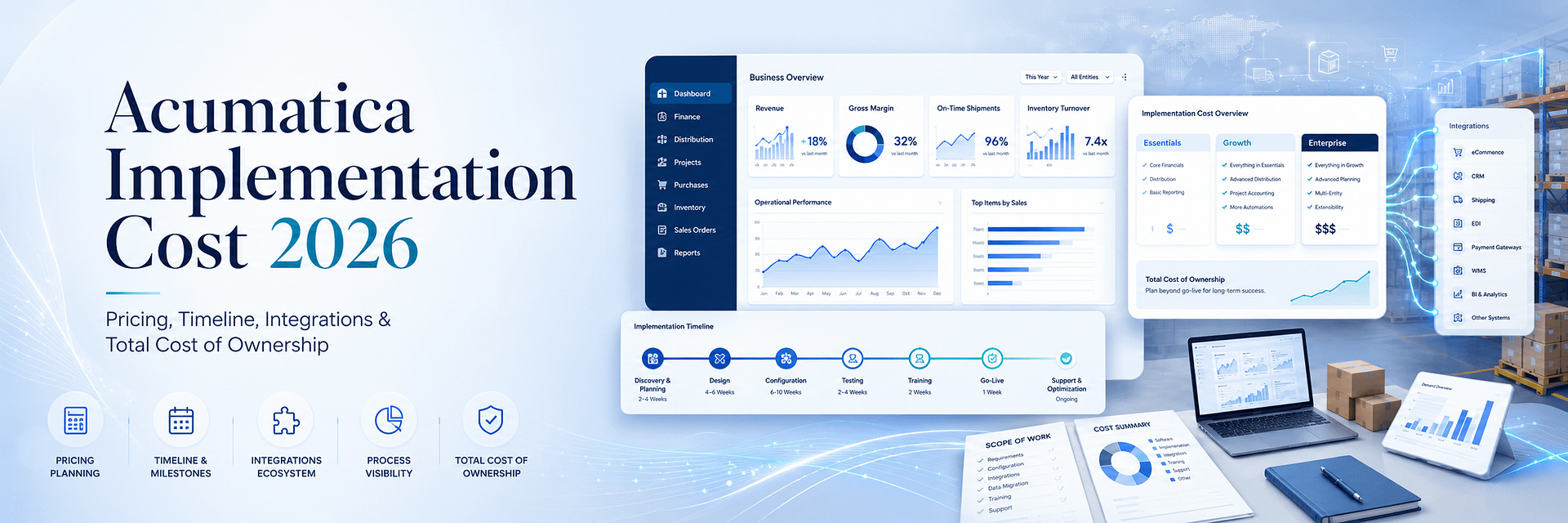
Acumatica Implementation Cost 2026: Pricing, Timeline, Integrations, and Total Cost of Ownership
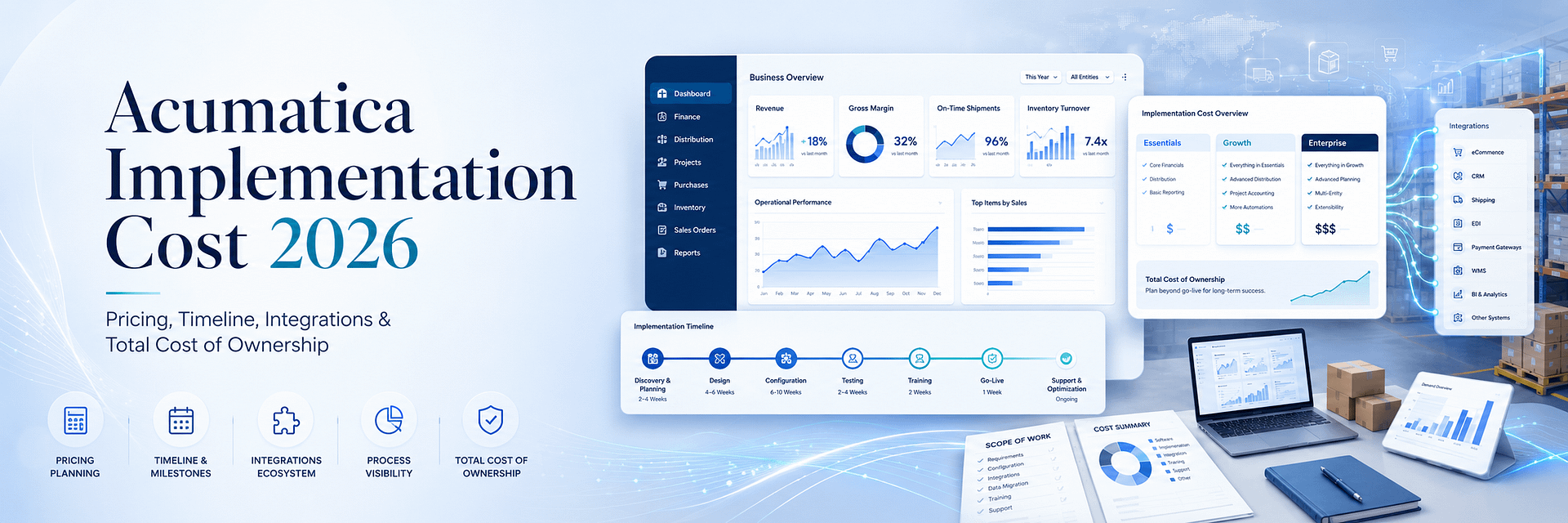
Acumatica Implementation Cost 2026: Pricing, Timeline, Integrations, and Total Cost of Ownership
“How much does Acumatica cost?” sounds like a simple question.
In practice, it is one of the most important and most frequently misunderstood questions in an ERP selection project.
There is no universal Acumatica implementation cost that applies equally to every company. A growing distributor with two warehouses, a manufacturer with production planning, a construction company with project accounting, and an eCommerce business processing thousands of marketplace orders may all use Acumatica Cloud ERP—but they will not require the same applications, integrations, data migration, customization, reporting, or implementation services.
That is why a reliable Acumatica pricing estimate cannot be created from employee count alone.
The complete cost depends on:
- the Acumatica applications and industry edition required;
- expected transaction volume and resource usage;
- deployment and licensing preferences;
- the number of companies, branches, warehouses, and operating entities;
- the complexity and quality of legacy data;
- the number and depth of external integrations;
- required workflows and customizations;
- reporting, dashboard, and analytics requirements;
- training and change management;
- testing, go-live, and post-implementation support.
A meaningful Acumatica ERP cost comparison must therefore separate software pricing from implementation pricing.
The Acumatica subscription or license gives the company access to the platform and selected applications. The implementation project makes that platform work inside the actual business. Data migration brings trusted operational and financial information into the new ERP. Integrations connect Acumatica to eCommerce, marketplaces, warehouses, payments, shipping platforms, CRM, EDI, and other systems. Training prepares employees to use the platform correctly. Ongoing support keeps the ERP stable and aligned with future business growth.
Each component affects the final Acumatica ERP budget.
As an Acumatica Gold Partner, BizTech helps companies build a complete implementation estimate rather than presenting an unrealistically low software-only number. Our team evaluates software scope, business processes, data migration, integrations, customization, testing, training, deployment, and support before defining the project plan.
The objective is not to produce the cheapest initial quote.
The objective is to create an Acumatica implementation that produces measurable business value and remains maintainable after go-live.
How Much Does Acumatica Cost in 2026?
Acumatica does not publish one universal list price for every customer.
According to the official Acumatica pricing model, pricing is tailored using three primary factors:
- The applications the business needs;
- Expected usage and resource requirements;
- Deployment and license preferences.
Acumatica also emphasizes an important distinction from seat-based ERP licensing:
Customers pay for the functionality and resources they need rather than purchasing a separate full ERP license for every user.
This makes Acumatica attractive to businesses that want broad ERP adoption across finance, sales, purchasing, warehouse teams, manufacturing, project management, customer service, executives, and other departments.
However, unlimited user access does not mean every Acumatica project has the same price.
The total cost still varies according to functional scope, transaction volume, storage, resource requirements, industry applications, integrations, customizations, implementation services, and support.
A complete Acumatica implementation estimate normally includes several separate categories.
| Cost category | What it covers | Typical cost type |
|---|---|---|
| Acumatica software | Applications, resource tier, data storage, deployment, and license model | Recurring or license-based |
| Implementation consulting | Discovery, process mapping, architecture, configuration, and project management | Primarily one-time |
| Data migration | Extraction, cleansing, mapping, import, validation, and reconciliation | One-time, sometimes phased |
| Integrations | eCommerce, marketplaces, payments, warehouses, shipping, CRM, EDI, and APIs | Implementation plus possible recurring support |
| Customization | Custom screens, fields, logic, actions, workflows, and enhancements | One-time development plus maintenance |
| Reporting and analytics | Financial reports, dashboards, Generic Inquiries, KPIs, and BI integrations | One-time and ongoing improvement |
| Training and change management | Role-based training, documentation, videos, workshops, and adoption support | Primarily one-time |
| Support and optimization | Monitoring, issue resolution, updates, enhancements, and performance improvement | Recurring |
The correct answer to “How much does Acumatica cost?” is therefore:
Acumatica cost is tailored to the software capabilities, technical resources, implementation services, and operational complexity required by the business.
A responsible Acumatica partner should explain every component separately.
Acumatica Software Cost vs. Acumatica Implementation Cost
One of the most common ERP budgeting mistakes is treating software and implementation as the same expense.
They are related, but they are not interchangeable.
Acumatica Software Cost
The software component covers access to Acumatica and the selected applications.
Depending on business requirements, applications may include:
- Financial Management;
- General Ledger;
- Accounts Payable;
- Accounts Receivable;
- Cash Management;
- Distribution Management;
- Inventory Management;
- Sales Order Management;
- Purchase Order Management;
- Warehouse Management;
- Manufacturing Management;
- Construction Management;
- Project Accounting;
- Field Service Management;
- CRM;
- Retail and Commerce functionality;
- Payroll;
- Reporting, dashboards, and analytics.
Software cost is also influenced by business usage, transaction volume, storage, resource requirements, and deployment preference.
Acumatica Implementation Cost
Implementation cost covers the professional work required to transform the Acumatica platform into a working business system.
This includes activities such as:
- business process discovery;
- requirements documentation;
- solution architecture;
- module configuration;
- company and branch setup;
- chart of accounts design;
- customer, vendor, item, and warehouse setup;
- data migration;
- integration development;
- customization;
- workflow automation;
- report and dashboard creation;
- testing;
- training;
- go-live preparation;
- post-go-live support.
A software quote without implementation scope is incomplete.
An implementation quote without clearly defined software scope is equally incomplete.
The two must be evaluated together.
The Complete Acumatica Total Cost Formula
The practical formula for evaluating Acumatica total cost of ownership is:
Acumatica software + implementation services + data migration + integrations + customization + reporting + training + support + third-party systems + internal project effort.
Businesses should analyze this formula over several years rather than evaluating only the initial implementation invoice.
A low first-year cost can become expensive if the system requires extensive corrective work, duplicate applications, manual processes, or repeated custom development.
A higher-quality implementation can create a lower total cost of ownership by reducing:
- manual data entry;
- duplicate software subscriptions;
- spreadsheet dependency;
- inventory errors;
- order processing delays;
- financial reconciliation effort;
- reporting delays;
- integration failures;
- support emergencies;
- future redevelopment.
The correct goal is not the lowest implementation invoice.
The correct goal is the strongest business value at a sustainable long-term cost.
What Determines Acumatica Licensing Cost?
The official Acumatica pricing structure uses three broad dimensions.
1. Applications and Functional Scope
The more business functions managed inside Acumatica, the broader the software scope.
A company implementing only core financials will have a different application profile from a company implementing financials, distribution, warehouse management, manufacturing, field service, project accounting, and commerce functionality.
Businesses should define which capabilities are:
- required for initial go-live;
- important for the next phase;
- valuable but not immediately necessary;
- already provided effectively by another integrated system.
This prevents the company from paying for unnecessary functionality while preserving a clear expansion roadmap.
2. Business Usage and Resource Requirements
Acumatica pricing reflects expected system use.
Relevant factors can include:
- transaction volume;
- number of sales and purchase documents;
- inventory movement volume;
- API activity;
- integration frequency;
- automation volume;
- data storage;
- file and document storage;
- processing intensity;
- future growth assumptions.
A high-volume eCommerce company importing thousands of orders and synchronizing inventory across multiple channels may require more resources than a professional services company with lower transaction volume.
3. Deployment and License Preferences
Deployment decisions can affect both software and operational cost.
The business may evaluate:
- Acumatica SaaS;
- private cloud deployment;
- partner-hosted environments;
- infrastructure and security requirements;
- backup and disaster recovery;
- internal IT management responsibilities;
- compliance and data-location requirements.
The right deployment decision should reflect operational requirements, risk tolerance, infrastructure capabilities, and long-term cost—not only the lowest initial price.
Why Unlimited User Pricing Changes the Cost Model
Acumatica’s unlimited user pricing philosophy is one of the most important components of its value proposition.
Many ERP systems charge according to the number or type of user licenses. That can cause companies to limit ERP access in order to control cost.
Limiting access often creates operational problems:
- employees rely on shared accounts;
- some departments remain outside the ERP;
- users request exported spreadsheets instead of accessing live data;
- approvals are delayed;
- management depends on intermediaries;
- data becomes incomplete;
- the ERP fails to become the company’s true system of record.
Acumatica’s model allows the business to focus more on usage and functionality than seat count.
This can be especially valuable for:
- warehouse operations with many occasional users;
- construction companies with field and project teams;
- manufacturers with supervisors and shop-floor users;
- distributors with sales, purchasing, warehouse, and customer service teams;
- organizations with many executives and report consumers;
- businesses expecting rapid employee growth.
Unlimited user access does not eliminate every cost. Training, support, security design, and resource requirements may still grow as more people use the platform.
However, it reduces the direct commercial penalty for expanding participation.
That can improve user adoption and ERP return on investment.
What Determines Acumatica Implementation Cost?
The largest implementation cost drivers are normally business complexity, data complexity, integration scope, and organizational readiness.
Number of Companies and Branches
A single-company implementation is usually simpler than an environment involving:
- multiple legal entities;
- multiple branches;
- intercompany transactions;
- consolidated reporting;
- multiple currencies;
- different tax structures;
- shared customers, vendors, or inventory;
- different operational processes by entity.
Each additional entity can affect configuration, migration, testing, security, reporting, and training.
Industry and Operational Complexity
A financial-only implementation generally has a different scope from:
- multi-warehouse distribution;
- discrete manufacturing;
- construction project accounting;
- field service operations;
- high-volume retail and eCommerce;
- complex recurring billing;
- consignment inventory;
- configurable kit processing;
- EDI retail networks.
Industry complexity affects design, configuration, testing, integration, and training.
Data Quality and Migration History
Clean master data with a limited amount of history is less expensive to migrate than:
- multiple legacy databases;
- duplicate customer records;
- inconsistent item identifiers;
- unreconciled financial balances;
- missing warehouse information;
- poor address quality;
- custom legacy fields;
- many years of detailed transactional history.
Data migration cost often reflects the condition of the data more than its raw file size.
Number of Integrations
Every external system adds architecture, mapping, testing, monitoring, and support requirements.
A simple one-direction customer export is different from a complete integration synchronizing:
- orders;
- customers;
- products;
- prices;
- inventory;
- payments;
- taxes;
- shipments;
- tracking;
- returns;
- refunds.
Customization Requirements
Standard configuration is generally more efficient to maintain than custom code.
Implementation cost increases when the business requires:
- custom screens;
- specialized document types;
- new business logic;
- complex approval processes;
- special inventory behavior;
- industry-specific compliance;
- custom processing actions;
- advanced automation.
Reporting and Analytics
Reporting cost depends on whether the company needs:
- standard financial statements;
- custom financial reports;
- Generic Inquiries;
- executive dashboards;
- operational KPIs;
- profitability analysis;
- multi-entity consolidation;
- Power BI or Tableau integration;
- custom data models.
Internal Team Availability
ERP implementation requires decisions from the client.
If internal subject matter experts are unavailable, approvals and testing may be delayed. Delays increase project management effort and can expand cost.
The client should assign clear process owners for finance, sales, purchasing, inventory, warehouse operations, manufacturing, projects, integrations, and reporting.
Acumatica Implementation Cost by Project Type
There is no reliable universal price for each project type, but businesses can compare relative scope and complexity.
| Project type | Typical scope | Relative complexity | Major cost drivers |
|---|---|---|---|
| Core financial implementation | GL, AP, AR, Cash Management, basic reporting | Lower to moderate | Chart of accounts, opening balances, reporting, entities |
| Distribution implementation | Financials, sales orders, purchasing, inventory, warehouses | Moderate to high | Items, warehouses, pricing, replenishment, shipping, EDI |
| Manufacturing implementation | Financials, distribution, BOMs, production, costing, planning | High | Production data, routing, costing, materials, shop-floor workflows |
| Construction implementation | Financials, projects, job costing, commitments, billing, field workflows | High | Project structure, change orders, payroll, documents, field adoption |
| Commerce-heavy implementation | ERP plus online stores, marketplaces, payments, fulfillment, returns | Moderate to very high | Channel count, order volume, inventory rules, refunds, integrations |
| Multi-entity transformation | Multiple companies, branches, currencies, integrations, consolidation | Very high | Governance, migration, intercompany logic, security, reporting |
The table should be used for planning, not as a substitute for discovery.
Two projects in the same industry can still have significantly different costs.
Acumatica Data Migration Cost
Data migration is often one of the most underestimated components of Acumatica implementation pricing.
The business is not simply moving files. It is creating the operational and financial foundation of the new ERP.
A complete migration may include:
- customers;
- vendors;
- contacts;
- inventory items;
- non-stock items;
- warehouses and locations;
- price lists;
- opening general ledger balances;
- open accounts receivable documents;
- open accounts payable documents;
- unreconciled payments;
- open sales orders;
- open purchase orders;
- projects;
- fixed assets;
- historical transactions;
- attachments and supporting documents.
Factors That Increase Acumatica Data Migration Cost
Migration becomes more expensive when:
- data comes from several systems;
- records contain duplicates;
- legacy fields do not map cleanly to Acumatica;
- historical transactions must remain fully searchable;
- financial balances are not reconciled;
- inventory quantities are unreliable;
- item units of measure are inconsistent;
- custom legacy tables must be preserved;
- multiple test migrations are required;
- the final cutover window is very short.
How to Reduce Acumatica Migration Cost
Businesses can reduce migration effort by:
- removing inactive and duplicate records before extraction;
- standardizing customer and vendor addresses;
- cleaning item IDs and descriptions;
- reconciling financial balances before migration;
- deciding which history genuinely needs to move;
- assigning internal data owners;
- approving field mappings early;
- performing at least one full test migration;
- validating imported totals before go-live.
BizTech’s Acumatica data migration process can include extraction, cleansing, mapping, import, validation, reconciliation, user review, and final production cutover.
Acumatica Integration Cost
Integrations can be a small part of the project or the most complex part of the entire implementation.
The cost depends on what the integration must accomplish.
Simple Integration
A simple integration may:
- move one entity in one direction;
- run on a schedule;
- use standard identifiers;
- require limited transformation;
- have low transaction volume.
Complex Integration
A complex integration may:
- synchronize data in both directions;
- process events in near real time;
- support many stores or accounts;
- transform data between different business models;
- manage inventory across warehouses;
- handle payments and refunds;
- create shipments and tracking updates;
- support retries and exception queues;
- maintain detailed logs and audit history;
- process high transaction volumes.
Major Acumatica Integration Cost Drivers
Integration pricing is affected by:
- number of connected platforms;
- number of connected accounts or stores;
- number of synchronized entities;
- one-way or bidirectional synchronization;
- scheduled, batch, or webhook-based processing;
- transaction volume;
- field transformation;
- cross-reference requirements;
- duplicate prevention;
- error handling and retries;
- logging and alerting;
- security and authentication;
- testing environments;
- ongoing monitoring and support.
Existing BizTech Connector vs. Custom Acumatica Integration
Using an existing integration product can reduce implementation time and risk compared with developing every workflow from the beginning.
BizTech has developed proprietary Acumatica solutions for commerce, marketplaces, payments, warehousing, shipping, CRM, and specialized inventory workflows.
Examples include:
- Amazon FBA and FBM Connector;
- Shopify Connector;
- WooCommerce Connector;
- Magento Connector;
- PayPal Integration;
- ShipHero Connector;
- ShipStation Connector;
- DSCO Connector;
- CommerceHub Connector;
- ServiceTitan Connector;
- Salesforce Integration;
- EDI integrations;
- Kit Processing;
- Consignment Processing;
- Gift Card Processing.
An existing connector may still require configuration, mapping, testing, training, and client-specific adjustments.
However, it begins with a proven functional foundation.
Custom integration development may be necessary when:
- the external platform is proprietary;
- the required workflows are highly specialized;
- standard connectors do not support the required entities;
- the business has unique inventory or financial rules;
- several systems must be orchestrated together;
- the integration requires unusual security or infrastructure.
BizTech can evaluate whether an existing connector, connector extension, middleware approach, or fully custom integration is the most economical long-term option.
Amazon Acumatica Integration Cost
Amazon integrations can involve both Fulfillment by Merchant and Fulfillment by Amazon.
The implementation scope may include:
- Amazon store configuration;
- order import;
- FBA and FBM identification;
- customer rules;
- item cross-references;
- payment mapping;
- tax mapping;
- warehouse mapping;
- PO acknowledgments;
- fulfillment exports;
- tracking updates;
- inventory synchronization;
- FBA warehouse transfers;
- refund processing;
- profitability reporting.
The Amazon Acumatica integration cost depends on the number of marketplaces, stores, fulfillment models, warehouses, products, order volume, mapping rules, and reporting requirements.
A seller using one Amazon store with standard FBM workflows will have a different scope from a global seller using several marketplaces, FBA transfers, multi-warehouse inventory, and detailed channel profitability reporting.
Shopify Acumatica Integration Cost
A Shopify integration may include:
- Shopify credentials and store configuration;
- B2C or B2B workflows;
- customer import;
- item and variant synchronization;
- product images and attributes;
- Shopify metafields;
- order import;
- payment mapping;
- Shopify location and Acumatica warehouse mapping;
- inventory synchronization;
- fulfillment updates;
- refund webhooks;
- order export from Acumatica to Shopify.
The Shopify Acumatica integration cost increases with store count, catalog complexity, B2B functionality, inventory rules, product mapping, custom metafields, and bidirectional order workflows.
WooCommerce Acumatica Integration Cost
The WooCommerce Acumatica integration cost may include:
- WordPress and WooCommerce API setup;
- product synchronization;
- customer synchronization;
- order import;
- tax category mapping;
- category synchronization;
- price and MSRP handling;
- warehouse quantity logic;
- shipping method mapping;
- fulfillment and tracking events;
- high-volume REST API processing.
Cost is influenced by catalog size, variation complexity, store customization, plugins, warehouse structure, data quality, and order volume.
PayPal Acumatica Integration Cost
A PayPal integration may support:
- PayPal invoice creation from Acumatica;
- customer email delivery;
- payment status synchronization;
- batch payment processing;
- cancellation of unpaid requests;
- full and partial refunds;
- transaction history;
- deposit and installment workflows;
- guest checkout.
The PayPal Acumatica integration cost depends on payment workflows, refund requirements, number of entities, currency handling, reconciliation design, security, and reporting.
Acumatica Customization Cost
Customization cost should be evaluated according to the simplest maintainable method that solves the business requirement.
There are several levels.
Level 1: Standard Configuration
This may include:
- system preferences;
- numbering sequences;
- order types;
- approval settings;
- notification templates;
- security roles;
- warehouse settings;
- financial periods;
- tax configuration.
Standard configuration usually creates the lowest long-term maintenance cost.
Level 2: No-Code and Low-Code Changes
This may include:
- custom fields;
- screen layouts;
- Generic Inquiries;
- dashboards;
- workflow adjustments;
- import and export scenarios;
- business events;
- notifications.
Level 3: Acumatica Customization Project
This may include:
- custom screens;
- new processing actions;
- specialized validations;
- custom data access classes;
- document automation;
- special inventory behavior;
- new business logic;
- industry-specific functionality.
Level 4: Custom Product or Integration
This may include:
- multi-system orchestration;
- proprietary API integration;
- complex external workflows;
- custom portals;
- specialized processing engines;
- high-volume synchronization services.
Customization cost depends on analysis, development, testing, documentation, deployment, support, and future upgrade compatibility.
BizTech follows a configuration-first approach:
- use standard Acumatica functionality when it fits;
- use configuration and workflow tools when possible;
- use integration when another system already solves the problem well;
- write custom code when it creates clear and sustainable business value.
Acumatica Reporting and Dashboard Cost
Reporting is often underestimated during initial ERP budgeting.
Companies may assume that standard reports will answer every management question. After discovery, they often identify requirements for:
- custom income statements;
- departmental reporting;
- multi-entity consolidation;
- cash-flow reporting;
- inventory aging;
- warehouse performance;
- sales margins;
- project profitability;
- manufacturing variance;
- channel profitability;
- customer payment status;
- integration exceptions;
- executive KPIs.
Reporting cost is influenced by:
- number of reports;
- data sources;
- calculation complexity;
- drill-down requirements;
- security by role or branch;
- real-time or scheduled refresh;
- external BI tools;
- historical data requirements.
A well-designed reporting scope should prioritize decision-making needs rather than recreating every legacy report.
Acumatica Training Cost and User Adoption
Training is not optional.
A technically successful implementation can still fail when users:
- do not understand the new workflow;
- continue using spreadsheets;
- enter incomplete data;
- avoid dashboards;
- do not know how to handle exceptions;
- depend on one internal expert for every task.
Training scope may include:
- administrator training;
- finance training;
- sales order training;
- purchasing training;
- inventory and warehouse training;
- manufacturing training;
- project or construction training;
- reporting and dashboard training;
- integration monitoring;
- role-specific documentation;
- recorded enablement videos;
- post-go-live office hours.
Acumatica’s unlimited user model can support broad participation, but the company must still budget for role-based education and change management.
The cost of training is usually lower than the cost of poor adoption.
Acumatica Support Cost
Acumatica ERP continues evolving after go-live.
Businesses may require:
- incident response;
- user assistance;
- integration monitoring;
- performance optimization;
- security updates;
- patch management;
- backup review;
- new dashboards;
- workflow adjustments;
- new integrations;
- release testing;
- customization maintenance;
- capacity planning.
Support may be structured as:
- hourly support;
- prepaid service blocks;
- monthly maintenance plans;
- SLA-backed managed support;
- project-based enhancement work.
The appropriate support model depends on system criticality, integration count, internal expertise, transaction volume, and response-time expectations.
BizTech offers post-implementation monitoring, issue resolution, performance optimization, feature updates, and long-term maintenance options.
How Long Does Acumatica Implementation Take?
There is no universal implementation timeline.
BizTech publicly notes that many standard configurations and connector projects can be completed in approximately two to four weeks, while broader implementations or advanced customization projects may require approximately six to ten weeks.
Acumatica’s broader ERP guidance notes that complete ERP programs across the market often take approximately six months to one year from planning through a fully operational environment.
These statements are not contradictory.
They describe different project scopes.
A connector deployment using an established BizTech product is different from a complete multi-entity ERP transformation involving financials, distribution, manufacturing, data migration, integrations, training, and phased rollout.
Timeline depends on:
- functional scope;
- company size;
- number of entities;
- data quality;
- integration complexity;
- custom development;
- reporting requirements;
- client decision speed;
- testing;
- training;
- go-live strategy.
Common Acumatica Go-Live Strategies
Big Bang: all required modules and business units move to Acumatica at one time.
Phased Rollout: modules, locations, entities, or departments move in controlled stages.
Parallel Operation: Acumatica and the legacy system run simultaneously for a defined period.
A phased implementation may spread cost over time and reduce operational risk, but it requires careful coordination and temporary cross-system processes.
How Timeline Affects Acumatica Implementation Cost
A shorter timeline does not always mean a lower cost.
Accelerated projects may require:
- more consultants working simultaneously;
- faster client decisions;
- compressed testing;
- additional project management;
- weekend or after-hours cutover;
- temporary workarounds;
- limited opportunity for process redesign.
A timeline that is too long also creates cost:
- extended project management;
- repeated requirement reviews;
- staff turnover;
- changing business requirements;
- duplicate work in old and new systems;
- loss of project momentum.
The best timeline is realistic, milestone-based, and supported by available client resources.
Hidden Acumatica Implementation Costs Businesses Often Miss
A strong ERP budget should include costs beyond software and consulting invoices.
Internal Employee Time
Executives, finance teams, warehouse managers, buyers, sales leaders, IT staff, and subject matter experts must participate in discovery, design, migration, testing, and training.
Their time is part of the total project cost.
Data Cleansing
Legacy data may require extensive internal review before migration.
Process Documentation
Undocumented workflows often require interviews, workshops, and validation before configuration can begin.
Third-Party Software
The final environment may include:
- tax applications;
- shipping platforms;
- EDI providers;
- payment gateways;
- BI software;
- document management;
- specialized industry applications.
Integration Monitoring
APIs and connectors require monitoring, exception management, and occasional updates.
Parallel Operations
Running two ERP systems simultaneously can create duplicate work and extended legacy software fees.
Change Requests
New requirements identified after scope approval may increase cost and timeline.
Post-Go-Live Optimization
Some improvements should intentionally occur after users gain real production experience.
Upgrade and Release Testing
Customizations and integrations should be tested against future Acumatica releases.
Change Management
Communication, training, internal leadership, and adoption support require time and resources.
Why the Cheapest Acumatica Quote Can Become the Most Expensive
A low-cost proposal may exclude important work.
Common exclusions include:
- data cleansing;
- historical migration;
- integration error handling;
- custom reporting;
- user acceptance testing;
- training documentation;
- post-go-live support;
- project management;
- upgrade compatibility;
- performance monitoring.
When these omissions become visible later, the business may need to pay for:
- architecture redesign;
- repeat migration;
- integration redevelopment;
- corrective reporting;
- emergency support;
- additional training;
- delayed go-live;
- extended legacy system operation.
The lowest initial quote is not necessarily the lowest total cost.
Businesses should compare proposals according to scope, deliverables, assumptions, exclusions, testing, training, and support—not only the final number.
How to Reduce Acumatica Implementation Cost Without Damaging the Project
Cost control should remove waste, not quality.
Complete Discovery Before Configuration
Clear requirements reduce rework.
Prioritize Requirements
Separate requirements into:
- mandatory for go-live;
- important for the next phase;
- optional improvements;
- legacy processes that should be eliminated.
Use Standard Acumatica Functionality First
Configuration is usually easier to maintain than custom development.
Clean Data Early
Data cleansing performed before migration reduces consultant effort and testing failures.
Use Existing BizTech Connectors
A proven connector may reduce custom development and implementation risk.
Assign Internal Process Owners
Fast and informed client decisions keep the project moving.
Implement in Phases When Appropriate
A phased roadmap can prioritize the highest-value capabilities and defer optional enhancements.
Define Reports Early
Reporting requirements affect data structures, workflows, and integrations.
Test Complete Business Scenarios
End-to-end testing reduces expensive production corrections.
Train by Role
Focused role-based training is more effective than generic system demonstrations.
Establish Change Control
Every proposed addition should be evaluated for business value, cost, timeline, and maintenance impact.
Acumatica Total Cost of Ownership
A complete Acumatica TCO analysis should cover the full ownership period.
| Cost area | Initial year | Ongoing years |
|---|---|---|
| Software | Subscription or license setup | Renewal, resources, storage, added applications |
| Implementation | Discovery, configuration, migration, testing, training | Normally limited after stabilization |
| Integrations | Setup, mapping, testing, deployment | Monitoring, API changes, new features |
| Customization | Initial development | Maintenance, release testing, enhancements |
| Support | Go-live stabilization | Managed support and optimization |
| Internal labor | Heavy project participation | Administration, process ownership, training |
A complete TCO analysis should also subtract expected savings and productivity gains.
How to Calculate Acumatica ROI
Acumatica return on investment should be evaluated against measurable operational outcomes.
Possible ROI categories include:
Reduced Manual Data Entry
Measure employee hours spent entering orders, payments, shipments, inventory adjustments, and financial data before and after implementation.
Faster Financial Close
Measure the number of days and employee hours required to close each period.
Improved Inventory Accuracy
Measure stock adjustments, write-offs, overselling, emergency purchasing, and lost sales.
Faster Order Processing
Measure order cycle time from receipt to shipment and invoice.
Lower Software Duplication
Identify legacy tools, spreadsheets, databases, reporting applications, and integration services that can be retired.
Improved User Adoption
Evaluate whether more employees can access live ERP data without additional seat-based licensing.
Reduced Integration Failures
Measure manual corrections, delayed orders, missing tracking, duplicate customers, and reconciliation work.
Better Margin Visibility
Evaluate whether leadership can identify profitability by product, customer, channel, project, or warehouse.
Scalability Without Equivalent Headcount Growth
Measure transaction growth relative to administrative staffing.
The strongest Acumatica ROI model uses company-specific operational data rather than generic industry assumptions.
How BizTech Builds an Acumatica Implementation Estimate
BizTech does not calculate implementation cost from one generic questionnaire.
A useful estimate requires structured discovery.
Step 1: Business Profile
BizTech reviews:
- industry;
- revenue and transaction profile;
- legal entities;
- branches;
- warehouses;
- sales channels;
- current systems;
- growth plans.
Step 2: Functional Scope
We identify the required Acumatica applications and modules.
Step 3: Process Mapping
We review order-to-cash, procure-to-pay, record-to-report, inventory, warehouse, production, project, service, and commerce workflows.
Step 4: Data Migration Assessment
We evaluate data sources, record volume, quality, history, mapping, and reconciliation requirements.
Step 5: Integration Inventory
We identify all eCommerce platforms, marketplaces, payment systems, warehouses, CRM tools, EDI providers, shipping systems, BI tools, and proprietary applications.
Step 6: Customization Assessment
We determine which requirements can be handled through standard Acumatica, configuration, existing BizTech products, or custom development.
Step 7: Reporting and Dashboard Scope
We identify financial, operational, executive, and compliance reporting requirements.
Step 8: Training and Change Management
We define user groups, documentation, training sessions, videos, and go-live support.
Step 9: Testing and Deployment
We define test cycles, user acceptance testing, migration rehearsals, go-live strategy, and stabilization support.
Step 10: Ongoing Support Plan
We identify monitoring, maintenance, response-time, and future enhancement requirements.
The resulting estimate should clearly separate:
- software;
- implementation;
- migration;
- integrations;
- customization;
- reporting;
- training;
- support;
- assumptions;
- exclusions.
Information Needed for an Acumatica Implementation Quote
A company can prepare for an estimate by collecting the following information:
- current ERP and accounting systems;
- number of legal entities and branches;
- number of warehouses and locations;
- required currencies and tax jurisdictions;
- current transaction volume;
- expected growth;
- required Acumatica modules;
- legacy data sources;
- historical data requirements;
- external integrations;
- custom workflows;
- reporting requirements;
- number and roles of users;
- desired go-live date;
- internal project team availability;
- support requirements.
Better input produces a more reliable estimate.
Questions to Ask Before Accepting an Acumatica Quote
Businesses should ask:
- Which Acumatica applications are included?
- What resource level is assumed?
- Which deployment model is included?
- Which implementation phases are covered?
- How much data history will be migrated?
- Are data cleansing and reconciliation included?
- Which integrations are included?
- Does integration scope include refunds, errors, retries, and monitoring?
- Which reports and dashboards are included?
- How many training sessions are included?
- Who is responsible for user acceptance testing?
- What support is included after go-live?
- How are change requests priced?
- What assumptions could change the cost?
- How will customizations be tested against upgrades?
A transparent quote should make these answers clear.
Why Work with BizTech for Acumatica Implementation?
BizTech is an Acumatica Gold Partner specializing in ERP implementation, customization, integrations, data migration, reporting, automation, training, testing, and support.
BizTech’s website reports more than 500 successful integrations and experience serving businesses across more than 35 countries.
Our main advantage is the combination of functional ERP expertise and product development.
BizTech does not only configure Acumatica.
We also build solutions that extend Acumatica into:
- eCommerce;
- marketplaces;
- payments;
- warehouse fulfillment;
- shipping;
- retail networks;
- CRM;
- EDI;
- custom inventory processes;
- industry-specific workflows.
This creates one accountable partner relationship for implementation and integration.
BizTech can help businesses:
- define ERP strategy;
- calculate software and implementation scope;
- configure Acumatica;
- migrate and reconcile data;
- deploy existing connectors;
- build custom integrations;
- develop specialized functionality;
- create dashboards and reports;
- train users;
- support the system after go-live.
Is Acumatica Worth the Cost?
Acumatica can be a strong investment for businesses that have outgrown disconnected accounting, inventory, order, warehouse, project, and eCommerce systems.
The platform is especially valuable when the company needs:
- one source of financial and operational truth;
- broader user access;
- multi-warehouse inventory visibility;
- automated purchasing and order management;
- manufacturing or construction functionality;
- eCommerce and marketplace integration;
- payment synchronization;
- real-time dashboards;
- workflow automation;
- open APIs and custom integration;
- a scalable midmarket ERP platform.
Acumatica may not be worth the investment if the business is unwilling to assign internal process owners, clean its data, test workflows, train users, or change inefficient legacy processes.
ERP value does not come from software alone.
It comes from combining the platform, implementation partner, internal team, and operational discipline.
Final Conclusion: Understanding Acumatica Implementation Cost
There is no honest universal answer to the question:
“How much does Acumatica cost?”
The software price depends on applications, usage, resources, and deployment preferences.
The implementation cost depends on business scope, data, integrations, customization, reporting, training, testing, timeline, and support.
A complete Acumatica budget may include:
- Acumatica software;
- implementation consulting;
- data migration;
- system integrations;
- custom development;
- reports and dashboards;
- training;
- go-live support;
- ongoing optimization.
The correct objective is not finding the smallest proposal.
The objective is understanding the total investment required to build a reliable, scalable, and maintainable ERP system.
Acumatica’s unlimited user philosophy can make the platform especially attractive for growing companies because it supports broad adoption without charging a separate full license for every user.
Its open APIs, cloud architecture, industry applications, workflows, dashboards, and customization tools also make Acumatica a strong foundation for connected business operations.
As an Acumatica Gold Partner, BizTech helps companies calculate the complete scope before implementation begins.
We combine:
- Acumatica consulting;
- ERP configuration;
- data migration;
- customization;
- eCommerce integration;
- marketplace automation;
- payment integration;
- warehouse connectivity;
- reporting;
- training;
- support.
For companies searching for:
- Acumatica Implementation Cost;
- Acumatica Pricing 2026;
- Acumatica ERP Pricing;
- How Much Does Acumatica Cost;
- Acumatica Implementation Estimate;
- Acumatica Data Migration Cost;
- Acumatica Integration Cost;
- Acumatica Customization Cost;
- Acumatica Total Cost of Ownership;
- Acumatica Gold Partner;
- BizTech Acumatica Implementation;
the next step is a structured discovery and scope assessment.
Acumatica provides the platform.
BizTech helps determine what it will take to make that platform work for your business.
FAQ: Acumatica Pricing and Implementation Cost
How much does Acumatica cost?
Acumatica does not have one universal public price. Software cost is tailored according to the applications required, expected business usage and resource requirements, and deployment or license preferences.
Does Acumatica charge per user?
Acumatica promotes unlimited user access and pricing based on functionality and resource consumption rather than purchasing a separate full ERP seat for every user.
How much does Acumatica implementation cost?
Implementation cost depends on functional scope, companies, branches, warehouses, data migration, integrations, customization, reporting, training, testing, and support. A discovery process is required for a reliable estimate.
Is Acumatica software included in implementation cost?
Software and implementation are normally separate cost categories. The software provides access to Acumatica applications and resources. Implementation covers consulting, configuration, migration, integration, training, testing, and deployment.
How long does Acumatica implementation take?
Timelines vary significantly. Standard connector and configuration projects may take several weeks. Broader ERP implementations may require several months depending on functional scope, data, integrations, customization, testing, and organizational readiness.
How much does Acumatica data migration cost?
Data migration cost depends on the number of source systems, record volume, data quality, required history, custom fields, reconciliation, and the number of migration rehearsals.
Are Acumatica integrations included in the software price?
Some standard commerce capabilities may be available through Acumatica applications, but third-party connectors, partner solutions, custom configuration, integration development, mapping, and support may involve separate costs.
How much does an Acumatica API integration cost?
API integration cost depends on the number of entities, synchronization direction, transaction volume, frequency, mapping, transformation, authentication, errors, retries, monitoring, and testing.
How much does Acumatica customization cost?
Customization cost depends on whether the requirement can be solved through configuration, low-code tools, workflow changes, a customization project, or custom product development. Custom code should be used only when it creates clear maintainable value.
What is included in Acumatica total cost of ownership?
Acumatica TCO may include software, implementation, migration, integrations, customizations, reporting, training, third-party applications, support, infrastructure, internal project effort, and ongoing optimization.
Is Acumatica expensive for a small business?
The answer depends on operational complexity. Acumatica is typically considered by growing businesses that need more functionality than basic accounting software. Its unlimited user pricing philosophy may make it attractive to organizations that need broad access across departments.
Is Acumatica cheaper than NetSuite, SAP, Microsoft Dynamics 365, or Epicor?
The answer depends on modules, users, resource consumption, implementation scope, integrations, and support. Acumatica’s non-seat-based pricing philosophy can be advantageous for organizations with many users, but a complete TCO comparison is required.
Can Acumatica be implemented in phases?
Yes. A phased implementation can introduce Acumatica by module, location, entity, or business function. This may reduce immediate scope and risk, although integration and cross-system coordination must be planned carefully.
Can BizTech provide an Acumatica implementation quote?
Yes. BizTech can assess business processes, required modules, data migration, integrations, customization, reporting, training, timeline, and support to develop a structured Acumatica implementation estimate.
Why choose BizTech for Acumatica implementation?
BizTech is an Acumatica Gold Partner combining ERP consulting, implementation, data migration, custom development, proprietary connectors, eCommerce integration, marketplace automation, warehouse connectivity, payment integration, reporting, training, and post-go-live support.
[/vc_column_text][/vc_column][/vc_row]
How to Choose an Acumatica Implementation Partner: Why Businesses Work with BizTech
How to Choose an Acumatica Implementation Partner: Why Businesses Work with BizTech
Choosing Acumatica Cloud ERP is an important strategic decision. Choosing the right Acumatica implementation partner may be even more important.
ERP software does not create business value simply because it has been purchased, licensed, or installed. Real value appears only when the ERP system reflects how the company actually operates: how it sells, purchases, receives inventory, manages warehouses, fulfills orders, invoices customers, processes payments, controls projects, analyzes profitability, and connects with outside platforms.
That is why an Acumatica ERP implementation should never be treated as a basic software installation.
A successful implementation requires business analysis, solution architecture, system configuration, data migration, customization, API integration, testing, user training, reporting, workflow automation, go-live preparation, and long-term support. It also requires an implementation team that understands both Acumatica technology and the operational reality behind the technology.
This is where the choice of an Acumatica Gold Partner becomes critical.
BizTech Services is an Acumatica Gold Partner and business technology consulting company specializing in Acumatica implementation, Acumatica integration, Acumatica customization, ERP automation, reporting, data management, eCommerce connectivity, marketplace integration, warehouse integration, payment workflows, and custom Acumatica solutions.
BizTech does more than configure standard Acumatica modules. Our team designs and develops proprietary Acumatica enhancements and connectors that solve operational problems not always covered by a standard ERP deployment.
Our Acumatica solutions include integrations and enhancements for:
- Amazon FBA and FBM;
- Shopify;
- WooCommerce and WordPress;
- Magento;
- PayPal;
- ShipHero;
- ShipStation;
- DSCO;
- CommerceHub;
- ServiceTitan;
- Salesforce;
- EDI workflows;
- Gift Card Processing;
- Kit Processing;
- Consignment Processing;
- custom warehouse, commerce, payment, and fulfillment processes.
This combination of ERP consulting and product development is what makes BizTech different from an implementation company that only deploys standard configuration.
We understand Acumatica as both an ERP product and a development platform.
For businesses searching for an Acumatica implementation partner, Acumatica Gold Partner, Acumatica VAR, Acumatica consultant, Acumatica integration company, or Acumatica custom development partner, this distinction matters.
The right partner should not merely make Acumatica available. The right partner should make Acumatica work for your business.
Why the Acumatica Implementation Partner Matters as Much as the ERP
Acumatica is a flexible, modern, and highly extensible cloud ERP platform. That flexibility creates significant opportunities, but it also means implementation decisions have long-term consequences.
Two companies can license the same Acumatica modules and achieve completely different outcomes.
One company may gain:
- accurate inventory visibility;
- faster order processing;
- automated purchasing workflows;
- real-time financial dashboards;
- integrated eCommerce operations;
- reliable warehouse synchronization;
- clean data and trusted reports;
- strong user adoption;
- scalable operating processes.
Another company may end up with:
- duplicate data;
- poorly mapped business processes;
- manual workarounds;
- unreliable reports;
- incomplete integrations;
- users returning to spreadsheets;
- expensive corrective development;
- an ERP system that never becomes the real source of truth.
The difference is often not Acumatica itself.
The difference is implementation quality.
A qualified Acumatica ERP implementation partner should understand how to translate operational requirements into:
- Acumatica modules;
- branches and companies;
- financial structures;
- order types;
- inventory policies;
- warehouse configurations;
- approval workflows;
- security roles;
- custom screens;
- automation rules;
- dashboards and reports;
- API connections;
- customization projects;
- external integration architecture.
This is why businesses should evaluate the implementation partner with the same seriousness as the ERP platform.
Acumatica provides the foundation. The implementation partner determines how effectively that foundation supports the business.
Acumatica Implementation Is Not the Same as Software Installation
A software installation is technical.
An ERP implementation is organizational.
Installing software means publishing packages, creating environments, configuring access, and activating functionality. Implementing ERP means redesigning how information and work move through the company.
A complete Acumatica implementation process may affect:
- financial management;
- accounts payable;
- accounts receivable;
- cash management;
- sales order management;
- purchase order management;
- inventory control;
- warehouse operations;
- manufacturing;
- distribution;
- project accounting;
- field service;
- construction management;
- CRM;
- customer service;
- eCommerce;
- marketplace operations;
- payments and reconciliation;
- reporting and analytics.
That is why a strong Acumatica implementation begins before anyone configures the system.
It begins with discovery.
The implementation partner must understand:
- how the business operates today;
- which processes should remain;
- which processes should change;
- where manual work creates errors;
- which systems must be integrated;
- which reports leadership requires;
- which users need access;
- which controls and approvals are required;
- how the company expects to grow.
Without this work, ERP configuration becomes guesswork.
BizTech approaches Acumatica ERP implementation as a business transformation project, not a package installation.
Why Work with an Acumatica Gold Partner?
An Acumatica Gold Partner is not simply a company that knows how to navigate Acumatica screens. The Gold Partner relationship indicates a serious and established commitment to the Acumatica ecosystem, customer delivery, technical expertise, and long-term ERP success.
For a customer, working with an Acumatica Gold Partner provides several practical advantages.
Deeper Acumatica Platform Experience
An experienced Acumatica Gold Partner understands standard functionality, industry editions, customization projects, APIs, webhooks, reporting tools, workflows, security, integrations, and upgrade considerations.
This matters because many ERP requirements cross multiple functional areas.
An inventory decision may affect order processing, purchasing, accounting, eCommerce availability, warehouse execution, and financial reporting. An implementation partner must understand those relationships before changing the system.
Access to Acumatica Resources and Ecosystem Knowledge
A Gold Partner operates within the Acumatica partner ecosystem and stays aligned with platform changes, releases, development practices, implementation standards, and technical resources.
That helps reduce the risk of creating customizations that work temporarily but become difficult to support later.
Long-Term Implementation Accountability
ERP is not finished at go-live.
Companies continue adding users, business units, products, warehouses, channels, integrations, reports, and automation. A serious Acumatica partner should support this evolution.
BizTech provides implementation, integration, customization, training, optimization, and ongoing Acumatica support as parts of one long-term relationship.
Ability to Handle Standard and Non-Standard Requirements
Many businesses need more than standard ERP configuration.
They may require:
- custom API integrations;
- marketplace automation;
- special payment workflows;
- warehouse synchronization;
- industry-specific extensions;
- custom reports and dashboards;
- external data exchange;
- custom order processing;
- specialized inventory behavior.
BizTech’s ability to build proprietary Acumatica solutions makes it possible to support these requirements without forcing the business into an unsuitable generic process.
Who Should Implement Acumatica ERP?
Acumatica should be implemented by a partner that combines functional consulting, technical development, integration experience, data expertise, project management, and post-go-live support.
The strongest Acumatica implementation team should include or have access to:
- ERP business analysts;
- Acumatica functional consultants;
- Acumatica developers;
- integration architects;
- data migration specialists;
- reporting and analytics experts;
- quality assurance specialists;
- project managers;
- training and support resources.
This multidisciplinary approach is important because ERP problems rarely belong to one technical category.
For example, connecting an online marketplace to Acumatica may require:
- API authentication;
- customer mapping;
- item cross-references;
- warehouse selection;
- inventory quantity rules;
- sales tax handling;
- payment mapping;
- carrier mapping;
- order import logic;
- shipment export;
- refund processing;
- financial reconciliation;
- exception reporting.
This is not only a development task. It is a complete business process design task.
BizTech’s Acumatica practice is built around this combination of business and technical capability.
What BizTech Provides as an Acumatica Implementation Partner
BizTech provides complete Acumatica implementation services across the ERP lifecycle.
Our work can include:
- ERP strategy and roadmap development;
- business process discovery;
- requirements analysis;
- solution architecture;
- Acumatica module selection;
- system configuration;
- financial structure design;
- inventory and warehouse setup;
- sales and purchasing workflows;
- data migration;
- customization development;
- API and webhook integrations;
- workflow automation;
- dashboard and report development;
- quality assurance;
- integration testing;
- user acceptance testing;
- end-user training;
- go-live planning;
- post-implementation support;
- performance optimization;
- ongoing feature development.
This allows BizTech to support both standard Acumatica ERP implementations and highly customized operating environments.
The BizTech Acumatica Implementation Process
A successful implementation requires structure. While every project is different, the following stages represent a practical Acumatica implementation framework.
Phase 1: Business Discovery and ERP Requirements Analysis
The first stage is understanding the business before designing the system.
BizTech reviews:
- current software systems;
- financial processes;
- sales workflows;
- purchasing workflows;
- inventory and warehouse processes;
- manufacturing or project operations;
- customer and vendor data;
- eCommerce and marketplace channels;
- payment systems;
- existing reports;
- manual spreadsheets;
- integration requirements;
- security and compliance needs;
- future growth plans.
The objective is not to reproduce every current process automatically.
Some current processes are valuable. Others exist only because the old system was limited.
A strong Acumatica consultant should distinguish between business requirements and legacy workarounds.
Phase 2: Solution Architecture and Scope Definition
After discovery, BizTech defines how Acumatica will support the business.
This may include:
- Acumatica editions and modules;
- company and branch structure;
- chart of accounts design;
- customer and vendor structures;
- inventory and warehouse architecture;
- order types;
- approval workflows;
- security roles;
- required integrations;
- customization requirements;
- reporting and dashboard scope;
- data migration scope;
- testing strategy;
- deployment timeline.
Clear scope reduces uncertainty and protects the implementation from uncontrolled expansion.
Phase 3: Acumatica Configuration
BizTech configures the Acumatica environment according to the approved design.
Configuration may include:
- General Ledger;
- Accounts Payable;
- Accounts Receivable;
- Cash Management;
- Tax Management;
- Sales Orders;
- Purchase Orders;
- Inventory Management;
- Warehouse Management;
- CRM;
- Project Accounting;
- Field Service;
- Manufacturing;
- Distribution;
- Construction;
- Commerce connectors;
- reporting and dashboards.
The configuration is designed around real business processes rather than a generic demonstration environment.
Phase 4: Acumatica Customization and Development
When standard configuration cannot fully support the business requirement, BizTech can develop Acumatica customizations and extensions.
Custom development may include:
- new screens;
- additional fields;
- custom actions;
- automated document creation;
- specialized workflow logic;
- custom inquiries;
- industry-specific extensions;
- custom validation rules;
- external API connections;
- scheduled synchronization processes;
- webhook-based event automation.
Customization should solve a real operational requirement. It should not reproduce unnecessary legacy complexity.
BizTech evaluates whether each need should be addressed through configuration, automation, integration, or custom development.
Phase 5: Acumatica Data Migration
Data migration is one of the most sensitive parts of an ERP implementation.
A technically successful import can still produce a failed ERP project if the imported data is incomplete, duplicated, incorrectly mapped, or not reconciled.
BizTech’s Acumatica data migration process can include:
- source system analysis;
- data extraction;
- data cleansing;
- duplicate detection;
- field mapping;
- customer and vendor migration;
- inventory item migration;
- opening balance migration;
- open AR and AP migration;
- open sales and purchase order migration;
- historical data planning;
- validation;
- financial reconciliation;
- migration testing;
- final cutover import.
The goal is not merely to move data. The goal is to establish a trusted operational foundation inside Acumatica.
Phase 6: Integration Development
Modern ERP rarely operates alone.
BizTech develops and configures integrations between Acumatica and external platforms using APIs, webhooks, scheduled processes, file exchange, and custom connectors.
Integration work may include:
- eCommerce order synchronization;
- inventory synchronization;
- customer synchronization;
- product and pricing synchronization;
- payment synchronization;
- shipment and tracking synchronization;
- refund processing;
- warehouse data exchange;
- EDI document exchange;
- CRM synchronization;
- financial data exchange;
- BI platform integration.
This is one of BizTech’s strongest areas of specialization.
Phase 7: Reporting, Dashboards, and Analytics
ERP success depends on visibility.
BizTech can create:
- executive dashboards;
- financial reporting packs;
- inventory dashboards;
- warehouse performance dashboards;
- sales dashboards;
- profitability reports;
- project performance reports;
- eCommerce channel dashboards;
- payment status dashboards;
- exception reports;
- operational KPI alerts;
- Power BI or Tableau integrations.
Reporting should answer real management questions, not merely reproduce old report layouts.
Phase 8: Testing and Quality Assurance
A complete implementation requires more than checking whether individual screens open.
BizTech tests complete business scenarios across modules and integrations.
Testing may include:
- unit testing;
- configuration testing;
- integration testing;
- data migration validation;
- financial reconciliation;
- security role testing;
- performance testing;
- end-to-end order processing;
- procure-to-pay testing;
- order-to-cash testing;
- returns and refund testing;
- warehouse transaction testing;
- user acceptance testing.
The purpose of testing is to identify issues before they affect live customers, inventory, operations, or financial records.
Phase 9: Acumatica User Training
Even a technically excellent ERP implementation can fail if users do not understand or trust the system.
BizTech can provide:
- role-based training;
- department-specific training;
- administrator training;
- process documentation;
- step-by-step guides;
- enablement videos;
- scenario-based exercises;
- go-live support materials.
Training should reflect the configured client environment, not only generic Acumatica functionality.
Phase 10: Go-Live and Post-Implementation Support
Go-live is the beginning of production use, not the end of the project.
BizTech supports:
- cutover planning;
- final data migration;
- production validation;
- user support;
- issue triage;
- integration monitoring;
- performance monitoring;
- system optimization;
- feature updates;
- long-term maintenance.
Ongoing support ensures that Acumatica continues to evolve with the company.
Acumatica Data Migration: Why Experience Matters
Businesses often underestimate ERP data migration.
They assume that data can simply be exported from one application and imported into Acumatica. In practice, data migration requires difficult decisions.
The implementation team must determine:
- which historical data should be migrated;
- which records should be archived;
- how duplicate customers should be handled;
- how inactive items should be treated;
- how open documents should be represented;
- how financial balances will be reconciled;
- how legacy identifiers will be preserved;
- how custom fields will be mapped;
- how integrations will recognize migrated records.
Poor data migration creates permanent distrust.
If users see incorrect balances, duplicate customers, missing inventory, or incomplete history, they begin questioning the entire ERP system.
BizTech treats Acumatica data migration services as a controlled data quality project. Validation and reconciliation are not optional final steps. They are part of the migration architecture.
Acumatica Customization: Configuration Before Code
Acumatica is highly customizable, but customization should be approached carefully.
The first question should not be:
“Can this be developed?”
The better question is:
“What is the simplest maintainable way to support this business requirement?”
BizTech evaluates four possible approaches:
- standard Acumatica functionality;
- configuration and workflow changes;
- integration with another specialized system;
- custom Acumatica development.
Custom code is appropriate when it creates clear operational value that cannot be achieved reliably through configuration.
This discipline helps reduce technical debt and upgrade risk.
Common Acumatica customization services provided by BizTech may include:
- specialized order workflows;
- inventory extensions;
- custom processing screens;
- automated document generation;
- custom approval rules;
- payment functionality;
- kit and consignment processing;
- custom fields and inquiries;
- industry-specific functionality;
- external API integrations.
Acumatica API Integration and Custom Connectors
Acumatica’s open APIs and extensible platform are major reasons businesses choose it.
However, having an API does not automatically create a reliable integration.
A production integration must address:
- authentication;
- rate limits;
- data transformation;
- record matching;
- duplicate prevention;
- error handling;
- retry logic;
- logging;
- alerting;
- security;
- versioning;
- traceability;
- upgrade compatibility.
BizTech develops Acumatica API integrations that support complete business workflows rather than isolated field transfers.
A good integration should preserve process integrity from beginning to end.
For example, an eCommerce integration may need to synchronize:
- products;
- SKUs;
- categories;
- prices;
- customers;
- orders;
- taxes;
- discounts;
- payments;
- warehouses;
- inventory availability;
- shipments;
- tracking numbers;
- returns;
- refunds.
That is why businesses benefit from an Acumatica integration partner that understands ERP operations, not only API calls.
BizTech’s Proprietary Acumatica Solutions
One of the strongest reasons to work with BizTech is our portfolio of proprietary Acumatica integrations and enhancements.
These solutions reflect practical experience with real business problems.
Amazon–Acumatica Integration
The BizTech Amazon Connector connects Amazon FBA and FBM operations with Acumatica.
The integration can support:
- Amazon order import;
- FBA and FBM workflows;
- PO acknowledgments;
- shipment fulfillment updates;
- tracking synchronization;
- inventory quantity synchronization;
- customer and item mapping;
- payment and tax mapping;
- warehouse configuration;
- refund processing;
- cross-reference management.
This solution helps make Acumatica the operational center for Amazon sales and fulfillment.
Shopify–Acumatica Integration
The BizTech Shopify Connector links Shopify with Acumatica Cloud ERP.
It can support:
- order import;
- Sales Order, SO Invoice, or AR Invoice creation;
- customer synchronization;
- item synchronization;
- inventory synchronization;
- Shopify location and Acumatica warehouse mapping;
- payment method mapping;
- product field and metafield mapping;
- fulfillment updates;
- refund webhooks;
- B2B workflows.
This creates a structured Shopify Acumatica integration rather than a collection of manual exports.
WooCommerce–Acumatica Integration
The BizTech WooCommerce Connector links WordPress and WooCommerce with Acumatica.
It can synchronize:
- orders;
- products;
- inventory;
- customers;
- payments;
- prices;
- tax categories;
- product categories;
- warehouse quantities;
- fulfillment events;
- tracking information.
The connector reduces duplicate entry and establishes a repeatable eCommerce data flow.
Magento–Acumatica Integration
The BizTech Magento Connector helps synchronize Magento commerce operations with Acumatica.
It can support:
- order synchronization;
- customer synchronization;
- item and SKU matching;
- category synchronization;
- customer-specific pricing;
- volume pricing;
- product images;
- inventory quantities;
- fulfillment updates.
This creates a connected Magento ERP environment for growing commerce operations.
PayPal Integration for Acumatica
The BizTech PayPal Integration connects customer payment activity with Acumatica.
It supports workflows such as:
- sending PayPal invoices from Acumatica;
- payment status synchronization;
- batch payment processing;
- cancellations;
- full and partial refunds;
- customer payment links;
- guest checkout;
- transaction visibility inside ERP.
This reduces manual reconciliation and gives finance teams clearer payment visibility.
ShipHero–Acumatica Integration
The BizTech ShipHero integration connects Acumatica with warehouse fulfillment operations.
It can support:
- orders;
- shipments;
- tracking numbers;
- purchase orders;
- purchase receipts;
- inventory transfers;
- returns;
- webhook-based updates.
This helps keep physical warehouse activity aligned with Acumatica inventory and accounting.
ShipStation–Acumatica Integration
The BizTech ShipStation Connector supports the order-to-fulfillment cycle between ShipStation and Acumatica.
The connector can handle:
- order import;
- shipment synchronization;
- tracking updates;
- carrier mapping;
- status mapping;
- customer creation;
- item creation;
- multi-channel fulfillment data.
This reduces manual shipping administration and keeps ERP records synchronized with fulfillment activity.
DSCO–Acumatica Integration
The BizTech DSCO Connector supports retail network workflows between DSCO and Acumatica.
It can automate:
- retail order import;
- order acknowledgments;
- shipment updates;
- invoice exports;
- cancellations;
- inventory synchronization;
- warehouse quantity rules.
This is especially useful for suppliers working with major retail partners that require timely and accurate transaction exchange.
CommerceHub–Acumatica Integration
The BizTech CommerceHub Connector helps connect Acumatica to retailer and supplier network workflows.
It can support:
- retail orders;
- acknowledgments;
- inventory exchange;
- shipment information;
- invoice processing;
- secure automated file exchange;
- high-volume retail operations.
This reduces the administrative burden of managing retailer orders and fulfillment requirements.
ServiceTitan–Acumatica Integration
The BizTech ServiceTitan Connector can help align service operations with Acumatica financial and operational data.
Depending on the implementation scope, integration may support:
- customers;
- jobs;
- invoices;
- payments;
- service data;
- financial synchronization;
- cross-system traceability.
This helps service businesses connect field operations and ERP accounting.
Salesforce–Acumatica Integration
The BizTech Salesforce–Acumatica Integration supports governed data exchange between CRM and ERP.
The solution can include:
- customer synchronization;
- order import;
- item synchronization;
- price book synchronization;
- discount synchronization;
- tax and payment options;
- address overrides;
- cross-reference mapping;
- import and export history.
This helps sales and operations work from aligned customer and order data.
Kit Processing for Acumatica
The BizTech Kit Processing solution extends Acumatica’s handling of kit items.
It supports processes such as:
- kit configuration;
- component control;
- serialized kit management;
- component changes during sales order entry;
- fulfillment;
- procurement;
- inventory visibility;
- custom product offerings.
This is useful for businesses that sell configurable bundles, equipment packages, or assembled product combinations.
Consignment Processing for Acumatica
BizTech Consignment Processing helps businesses manage inventory stored at customer or partner locations.
The solution can support:
- consignment warehouses;
- customer-specific warehouse mapping;
- consignment orders;
- inventory transfers;
- invoicing;
- returns;
- consigned inventory visibility;
- controlled document workflows.
This gives businesses better control over inventory that has moved physically but has not yet been sold.
Gift Card Processing for Acumatica
BizTech Gift Card Processing manages the gift card lifecycle directly inside Acumatica.
It can support:
- gift card issuance;
- serialized gift cards;
- code-based gift cards;
- gift card sales;
- redemption;
- balance tracking;
- transaction history;
- returns;
- expiration controls;
- use as an Acumatica payment method.
This keeps gift card accounting and customer payment activity inside the ERP environment.
Custom Acumatica Integrations
Not every business uses a platform covered by an existing connector.
BizTech also develops custom Acumatica API integrations for specialized systems, including:
- industry applications;
- proprietary customer portals;
- warehouse systems;
- CRM platforms;
- shipping platforms;
- payment gateways;
- tax services;
- EDI providers;
- BI tools;
- custom databases;
- internal operational software.
This means customers are not limited to a predefined connector catalog.
Acumatica Implementation for Commerce Businesses
Commerce businesses require more than accounting.
They need ERP to connect:
- storefronts;
- marketplaces;
- inventory;
- warehouses;
- orders;
- payments;
- taxes;
- shipping;
- returns;
- customer data;
- financial reporting.
BizTech’s commerce experience is one of the strongest reasons eCommerce companies choose us as their Acumatica implementation partner.
We understand that successful commerce integration requires more than importing orders.
The complete workflow may include:
- product publication;
- SKU and variant mapping;
- category synchronization;
- price synchronization;
- inventory availability;
- order import;
- payment capture and reconciliation;
- tax mapping;
- warehouse selection;
- shipment confirmation;
- tracking updates;
- refunds;
- returns;
- channel profitability reporting.
BizTech can implement Acumatica as the central operational system behind these commerce workflows.
Acumatica Implementation for Distribution Companies
Distribution companies need accurate inventory and fast order execution.
A distribution ERP project may include:
- multi-warehouse inventory;
- purchasing;
- sales orders;
- allocation and availability;
- replenishment;
- customer-specific pricing;
- shipping;
- returns;
- EDI;
- warehouse management;
- eCommerce channels;
- margin reporting.
BizTech helps distributors configure Acumatica around order-to-cash, procure-to-pay, inventory management, warehouse operations, and external sales channels.
Our integration experience is especially valuable for distributors managing Amazon, Shopify, WooCommerce, Magento, DSCO, CommerceHub, ShipHero, ShipStation, EDI, and multiple warehouse systems.
Acumatica Implementation for Manufacturing Companies
Manufacturing ERP requires coordination across finance, production, purchasing, inventory, sales, and planning.
A manufacturing implementation may involve:
- BOMs;
- production orders;
- material requirements;
- work centers;
- routing;
- costing;
- quality workflows;
- shop-floor reporting;
- purchasing;
- inventory;
- sales demand;
- warehouse operations;
- financial reporting.
BizTech can also connect manufacturing ERP with commerce channels, warehouse platforms, shipping systems, EDI providers, customer portals, and payment workflows.
This is important because modern manufacturers often operate across manufacturing, distribution, commerce, and service at the same time.
Acumatica Implementation for Field Service and General Business
Acumatica is also used by service organizations and general businesses that need connected financial and operational management.
Field service requirements may include:
- customers;
- appointments;
- dispatching;
- inventory;
- purchasing;
- service orders;
- billing;
- payments;
- financial reporting.
General business implementations may focus on:
- financial management;
- CRM;
- reporting;
- cash management;
- accounts payable;
- accounts receivable;
- workflow automation;
- integration with external business systems.
BizTech helps determine which modules and integrations are necessary without adding unnecessary complexity.
Why Acumatica ERP Implementations Fail
ERP implementation failures are rarely caused by one dramatic technical problem. They are usually caused by accumulated planning and execution mistakes.
Common causes include:
Unclear Objectives
“Implement ERP” is not a measurable objective.
A project should define outcomes such as:
- reduce manual order entry;
- improve inventory accuracy;
- shorten financial close;
- automate marketplace fulfillment;
- create real-time profitability dashboards;
- replace spreadsheet approvals;
- connect warehouse and accounting data.
Recreating Every Legacy Process
Some legacy processes exist only because the previous system was limited.
Copying every old process into Acumatica can preserve inefficiency.
A qualified Acumatica consultant should challenge unnecessary steps and identify better standard workflows.
Weak Data Preparation
Dirty data creates dirty ERP.
Duplicate customers, inconsistent SKUs, incomplete addresses, incorrect balances, and inactive records must be addressed before go-live.
Insufficient Integration Planning
External systems should not be considered at the end of the implementation.
Integrations affect customers, items, warehouses, order types, taxes, payments, and financial posting. They must be included in the core architecture.
Too Much Customization Too Early
Custom development should follow process validation, not precede it.
The implementation team should first evaluate standard functionality and configuration.
Insufficient Testing
Testing isolated features is not enough.
Businesses need end-to-end testing across sales, purchasing, inventory, warehouses, payments, integrations, and accounting.
Weak User Involvement
Users should participate in discovery, process validation, testing, and training.
An ERP built without user input may be technically correct but operationally unusable.
No Post-Go-Live Plan
The company needs support, monitoring, optimization, training, and controlled enhancement after launch.
BizTech structures implementation to address these risks from the beginning.
How to Evaluate an Acumatica Implementation Partner
Before selecting a partner, ask specific questions.
Does the Partner Hold a Meaningful Acumatica Status?
Verify whether the company is an established Acumatica partner and whether it has a serious commitment to the platform.
BizTech is an Acumatica Gold Partner.
Can the Partner Handle Functional and Technical Work?
Some companies understand accounting but cannot build integrations. Others can develop code but do not understand ERP processes.
The partner should combine both capabilities.
BizTech provides Acumatica consulting, implementation, customization, integration, analytics, training, and support.
Does the Partner Build Its Own Acumatica Products?
A partner that develops its own Acumatica solutions demonstrates deeper platform capability than one that only performs basic configuration.
BizTech has developed connectors and enhancements across commerce, marketplaces, payments, warehouses, EDI, CRM, fulfillment, kits, gift cards, and consignment.
Does the Partner Understand Your Industry?
Ask for relevant experience in:
- commerce;
- distribution;
- manufacturing;
- field service;
- general business;
- warehousing;
- retail networks;
- project-based operations.
How Does the Partner Approach Data Migration?
The answer should include cleansing, mapping, validation, reconciliation, and testing—not only import tools.
How Does the Partner Test Integrations?
Ask about:
- error handling;
- duplicates;
- retries;
- logging;
- security;
- exception management;
- end-to-end testing.
What Happens After Go-Live?
Confirm whether the partner offers:
- support;
- monitoring;
- issue resolution;
- performance optimization;
- feature updates;
- maintenance plans;
- long-term development.
BizTech offers ongoing Acumatica support and optimization after project completion.
Acumatica Implementation Timeline
There is no universal Acumatica implementation timeline.
The duration depends on:
- number of modules;
- number of entities and branches;
- data quality;
- migration history requirements;
- number of integrations;
- custom development;
- reporting complexity;
- user availability;
- testing requirements;
- organizational readiness.
BizTech indicates that standard connector or configuration engagements may often be completed in approximately two to four weeks, while broader implementations or advanced customization projects may require approximately six to ten weeks or more depending on scope.
These are planning ranges, not universal promises.
A responsible Acumatica implementation company should provide a scope-based timeline with milestones, dependencies, testing windows, and review checkpoints.
Fast implementation is valuable only when the result is reliable.
Acumatica Implementation Cost
The cost of Acumatica implementation depends on project scope rather than one fixed number.
Cost drivers may include:
- module configuration;
- number of companies and branches;
- data migration volume;
- customizations;
- integrations;
- reporting;
- training;
- testing;
- support requirements;
- deployment complexity.
A low initial estimate is not necessarily a low total cost.
An incomplete implementation may later require:
- corrective data migration;
- integration redevelopment;
- process redesign;
- new reporting work;
- user retraining;
- emergency support.
The better measure is total cost of ownership and time to business value.
BizTech focuses on creating an implementation that is maintainable, scalable, integrated, and aligned with the client’s operations.
Security and Data Protection in Acumatica Integrations
Security must be part of integration architecture from the beginning.
BizTech’s website states that integrations use SSL/TLS encryption and follow Acumatica API authentication standards. The company also identifies GDPR and data-protection best practices as part of its approach.
A secure implementation should address:
- credential storage;
- encrypted communication;
- API authentication;
- least-privilege access;
- role-based permissions;
- auditability;
- logging;
- backup strategy;
- patch management;
- environment separation;
- data retention;
- incident response.
Security should not be added after the integration has already been designed.
Acumatica Support and Managed Services
A strong Acumatica support partner helps maintain system reliability after go-live.
BizTech’s support capabilities can include:
- incident response;
- issue diagnosis;
- integration monitoring;
- performance monitoring;
- capacity planning;
- health checks;
- security updates;
- patch management;
- backup planning;
- feature updates;
- workflow optimization;
- new reporting;
- user assistance;
- ongoing development.
The objective is not only to fix failures.
Ongoing support should improve the system as the company changes.
Why BizTech Is Different from a Typical Acumatica Partner
Many Acumatica partners can configure standard modules.
BizTech combines standard ERP implementation with advanced integration and product development.
Our differentiators include:
- Acumatica Gold Partner status;
- deep Acumatica platform expertise;
- business process consulting;
- custom Acumatica development;
- proprietary integrations and enhancements;
- eCommerce and marketplace specialization;
- warehouse and fulfillment integrations;
- payment workflow expertise;
- data migration and validation;
- reporting and analytics;
- quality assurance and testing;
- post-go-live support;
- long-term optimization.
BizTech’s website reports more than 500 successful integrations, a portfolio of more than 15 solutions, work spanning more than 35 countries, and a 98% client satisfaction rate.
More important than any individual number is the practical operating model behind the company:
BizTech does not only recommend Acumatica.
We implement it, extend it, integrate it, test it, support it, and build new products on top of it.
Why Businesses Choose BizTech as Their Acumatica Gold Partner
Businesses choose BizTech when they need more than basic ERP configuration.
They choose BizTech because they need an Acumatica implementation partner that can connect strategy, operations, technology, and support.
BizTech can help a business:
- select the right Acumatica modules;
- replace a legacy ERP;
- migrate from accounting software;
- redesign business workflows;
- clean and migrate data;
- connect eCommerce channels;
- automate marketplace operations;
- integrate warehouses;
- synchronize payments;
- build custom functionality;
- create executive dashboards;
- train users;
- support the system after go-live.
This creates one accountable implementation relationship rather than a collection of disconnected vendors.
When Should a Business Contact an Acumatica Implementation Partner?
A business should consider contacting an Acumatica implementation consultant when:
- financial reporting takes too long;
- inventory cannot be trusted;
- orders are re-entered manually;
- warehouse and accounting systems disagree;
- eCommerce channels are disconnected from ERP;
- payment reconciliation is manual;
- users depend heavily on spreadsheets;
- the current ERP cannot support growth;
- the company is adding entities or locations;
- management lacks real-time dashboards;
- custom processes cannot be automated;
- the business is evaluating Acumatica against NetSuite, SAP, Microsoft Dynamics 365, Epicor, Sage, or another ERP.
The best time to involve an implementation partner is before system decisions become fixed.
Early involvement allows the partner to help shape architecture, scope, integration strategy, and realistic cost expectations.
Final Conclusion: Choosing the Right Acumatica Implementation Partner
Acumatica is one of the most flexible and practical cloud ERP platforms for growing businesses.
But flexibility creates value only when it is guided by strong implementation.
The right Acumatica implementation partner should understand:
- business processes;
- Acumatica functionality;
- data migration;
- customization;
- API integration;
- automation;
- reporting;
- testing;
- training;
- support.
BizTech combines these capabilities as an Acumatica Gold Partner, ERP consulting company, integration developer, and creator of proprietary Acumatica solutions.
Our work extends from standard Acumatica implementation to advanced connected operating environments involving Amazon, Shopify, WooCommerce, Magento, PayPal, ShipHero, ShipStation, DSCO, CommerceHub, ServiceTitan, Salesforce, EDI, gift cards, kits, consignment, and custom platforms.
That is the central reason to work with BizTech.
We do not treat Acumatica as software that must simply be deployed.
We treat Acumatica as a platform that must be designed around the business.
For companies searching for:
- Acumatica Implementation Partner;
- Acumatica Gold Partner;
- Acumatica ERP Implementation;
- Acumatica Integration Partner;
- Acumatica VAR;
- Acumatica Consultant;
- Acumatica Custom Development;
- Acumatica Data Migration;
- Acumatica API Integration;
- Acumatica Support Partner;
- BizTech Acumatica Implementation;
BizTech provides a complete path from initial ERP strategy to implementation, integration, go-live, support, and long-term optimization.
Acumatica provides the ERP platform.
BizTech makes the platform work for your business.
FAQ: Acumatica Implementation Partner and BizTech
What is an Acumatica implementation partner?
An Acumatica implementation partner is a consulting and technology company that helps businesses plan, configure, deploy, customize, integrate, test, and support Acumatica ERP. The partner translates business requirements into a working Acumatica environment.
Is BizTech an Acumatica Gold Partner?
Yes. BizTech Services is an Acumatica Gold Partner specializing in Acumatica ERP implementation, integration, customization, automation, reporting, data migration, training, and support.
What services does BizTech provide for Acumatica?
BizTech provides Acumatica consulting, business process discovery, ERP implementation, configuration, data migration, custom development, workflow automation, API integrations, dashboards, reporting, testing, training, go-live support, and ongoing optimization.
Does BizTech build custom Acumatica integrations?
Yes. BizTech develops custom Acumatica API integrations and proprietary connectors for eCommerce platforms, marketplaces, warehouses, payment providers, CRM systems, EDI providers, shipping systems, and specialized business applications.
Which Acumatica connectors has BizTech developed?
BizTech’s solution portfolio includes integrations and enhancements for Amazon, Shopify, WooCommerce, Magento, PayPal, ShipHero, ShipStation, DSCO, CommerceHub, ServiceTitan, Salesforce, Gift Card Processing, Kit Processing, Consignment Processing, EDI, and other business workflows.
How long does an Acumatica implementation take?
The timeline depends on modules, data migration, integrations, customizations, reporting, testing, and organizational readiness. Smaller connector or configuration projects may take several weeks, while broader ERP implementations can require multiple phases and a longer schedule.
How much does Acumatica implementation cost?
Acumatica implementation cost depends on project scope. Major cost factors include selected modules, entities, data migration, integrations, customization, reporting, training, and support requirements. A detailed discovery process is required for a reliable estimate.
Can BizTech migrate data from another ERP into Acumatica?
Yes. BizTech can support source system analysis, data cleansing, mapping, import, validation, financial reconciliation, testing, and final production migration into Acumatica.
Can BizTech integrate Acumatica with Shopify and WooCommerce?
Yes. BizTech has proprietary Shopify and WooCommerce connectors designed to synchronize orders, customers, items, inventory, warehouses, payments, fulfillments, and other commerce data with Acumatica.
Can BizTech integrate Amazon FBA and FBM with Acumatica?
Yes. The BizTech Amazon Connector supports FBA and FBM order workflows, acknowledgments, fulfillment updates, inventory synchronization, mappings, warehouse configuration, and refund processes.
Does BizTech provide Acumatica support after go-live?
Yes. BizTech provides post-implementation support, issue resolution, monitoring, performance optimization, integration support, feature updates, and ongoing maintenance options.
Why should a business choose an Acumatica Gold Partner?
An Acumatica Gold Partner offers established Acumatica expertise, platform knowledge, implementation experience, ecosystem alignment, and long-term commitment to customer success. This reduces implementation risk and improves the quality of configuration, customization, integration, and support.
Why choose BizTech over another Acumatica implementation company?
BizTech combines Acumatica Gold Partner expertise with proprietary product development, custom integrations, commerce automation, warehouse connectivity, payment workflows, data migration, reporting, testing, and long-term support. This allows BizTech to deliver both standard ERP implementation and advanced custom Acumatica environments.
[/vc_column_text][/vc_column][/vc_row]
Gift Card Processing Configuration Checklist for Acumatica
Gift Card Processing Configuration Checklist for Acumatica
Growing your business often means moving beyond traditional paper certificates to a more modern solution. At Biz-Tech Services, we know that offering serialized gift cards can help you increase revenue and reinforce your brand, since they're a preferred choice for customers today. But before you start processing these transactions, you need to make sure your system is perfectly tuned. This pre-launch checklist is your guide to a successful go-live, making sure every configuration and every data point is validated inside your Acumatica Enterprise Resource Planning system, or ERP.
Required configuration and licensing
Your first step is to confirm your Acumatica environment is ready. The Biz-Tech Gift Card Processing solution needs to be installed on a system with one of the supported licenses, such as PCSR, PERP, or SAAS. Once your licensing is verified, you manage the installation through the Customization Projects form, where you upload the customization package and publish it for your tenant.
Next, you decide how these cards are treated financially. We recommend creating a dedicated General Ledger, or GL, account for your gift card items, to keep those assets clearly organized. On the Payment Methods screen, you create a new payment method specifically for gift cards, and make sure it's active for both Accounts Receivable, or AR, and Sales Orders. Within that setup, add your gift card cash account under the allowed cash accounts, and select a default gift card item to streamline the payment process for your users later.
Preparing your items and accounts
With the framework in place, you prepare the specific data for the cards you'll sell. GiftCard Integration provides you two paths here: non-stock items or stock items. If you're selling digital or non-physical cards, you configure a non-stock item and associate it with your new gift card payment method. For physical cards that need inventory tracking, you use the Stock Items screen instead.
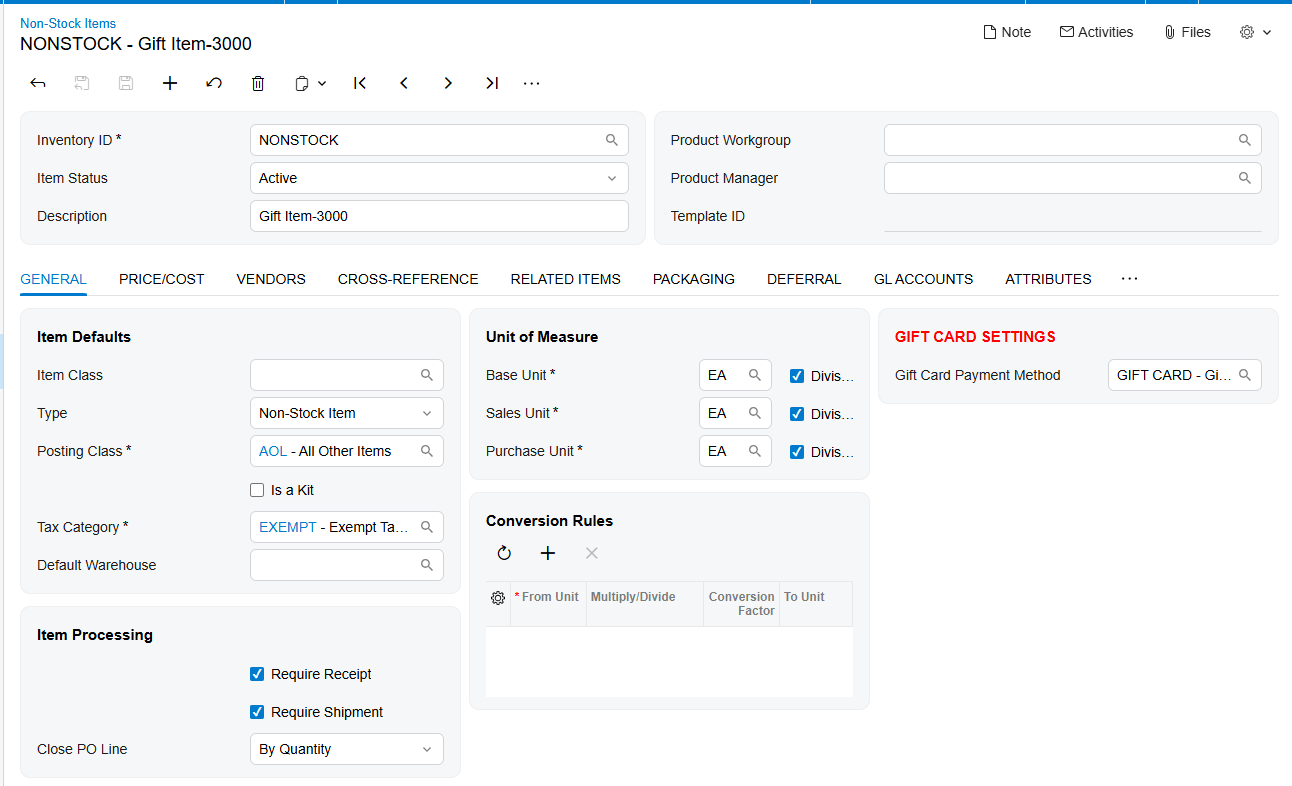
For those stock items, data preparation takes a few extra steps. You create a specific lot or serial class that tracks serial numbers as they're received. And it's important to enable the Track Expiration Date option within that class if you plan to have your cards expire, because that date is established during the initial gift card receipt.
Validation and preferences
Before you process your first order via GiftCard Connector, validate your settings on the Gift Card Preferences screen. This is where you map your internal Acumatica items to any external Stock Keeping Units, or SKUs, if you're importing orders from a commerce platform. If you don't select the option to use multiple cards in commerce, the system simply defaults to your primary non-stock gift card item during imports.
You also validate your numbering logic. You decide between a structured numbering sequence and random generation. If you choose a structured approach, confirm that you've configured an auto-incremental value in the numbering segments. If you prefer more security, you can enable random numbering, which prevents anyone from guessing sequences by generating a unique number only when a quantity is specified on a sales order.
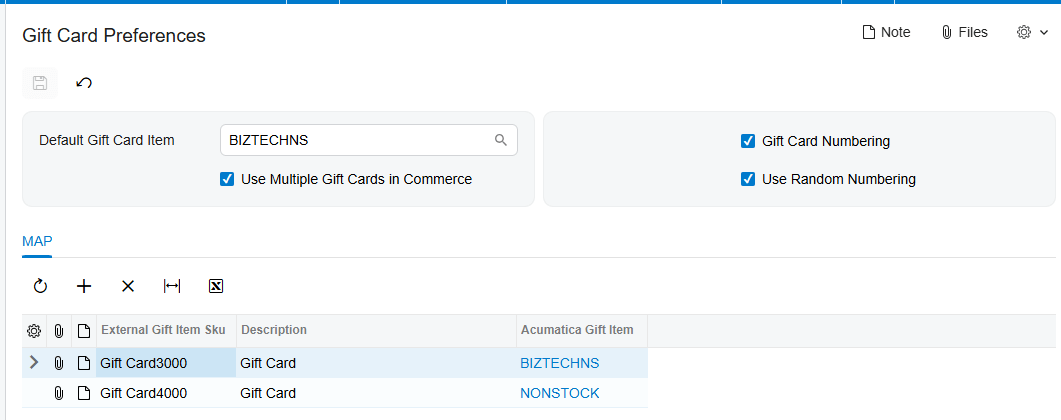
Testing the workflow
Testing is perhaps the most critical phase before go-live, and we suggest starting with the sales process. Enter a Sales Order for a gift card and confirm the system generates the serial numbers correctly, whether manually or automatically. For non-stock items, remember the shipping rule defaults to Ship Complete on the order line. For stock items, validate the receipt process by adding items to a receipt, generating serial numbers, and assigning expiration dates in the line details.
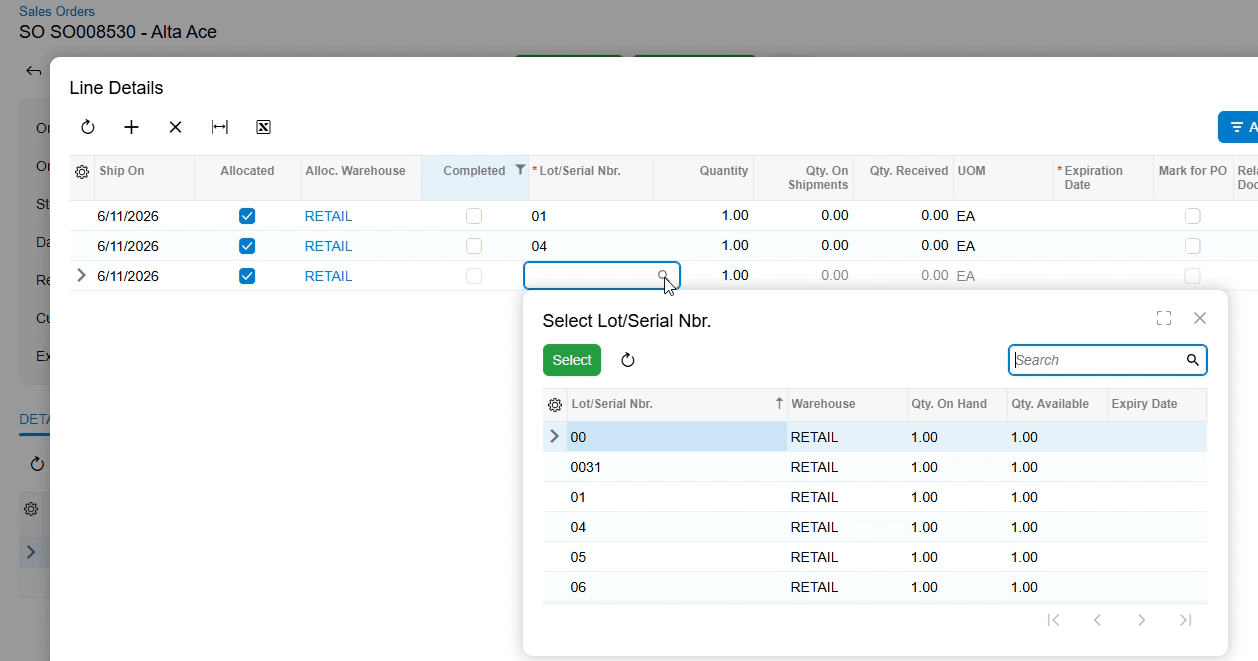
Next, test the payment side. You should be able to select Gift Card as a payment method directly from a sales order, from the Payments and Applications screen, or from an invoice. Verify that the system lets you choose a serial number and that it correctly shows the remaining balance on the card. Finally, run a test return. Use the return order type to process a credit for a gift card, and confirm the system updates the Gift Card History screen with the returned amount.
Go-live readiness and reporting
As you approach your go-live date, the final check is your reporting and visibility. The Gift Card Summary and Gift Card History screens should be your main validation points. The history screen should show a clear audit trail of every transaction, including the original invoice, any payments made, and even voided transactions. And if you use an Application Programming Interface, or API, to connect to external systems, do a final sync to make sure customer information and serial numbers are flowing in accurately.
Go-live readiness means more than just having the software installed. It means having confidence that every gift card you sell is a secure, traceable asset for your business. Once you've verified your GL accounts, validated your numbering, and successfully tested a full sale, payment, and return cycle, you're ready to launch.
To see these steps in action, or to learn how we can help you grow your sales, visit us at biz-techservices.com to schedule a personalized demo.
Kit Processing Configuration Checklist for Acumatica
Kit Processing Configuration Checklist for Acumatica
When your business prepares to launch a new tool inside your Enterprise Resource Planning system, or ERP, the difference between a smooth transition and a frustrated team often comes down to preparation. At Biz-Tech Services, we've found that a structured pre-launch phase makes sure the automation in our Kit Processing enhancement works exactly as you expect from day one. So think of this as your checklist, your roadmap through configuration, data preparation, and validation, so your team is ready for a successful go-live.
Required configuration and installation
Before you can build a single kit, you need your environment technically prepared. First, confirm that your Acumatica system is running on a supported license, such as PCSR, PERP, or SAAS. Once the platform is ready, install the necessary customization packages through the Customization Projects screen. You'll import and publish both the Biz-Tech license package and the Kit Processing package to activate our specialized tools.
Just as important, make sure the native Acumatica Kit Assembly feature is turned on in the Enable and Disable Features form. This is the foundation our processing engine sits on. Without that native feature active, the Kit Specifications form simply won't be available.
Data preparation and item setup
With the framework in place, turn your attention to your data. Every item you plan to sell as a kit must first be defined as one, on either the Stock Items or the Non-Stock Items form. On the General tab of those screens, confirm you've marked the Is a Kit checkbox for every relevant product.
Next, prepare what we call kit placeholder items. These are non-stock items that stand in for the kit parent on a sales order, after the kit explodes into its components. A vital validation point here is the unit of measure, or UOM. The unit of measure on your placeholder item must exactly match the unit of measure of the kit itself, or the system will warn you during order entry.
Finally, for each kit, you set up its kit specification. This is where you define the components and the revision number, and, most importantly, mark the revision as active and current. Only the current revision is used to explode components when an order is entered, so this step is easy to overlook and important to get right.
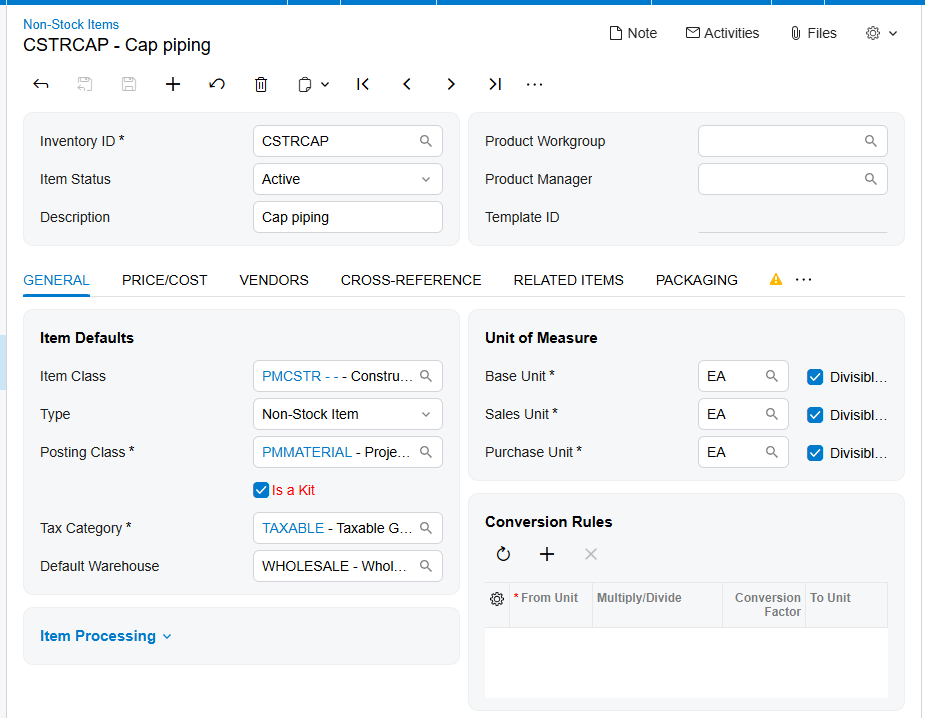
Defining your business logic
Once your items are ready, you tell the system how to handle them day to day, on the Sales Order Preferences screen. Here you choose your default explode option. You can have the system automatically break kits into their components, prompt the user to decide each time, or not explode at all. But if the specific item has configyration in Kit Specifications screen, then the setup of individual item would be used.
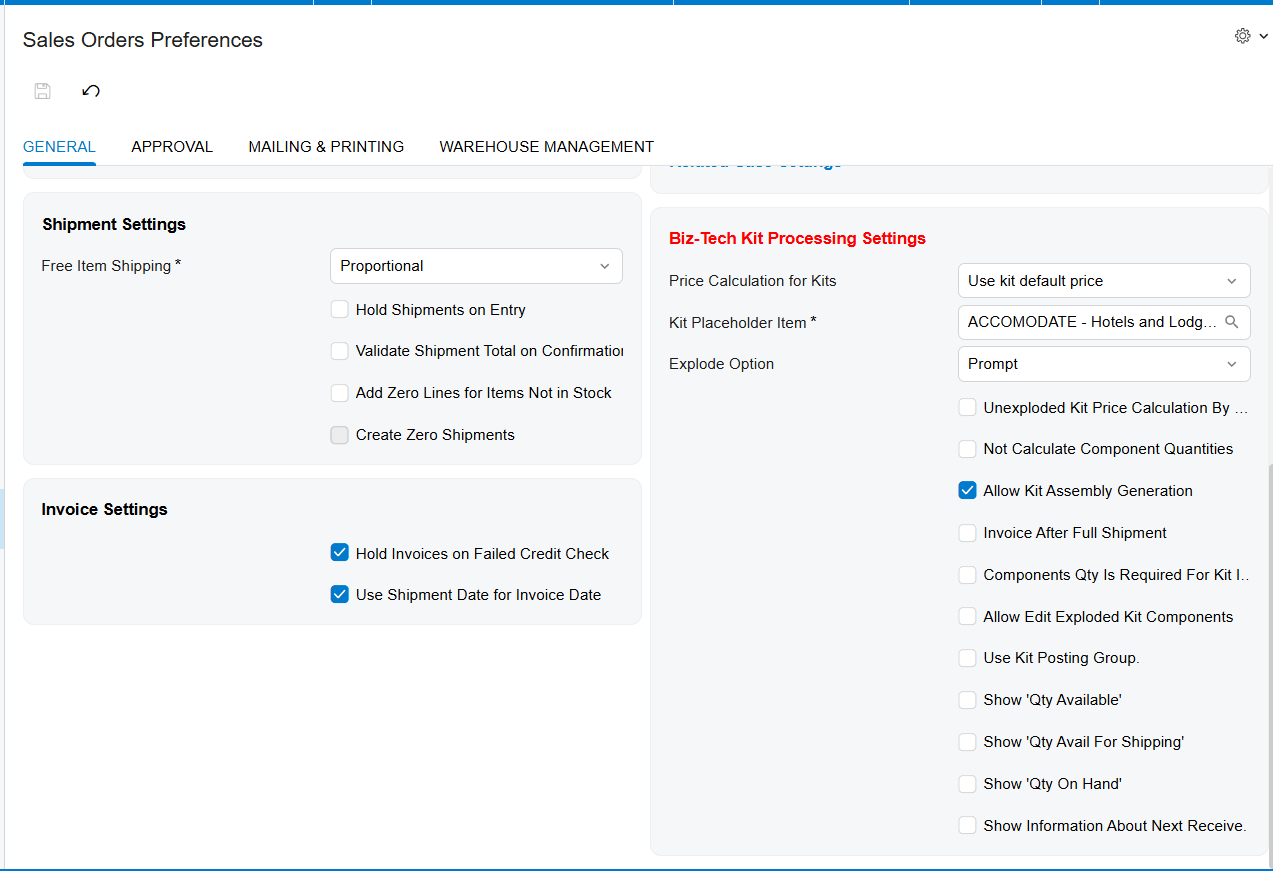
You also set your price calculation strategy. Your business might price from the kit's default price, from the components' default prices, or use a combined approach. And if you'd rather keep the kit intact on the order but still price it from its parts, you can turn on the unexploded kit price calculation by components.
Lastly, think through your shipping logic. Under the Biz-Tech Kit Processing settings, you decide whether to ship the available quantity or only the ordered quantity. Choosing the ordered quantity makes sure nothing leaves the warehouse until every component of the kit is allocated and ready to go.
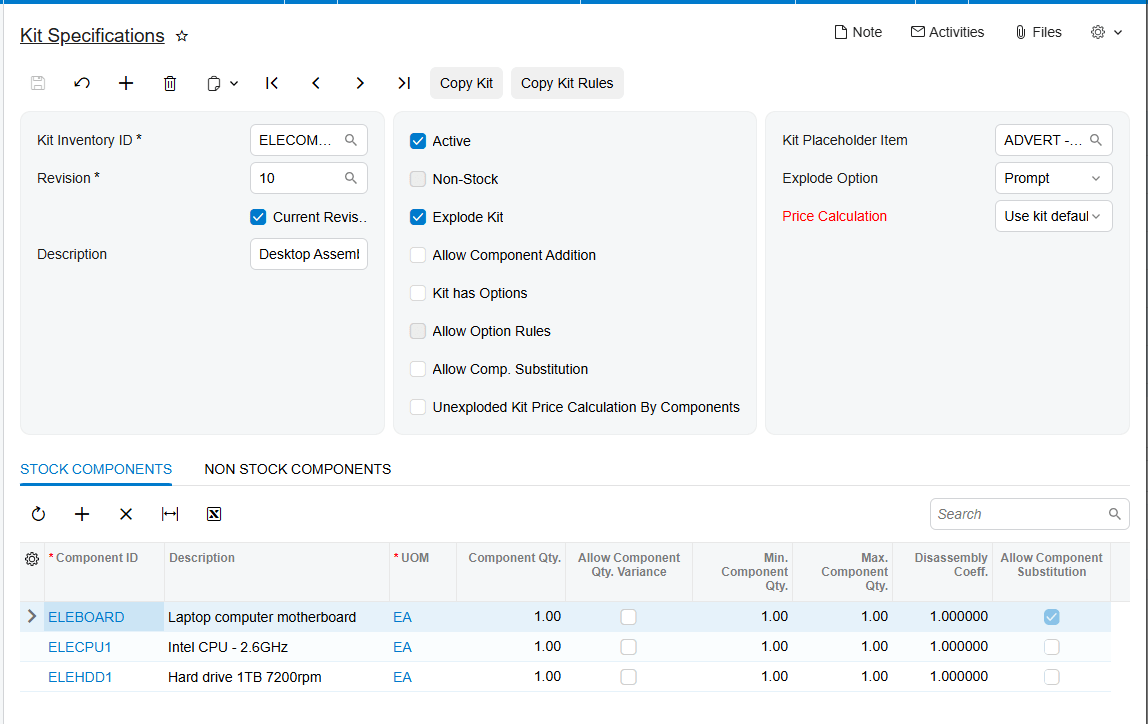
Validating your options and rules
For configurable kits, validating your rules is a critical pre-launch step. If your kits have options, you set up option categories and option codes inside the kit specification. To keep orders accurate, you can use option rules to create exclusion logic. For example, a rule that makes certain color choices unavailable once a customer picks a particular size.
And if you allow flexibility in the warehouse, confirm that component substitution is enabled. That lets your team swap a standard component for a pre-defined substitute when the primary item is out of stock, without holding up the order.
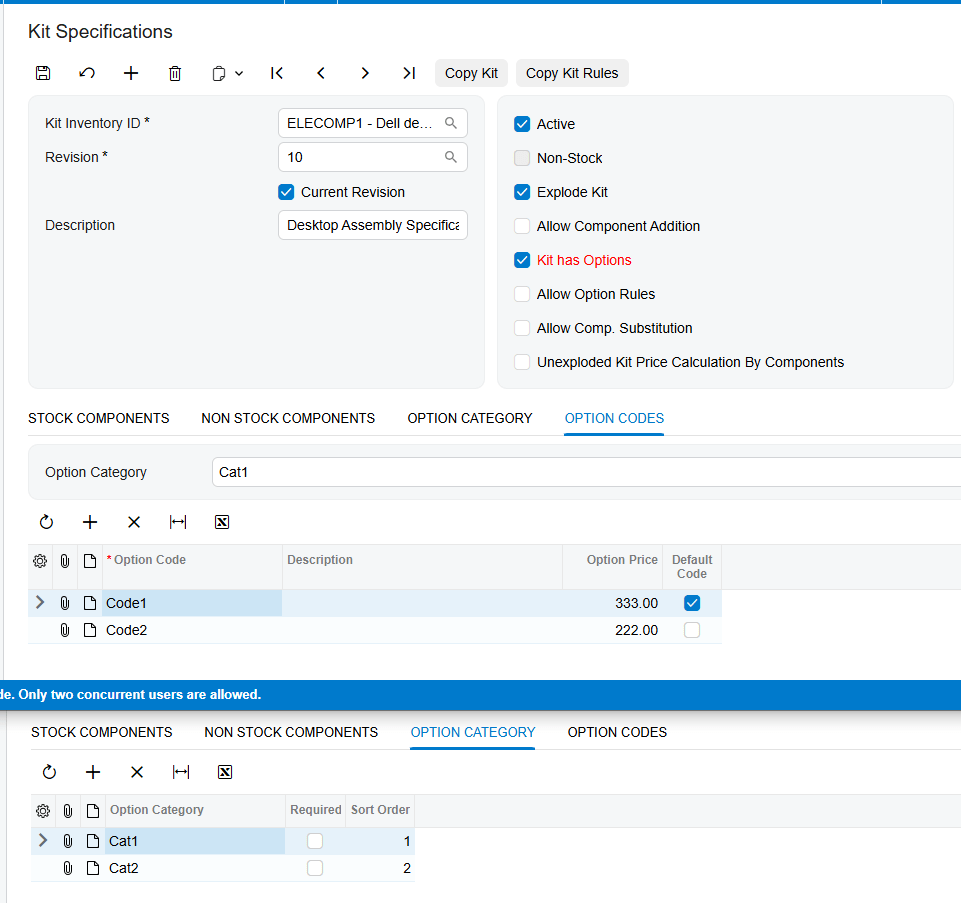
Testing and go-live readiness
The final phase of the checklist is a thorough testing cycle. We recommend entering several sales orders to watch the kit explosion happen, and opening the component details window to confirm the quantities and warehouses populate correctly. If you've enabled kit assembly generation, test creating a kit assembly right from the sales order, so your production and sales workflows are properly linked.
Then confirm the financial flow by taking a test order all the way through shipment and invoicing. Pay close attention to how the system handles the kit placeholder item, and make sure the costs carry forward to the invoice as you expect. And if you run a storefront integration, verify that the setting to fulfill exploded kit items is active, so shipment status syncs back to your store correctly.
The real sign of go-live readiness is when your settings in Sales Order Preferences perfectly mirror your physical warehouse and your accounting workflows. When your testing shows components allocated correctly and prices calculating exactly as your catalog defines, you're ready to launch with confidence.
To see these features in action, or to get a guided walkthrough of the setup, visit us at biz-techservices.com for a full demo of our Kit Processing solution.
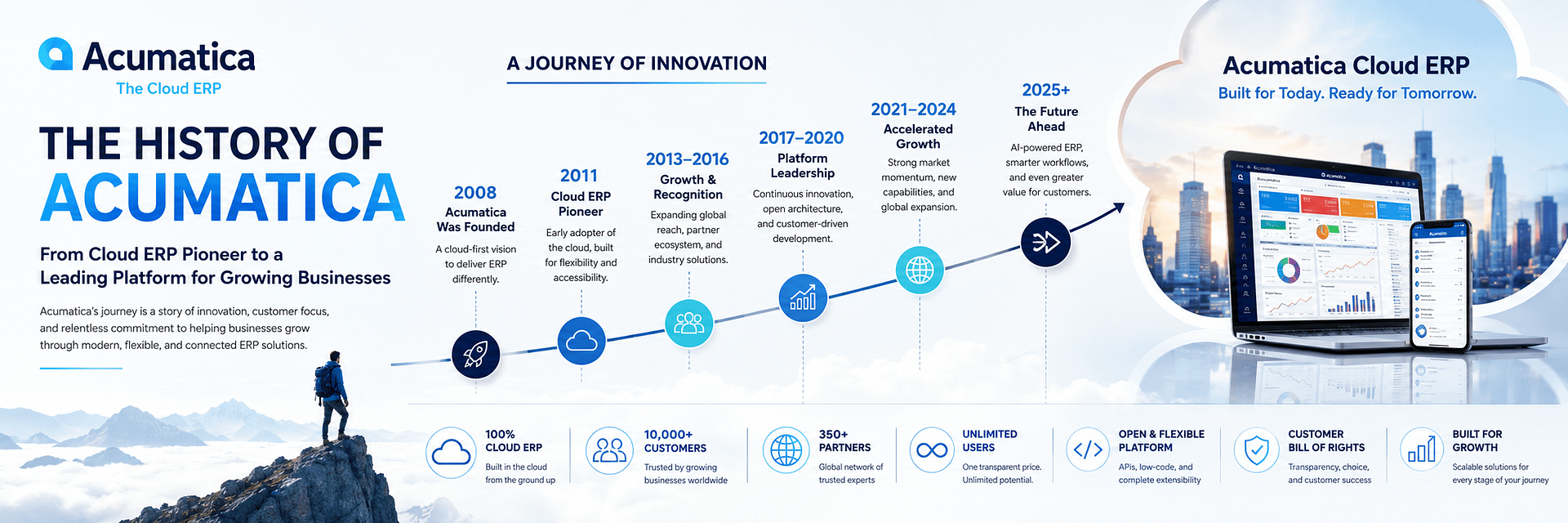
The History of Acumatica: From Cloud ERP Pioneer to a Leading Platform for Growing Businesses
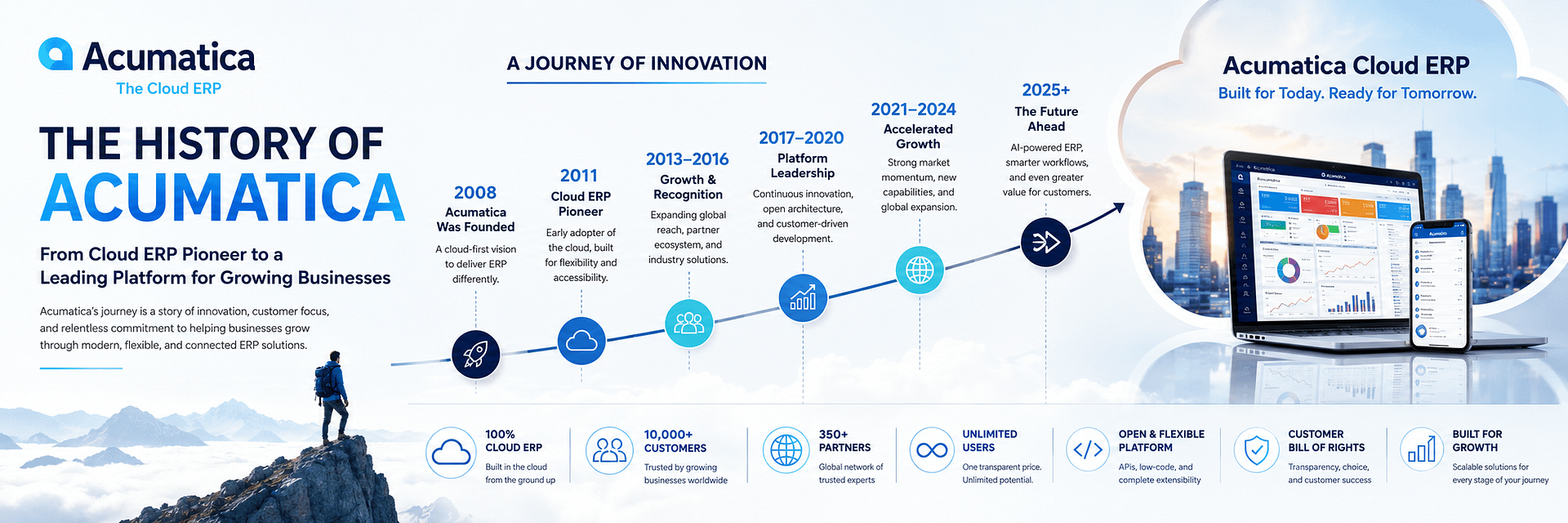
The History of Acumatica: From Cloud ERP Pioneer to a Leading Platform for Growing Businesses
The history of Acumatica is not simply the story of another ERP vendor entering a crowded software market. It is the story of a company that saw early what many businesses would later discover the hard way: traditional ERP was becoming too rigid, too expensive, too disconnected, and too difficult for growing companies to adapt.
Long before cloud ERP became the standard direction for modern business management software, Acumatica was built around a different idea. ERP should be flexible. ERP should be accessible. ERP should be connected. ERP should be built for real business workflows, not only for enterprise IT departments. ERP should help small and midmarket companies compete with larger organizations without forcing them into unnecessary complexity.
That idea became Acumatica Cloud ERP.
Today, businesses search for Acumatica, Acumatica ERP, Acumatica Cloud ERP, Acumatica implementation, Acumatica integration, cloud ERP for growing businesses, ERP for midmarket companies, Acumatica partner, and Acumatica consultant because they are looking for more than software. They are looking for a practical platform that can support finance, operations, inventory, distribution, manufacturing, construction, retail, eCommerce, project accounting, CRM, reporting, dashboards, automation, APIs, webhooks, and business growth in one connected system.
This is why Acumatica’s development matters.
Acumatica did not become relevant by imitating older ERP systems. It became relevant by challenging the assumptions that made older ERP systems difficult for growing companies. It focused on cloud architecture, open integration, partner-driven implementation, customer-friendly business practices, flexible deployment, and broad user access. It built a product and ecosystem around the idea that growing businesses need ERP that can adapt with them.
That is also why BizTech chose to work with Acumatica and promote Acumatica as one of the most practical ERP platforms for growing companies. As an implementation and integration-focused company, BizTech needs technology that can be shaped around real workflows. Acumatica fits that philosophy. It is modern enough for connected businesses, flexible enough for custom processes, open enough for integrations, and practical enough for companies that do not want ERP to become a burden.
This article explores the history of Acumatica, how Acumatica Cloud ERP evolved, why Acumatica became a leading cloud ERP platform for small and midmarket organizations, and why BizTech believes Acumatica is one of the strongest ERP choices for companies that want to grow with control, visibility, and flexibility.
Why the History of Acumatica Matters
Understanding the history of Acumatica matters because ERP selection is not only about features. It is also about philosophy.
When a business chooses ERP software, it is choosing a long-term foundation. That ERP platform will affect how the company manages financials, inventory, purchasing, sales orders, warehouse operations, production, projects, reporting, integrations, automation, and customer data. It will affect how quickly teams can work, how accurately leadership can report, how easily the business can scale, and how expensive change becomes over time.
That is why the company behind the ERP matters.
A vendor’s history tells you what it values. It tells you whether the platform was designed for flexibility or control. It tells you whether the company listens to users or simply follows enterprise software trends. It tells you whether the ecosystem is partner-friendly. It tells you whether the product was built around modern cloud business requirements or adapted later from older assumptions.
Acumatica’s history is important because it shows a consistent direction:
- cloud-first thinking;
- open architecture;
- flexible deployment;
- customer-friendly licensing;
- partner-driven delivery;
- industry-specific development;
- customer-driven innovation;
- practical ERP for small and midmarket companies.
For BizTech, those principles matter. We do not believe ERP should be implemented as a rigid template that ignores how the business actually works. We believe ERP should become a connected operating system that supports real processes, integrates with external systems, and gives leadership reliable data.
Acumatica’s history aligns with that belief.
Acumatica Was Born in the Cloud
Acumatica was founded in 2008, during a period when many businesses were still running ERP systems on older on-premise technology, local servers, expensive infrastructure, and rigid licensing models. At that time, cloud ERP was not as widely accepted as it is today. Many companies still assumed that serious ERP had to be installed, maintained, upgraded, and customized in the traditional way.
Acumatica took a different path.
The company was born around the belief that ERP could be more accessible through the cloud and the web. That was a major strategic decision. Instead of building another legacy ERP system and later trying to modernize it, Acumatica began with the idea that business management software should be browser-based, connected, and easier to deploy across different environments.
This early cloud-first foundation is one of the most important parts of the Acumatica company history.
The early Acumatica vision was not just “ERP in the cloud.” It was broader than that. It was the idea that growing companies needed a flexible platform that could support modern business processes without forcing customers into the limitations of traditional ERP. That meant better access, easier collaboration, more flexible deployment, and stronger integration potential.
Today, the market has largely moved toward that same direction. Businesses now expect cloud ERP, mobile access, real-time data, API integrations, flexible workflows, and remote collaboration. Acumatica was built around those expectations early.
That is why the phrase Acumatica Cloud ERP is so central to the company’s identity.
The Early ERP Problem Acumatica Set Out to Solve
To understand why Acumatica became important, you have to understand the ERP problem it was solving.
Traditional ERP often created three major challenges for small and midmarket companies:
- high cost;
- limited flexibility;
- difficult adoption.
Many ERP platforms were built for large enterprises first. They could be powerful, but they were often expensive to implement, expensive to maintain, difficult to customize, and difficult for everyday users to adopt. Smaller and midmarket businesses needed many of the same operational capabilities as larger companies, but they could not always justify the same level of cost, complexity, and implementation burden.
Acumatica’s development responded directly to that gap.
The company focused on making ERP more practical for growing organizations. It built around web access, cloud deployment, open architecture, integrations, user-friendly workflows, and partner-led implementations. Over time, this created a different kind of ERP experience.
For growing companies, the value was clear.
They did not need a system that only large enterprises could afford and manage. They needed cloud ERP software that could support financial management, distribution, manufacturing, construction, retail, project accounting, inventory management, warehouse management, CRM, reporting, dashboards, field service, and eCommerce without locking the business into unnecessary constraints.
That is where Acumatica found its space.
The Acumatica Platform Philosophy: Flexibility First
One of the main reasons Acumatica became successful is that it was not built only as a collection of ERP modules. It was built as a platform.
This distinction is important.
A traditional ERP system often feels like a fixed application. The business must adapt to the system. Customization is possible, but it may be expensive, slow, and technically difficult. Integrations may require specialized work. Reporting may require heavy support. Process changes may become projects of their own.
Acumatica’s platform philosophy is different.
Acumatica is designed to support flexibility through:
- open architecture;
- modern cloud technology;
- low-code and no-code customization;
- configurable workflows;
- dashboards and reporting;
- web APIs;
- webhooks;
- mobile access;
- role-based experiences;
- industry-specific editions;
- partner and developer ecosystem support.
This is why companies search for Acumatica API, Acumatica webhooks, Acumatica integration, Acumatica customization, Acumatica automation, and Acumatica xRP platform. They are not just looking for standard ERP. They are looking for an ERP platform that can connect to the rest of the business.
For BizTech, this platform philosophy is one of the biggest reasons we chose Acumatica.
Our clients rarely need a completely standard ERP deployment. They need integration with eCommerce platforms, payment systems, marketplaces, warehouse systems, shipping tools, CRM, tax software, dashboards, and custom workflows. Acumatica gives us the technical and functional foundation to build those connected environments.
That is why Acumatica is not just ERP software to us. It is a flexible business platform.
The Evolution from ERP Software to Business Management Platform
Acumatica’s history is also the story of ERP expanding beyond accounting.
Many companies first think about ERP because finance becomes too complex for basic accounting software. They need accounts payable, accounts receivable, general ledger, financial reporting, cash management, multi-entity accounting, project accounting, and better audit visibility.
But once ERP is implemented, the business quickly realizes that finance is only one piece of the puzzle.
The real value comes when Acumatica connects finance with operations.
Acumatica evolved into a broader business management platform that supports:
- Financial Management;
- Distribution Management;
- Manufacturing Management;
- Construction Management;
- Retail Management;
- Inventory Management;
- Field Service Management;
- Order Management;
- Warehouse Management System;
- Project Accounting;
- CRM;
- Payroll;
- Payments;
- Reporting, Dashboards, and BI;
- Commerce Connectors;
- Artificial Intelligence and automation capabilities.
This is one of the reasons Acumatica became so relevant for growing businesses. It does not only solve one back-office problem. It supports a connected operating model.
A distributor can connect inventory, purchasing, sales, warehouses, shipping, eCommerce, and financials.
A manufacturer can connect production, materials, purchasing, sales orders, inventory, costing, and reporting.
A construction company can connect projects, job costing, billing, field activity, payroll reporting, documents, and financials.
An eCommerce business can connect online orders, product data, inventory, payments, fulfillment, returns, and dashboards.
That is why Acumatica ERP is often described as business management software, not only accounting software.
Acumatica and the Partner-Driven Model
Another major part of the Acumatica company history is its partner-first approach.
Acumatica is channel-driven. Instead of trying to handle every implementation directly from the vendor level, Acumatica works through a network of value-added resellers, implementation partners, ISVs, OEMs, developers, consultants, and service providers. This is not a minor detail. It is central to how Acumatica scales.
ERP is not a one-size-fits-all product.
Every company has different processes, systems, reporting needs, integration requirements, industry demands, and growth goals. A partner-driven model allows Acumatica customers to work with specialists who understand implementation, configuration, customization, integrations, local business practices, and industry-specific needs.
For companies searching for Acumatica implementation partner, Acumatica integration partner, Acumatica VAR, Acumatica consultant, Acumatica customization services, and Acumatica support, the partner ecosystem is one of the most important reasons to choose the platform.
This is where BizTech fits naturally.
BizTech works with Acumatica because the platform supports partner-led value creation. We can help companies implement Acumatica, customize workflows, connect third-party systems, automate eCommerce operations, integrate payment tools, build dashboards, design reporting, and support the system after go-live.
This is exactly the kind of ERP partnership model growing businesses need.
They do not just need software. They need a team that can make the software work in the real business environment.
Acumatica’s Growth: From Cloud ERP Vision to Global Platform
Acumatica started as a cloud ERP vision, but its growth over the years reflects a larger market shift.
Businesses began moving away from legacy ERP and toward more flexible cloud-based platforms. They wanted browser access, lower infrastructure burden, better integration, stronger dashboards, mobile capabilities, faster updates, and easier scalability. Acumatica was aligned with those trends from the beginning.
Over time, Acumatica expanded its product functionality, partner ecosystem, industry editions, developer community, and global reach. The company’s growth accelerated as more organizations recognized that cloud ERP was not only viable, but often more practical than traditional ERP.
The company’s growth story includes several important themes:
- cloud-first architecture from the beginning;
- expansion into multiple industry editions;
- growth of the VAR and partner ecosystem;
- increasing focus on usability and customer success;
- continued investment in product innovation;
- strong adoption among small and midmarket companies;
- broader recognition as a modern cloud ERP platform.
Today, Acumatica serves thousands of customers worldwide and supports a large partner ecosystem. Its global presence, industry editions, and customer-driven product strategy have helped position it as one of the strongest names in modern cloud ERP.
For BizTech, this matters because we want to promote platforms with long-term momentum. ERP decisions are long-term decisions. Our clients need a solution that will continue evolving, not a system that is standing still.
Acumatica has demonstrated that it is still moving forward.
The EQT Growth Phase and the Vista Milestone
Acumatica’s growth accelerated significantly during its EQT ownership period. Under EQT, the company expanded its global reach, partner ecosystem, product innovation, vertical functionality, and customer base. This period helped Acumatica move from an already respected cloud ERP vendor into a stronger global business management platform.
The 2025 agreement for Vista Equity Partners to acquire Acumatica marked another major milestone in the company’s development. Vista is known for its focus on enterprise software and technology-enabled businesses, and the transaction reflected Acumatica’s strong position in the cloud ERP market.
For customers and partners, this kind of growth matters because it signals investment, market relevance, and long-term platform potential.
Acumatica’s continued expansion shows that the market is moving toward the kind of ERP Acumatica has been building for years:
- cloud-based;
- AI-enabled;
- customer-driven;
- industry-specific;
- partner-supported;
- integration-friendly;
- built for small and midmarket growth.
For BizTech, this reinforced our confidence in Acumatica as a platform worth supporting and promoting.
We do not want to build client solutions on a platform that is static. We want a platform with momentum, investment, product direction, and a community behind it.
Acumatica provides that.
Customer-Driven Innovation: A Core Part of Acumatica’s Identity
One of the strongest reasons Acumatica stands out is its emphasis on customer-driven innovation.
Many software vendors talk about innovation. But innovation only matters if it solves real problems. ERP customers do not need features created only for marketing. They need tools that reduce manual work, improve visibility, simplify workflows, increase accuracy, and help teams make better decisions.
Acumatica has consistently positioned itself around listening to customers and building capabilities that address real operational challenges.
This is especially important because ERP users experience the product every day. They know where workflows are slow. They know where reports are unclear. They know where integrations break. They know where dashboards need improvement. They know which manual steps create bottlenecks. A vendor that listens to this feedback can build a better product.
Acumatica’s direction around AI, modern UX, no-code personalization, reporting, portals, industry-specific enhancements, and workflow automation reflects this customer-driven approach.
For BizTech, this is one of the reasons we trust Acumatica.
Our clients need ERP that keeps improving. They need a vendor that listens to the market. They need a product roadmap that moves with business reality. They need a platform that is not trapped in outdated ERP assumptions.
Acumatica’s customer-driven innovation gives us confidence that the platform will remain relevant for growing businesses.
Why Acumatica Became a Leading Cloud ERP Platform
Acumatica became a leading cloud ERP platform because it solved practical problems that older ERP systems often made worse.
The company focused on the needs of small and midmarket organizations:
- flexibility instead of rigidity;
- open integration instead of closed architecture;
- broad user access instead of seat anxiety;
- cloud deployment instead of infrastructure burden;
- partner-led implementation instead of generic deployment;
- customer-driven innovation instead of vendor-first product direction;
- industry-specific capabilities instead of generic ERP only;
- modern usability instead of outdated interface logic.
These choices created a platform that fits the way growing businesses actually operate.
A company that needs Acumatica distribution ERP can manage inventory, warehouses, orders, purchasing, replenishment, and reporting.
A company that needs Acumatica manufacturing ERP can manage materials, production, costing, purchasing, inventory, and operations.
A company that needs Acumatica construction ERP can manage job costing, project accounting, change orders, field data, billing, and reporting.
A company that needs Acumatica eCommerce ERP can connect online stores, marketplaces, payments, fulfillment, customer data, product data, and inventory.
A company that needs Acumatica project accounting can connect budgets, costs, billing, resources, profitability, and financial reporting.
This broad practical fit is one of the reasons Acumatica’s reputation has grown.
Acumatica’s Customer Bill of Rights and Why It Matters
One of the clearest expressions of Acumatica’s philosophy is its Customer Bill of Rights.
This is important because ERP customers often worry about hidden costs, locked data, limited user access, complex contracts, difficult customization, and vendor dependency. Acumatica directly addresses these concerns through principles such as:
- clear fee structures;
- unlimited user access;
- ability to adapt and customize the solution;
- transparent and fair pricing;
- public or private cloud deployment;
- open platform with robust APIs;
- security model for applications, data, reports, and devices;
- ownership and access to data;
- community knowledge and resources;
- online training.
For BizTech, these principles matter because they align with what clients actually need from ERP.
Clients do not want surprises. They do not want to feel trapped. They do not want to pay just to let more employees use the system. They do not want their data locked away. They do not want an ERP platform that cannot integrate with modern tools.
Acumatica’s Customer Bill of Rights supports a healthier ERP relationship.
That is one of the reasons we promote Acumatica.
Unlimited Users: A Major Reason BizTech Supports Acumatica
One of the most important reasons BizTech chose Acumatica is the platform’s approach to user access.
ERP works best when people use it.
If a company limits access because every additional user creates more cost, the ERP becomes less valuable. Teams begin working around the system. Data becomes incomplete. Reports become less reliable. Processes become fragmented. The company loses the full value of the ERP investment.
Acumatica’s unlimited user philosophy changes that dynamic.
It allows businesses to think in terms of adoption rather than restriction.
Instead of asking:
“How many licenses can we afford?”
the business can ask:
“Who should be inside Acumatica to make the company run better?”
That is a better way to think about ERP.
Warehouse teams, sales teams, finance users, purchasing managers, project managers, executives, service teams, operations leaders, and customer service users can all benefit from access to accurate ERP data. When they work inside one system, the business becomes more connected.
For BizTech, this is practical. We want clients to get real value from ERP, not just buy software. Broad adoption is one of the biggest drivers of ERP success.
Acumatica supports that.
Open APIs and Integrations: Why Acumatica Fits BizTech’s Work
BizTech works heavily with integrations, automation, eCommerce, payment workflows, marketplace sync, warehouse processes, and custom business logic. That means we need an ERP platform that is open and flexible.
Acumatica fits this requirement extremely well.
The platform supports APIs, webhooks, developer tools, workflows, customization, dashboards, and extensions. This makes it suitable for integration-heavy businesses that need to connect ERP with the rest of their technology stack.
Common Acumatica integration scenarios include:
- Shopify Acumatica integration;
- WooCommerce Acumatica integration;
- Amazon Acumatica integration;
- PayPal Acumatica integration;
- BigCommerce Acumatica integration;
- Magento Acumatica integration;
- warehouse management integration;
- shipping carrier integration;
- payment gateway integration;
- EDI integration;
- CRM integration;
- BI and reporting integration;
- custom API integration.
This is where BizTech adds value.
We can use Acumatica’s platform capabilities to build connected workflows that reduce manual data entry, improve accuracy, automate repetitive tasks, and create better visibility across the business.
For a client, this means Acumatica is not just a standalone ERP. It becomes the center of a connected business system.
Why BizTech Decided to Work with Acumatica
BizTech decided to work with Acumatica because the platform matches the kind of ERP solution we believe growing businesses need.
We wanted an ERP platform that is:
- modern;
- cloud-ready;
- flexible;
- integration-friendly;
- practical for small and midmarket companies;
- strong in financial management;
- strong in distribution and inventory;
- capable in manufacturing and construction;
- open to customization;
- built around customer-friendly business practices;
- supported by a strong partner ecosystem;
- moving with modern ERP trends.
Acumatica met those requirements.
From BizTech’s perspective, the platform gives us a strong foundation to help clients with real problems:
- manual order entry;
- disconnected eCommerce systems;
- unreliable inventory visibility;
- slow financial reporting;
- manual payment reconciliation;
- warehouse inefficiencies;
- fragmented customer data;
- poor integration between sales and operations;
- lack of dashboards;
- custom workflow needs;
- limited scalability from legacy systems.
Acumatica gives us the tools to solve these problems in a structured way.
That is why BizTech promotes Acumatica.
Not because it is simply another ERP product. Because it is a practical platform for building better business operations.
BizTech’s Role as an Acumatica Implementation and Integration Partner
An ERP platform only creates value when it is implemented correctly.
That is where BizTech comes in.
BizTech helps companies turn Acumatica into a working business system. We help clients design the right ERP structure, configure modules, migrate data, build dashboards, connect third-party systems, automate workflows, and support users after go-live.
A BizTech-led Acumatica project can include:
- business process analysis;
- ERP requirements discovery;
- Acumatica implementation planning;
- module configuration;
- custom workflow design;
- Acumatica customization;
- Acumatica API integration;
- eCommerce integration;
- payment integration;
- marketplace integration;
- warehouse automation;
- dashboard and reporting setup;
- data migration;
- user training;
- post-go-live support;
- long-term optimization.
This is important because no two businesses are identical.
A successful Acumatica implementation should not simply copy a generic template. It should reflect how the company sells, buys, stores, ships, produces, invoices, reports, and grows.
BizTech helps bridge that gap between software capability and business reality.
Acumatica for eCommerce: A Major Area of BizTech Focus
One of the reasons BizTech values Acumatica is its strong fit for connected commerce.
Modern eCommerce businesses need ERP to connect with sales channels, inventory, customers, payments, shipping, fulfillment, and reporting. Without integration, eCommerce growth creates operational chaos.
Acumatica can become the ERP backbone for eCommerce operations.
BizTech helps companies connect Acumatica with systems such as:
- Shopify;
- WooCommerce;
- Amazon;
- PayPal;
- BigCommerce;
- Magento;
- marketplaces;
- payment gateways;
- shipping tools;
- warehouse systems.
This matters because eCommerce companies often struggle with disconnected data:
- orders in one system;
- inventory in another;
- payments in another;
- shipping in another;
- financial reporting somewhere else;
- customer data split across platforms.
Acumatica helps centralize and organize that data.
With BizTech integrations, Acumatica can support order sync, inventory sync, payment sync, tracking updates, customer sync, product data sync, warehouse mapping, refunds, fulfillment automation, and profitability dashboards.
This is one of the clearest reasons BizTech chose Acumatica as a platform to promote.
Acumatica for Distribution, Manufacturing, and Construction
Acumatica’s industry focus is another reason it became a strong ERP platform.
Many ERP systems claim to serve multiple industries, but not all of them provide practical workflows for those industries. Acumatica has built strong positioning in distribution, manufacturing, construction, retail, professional services, field service, and other midmarket sectors.
For distribution companies, Acumatica can support inventory, purchasing, sales orders, warehouse workflows, replenishment, customer service, pricing, shipping, and reporting.
For manufacturing companies, Acumatica can support production, materials, BOMs, purchasing, inventory, costing, shop floor visibility, and operational reporting.
For construction companies, Acumatica can support job costing, project accounting, change orders, field workflows, billing, payroll reporting, document management, and project visibility.
For retail and commerce companies, Acumatica can support product data, order management, inventory, point of sale, online stores, payment processing, fulfillment, and reporting.
This industry coverage matters because many growing businesses are hybrid.
A distributor may also do light manufacturing. A manufacturer may also sell online. A contractor may also manage inventory. A retail company may also operate wholesale channels. A service company may also sell products. A modern ERP must support business models that do not fit into one simple box.
Acumatica’s flexibility makes it suitable for these converging business models.
That is another reason BizTech works with Acumatica.
Acumatica and the Move from System of Record to System of Intelligence
ERP used to be primarily a system of record. It stored transactions, customer data, inventory activity, invoices, payments, and financial information.
That is still important, but it is no longer enough.
Modern businesses need ERP to become more intelligent. They need insights, anomaly detection, AI-assisted workflows, predictive reporting, better dashboards, proactive alerts, and smarter automation.
Acumatica’s product direction reflects this shift.
The company has emphasized AI-powered reporting, AI assistants, modern experiences, customer and vendor portals, collaborative workflows, industry-specific AI capabilities, and a broader vision of ERP evolving from a passive system of record into a more proactive system of intelligence.
This matters because the future of ERP will not be only about storing data. It will be about using data to make better decisions.
For BizTech, this direction is important. We want to help clients build systems that do more than record business activity. We want systems that help identify problems, automate workflows, improve visibility, and support better decisions.
Acumatica’s innovation roadmap fits that direction.
Why Acumatica’s Story Resonates with Growing Businesses
Acumatica’s story resonates because it matches the experience of many growing companies.
A business starts small. It uses basic tools. It grows. Processes become more complicated. Data becomes fragmented. Reporting slows down. Manual work increases. Inventory gets harder to trust. Finance becomes disconnected from operations. Leadership needs better visibility.
At that point, the company needs ERP.
But it does not want an old-style ERP project that creates more complexity than it solves.
It wants an ERP platform that is:
- modern;
- flexible;
- cloud-based;
- integration-friendly;
- usable;
- scalable;
- industry-aware;
- customer-focused;
- practical to implement.
That is the role Acumatica fills.
Acumatica’s history is the story of building ERP for this exact market.
That is why it fits BizTech’s clients.
Why BizTech Promotes Acumatica Today
BizTech promotes Acumatica because we believe it is one of the most practical ERP platforms for modern growing businesses.
Our decision is based on several practical factors:
1. Acumatica is flexible
Growing companies change quickly. Acumatica can be adapted, customized, and extended to support evolving business processes.
2. Acumatica is integration-friendly
Modern businesses need ERP connected to eCommerce, payments, warehouses, marketplaces, shipping, CRM, and reporting tools. Acumatica’s API and webhook capabilities make that possible.
3. Acumatica supports broad user access
ERP is more valuable when teams use it. Acumatica’s unlimited user philosophy supports better adoption.
4. Acumatica is customer-driven
The product direction is strongly tied to customer needs, practical innovation, usability, and industry-specific functionality.
5. Acumatica fits midmarket reality
Many growing companies need serious ERP capabilities but do not want unnecessary enterprise heaviness. Acumatica fits that middle ground.
6. Acumatica works well with BizTech’s strengths
BizTech specializes in implementation, integrations, eCommerce workflows, payment automation, custom development, reporting, dashboards, and process improvement. Acumatica gives us the right foundation for that work.
This is why we choose Acumatica.
And this is why we continue to promote it.
The Future of Acumatica
The future of Acumatica is closely connected to the future of cloud ERP.
Businesses are moving away from disconnected systems and toward connected platforms. They want cloud access, integrations, automation, AI, dashboards, mobile experiences, flexible deployment, and industry-specific workflows. They want ERP that can support business models that blend distribution, manufacturing, retail, services, construction, and eCommerce.
Acumatica is well positioned for this future because its history already points in that direction.
The company was born in the cloud. It built a flexible platform. It focused on partners. It emphasized customer-friendly business practices. It invested in industry editions. It expanded globally. It developed around customer-driven innovation. It continues to move toward AI-powered ERP and more intelligent business workflows.
For BizTech, this is exactly the kind of platform we want to build on.
ERP should not stand still. Businesses do not stand still. Acumatica’s future direction gives us confidence that the platform will continue evolving with the needs of growing companies.
Conclusion: Acumatica’s History Explains Why BizTech Believes in It
The history of Acumatica is a history of practical ERP innovation.
It began with a cloud-first vision at a time when many ERP systems were still tied to older models. It grew by focusing on flexibility, open architecture, partner delivery, customer-friendly licensing, industry functionality, and customer-driven product development. It expanded into a global cloud ERP platform serving thousands of businesses. It continued evolving through AI, automation, modern user experiences, and industry-specific innovation.
That history explains why Acumatica matters.
And it explains why BizTech chose to work with Acumatica.
We believe Acumatica is one of the best ERP platforms for growing businesses because it gives companies a practical way to connect finance, operations, inventory, eCommerce, payments, manufacturing, distribution, construction, projects, CRM, reporting, dashboards, and automation in one flexible cloud ERP environment.
For companies searching for Acumatica, Acumatica ERP, Acumatica Cloud ERP, Acumatica history, history of Acumatica, Acumatica company history, Acumatica implementation, Acumatica integration, Acumatica implementation partner, Acumatica integration partner, Acumatica consultant, Acumatica customization, Acumatica eCommerce integration, Acumatica API integration, cloud ERP for growing businesses, and ERP for midmarket companies, the message is clear:
Acumatica is not just another ERP system.
It is a modern cloud ERP platform built around the way growing businesses actually need to work.
And with BizTech as an Acumatica implementation and integration partner, businesses can turn that platform into a connected, scalable, and practical operating system for long-term growth.
FAQ: The History of Acumatica and Why BizTech Works with Acumatica
When was Acumatica founded?
Acumatica was founded in 2008. The company was built around a cloud-first ERP vision and has grown into a modern cloud ERP and business management platform for small and midmarket companies.
What is Acumatica known for?
Acumatica is known for Acumatica Cloud ERP, flexible deployment, unlimited user pricing philosophy, open architecture, APIs, webhooks, industry editions, dashboards, reporting, customer-driven innovation, and strong fit for growing businesses.
Why is Acumatica considered a strong cloud ERP platform?
Acumatica is considered strong because it combines financial management, inventory, distribution, manufacturing, construction, project accounting, CRM, reporting, dashboards, automation, and integrations in one flexible cloud ERP platform.
Why did BizTech choose to work with Acumatica?
BizTech chose Acumatica because it is flexible, modern, integration-friendly, practical for growing businesses, and well aligned with BizTech’s expertise in ERP implementation, eCommerce integrations, payment automation, custom development, dashboards, and business process optimization.
What makes Acumatica different from traditional ERP?
Acumatica differs from traditional ERP through cloud-first architecture, open APIs, low-code/no-code customization, flexible deployment, unlimited user access, customer-friendly business practices, and a strong partner-driven implementation model.
Is Acumatica good for small and midmarket companies?
Yes. Acumatica is designed for small and midmarket companies that need scalable ERP functionality without unnecessary enterprise complexity. It is especially strong for businesses that need finance, inventory, distribution, manufacturing, construction, eCommerce, reporting, and integration capabilities.
Does Acumatica support integrations?
Yes. Acumatica supports integrations through APIs, webhooks, developer tools, commerce connectors, customization options, and partner-built solutions. BizTech helps businesses connect Acumatica with systems such as Shopify, WooCommerce, Amazon, PayPal, marketplaces, warehouses, shipping tools, CRM platforms, and custom applications.
What industries use Acumatica?
Acumatica is used by businesses in distribution, manufacturing, construction, retail, eCommerce, field service, professional services, agriculture, software, technology, business services, and other industries.
What is an Acumatica implementation partner?
An Acumatica implementation partner helps businesses configure, deploy, customize, integrate, and support Acumatica ERP. BizTech acts as an Acumatica implementation and integration partner by helping companies turn Acumatica into a practical business operating system.
Why should a company work with BizTech for Acumatica?
A company should work with BizTech for Acumatica because BizTech focuses on practical implementation, integrations, workflow automation, custom development, dashboards, eCommerce connectors, payment integrations, reporting, and long-term optimization. BizTech helps businesses make Acumatica fit real operational needs.
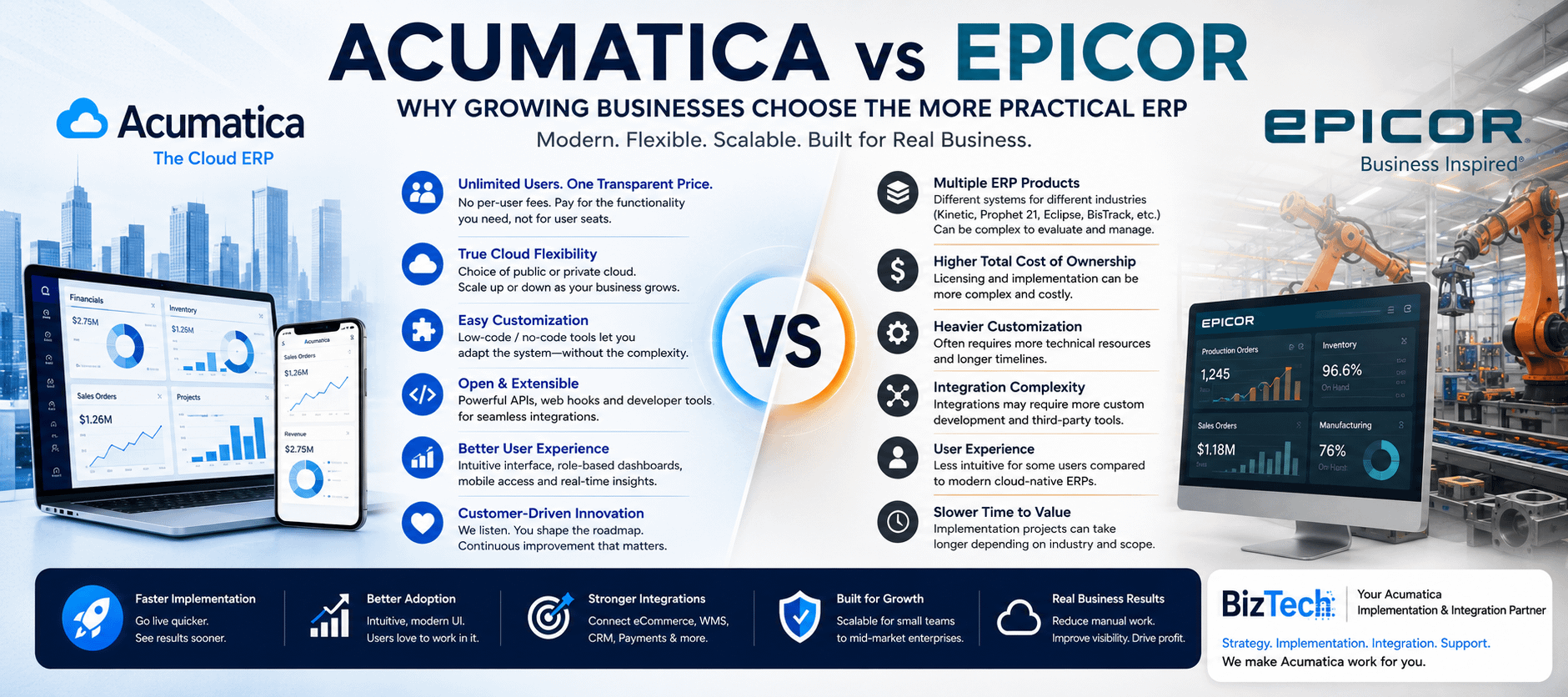
Acumatica vs Epicor: Why Growing Businesses Choose the More Practical ERP
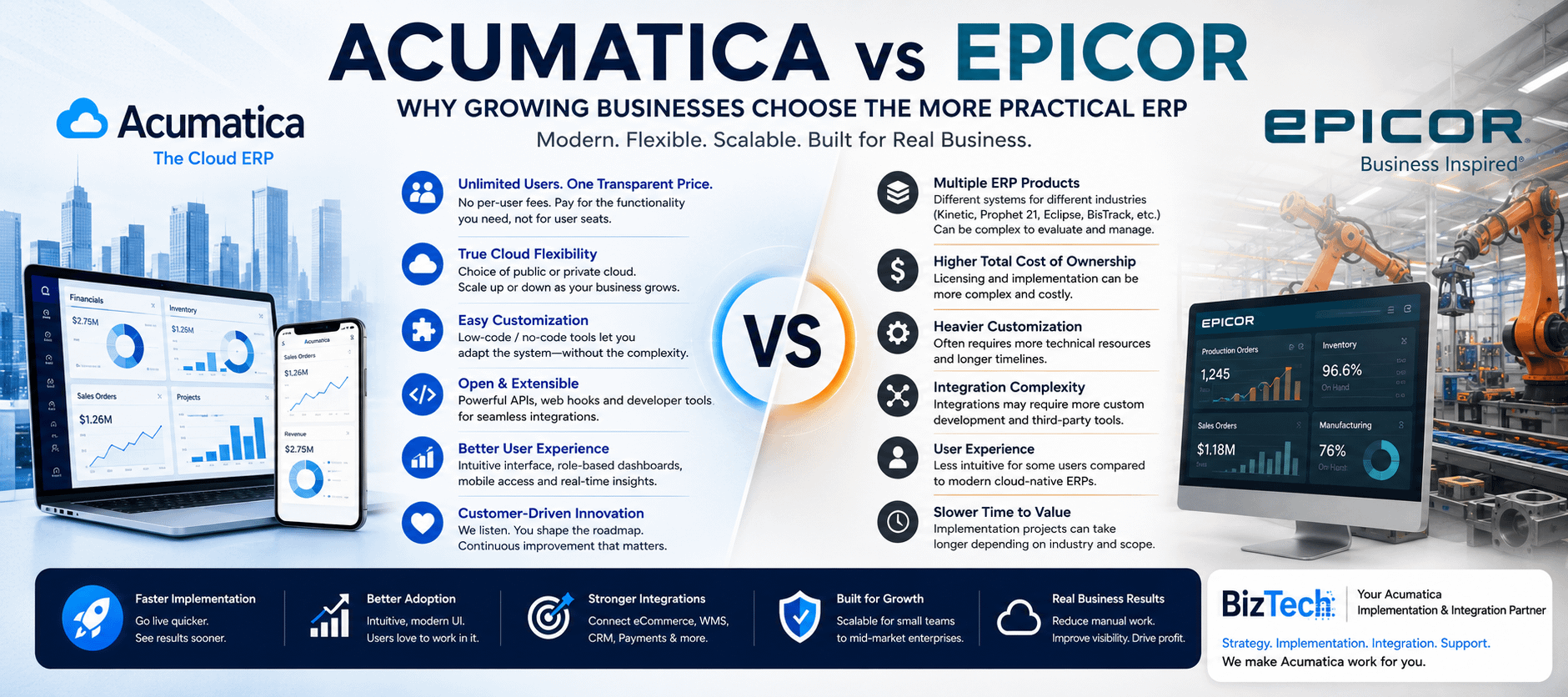
Acumatica vs Epicor: Why Growing Businesses Are Choosing the More Practical ERP
Choosing between Acumatica vs Epicor is not just a technology decision. It is a decision about how your company will manage finance, operations, inventory, purchasing, sales, manufacturing, distribution, reporting, automation, integrations, and long-term growth. ERP is not a small internal tool. It becomes the operational backbone of the business. That is why the comparison between Acumatica ERP and Epicor ERP matters so much.
Both platforms are serious ERP solutions. Both are known in the midmarket. Both can support manufacturing, distribution, financial management, operations, and industry-specific workflows. Epicor has a long history in ERP and is especially known for products such as Epicor Kinetic, Epicor Prophet 21, Epicor Eclipse, Epicor BisTrack, and other industry-focused systems.
But a strong product history does not automatically mean the best fit for every growing business.
For many companies evaluating Acumatica vs Epicor, the real question is not “Which ERP has more years in the market?” The better question is:
Which ERP is easier to adopt, easier to scale, easier to customize, easier to integrate, easier to support, and easier to keep aligned with the way the business actually works?
That is where Acumatica often becomes the more practical and more reasonable choice.
Acumatica is a modern cloud ERP platform built around flexible pricing, unlimited users, integrated applications, projected resource-based scaling, deployment choice, open architecture, low-code and no-code customization, dashboards, web APIs, webhooks, industry editions, and customer-driven innovation.
This is a major advantage in the Acumatica vs Epicor decision.
Epicor can be powerful, especially for manufacturing and distribution companies. But Epicor can also feel more product-fragmented, more industry-siloed, and more complex to evaluate because Epicor’s ERP portfolio includes several separate products for different industries and use cases. Acumatica, by contrast, often feels more unified, modern, open, and practical for growing businesses that want one adaptable ERP platform instead of a portfolio decision.
This is why companies searching for Acumatica vs Epicor, Acumatica vs Epicor Kinetic, Epicor alternative, Epicor Kinetic alternative, best cloud ERP for manufacturing, best ERP for distribution, Acumatica ERP vs Epicor ERP, cloud ERP comparison, and midmarket ERP comparison are increasingly taking Acumatica seriously.
And this is also where implementation matters. Choosing Acumatica is important, but implementing it correctly is what creates business value. As an Acumatica implementation and integration partner, BizTech helps companies turn Acumatica into a practical operating system: configured around real workflows, connected to external systems, supported with dashboards, integrated with eCommerce and payment tools, and optimized for daily business performance.
Acumatica vs Epicor: The Real Difference Is Practicality
At a high level, both Acumatica and Epicor are ERP systems. Both can support accounting, operations, inventory, purchasing, sales, manufacturing, reporting, and industry-specific needs. But the difference is not just feature coverage.
The real difference is how each ERP feels when the business has to use it every day.
A growing company does not need ERP complexity for its own sake. It needs ERP that helps people work better. It needs ERP that departments can adopt without excessive friction. It needs ERP that does not become a bottleneck every time a process changes. It needs ERP that connects easily to the rest of the technology stack. It needs ERP that gives management clean data and gives operational users practical workflows.
That is where Acumatica often looks stronger.
Acumatica is designed around practical midmarket ERP adoption. Its platform story emphasizes a modern cloud platform, low-code and no-code customization, role-based personalization, dashboards, workflows, mobile access, APIs, and webhooks. That is exactly the kind of foundation growing companies need when ERP must connect finance, operations, eCommerce, warehouse systems, payment platforms, CRM, analytics, and custom workflows.
Epicor is also serious ERP software, but its portfolio is more product-specific. Epicor lists multiple ERP products, including BisTrack, CMS, Eclipse, Indago, Kinetic, LumberTrack, Prophet 21, Vision, and others. Epicor Kinetic is specifically positioned as a manufacturing ERP. Epicor Eclipse is described for electrical, plumbing, HVAC, and PVF distributors. Prophet 21 is positioned as a built-for-distribution answer. BisTrack is positioned for building suppliers.
That industry focus can be useful. But it can also make Epicor feel less unified for a growing business that wants one modern cloud ERP platform with broad adaptability.
This is one of the most important points in the Acumatica vs Epicor comparison:
Epicor often feels like a collection of strong industry ERP products. Acumatica feels more like a unified, flexible cloud ERP platform that can adapt across industries.
For many growing companies, that difference matters more than a long feature checklist.
Why Acumatica Often Feels More Modern
Modern ERP is not only about being in the cloud. It is about how easily the system can adapt, integrate, and support change.
A modern ERP should allow the company to:
- bring more users into the system;
- customize workflows without excessive technical overhead;
- create dashboards and reports quickly;
- connect external systems through APIs;
- support mobile and remote work;
- integrate eCommerce, payments, warehouse, and marketplace tools;
- scale without constantly rethinking the system;
- evolve based on customer feedback and market changes.
This is where Acumatica’s platform story is especially strong.
Acumatica’s public platform materials emphasize low-code and no-code customization, usability, modern cloud technology, mobility, dashboards, reports, workflows, role-based access, web APIs, webhooks, and developer tools. That makes Acumatica highly attractive for companies that want practical ERP flexibility without turning every change into a large development project.
Epicor has modernized substantially, especially with Epicor Kinetic and related cloud offerings. But Epicor’s product story is still heavily tied to specific industries and specific ERP products. That can work well for companies that fit exactly into one Epicor product lane. But for businesses that need broader flexibility, Acumatica often feels more future-ready.
This matters because growing businesses rarely stay in one clean operational box.
A manufacturer may add eCommerce. A distributor may add light assembly. A retailer may add wholesale. A construction company may need field service. A service business may start selling physical products. A company that begins with one entity may become multi-entity. An ERP system must be able to adapt as the business changes.
Acumatica is usually easier to position for that kind of fluid growth.
That is why Acumatica vs Epicor is not only a comparison between two ERP vendors. It is a comparison between two different ERP philosophies.
Cost and Licensing: Why Acumatica’s Unlimited User Model Matters
One of the strongest reasons to choose Acumatica in the Acumatica vs Epicor comparison is licensing philosophy.
ERP value increases when more people use the system properly.
Finance needs access. Sales needs access. Purchasing needs access. Warehouse teams need access. Project managers need access. Manufacturing supervisors need access. Executives need dashboards. Customer service needs visibility. Operations leaders need live information. The more people who work inside the ERP, the stronger the system becomes as a single source of truth.
This is why Acumatica’s pricing model is such a major advantage.
Acumatica publicly positions its pricing around unlimited users, transparent pricing, the applications implemented, projected resources, and deployment/license choice. It also emphasizes paying for the functionality the business needs rather than paying for user seats.
That changes the psychology of ERP adoption.
With Acumatica, the business can ask:
Who should be using the ERP to make the business more accurate and efficient?
With a more traditional or less transparent ERP pricing structure, the business may start asking:
Who really needs access, and who can we keep outside the system?
Those are very different questions.
A company should not have to ration ERP visibility. If the warehouse needs access, give the warehouse access. If managers need dashboards, give managers dashboards. If project teams need live job information, give them access. If customer service needs order visibility, bring them into the system.
That is how ERP becomes useful.
In contrast, when user access feels expensive, complicated, or restricted, companies often build side processes. They use spreadsheets. They export data. They share screenshots. They wait for licensed users to pull reports. They create manual workarounds. Eventually, ERP becomes less central than it should be.
This is one of the clearest reasons Acumatica often beats Epicor in practical ERP evaluations. It supports broad adoption more naturally.
For companies searching Acumatica vs Epicor cost, Acumatica vs Epicor pricing, ERP cost comparison, unlimited user ERP, ERP without user-based pricing, and best ERP for growing teams, Acumatica has a strong story.
It is not only about cost savings. It is about building a better operating model.
User Reviews: Acumatica Scores Stronger in Key Practical Categories
A vendor can claim almost anything in marketing. User review data gives buyers another angle.
In public software review comparisons, Acumatica is frequently positioned strongly against Epicor Kinetic in practical categories such as ease of use, ease of setup, quality of support, business partner rating, product direction, workflow capability, customization, reporting, dashboards, and performance.
Those categories matter.
ERP buyers should pay attention to ratings like:
- Ease of Use;
- Ease of Setup;
- Quality of Support;
- Product Direction;
- Workflow Capability;
- Customization;
- Performance and Reliability;
- Dashboards;
- Custom Reporting;
- Integration APIs.
These are not cosmetic. They determine whether the system is practical after go-live.
A system can have powerful functionality and still be harder to use, harder to implement, or harder to support. Acumatica’s advantage is that it pairs strong ERP functionality with a more practical user experience and stronger user-review signals in several areas that directly affect adoption.
This is highly relevant for companies deciding between Acumatica ERP vs Epicor Kinetic.
Product Direction: Why Acumatica’s Customer-Driven Innovation Matters
ERP is not a one-time purchase. It is a long-term relationship with a platform and vendor.
That is why product direction matters.
A company choosing ERP today should ask:
- Is the vendor improving the system?
- Is the vendor listening to customers?
- Is the product roadmap aligned with real business needs?
- Is innovation practical or just marketing?
- Does the vendor move with the market?
- Will the ERP still feel modern in five years?
This is another area where Acumatica has a strong advantage.
Acumatica’s product direction emphasizes AI-powered and industry-focused enhancements, customer-driven innovation, modern user experiences, no-code personalization, AI-assisted reporting, AI-powered workflows, industry-specific improvements, and close collaboration with customers to shape product strategy.
That language matters.
Acumatica is not only adding features. It is publicly framing its innovation around customer needs, real workflows, usability, and practical business outcomes. For growing companies, that is exactly the type of vendor behavior that creates confidence.
Epicor also continues to innovate. Its product portfolio includes ERP, analytics, integration tools, connected worker capabilities, EDI, WMS, MES, and industry-specific solutions.
But Acumatica’s product direction often feels more directly tied to modern midmarket ERP usability and customer-driven evolution.
That matters because growing companies want to feel heard.
They want an ERP vendor that responds to feedback. They want improvements that make daily work easier. They want modernization that supports adoption, automation, and reporting. They want practical AI, not just enterprise messaging.
This is why Acumatica vs Epicor is also a comparison of roadmap confidence.
For many businesses, Acumatica feels like the vendor moving more closely with customer feedback and modern ERP expectations.
Acumatica vs Epicor Kinetic
The most common comparison is Acumatica vs Epicor Kinetic.
Epicor Kinetic is Epicor’s manufacturing ERP and is positioned to help manufacturers grow, compete globally, work smarter, and stay connected. For manufacturing companies, Kinetic can be a legitimate option. It has a strong manufacturing identity and deep industry recognition.
But the question is whether it is the most practical choice for every growing manufacturer.
Acumatica is often the better choice for manufacturers that want:
- broader cloud ERP flexibility;
- unlimited user access;
- easier adoption across teams;
- more open integration possibilities;
- modern dashboards and reporting;
- lower-friction customization;
- strong user-review signals in practical categories;
- a system that can support manufacturing while also adapting to distribution, commerce, service, and project needs.
Manufacturers are changing. Many no longer operate as pure production companies. They may sell through eCommerce. They may manage service contracts. They may run multiple warehouses. They may need customer portals. They may need EDI. They may need marketplace integrations. They may need payment automation. They may need advanced reporting across multiple entities.
This is where Acumatica can be more practical than Epicor Kinetic.
Epicor Kinetic is manufacturing-centered. Acumatica is a broader modern ERP platform with strong manufacturing capabilities and a more flexible business model.
For many companies, that broader flexibility is more valuable than a manufacturing-only identity.
Acumatica vs Epicor for Manufacturing
Manufacturing companies need ERP that supports production, inventory, purchasing, costing, scheduling, bills of materials, shop floor visibility, reporting, quality, and operational control.
Epicor has strong manufacturing roots. That is one of its clearest strengths.
But manufacturing ERP success depends on more than manufacturing features. It depends on how well the ERP supports the entire business.
A manufacturer still needs:
- financial management;
- inventory control;
- purchasing;
- supplier management;
- warehouse operations;
- sales orders;
- customer service;
- dashboards;
- integrations;
- reporting;
- mobile access;
- eCommerce or B2B portals;
- payment workflows;
- multi-entity visibility.
Acumatica is strong because it can support manufacturing while also remaining a flexible cloud ERP platform across the rest of the business.
This matters for companies searching Acumatica vs Epicor manufacturing, Epicor Kinetic alternative, best manufacturing ERP, cloud manufacturing ERP, ERP for discrete manufacturing, and midmarket manufacturing ERP.
Acumatica often becomes the more reasonable choice when the manufacturer wants not only production control, but also operational agility.
With BizTech as the implementation and integration partner, manufacturers can configure Acumatica around real shop-floor and back-office workflows, connect external tools, improve dashboards, automate order-to-cash and procure-to-pay processes, and build integrations with eCommerce, EDI, shipping, and payment systems.
That is the practical advantage.
Acumatica vs Epicor for Distribution
Distribution is another major area in the Acumatica vs Epicor comparison.
Epicor has strong distribution products. Epicor’s portfolio includes distribution-focused solutions for wholesale, industrial, electrical, plumbing, HVAC, building-supply, and related distributors. Epicor Prophet 21 and Epicor Eclipse are especially associated with distribution ERP use cases.
This means Epicor can be a serious option for distributors.
But Acumatica often becomes the better fit for distributors that want a modern cloud ERP platform with flexible access, integrated applications, open APIs, eCommerce readiness, and practical scalability.
Distribution businesses need:
- accurate inventory;
- multi-warehouse visibility;
- pricing controls;
- order management;
- replenishment;
- purchasing;
- sales reporting;
- margin analysis;
- customer service visibility;
- shipping integration;
- eCommerce integration;
- EDI;
- dashboards;
- payment integration.
In a distribution business, user access matters a lot. Warehouse staff, buyers, sales teams, managers, customer service, finance, and executives all need visibility. Acumatica’s unlimited user philosophy makes it easier to bring the right people into the system without turning every access decision into a licensing discussion.
That is a major reason Acumatica can be more practical than Epicor for growing distributors.
Epicor’s distribution products can be deep and industry-specific. But Acumatica’s unified cloud ERP model, open platform, and access-friendly pricing philosophy often create a more flexible path for companies that want to scale across channels, warehouses, and systems.
For search intent around Acumatica vs Epicor distribution, Epicor Prophet 21 alternative, Epicor Eclipse alternative, best ERP for wholesale distribution, distribution ERP comparison, and cloud ERP for distributors, Acumatica should be positioned as the practical modern choice.
Acumatica vs Epicor for Construction and Project-Based Businesses
Epicor is strongest in manufacturing, distribution, retail, building supply, and related industries. Acumatica has a broader practical story for companies that also need construction, project accounting, field service, and professional services workflows.
This matters because many growing companies are not purely manufacturing or purely distribution. They may have project-driven revenue. They may provide services after the sale. They may need job costing. They may need field teams. They may manage installations, maintenance, construction projects, or customer-specific work.
Acumatica’s product family includes construction management, professional services management, field service management, project accounting, payroll, CRM, WMS, order management, reporting, dashboards, BI, commerce connectors, and other modules.
That broad integrated scope is important.
A company that needs project accounting plus inventory plus field service plus financials plus customer management may find Acumatica more flexible than an Epicor product designed primarily for one industry lane.
This is one of the underappreciated strengths of Acumatica.
It can support companies that sit between categories.
A distributor that does installations.
A manufacturer that does service.
A retailer that does wholesale.
A contractor that manages inventory.
A professional services firm that needs project accounting and billing.
A product company that also manages field work.
For these hybrid business models, Acumatica often feels more adaptable.
That is why Acumatica vs Epicor is not only about manufacturing ERP. It is about business model flexibility.
Integration: Why Acumatica and BizTech Are a Strong Combination
Modern ERP must integrate.
No serious business runs on ERP alone. Companies need ERP to connect with:
- eCommerce platforms;
- Amazon;
- Shopify;
- WooCommerce;
- BigCommerce;
- Magento;
- payment processors;
- PayPal;
- shipping carriers;
- tax automation tools;
- EDI systems;
- warehouse systems;
- CRM platforms;
- BI tools;
- custom applications;
- customer portals;
- vendor portals;
- marketplace platforms.
This is one of the strongest reasons to choose Acumatica.
Acumatica’s platform supports web APIs, webhooks, developer tools, low-code and no-code customization, configurable workflows, dashboards, reporting, and personalized workspaces. That makes Acumatica a strong foundation for integration-heavy businesses.
This is where BizTech becomes part of the value proposition.
BizTech helps companies turn Acumatica into a connected business platform. That can include:
- eCommerce integrations;
- marketplace automation;
- PayPal and payment integrations;
- WooCommerce and WordPress ERP sync;
- Amazon FBA/FBM automation;
- warehouse integrations;
- shipping automation;
- custom dashboards;
- data synchronization;
- customer portals;
- API-based automation;
- reporting and BI improvements.
This matters because ERP should not become a closed box. It should become the center of a connected operating environment.
Epicor also supports integration, and Epicor includes API, integration, data management, analytics, EDI, WMS, and other connected capabilities across its ecosystem.
But Acumatica often feels more accessible for midmarket companies that want practical integrations without excessive complexity.
That is the real difference.
With Acumatica and BizTech together, the business can design ERP around real workflows and connect the systems that actually matter.
User Adoption: Why Ease of Use Matters More Than Feature Count
Many ERP buyers overvalue features and undervalue adoption.
That is a mistake.
A feature that users avoid is not valuable.
A dashboard nobody trusts is not valuable.
A workflow that people bypass is not valuable.
An ERP that forces teams back into spreadsheets is not successful.
That is why user adoption should be central in the Acumatica vs Epicor comparison.
Acumatica’s usability advantage aligns with its platform messaging: modern user interface, dashboards, mobile access, configurable workflows, reports, alerts, and personalized workspaces.
This is one of the biggest reasons Acumatica can be the more reasonable choice.
Epicor may have deep functionality, especially in specific manufacturing and distribution scenarios. But if users find a system harder to learn, harder to set up, or harder to support, the total business value suffers.
Acumatica’s advantage is practical adoption.
It is easier to bring more users in.
It is easier to personalize workflows.
It is easier to expose dashboards.
It is easier to create a unified operating environment.
It is easier to build around customer feedback and modern cloud expectations.
That is why Acumatica often wins in the real world.
Reporting, Dashboards, and Decision-Making
ERP is not only about transactions. It is about decisions.
A growing business needs to know:
- What is profitable?
- What inventory is available?
- Which orders are delayed?
- Which customers are growing?
- Which suppliers are creating risk?
- Which jobs are over budget?
- Which products have margin pressure?
- Which warehouses are underperforming?
- Which workflows are creating bottlenecks?
This is where reporting and dashboards matter.
Acumatica’s platform emphasizes reporting, dashboards, BI, custom reports, workflows, alerts, and analytics. Acumatica also highlights AI-powered reporting and modernized user experiences in its product direction.
This is a major business advantage.
ERP data should not be locked away. It should be usable. Management needs dashboards that expose reality. Finance needs reliable reports. Operations needs fast visibility. Sales needs accurate order and inventory information. Warehouse teams need live data. Executives need trends and exceptions.
Acumatica makes a strong case as the more practical ERP for visibility.
And with BizTech, companies can take that further by designing role-specific dashboards, KPI reports, profitability dashboards, operational exception reports, eCommerce performance dashboards, payment visibility dashboards, and warehouse performance views.
This turns Acumatica from an ERP system into a decision platform.
Customization and Workflow Flexibility
No ERP implementation is successful if the system cannot adapt.
Every business has processes that make it different. Some are good differences. Some are inefficient differences that should be improved. A strong ERP implementation has to know which is which.
Acumatica’s advantage is that it supports flexibility without forcing every change into a heavy development cycle. The platform emphasizes low-code/no-code customization, configurable workflows, dashboards, reports, screens, and developer tools.
That matters because workflow flexibility affects real operations.
A manufacturer may need custom approvals.
A distributor may need pricing rules.
A service company may need job-specific billing.
A construction company may need project-specific dashboards.
An eCommerce company may need unique order routing.
A multi-entity company may need specialized reporting.
A warehouse may need customized inventory views.
The ERP should support those needs without making the company feel trapped.
This is another reason Acumatica often feels more practical than Epicor.
Epicor can be customizable, and it can be strong in certain industry-specific scenarios. But Acumatica’s combination of modern platform flexibility, open architecture, user-friendly customization, unlimited user pricing, and customer-driven innovation makes its customization story especially compelling.
Epicor’s Strengths: Where It Can Make Sense
A good comparison should be honest.
Epicor can make sense.
Epicor may be a strong choice for companies that fit very cleanly into one of its industry-specific ERP products. A manufacturer with highly specific production requirements may consider Epicor Kinetic. A distributor in an industry where Prophet 21 or Eclipse has strong historical fit may evaluate Epicor seriously. A building supply company may look at BisTrack. A retail business may evaluate Epicor retail solutions.
Epicor has deep industry experience, especially in manufacturing and distribution.
So the right conclusion is not “Epicor is bad.”
The better conclusion is:
Epicor can be strong in specific industry lanes, but Acumatica is often the more flexible, modern, practical, and scalable cloud ERP choice for growing businesses that want broader adaptability.
That is a more credible and more effective argument.
Why Acumatica Often Comes Out Ahead
When buyers compare Acumatica vs Epicor, Acumatica often comes out ahead because it solves the practical problems that matter most after go-live.
Acumatica offers:
- unlimited user pricing philosophy;
- transparent pricing based on functionality, applications, resources, and deployment choice;
- modern cloud ERP platform;
- open APIs and webhooks;
- low-code/no-code customization;
- strong usability positioning;
- broad industry coverage;
- customer-driven innovation;
- strong fit for hybrid business models;
- practical implementation path with partners like BizTech.
Epicor offers deep industry products, especially for manufacturing and distribution, but Acumatica often feels like the better long-term platform for companies that want flexibility without unnecessary complexity.
That is the key SEO and business message.
For searches like:
- Acumatica vs Epicor
- Acumatica vs Epicor Kinetic
- Acumatica ERP vs Epicor ERP
- Epicor alternative
- Epicor Kinetic alternative
- Acumatica manufacturing ERP
- Epicor manufacturing ERP alternative
- Acumatica distribution ERP
- Epicor Prophet 21 alternative
- Epicor Eclipse alternative
- cloud ERP comparison
- best ERP for midmarket
- best ERP for growing business
- ERP cost comparison
- unlimited user ERP
- ERP implementation partner
- Acumatica implementation partner
- BizTech Acumatica integration
Acumatica should be positioned as the more practical, modern, and growth-friendly choice.
Why BizTech Matters in an Acumatica ERP Project
Choosing Acumatica is the first step. Implementing it correctly is what creates value.
That is where BizTech fits naturally.
BizTech helps companies design Acumatica around real business workflows. The goal is not just to install ERP. The goal is to make ERP useful, connected, and scalable.
A BizTech-led Acumatica project can include:
- business process analysis;
- ERP requirements discovery;
- system configuration;
- data migration planning;
- dashboard and reporting design;
- workflow automation;
- third-party integrations;
- eCommerce integrations;
- Amazon FBA/FBM automation;
- WooCommerce and WordPress ERP sync;
- PayPal payment integration;
- warehouse and shipping integrations;
- custom API development;
- user training;
- post-go-live support;
- long-term optimization.
This is important because ERP success depends on fit.
A company moving from Epicor, evaluating Epicor Kinetic, replacing a legacy ERP, or implementing cloud ERP for the first time needs more than software. It needs a partner who can translate operational reality into a working system.
That is what BizTech does with Acumatica.
The result is not just an ERP implementation. It is a more connected business.
Final Verdict: Acumatica vs Epicor
The best ERP is not always the one with the deepest legacy in a specific industry. The best ERP is the one that fits the business, supports growth, improves adoption, reduces complexity, integrates well, and adapts as the company changes.
That is why Acumatica often comes out ahead in the Acumatica vs Epicor comparison.
Epicor is strong. Epicor has deep manufacturing and distribution experience. Epicor has multiple industry ERP products. For some companies, especially those that fit very specifically into one Epicor lane, it may be a serious option.
But Acumatica is often the more reasonable choice for growing businesses that want a modern, flexible, cloud-first ERP platform with unlimited user pricing, open integrations, strong usability, practical customization, customer-driven innovation, and a more unified platform experience.
Acumatica is easier to position as the ERP that grows with the business instead of forcing the business into a narrower product structure.
And with BizTech as the Acumatica implementation and integration partner, companies get more than ERP software. They get a practical path to better workflows, stronger integrations, cleaner reporting, better automation, wider adoption, and more scalable operations.
That is the real reason growing businesses choose Acumatica.
Not because Epicor is weak.
But because Acumatica is often the more practical ERP for how modern businesses actually grow.
FAQ: Acumatica vs Epicor
Is Acumatica better than Epicor?
For many growing businesses, Acumatica is often the more practical choice. Epicor can be strong in manufacturing and distribution, but Acumatica usually offers a more flexible cloud ERP platform, stronger unlimited user pricing logic, open APIs, easier customization, and broader adaptability.
Is Acumatica a good Epicor alternative?
Yes. Acumatica is a strong Epicor alternative, especially for companies evaluating Epicor Kinetic alternative, Epicor Prophet 21 alternative, or Epicor Eclipse alternative. Acumatica is especially attractive for companies that want a modern cloud ERP platform with flexible integrations and broad user access.
How does Acumatica compare to Epicor Kinetic?
Epicor Kinetic is a manufacturing-focused ERP. Acumatica also supports manufacturing, but it is broader as a cloud ERP platform and often better suited for companies that need manufacturing plus distribution, eCommerce, project accounting, service, reporting, and integrations.
Why do companies choose Acumatica over Epicor?
Companies often choose Acumatica over Epicor because Acumatica offers unlimited user pricing, open architecture, cloud flexibility, low-code/no-code customization, strong usability, modern dashboards, API-based integrations, and customer-driven product direction.
Is Epicor only for manufacturing?
No. Epicor has several products for different industries, including manufacturing, distribution, retail, building supply, automotive, and others. However, Epicor Kinetic is specifically positioned as manufacturing ERP, while other Epicor products serve different industry lanes.
Which ERP is better for distribution: Acumatica or Epicor?
Epicor has strong distribution-specific products such as Prophet 21 and Eclipse. Acumatica can be better for distributors that want a modern cloud ERP platform, broad user access, eCommerce readiness, open integrations, dashboards, and flexibility across multiple channels and warehouses.
What role does BizTech play in Acumatica implementation?
BizTech helps companies implement, integrate, customize, and optimize Acumatica. That includes process design, data migration, integrations, dashboards, reporting, workflow automation, eCommerce connectors, payment integrations, and post-go-live support.
Which ERP is better for growth: Acumatica or Epicor?
For many growing companies, Acumatica is the better growth platform because it supports broad user access, flexible customization, open integrations, scalable cloud architecture, and practical implementation. Epicor may be a good fit for specific industry requirements, but Acumatica often provides a more adaptable path for changing business models.

Acumatica vs SAP: Which ERP Is More Practical for Growing Businesses

Acumatica vs SAP: Why Growing Businesses Are Choosing the More Practical ERP Path
Choosing between Acumatica vs SAP is not just a software comparison. It is a decision about how your business will operate, scale, report, automate, integrate, and adapt for years. ERP is not a small internal tool. It becomes the operational backbone of finance, inventory, purchasing, sales, warehouse operations, manufacturing, construction, project accounting, reporting, and executive decision-making.
That is why the question “Acumatica vs SAP” matters so much.
SAP is one of the most recognized names in enterprise software. It has decades of market presence, deep enterprise functionality, and a massive global ecosystem. For large multinational corporations with highly complex global requirements, SAP can be a serious and valid choice. SAP S/4HANA Cloud is positioned as a cloud ERP system with public and private options, and SAP Business One is positioned as an ERP solution for small businesses.
But recognition is not the same as fit.
For many growing businesses, especially small and midmarket companies, the practical ERP question is not “Which vendor is bigger?” The better question is:
Which ERP is easier to implement, easier to use, easier to customize, easier to scale, and easier to keep aligned with the way the business actually works?
That is where Acumatica becomes the stronger option for many companies.
Acumatica is built as a modern cloud ERP platform for growing businesses. It emphasizes flexible pricing, unlimited users, open architecture, low-code and no-code customization, industry-specific functionality, flexible deployment, and customer-driven innovation. This is the core difference in the Acumatica vs SAP decision.
SAP is powerful, but often heavier. Acumatica is powerful enough for growing companies, but usually more practical, more flexible, and more approachable. SAP often feels like a system designed for large enterprise governance first. Acumatica feels like a system designed for companies that want to move fast, improve operations, expand access, and keep ERP close to real business needs.
That is why more companies searching for SAP alternative, SAP Business One alternative, SAP S/4HANA alternative, Acumatica vs SAP Business One, Acumatica vs SAP S/4HANA, and best ERP for growing business are taking Acumatica seriously.
And this is also where an implementation partner matters. With the right Acumatica implementation partner, the platform becomes more than software. It becomes a practical operating system for the business. As an Acumatica-focused integration and implementation team, BizTech helps companies design, implement, customize, integrate, and support Acumatica in a way that fits real processes instead of forcing the business into unnecessary ERP complexity.
Acumatica vs SAP: The Real Difference Is Practicality
At a high level, both Acumatica and SAP are ERP systems. Both can manage financial data. Both can support operational workflows. Both can improve reporting. Both can help companies move beyond spreadsheets and disconnected applications.
But the real difference is not simply the existence of ERP features.
The real difference is how each system feels when the business has to live with it every day.
A growing company needs ERP that helps people work better. It needs ERP that departments can actually adopt. It needs ERP that does not become a bottleneck whenever a process changes. It needs ERP that can connect to eCommerce platforms, payment systems, warehouse tools, CRM systems, reporting layers, and industry-specific workflows. It needs ERP that supports growth without making every additional user, automation, or integration feel like a new strategic burden.
This is where Acumatica vs SAP becomes a practical business decision.
SAP can be extremely capable, but its strength often comes with enterprise weight. SAP environments can involve larger implementation scopes, more specialized consulting resources, more governance, more licensing complexity, and more rigid project structures. That can be appropriate for global enterprises. But for many growing companies, the same enterprise weight can slow down progress.
Acumatica takes a different path.
Acumatica is designed to be flexible, open, modern, and more accessible for small and midmarket companies. Its platform story highlights modern cloud technology, low-code and no-code customization, usability, scalability, mobility, dashboards, workflows, and developer-friendly extensibility.
That matters because growing companies change quickly.
A distributor may add new warehouses. A manufacturer may change production processes. A construction company may need new project controls. An eCommerce business may add new sales channels. A service company may need new billing models. A company expanding internationally may need better reporting and multi-entity visibility.
In those situations, the best ERP is not always the largest ERP. The best ERP is the one that adapts without making the business feel trapped.
That is why Acumatica often wins the practical side of the Acumatica vs SAP comparison.
Which SAP Are We Comparing Against?
When people say SAP, they may mean different things.
Some companies mean SAP S/4HANA Cloud, SAP’s modern cloud ERP platform. SAP S/4HANA Cloud is positioned as a next-generation cloud ERP system with public and private options, subscription-based scaling, and advanced technologies such as AI and machine learning.
Other companies mean SAP Business One, which SAP positions as an affordable ERP solution for small businesses. SAP Business One covers accounting, financials, purchasing, inventory, sales, customer relationships, reporting, and analytics.
This distinction matters.
SAP S/4HANA Cloud is a serious enterprise-grade ERP platform. It is broad, sophisticated, and globally oriented. But for many midmarket companies, it can feel like more ERP than they need.
SAP Business One is closer to the SMB market. But for businesses that want a more modern cloud ERP experience, flexible user access, stronger open architecture, and a platform designed around current midmarket cloud ERP expectations, Acumatica often feels more forward-looking and practical.
So when evaluating Acumatica vs SAP, the question should not be “Is SAP good?” SAP is good in the right context.
The real question is:
Which SAP product are we comparing against, and does that SAP product fit the way your business actually needs to grow?
For many companies, Acumatica provides the better balance: modern ERP depth without excessive enterprise heaviness.
Why Acumatica Often Feels More Practical Than SAP
The strongest argument for Acumatica is not that SAP lacks capability. SAP has capability. The stronger argument is that Acumatica often delivers the right capability in a more usable, flexible, and cost-conscious way.
That is the practical advantage.
Acumatica is especially attractive for growing companies because it combines several advantages:
- modern cloud ERP architecture;
- unlimited user pricing philosophy;
- flexible deployment options;
- open APIs and integration readiness;
- low-code and no-code customization;
- industry-specific editions;
- mobile access;
- customer-driven product evolution;
- strong fit for distribution, manufacturing, construction, retail, services, and project-based companies.
SAP can support many of these business areas too. But SAP often does so through a larger, more complex ecosystem. That can create a heavier experience for companies that do not need enterprise-level global complexity.
Acumatica’s advantage is focus.
The platform is designed around the realities of small and midmarket growth. Acumatica is purpose-built for growing companies that need flexible business management, modern technology, usability, scalability, mobility, and practical customization.
That reflects a different ERP philosophy.
SAP often feels like a platform where the business must align itself with a large enterprise system.
Acumatica often feels like a platform that can be shaped around the business.
That is why Acumatica vs SAP is not just a technical comparison. It is a comparison of operating models.
Cost and Licensing: Acumatica’s Unlimited User Model Is a Major Advantage
One of the biggest differences between Acumatica vs SAP is cost structure.
ERP cost is not only about the first quote. The more important issue is what happens as the business grows.
A company that is implementing ERP usually wants more people to use the system, not fewer. Finance needs access. Operations needs access. Warehouse users need access. Sales managers need access. Executives need dashboards. Project managers need project visibility. Service teams need work order information. Manufacturing teams need production visibility. Construction teams need job costing and field data.
If ERP access is restricted, adoption suffers.
This is where Acumatica’s pricing philosophy becomes very important. Acumatica publicly positions its pricing around unlimited users, transparent pricing, and paying for the functionality the business needs rather than paying for user seats.
That is a major practical advantage.
With Acumatica, the business can think in terms of adoption:
Who should be in the system?
With more traditional user-based or complex enterprise licensing models, companies often start thinking in terms of restriction:
Who really needs access?
Those are very different questions.
A growing business should not have to ration ERP visibility. The more people who work from one system, the better the data becomes. The better the data becomes, the more reliable reporting becomes. The more reliable reporting becomes, the better leadership decisions become.
Acumatica’s unlimited user pricing philosophy supports that kind of broad adoption.
For many businesses comparing Acumatica ERP vs SAP, this is one of the most important reasons to choose Acumatica. It is not only about saving money. It is about removing internal friction. When more people can use ERP without turning every access decision into a licensing discussion, the system becomes more valuable.
That is especially important in distribution, manufacturing, construction, retail, and service businesses where many operational roles need visibility.
SAP’s Strength Can Also Become Its Weakness
SAP’s greatest strength is also one of the reasons many growing companies hesitate.
SAP is large. SAP is deep. SAP is enterprise-proven. SAP has broad global capabilities. SAP Cloud ERP offers advanced technology, analytics, scalability, security, and enterprise-grade process coverage.
For a global enterprise, those are strong benefits.
But for a growing midmarket company, SAP’s scale can become overwhelming.
This does not mean SAP is bad. It means SAP may be more system than the business needs. A company may not need a massive enterprise ERP footprint. It may not need a highly complex transformation program. It may not need the same depth of global governance that a multinational enterprise requires.
It may need something more practical:
- faster implementation;
- easier customization;
- better user adoption;
- simpler ownership;
- stronger integration flexibility;
- more responsive ERP evolution;
- a partner who can tailor the system around actual workflows.
This is where Acumatica often becomes the better choice.
Acumatica delivers modern ERP functionality without forcing the company into unnecessary enterprise weight. It gives growing companies an ERP platform that can expand with them, but does not require them to behave like a global enterprise before they are ready.
That is why Acumatica vs SAP often comes down to one sentence:
SAP is powerful, but Acumatica is often more practical.
Deployment Flexibility: Acumatica Gives Businesses More Room to Choose
Deployment strategy matters more than many companies realize.
ERP is not a small SaaS tool. It is the operational backbone of the business. The way it is deployed affects cost, integrations, security, control, scalability, compliance, and long-term flexibility.
SAP S/4HANA Cloud offers public and private cloud options, and SAP positions the product as a cloud ERP system that uses a subscription model and can scale based on business needs and flexibility requirements.
Acumatica also offers flexible deployment options, and its pricing structure includes deployment and license choice. Acumatica’s platform materials emphasize cloud architecture, modern technology, scalability, and open customization for growing businesses.
The difference is how this flexibility feels in practice.
Acumatica is often perceived as more accessible to businesses that want control without enterprise complexity. Its architecture supports flexible cloud models, and the platform is designed to be configured and extended by partners, developers, and business users.
This matters for companies that need integrations with:
- eCommerce platforms;
- Amazon, Shopify, WooCommerce, Magento, BigCommerce, or other commerce systems;
- warehouse management systems;
- shipping carriers;
- payment gateways;
- EDI tools;
- CRM platforms;
- field service tools;
- BI dashboards;
- custom industry applications.
In these environments, ERP cannot be a closed system. It must be a flexible core.
Acumatica’s open architecture and API-friendly design make it a strong choice for integration-heavy businesses. Acumatica supports extensible web APIs, web hooks, developer tools, configurable workflows, dashboards, reports, and personalized workspaces.
This is where BizTech becomes important.
As an Acumatica implementation and integration partner, BizTech helps companies turn Acumatica into a connected operating environment. That means more than installing ERP. It means designing integrations, automating workflows, connecting eCommerce and payment platforms, aligning data flows, improving dashboards, and building practical processes that reduce manual work.
For companies comparing Acumatica vs SAP, this implementation layer can be decisive. The ERP is only as effective as the way it is designed around the business.
Customer Feedback and Product Direction: Acumatica Listens Closely
One of the most important reasons to choose Acumatica is product responsiveness.
Growing businesses do not want an ERP vendor that feels distant. They want a vendor that listens, adapts, and improves the product based on real business needs.
Acumatica publicly emphasizes customer-driven innovation. Its 2026 product messaging highlights AI-powered, customer-driven enhancements, modern user experiences, industry-specific depth, practical innovation, and close collaboration with customers to shape product strategy.
That is a very important signal.
ERP buyers should care about this because the initial implementation is only the beginning. The product roadmap matters. User experience matters. Workflow improvements matter. AI and automation matter. The vendor’s ability to respond to real operational challenges matters.
Acumatica’s innovation direction includes modernized user experiences, no-code personalization, AI-powered reporting, collaborative portals, AI-assisted workflows, and industry-specific enhancements for manufacturing, distribution, retail, construction, and professional services.
This supports the argument that Acumatica is moving with the market.
SAP also innovates, especially around AI, automation, analytics, and cloud ERP. But the difference is focus and proximity.
SAP’s innovation is broad and enterprise-scale. Acumatica’s innovation often feels closer to midmarket operational pain. For many growing companies, that matters more than the size of the vendor.
Acumatica feels like it is listening to the type of company that is actually evaluating it.
That is a strong reason to choose Acumatica in the Acumatica vs SAP comparison.
Implementation Reality: The Best ERP Is the One Your Team Can Actually Use
ERP failure rarely happens because a system has no features.
ERP failure usually happens because the implementation becomes too complex, users resist the system, workflows do not fit reality, reporting is not trusted, integrations are delayed, or the business cannot adapt the ERP without expensive rework.
That is why implementation reality matters.
SAP implementations can be successful, but they often require more specialized expertise, more governance, more structure, and more change management. For large enterprises, that may be necessary. For growing businesses, that may be excessive.
Acumatica implementations are typically more aligned with midmarket practicality. The platform’s low-code/no-code customization tools, dashboards, configurable workflows, and open APIs give implementation partners more room to adapt the system around actual business processes.
That matters.
When ERP is easier to adapt, the business is more likely to use it properly. When users can personalize screens and dashboards, adoption improves. When workflows can be configured around real business needs, teams are less likely to return to spreadsheets. When reporting is easier to build and maintain, management gains more confidence.
This is where BizTech plays a practical role.
A strong Acumatica partner does not simply “install ERP.” BizTech helps companies define the right implementation path:
- process discovery;
- ERP requirements analysis;
- data migration planning;
- configuration and customization;
- dashboard and reporting design;
- integration with third-party tools;
- eCommerce and marketplace automation;
- warehouse and inventory workflows;
- finance and AR/AP process optimization;
- post-go-live support.
This is important because the best ERP decision is not just software selection. It is software plus implementation discipline.
For many companies comparing Acumatica vs SAP, the combination of Acumatica plus a practical implementation partner like BizTech creates a more realistic path to value than a heavier SAP project.
Acumatica vs SAP Business One
For SMB and midmarket buyers, the most common comparison is often Acumatica vs SAP Business One.
SAP Business One is a legitimate ERP solution for small and midsize companies. It is positioned for accounting, financials, purchasing, inventory, sales, customer relationships, reporting, and analytics.
But SAP Business One can feel less modern to companies that want a cloud-native ERP experience, stronger browser-based usability, more flexible user access, and a platform designed around current cloud ERP expectations.
Acumatica often has the stronger practical story for growing companies because:
- it is cloud-native in positioning;
- it supports unlimited users;
- it is designed around flexible business management;
- it offers low-code/no-code personalization;
- it provides open APIs and extension tools;
- it is built for small and midmarket companies that want to scale;
- it has strong industry editions;
- it emphasizes customer-driven product improvement.
For companies looking for a SAP Business One alternative, Acumatica is often the more future-ready choice.
This is especially true when the business needs eCommerce integrations, warehouse visibility, multi-entity reporting, complex distribution workflows, manufacturing control, project accounting, construction functionality, or a modern cloud ERP interface.
SAP Business One may work well for certain companies. But when the business wants a more flexible cloud ERP platform with more modern scalability logic, Acumatica often becomes the better answer.
Acumatica vs SAP S/4HANA
The comparison Acumatica vs SAP S/4HANA is different.
SAP S/4HANA Cloud is a much larger enterprise platform. SAP positions it as a cloud ERP system with advanced technologies such as AI and machine learning, real-time analytics, simplified data models, mobile-oriented user experience, and support for many business processes.
For very large enterprises, SAP S/4HANA can be a strong choice.
But for growing midmarket companies, SAP S/4HANA may be more than necessary. It can involve a broader transformation program, a heavier implementation model, and a larger ecosystem of SAP tools and services. That may be appropriate for a global corporation, but it can be too much for a company that mainly wants a practical, flexible, scalable ERP system.
Acumatica’s advantage is right-sizing.
It gives growing companies a modern ERP platform without making them adopt an enterprise ERP footprint before they need one.
This matters for businesses that need:
- financial management;
- order management;
- inventory control;
- purchasing;
- distribution;
- manufacturing;
- project accounting;
- construction management;
- CRM;
- dashboards;
- integrations;
- automation.
Acumatica can support these needs in a way that often feels more accessible and practical than SAP S/4HANA for midmarket companies.
That is why companies searching for SAP S/4HANA alternative often land on Acumatica.
Acumatica for Distribution Companies
Distribution businesses need ERP that can handle inventory, purchasing, sales orders, replenishment, warehouse visibility, customer pricing, fulfillment, margins, returns, and multi-location operations.
In the Acumatica vs SAP comparison, distribution companies often care less about brand prestige and more about daily operational control.
They need to know:
- What inventory is available?
- Which warehouse has stock?
- Which orders are at risk?
- Which products are profitable?
- Which customers are driving margin?
- Which purchases need attention?
- Which workflows can be automated?
- Which systems can be integrated?
Acumatica is strong here because it supports broad user access and open integration. Warehouse teams, purchasing teams, sales teams, operations leaders, and management can work from the same system without turning every additional user into a cost concern.
With BizTech as an Acumatica integration partner, distribution businesses can also connect Acumatica to eCommerce stores, marketplaces, shipping platforms, warehouse tools, payment systems, and reporting dashboards.
This creates a practical distribution ERP environment that is easier to run and scale.
For companies searching for distribution ERP, SAP alternative for distribution, Acumatica distribution ERP, or Acumatica vs SAP for wholesale distribution, Acumatica deserves serious attention.
Acumatica for Manufacturing Companies
Manufacturing companies need ERP that supports planning, purchasing, inventory, BOMs, production workflows, costing, shop floor visibility, quality processes, and reporting.
SAP has deep manufacturing capabilities, especially in enterprise environments. But not every manufacturer needs enterprise SAP complexity.
Many growing manufacturers need a system that is practical, flexible, and easier to adopt. They need ERP that can support production without becoming too heavy for the organization.
Acumatica’s modern platform, low-code customization, APIs, dashboards, and industry-specific functionality make it a strong fit for many manufacturing businesses. Acumatica has also continued to highlight manufacturing innovation, operational visibility, order orchestration, and shop floor improvements.
That matters because manufacturing companies change constantly.
Products change. Suppliers change. Demand changes. Production constraints change. Costs change. Customer expectations change. ERP must adapt with those changes.
This is where Acumatica often feels more practical than SAP for growing manufacturers.
With BizTech, manufacturers can take Acumatica further by implementing integrations, automating workflows, improving production dashboards, connecting eCommerce or B2B order channels, and designing reporting around operational realities.
For manufacturers searching Acumatica vs SAP for manufacturing, SAP manufacturing ERP alternative, best manufacturing ERP for midmarket, or cloud ERP for manufacturing, Acumatica offers a strong and practical path.
Acumatica for Construction Companies
Construction companies have a different ERP reality.
They need job costing, project accounting, change orders, commitments, billing, payroll, field visibility, document management, equipment, subcontractor coordination, and reporting. ERP must support project complexity without forcing office and field teams into disconnected workflows.
SAP can support complex enterprise project structures, but construction-focused midmarket companies often need something more practical and easier to adapt.
Acumatica has a strong construction ERP story because it supports project financials, field service, document management, payroll reporting, and industry-specific workflows. Acumatica has also continued to emphasize construction and professional services functionality, including estimating, project execution, field service, closeout, project financials, payroll reporting, document management, and AI-powered anomaly detection.
For construction firms comparing Acumatica vs SAP, the practical question is not whether SAP can manage complex projects. The practical question is whether SAP is the best fit for a construction company that needs adoption, field usability, project visibility, and flexible reporting without excessive enterprise overhead.
Acumatica often fits that profile better.
And with BizTech as the implementation partner, construction firms can configure Acumatica around real project processes, connect external systems, create dashboards, improve billing workflows, and build a more connected project accounting environment.
For searches like construction ERP, SAP alternative for construction, Acumatica construction ERP, and Acumatica vs SAP for project accounting, Acumatica should be positioned as a strong practical choice.
Integration: The Area Where Acumatica and BizTech Work Together Best
Modern ERP must integrate.
No serious business runs on ERP alone. Companies need ERP to connect with:
- eCommerce platforms;
- payment processors;
- marketplace systems;
- CRM;
- warehouse management;
- shipping carriers;
- tax automation;
- EDI;
- BI tools;
- customer portals;
- vendor portals;
- mobile apps;
- custom industry software.
This is one of the strongest reasons to choose Acumatica.
Acumatica’s platform supports extendable web APIs, web hooks, developer tools, customizable workflows, dashboards, reporting, screens, and personalized workspaces.
That makes Acumatica a strong foundation for integration-heavy businesses.
This is also where BizTech becomes part of the value proposition.
BizTech can help companies connect Acumatica to the systems they already use and the systems they plan to add. That can include marketplace automation, eCommerce connectors, payment integrations, operational dashboards, custom workflows, and business-specific automations.
This matters because ERP should not become a wall around the business. It should become the center of a connected operating environment.
For many companies evaluating Acumatica vs SAP, integration flexibility is one of the deciding factors. SAP can integrate, of course. But SAP integration often requires more specialized enterprise resources. Acumatica integrations often feel more accessible for midmarket teams and partners.
That makes Acumatica more practical for businesses that want automation without unnecessary complexity.
User Adoption: Why Practical ERP Wins
ERP value depends on user adoption.
If people do not use the system, the implementation fails. If teams work around the ERP in spreadsheets, the data becomes unreliable. If users find the system too difficult, reporting suffers. If workflows do not match reality, the business loses trust in the platform.
That is why usability matters in Acumatica vs SAP.
Acumatica is designed around usability, personalization, dashboards, workflows, and role-based access. Its platform materials emphasize intuitive user experience, mobility, customizable reports, configurable workflows, alerts, personalized workspaces, and no-code reporting and analytics.
This is not just a technical benefit. It is a business benefit.
When users can work more naturally in ERP, adoption improves. When adoption improves, data improves. When data improves, management decisions improve.
SAP can be powerful, but many users associate SAP environments with more formal structure, more training, and heavier process discipline. In large enterprises, that may be acceptable. In growing businesses, it can slow adoption.
Acumatica’s advantage is that it feels more approachable while still being capable.
That is a major reason Acumatica often wins the practical side of the Acumatica vs SAP comparison.
Why BizTech Matters in an Acumatica ERP Project
Choosing Acumatica is important. Implementing it correctly is just as important.
That is where BizTech fits naturally.
BizTech helps companies turn Acumatica from a software purchase into a practical business platform. The goal is not just to launch ERP. The goal is to make ERP work in the real business environment.
A strong BizTech-led Acumatica project can include:
- process analysis;
- gap analysis;
- solution design;
- ERP configuration;
- workflow automation;
- custom development;
- third-party integrations;
- data migration;
- dashboard creation;
- reporting strategy;
- training;
- post-go-live support;
- ongoing optimization.
This is especially important when replacing SAP, moving away from legacy ERP, or implementing ERP for the first time.
A company migrating from SAP Business One may need cleaner cloud ERP workflows, better integrations, and more flexible access.
A company avoiding SAP S/4HANA may need a right-sized ERP solution that gives them modern functionality without enterprise-level implementation weight.
A company comparing Acumatica vs SAP may need an expert partner to evaluate the real cost, real scope, real timeline, and real process impact of each option.
BizTech can support that decision by focusing on practical outcomes:
- less manual work;
- better visibility;
- stronger integrations;
- faster workflows;
- more reliable reporting;
- better user adoption;
- more scalable operations.
That is the kind of implementation partner businesses need when choosing Acumatica.
When SAP Still Makes Sense
A credible comparison should be honest.
SAP can make sense.
SAP may be the right choice if your company is a large multinational enterprise with extremely complex global requirements, deeply established SAP infrastructure, heavy compliance needs, complex enterprise process standardization, and the budget and internal resources to support a major SAP environment.
SAP S/4HANA Cloud is a serious platform. SAP Cloud ERP offers managed updates, AI, analytics, compliance, scalability, open APIs, localization capabilities, and enterprise-grade process coverage.
SAP Business One can also work for small and midsize businesses that want an SAP-branded ERP and are comfortable with its ecosystem.
But that does not mean SAP is the best choice for every growing company.
For many businesses, SAP may be more than they need. It may require more consulting effort, more specialized skills, more process standardization, and more ecosystem commitment than the business actually wants.
That is where Acumatica is usually more attractive.
Acumatica is not trying to be the biggest enterprise ERP in the world. It is trying to be a practical, modern, flexible ERP platform for growing companies.
That focus is exactly why it often makes more sense.
Final Verdict: Acumatica vs SAP
The best ERP is not always the largest ERP.
The best ERP is the one that fits the business, supports growth, improves adoption, reduces complexity, integrates well, and adapts as the company changes.
That is why Acumatica often comes out ahead in the Acumatica vs SAP comparison.
SAP is powerful. SAP is established. SAP is enterprise-proven. But for many growing businesses, SAP can feel too heavy, too broad, too complex, and too enterprise-oriented.
Acumatica is different.
Acumatica offers a modern cloud ERP platform with unlimited user pricing philosophy, flexible deployment, open APIs, low-code and no-code customization, strong usability, industry-specific depth, and a clear commitment to customer-driven innovation.
For companies that want a practical SAP alternative, Acumatica is one of the strongest options available.
And with BizTech as the Acumatica implementation and integration partner, the business gets more than ERP software. It gets a practical path to better workflows, better integrations, better reporting, better automation, and better long-term scalability.
That is the real reason growing companies choose Acumatica.
Not because SAP is weak.
But because Acumatica is often the better fit for how modern growing businesses actually operate.
FAQ: Acumatica vs SAP
Is Acumatica better than SAP?
For many small and midmarket companies, Acumatica is often the more practical choice. SAP is extremely powerful, but it can be heavier and more enterprise-oriented. Acumatica is usually easier to position for businesses that want flexible licensing, open architecture, stronger usability, and a more adaptable cloud ERP platform.
Is Acumatica a good SAP alternative?
Yes. Acumatica is a strong SAP alternative, especially for companies comparing Acumatica vs SAP Business One or looking for a more practical SAP S/4HANA alternative. It is particularly attractive for growing businesses in distribution, manufacturing, construction, retail, services, and project-based operations.
Why do companies choose Acumatica over SAP?
Companies often choose Acumatica over SAP because Acumatica offers unlimited user pricing, flexible deployment, open APIs, low-code/no-code customization, industry-specific functionality, and a strong focus on customer-driven innovation. These factors can make Acumatica more practical for growing businesses.
Is SAP too complex for SMBs?
SAP can work for SMBs, especially through SAP Business One. But many growing companies find that Acumatica feels more modern, flexible, and aligned with midmarket cloud ERP expectations. The right answer depends on business size, complexity, budget, implementation goals, and internal resources.
What role does BizTech play in Acumatica implementation?
BizTech helps companies implement, integrate, customize, and optimize Acumatica. That can include process mapping, data migration, workflow automation, third-party integrations, dashboards, reporting, eCommerce integrations, payment integrations, and post-go-live support.
Which ERP is better for growth: Acumatica or SAP?
For many growing companies, Acumatica is the better growth platform because it supports broad user access, flexible customization, open integration, and practical scalability. SAP may be better for large enterprises with deep global complexity, but Acumatica is often better aligned with midmarket growth.
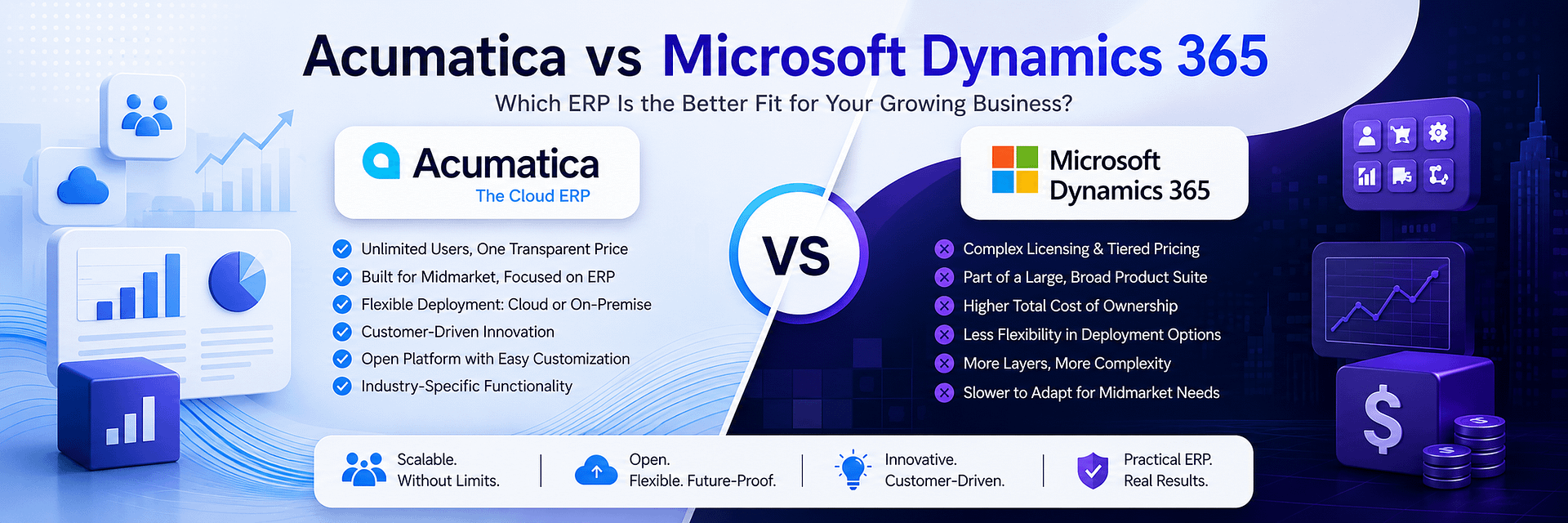
Acumatica vs Microsoft Dynamics 365
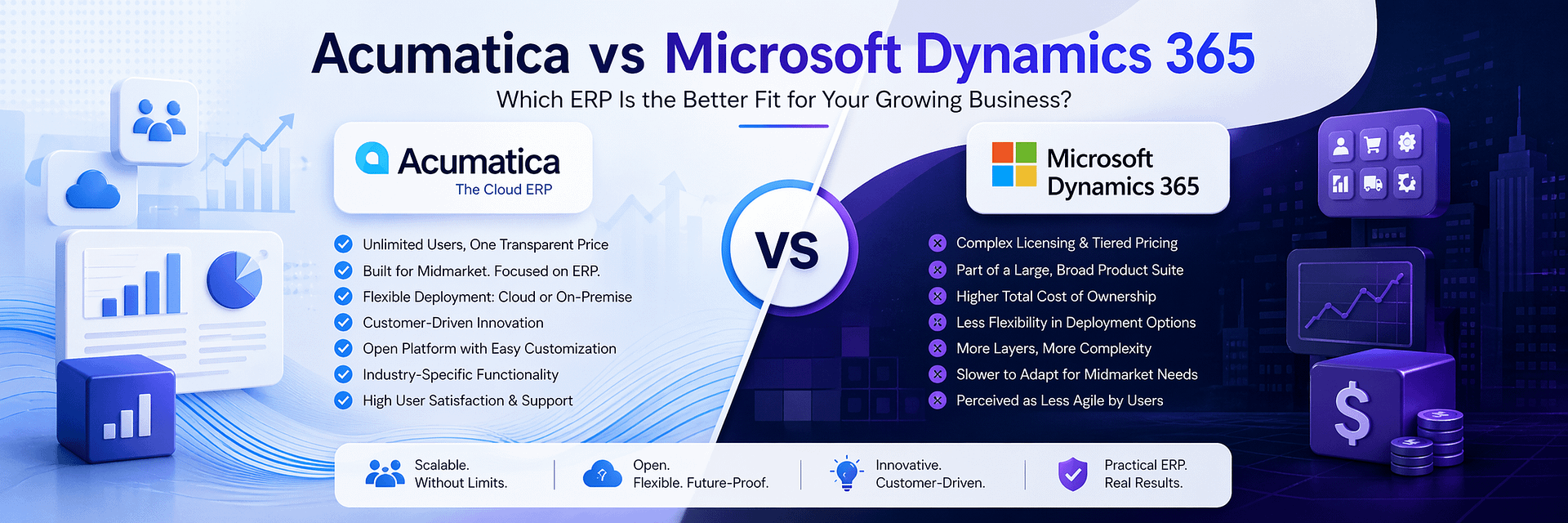
Acumatica vs Microsoft Dynamics 365: Why More Growing Businesses Are Choosing the More Practical ERP Path
When businesses start evaluating Acumatica vs Microsoft Dynamics 365, they are not simply comparing two software brands. They are choosing how finance, operations, inventory, reporting, supply chain workflows, project execution, and long-term growth will actually function inside the company. That is why this comparison matters so much. Both platforms are well-known. Both support modern business management. Both are credible ERP options. But once you move past brand recognition and surface-level feature lists, the difference becomes much more important.
The real question is not just which platform can do more on paper. The real question is which platform is more practical, more scalable, easier to own, easier to understand, and better aligned with the needs of growing businesses that want control without unnecessary complexity.
That is exactly where Acumatica vs Microsoft Dynamics 365 becomes such a meaningful ERP comparison.
Microsoft Dynamics 365 is part of a broad family of business applications that spans ERP, CRM, service, sales, finance, supply chain, commerce, and more. For some organizations, that broad ecosystem is attractive. But for many midmarket businesses, it also creates a more layered and more demanding ownership model. Companies often end up navigating multiple modules, multiple license types, multiple application boundaries, and a larger product story than they originally intended to buy.
Acumatica, by contrast, feels much more focused.
It is positioned as a modern cloud ERP platform specifically built for growing businesses that want flexibility, transparency, integrated functionality, and practical scalability. It is not trying to be everything for everyone across every Microsoft business application category. It is trying to be an ERP platform that businesses can actually live with, grow with, and adapt over time.
That difference matters more than many buyers expect.
In the Acumatica vs Microsoft Dynamics 365 conversation, Acumatica often comes out ahead not because Microsoft Dynamics 365 lacks functionality, but because Acumatica usually feels more coherent as an ERP choice. It is easier to explain. It is easier to justify. It is easier to scale across the organization. And it is often easier to shape around real operational needs without creating the sense that the ERP is part of a much larger suite strategy that the customer must constantly keep up with.
This is one of the biggest reasons more companies are taking a serious look at Acumatica ERP vs Dynamics 365 rather than defaulting to Microsoft because of name familiarity alone.
Why the Acumatica vs Microsoft Dynamics 365 Comparison Matters So Much
A lot of ERP buyers begin this comparison with the wrong question. They ask which system has more modules, more enterprise credibility, or more brand power. But ERP success is rarely decided there.
ERP success is decided by:
- how easy the platform is to adopt,
- how expensive it becomes as the business grows,
- how quickly the organization can adapt it to changing needs,
- how well the vendor understands the midmarket,
- and how practical the product remains after implementation.
That is why Acumatica vs Microsoft Dynamics 365 is not just a product comparison. It is a philosophy comparison.
One path is highly capable but broader, more layered, and more tightly tied to a large ecosystem strategy. The other is more focused, more ERP-centric, and more directly aligned with the needs of growing organizations that want modern capabilities without unnecessary heaviness.
This is where Acumatica has a real advantage.
Acumatica is designed around the idea that growing businesses need an ERP system that is adaptable, open, scalable, and usable across the whole business. That message is reflected in how it talks about unlimited users, flexible deployment, open APIs, customer-driven innovation, and practical usability. Microsoft Dynamics 365, on the other hand, is positioned as part of a larger business applications universe. That scale can be powerful, but it can also create more complexity than many businesses actually need.
When companies search for:
- Acumatica vs Microsoft Dynamics 365
- Acumatica ERP vs Dynamics 365
- Microsoft Dynamics 365 alternative
- best ERP for growing business
- Dynamics 365 Business Central alternative
- Acumatica vs Business Central
they are usually not looking for a theoretical comparison. They are trying to understand which ERP will actually be easier to live with in the real world.
That is where Acumatica becomes extremely compelling.
Focused ERP Platform vs Broad Business Application Suite
One of the most important differences in the Acumatica vs Microsoft Dynamics 365 debate is vendor focus.
Acumatica is fundamentally an ERP company. Its messaging, roadmap, platform philosophy, and pricing story are all centered on business management software for growing organizations. The product identity is clear. The vendor identity is clear. The customer promise is clear. Acumatica is focused on helping small and midsized businesses run finance, operations, inventory, projects, reporting, and industry workflows on a platform that is built to adapt.
Microsoft Dynamics 365 is different.
It is not just ERP. It is a much broader application family across CRM, service, sales, finance, supply chain, commerce, and more. That may sound like an advantage, and in some cases it is. But it also means the ERP buyer is stepping into a much wider ecosystem decision. The company is not merely evaluating one focused ERP path. It is often evaluating how various Microsoft business applications fit together over time.
For some enterprises, that is perfectly reasonable.
For many midmarket businesses, it is more than they actually want.
This is why Acumatica often feels more practical in the Acumatica vs Microsoft Dynamics 365 comparison. It is a product built to solve the ERP problem directly. The buyer does not need to sort through a broad family of app categories to understand the core value proposition. Acumatica feels more purpose-built for the ERP conversation itself.
That clarity matters.
Businesses do not just buy ERP functionality. They buy the long-term relationship with the platform. They buy the cost model. They buy the roadmap. They buy the complexity level. They buy the vendor’s attention.
And in that context, Acumatica often feels like the vendor whose attention is more directly centered on ERP success for the customer.
Licensing and Cost Growth: Why Acumatica Often Feels More Rational
Cost is one of the biggest reasons companies compare Acumatica vs Microsoft Dynamics 365 so carefully.
Not just year-one licensing cost.
Not just implementation cost.
But the long-term economics of growth.
This is one of Acumatica’s strongest advantages.
Acumatica is widely recognized for its unlimited user philosophy and transparent pricing logic. That is a major differentiator because growth usually means more people need access to ERP. Finance needs access. Warehouse teams need access. Managers need access. Operations leaders need access. Project teams need access. Decision-makers want dashboards. Controllers want visibility. The more structured the company becomes, the more people need to work in the system.
A platform that treats growth in user participation as normal will usually feel more aligned with real business growth.
That is exactly why Acumatica often feels like the more practical ERP.
In the Acumatica vs Microsoft Dynamics 365 comparison, Microsoft’s licensing structure can feel more layered. Business Central has Essentials, Premium, Team Members, device logic, attach scenarios, and broader licensing rules depending on the wider Microsoft environment. That does not make it unusable. But it does make the cost conversation feel more structured around products and user types.
Acumatica’s value story is simpler and stronger for many buyers:
- more access across the organization,
- less license anxiety as the team grows,
- more freedom to make ERP widely usable,
- fewer internal debates about who should and should not be inside the system.
That is not a small difference. It changes how the business behaves.
A company that adopts Acumatica is more likely to think:
“Let’s get more people into the system.”
A company dealing with a more tiered or user-sensitive structure may more often think:
“Who really needs access?”
That difference affects adoption, data quality, reporting accuracy, and process discipline.
This is one of the clearest reasons many buyers conclude that Acumatica ERP vs Dynamics 365 is not just a feature comparison. It is a practical operating model comparison.
Acumatica vs Microsoft Dynamics 365 for Midmarket Businesses
Midmarket businesses do not need bloated complexity. They need control, speed, flexibility, and a platform that can grow with them without becoming painful.
This is where Acumatica is especially strong.
Acumatica is consistently positioned toward small and midsized organizations that need a modern ERP system without the overhead of enterprise-style sprawl. Its platform story is built around open architecture, usability, industry specificity, scalability, and flexible deployment. That combination speaks directly to the midmarket.
Microsoft Dynamics 365 Business Central also targets SMB and midmarket organizations, and it absolutely has serious strengths. But it still lives inside a broader Microsoft business applications context. That larger context can sometimes make the ERP feel like one part of a bigger portfolio rather than the primary center of focus.
For buyers, this often translates into a very practical question:
Which ERP feels more like it was built for my business type and growth stage?
Very often, the answer is Acumatica.
That is especially true for companies in:
- distribution,
- manufacturing,
- construction,
- project-driven services,
- multi-entity operational growth scenarios.
In these environments, businesses want an ERP that is strong, modern, flexible, and practical. They do not want the buying and ownership experience to feel heavier than the actual business problem they are trying to solve.
That is why Acumatica vs Microsoft Dynamics 365 often ends with Acumatica being viewed as the more natural fit for the midmarket.
Deployment Flexibility and Long-Term Control
Another major reason Acumatica often looks better in the Acumatica vs Microsoft Dynamics 365 comparison is deployment flexibility.
Acumatica’s public positioning around public cloud and private cloud deployment creates a much stronger sense of control for many buyers. Businesses like having options. They like knowing the ERP can fit their infrastructure preferences, governance preferences, or long-term IT strategy. They like feeling that the platform is adaptable not just functionally, but architecturally.
That flexibility is part of what makes Acumatica feel more practical.
It is not just about where the software runs. It is about the mindset behind the product. A platform that allows more flexibility tends to feel less prescriptive. It feels more like a business system that can adapt to the company rather than a large ecosystem that expects the company to align with its structure.
In the Acumatica vs Microsoft Dynamics 365 discussion, this matters because ERP is not a lightweight app. It is a long-term operational backbone. Buyers naturally want more control over something that central.
Acumatica supports that mindset well.
Microsoft Dynamics 365, by design, is more deeply tied to Microsoft’s cloud and applications universe. For organizations that want exactly that, it can be a benefit. But for companies that want more flexibility and a more ERP-specific sense of control, Acumatica often looks better and more future-proof.
Customer Feedback, Product Direction, and Vendor Listening
This is one of the most important qualitative differences between the two.
Acumatica repeatedly emphasizes customer-driven innovation. That is not just marketing language. It is a meaningful product signal. The company’s public messaging consistently highlights that it works closely with customers, adapts based on feedback, and focuses on practical innovation rather than innovation for its own sake.
That resonates strongly in the ERP market.
Businesses do not want an ERP vendor that merely releases features. They want an ERP vendor that listens. They want roadmap movement that reflects real-world operational pain points. They want the feeling that their needs matter to the vendor.
Acumatica does a strong job creating that confidence.
In user-review comparisons, this has also shown up in product direction and satisfaction signals. That is important because product direction is one of the clearest indicators of whether customers feel the vendor is actually listening and evolving in a useful way.
Microsoft, by contrast, is operating at a much larger scale across many different business-applications priorities. That does not mean Microsoft ignores customers. It means the relationship can feel less focused for ERP buyers, especially midmarket buyers who want to feel that ERP itself is the vendor’s primary mission rather than one part of a massive enterprise software portfolio.
This is a very important difference in the Acumatica vs Microsoft Dynamics 365 comparison.
Acumatica feels closer to the user.
That matters.
Because in ERP, responsiveness is not cosmetic. It affects:
- feature relevance,
- workflow quality,
- industry alignment,
- support confidence,
- long-term trust in the platform.
Why Acumatica Often Feels More Practical Day to Day
A good ERP is not just one that looks impressive in a demo. It is one that remains practical every day after go-live.
This is where Acumatica consistently performs well in perception and positioning.
Acumatica often feels:
- more direct,
- more focused,
- more user-friendly in philosophy,
- more open in architecture,
- more scalable without becoming administratively heavy.
That practicality matters because day-to-day ERP value is created through:
– usability,
– reporting trust,
– workflow clarity,
– adoption across departments,
– easier scaling,
– lower friction in change.
In the Acumatica vs Microsoft Dynamics 365 decision, a lot of buyers initially pay attention to Microsoft’s ecosystem size. But later, many realize that ecosystem size is not always the same as ERP practicality.
Acumatica’s strength is that it usually feels like it was designed to help a growing business run better, not to pull the business into a broader suite story.
That is an important difference.
It is also why the phrase Microsoft Dynamics 365 alternative continues to have strong commercial relevance in search. Buyers are not necessarily rejecting Microsoft entirely. They are often looking for something more focused, more agile, and more practical.
Acumatica gives them that alternative.
Where Microsoft Dynamics 365 Still Makes Sense
A balanced comparison should say this clearly: Microsoft Dynamics 365 can absolutely make sense for some organizations.
If a company is already deeply standardized on Microsoft’s stack, wants maximum alignment with that broader ecosystem, and is comfortable with a broader product family approach, then Dynamics 365 can be a valid strategic choice.
Business Central also remains a serious ERP application for small and midsized businesses, and Microsoft continues investing in it.
But that does not remove Acumatica’s advantage.
Because the question is not whether Dynamics 365 can work.
The question is whether it is the most practical ERP choice for a growing business that wants clarity, flexibility, usability, and a more focused vendor relationship.
In many cases, it is not.
And that is exactly why Acumatica keeps gaining attention in the Acumatica vs Microsoft Dynamics 365 conversation.
Why More Businesses Are Choosing Acumatica
When buyers step back and look at the full picture, Acumatica often comes out ahead for very practical reasons:
- Acumatica offers a more growth-friendly licensing philosophy.
- Acumatica feels more focused as an ERP vendor.
- Acumatica supports flexible deployment options.
- Acumatica emphasizes customer-driven innovation.
- Acumatica often feels more usable and more coherent for midmarket buyers.
- Acumatica avoids some of the heaviness that can come with a broader suite strategy.
That is why so many businesses researching:
- Acumatica vs Microsoft Dynamics 365
- Acumatica ERP vs Dynamics 365
- Acumatica vs Business Central
- Microsoft Dynamics 365 alternative
- best ERP for midmarket business
end up seeing Acumatica as the better and more practical option.
It is not because Microsoft Dynamics 365 is weak.
It is because Acumatica is often better aligned with the real needs of growing businesses.
Final Conclusion
The best way to understand Acumatica vs Microsoft Dynamics 365 is this:
Microsoft Dynamics 365 is broad, credible, and powerful.
Acumatica is focused, practical, and easier to align with midmarket ERP reality.
For many businesses, that difference is decisive.
If your company wants an ERP system that is easier to scale, easier to justify, more focused on ERP itself, more flexible in deployment, more transparent in growth logic, and more closely shaped by customer feedback, Acumatica often comes out as the stronger choice.
That is why more growing businesses are choosing Acumatica.
Not because it is louder.
Not because it is bigger.
But because it is often simply the more practical ERP path.
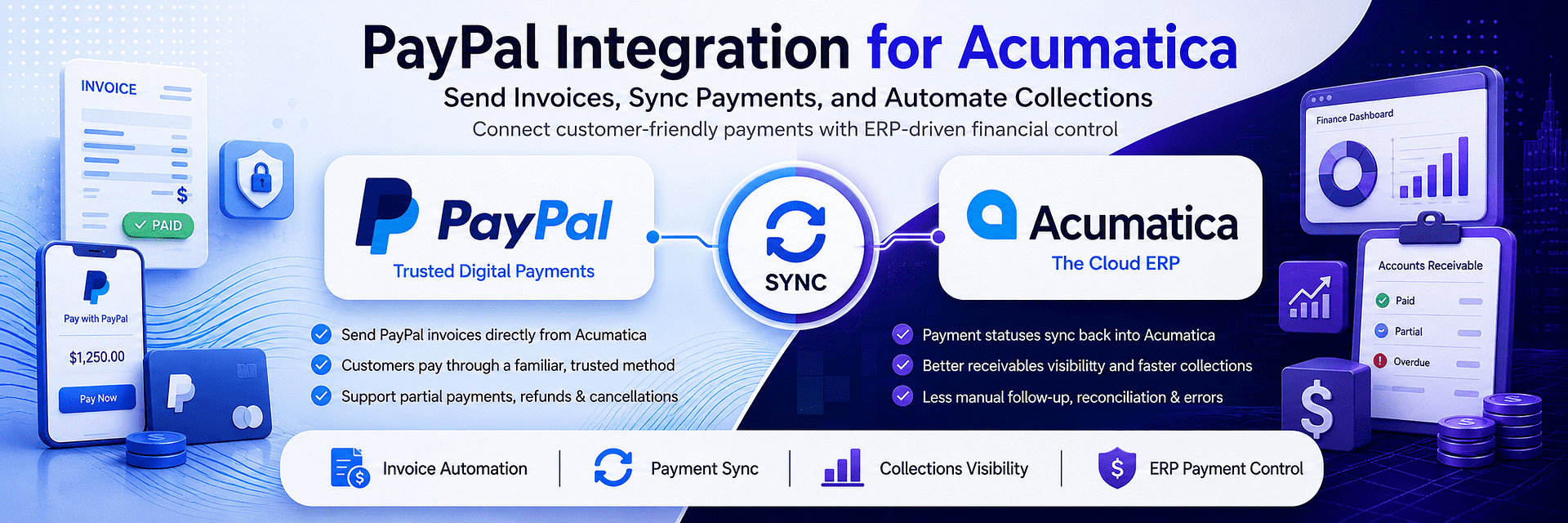
PayPal Integration for Acumatica
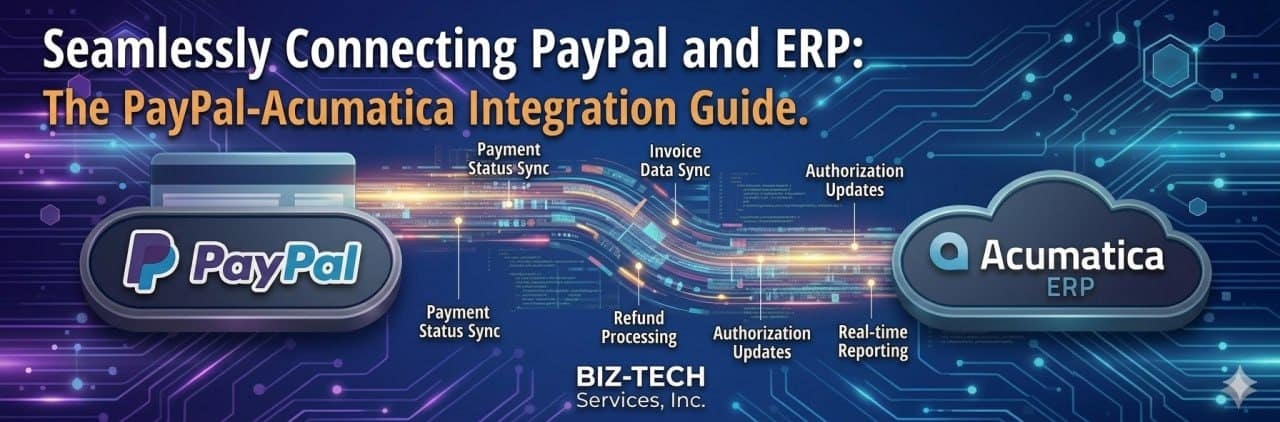
PayPal Integration for Acumatica: A Smarter Way to Send Invoices, Track Payments, and Automate Collections
For many growing businesses, the payment problem is not customer demand. It is the distance between getting paid and seeing that payment reflected accurately inside the ERP. Sales teams move fast. Finance needs control. Customers want a payment method they already trust. Management wants real-time visibility into invoice status, incoming funds, refunds, cancellations, partial collections, and transaction history. But when PayPal lives in one environment and Acumatica lives in another, the business ends up spending too much time on manual follow-up, reconciliation, status checks, and exception handling.
That is exactly why PayPal Integration for Acumatica has become such a high-value search topic for modern businesses. Companies are no longer looking for a basic payment add-on. They are looking for a true Acumatica PayPal Integration that turns payment collection into a controlled, visible, and scalable business process. They want to send PayPal invoices directly from Acumatica. They want to monitor statuses without jumping between systems. They want PayPal Payment Synchronization to happen reliably. They want accounting accuracy. They want faster collections. And they want a better customer payment experience without increasing internal workload.
This is where Biz-Tech PayPal Integration stands out.
Our PayPal Integration is built specifically to connect Acumatica ERP with the PayPal ecosystem in a way that is practical for real businesses. It helps teams send invoices directly from Acumatica, track invoice and payment status, synchronize payment data once funds are received, and manage the payment lifecycle with far less manual effort. Instead of treating PayPal as an external payment island, the Biz-Tech Acumatica PayPal Connector turns PayPal into a connected part of your ERP-driven finance workflow.
That difference matters.
A business can use PayPal without integration. But without a real PayPal ERP Integration, the company still has to bridge the gap manually. Someone sends an invoice from one place. Someone checks status in another. Someone updates Acumatica later. Someone handles refunds separately. Someone tries to explain why a payment appears completed in PayPal but still looks open inside ERP. Over time, the organization ends up with more transactions, more customers, and more operational noise.
A strong PayPal Acumatica Integration removes that noise.
It creates a cleaner order-to-cash process. It gives finance a better view of receivables. It helps accounting stay aligned with real payment activity. It reduces manual follow-up. It improves customer convenience. And it gives leadership something every growing company eventually needs: confidence that payment data is current, accurate, and usable.
This is why businesses searching for PayPal Integration, PayPal Integration for Acumatica, Acumatica PayPal Payments, PayPal Invoice Sync, Acumatica PayPal Connector, PayPal Business Integration, and ERP payment automation are not just looking for connectivity. They are looking for control.
Why PayPal Still Matters for Business Payments
There is a reason PayPal continues to be one of the most recognized and widely used digital payment platforms in business. Customers already know it. They trust it. They are comfortable paying through it. It reduces payment hesitation. It supports fast invoice settlement. And in many B2B and service-oriented scenarios, it can accelerate collections far more effectively than slower, more cumbersome payment methods.
But PayPal becomes far more valuable when it is part of a connected ERP workflow.
Without PayPal Integration for Acumatica, businesses often get only the surface-level convenience of PayPal while keeping all the back-office friction. Customers may find payment easy, but internal teams still deal with manual status checks, disjointed payment records, delayed updates, and scattered refund handling. The customer experience may look modern from the outside while the finance process remains inefficient on the inside.
That is not enough for a serious business.
A modern company needs a payment method that customers prefer and an internal workflow that finance can trust. That is why Acumatica PayPal Integration is no longer just a convenience feature. It is a process improvement strategy.
With the Biz-Tech PayPal Integration, businesses can use PayPal as more than a payment option. They can use it as part of a synchronized financial workflow inside Acumatica. This gives teams a better way to manage invoices, payment statuses, customer payment behavior, and financial follow-through without constant switching between platforms.
That is what makes PayPal Business Integration valuable. It is not just about helping customers pay. It is about helping the business operate better after the invoice is sent.
Send PayPal Invoices Directly from Acumatica
One of the strongest advantages of the Biz-Tech PayPal Integration for Acumatica is the ability to send PayPal invoices directly from the ERP.
This is a major operational improvement because invoicing should begin where customer and receivables data already lives. If a business is already using Acumatica to manage AR activity, sales orders, invoicing logic, and financial processing, then payment requests should not be forced into a separate disconnected workflow.
With a proper Acumatica PayPal Connector, invoicing becomes faster, cleaner, and more consistent.
Instead of exporting data or manually rebuilding payment requests somewhere else, users can generate PayPal invoices directly from Acumatica. This reduces duplication. It lowers error risk. It keeps billing activity closer to the ERP record. It helps teams move faster. And it gives businesses a stronger audit trail from invoice creation through payment completion.
This is especially important for businesses with multiple billing patterns. Some organizations generate payment requests from Sales Orders. Others work from AR Invoices. Others need flexibility around AR Payments, deposits, partial collections, or milestone-based billing. A weak payment tool often struggles once a business uses more than one billing path. A strong PayPal Integration for Acumatica must support the way real businesses actually invoice.
That is one reason the Biz-Tech solution is easy to recommend. It is designed for business workflow flexibility, not just one narrow use case.
For companies searching terms like PayPal Invoice Sync, PayPal invoice automation, Acumatica payment request, and PayPal invoice from ERP, this is exactly the kind of functionality that matters. The question is not whether PayPal can collect money. It can. The question is whether your ERP can remain the center of control while PayPal handles customer-facing payment collection. With Biz-Tech PayPal Integration, the answer is yes.
Quick Setup for Immediate End-to-End Processing
A lot of integrations sound useful until setup begins. Then the business discovers that “integration” really means lengthy technical work, fragile dependencies, and more operational overhead than expected.
That is not what businesses want from a payment workflow solution.
They want quick value. They want a clean configuration process. They want to go live without turning payments into an IT project. And they want end-to-end processing that works as soon as the foundation is in place.
This is another area where the Biz-Tech PayPal Integration for Acumatica is positioned strongly. The setup is straightforward and built around the things businesses already manage in Acumatica: Payment Methods and Customer records. Once customers have a PayPal-enabled Payment Method and a valid email address, invoices can be sent directly from Acumatica through the connected workflow.
That matters because businesses searching for PayPal Integration are rarely looking for a science experiment. They are looking for a solution they can use.
Quick setup creates immediate business benefits:
- faster invoice delivery,
- faster customer response,
- shorter time to collection improvement,
- less manual preparation work,
- cleaner handoff between finance and customer payment action.
And because the workflow is not locked into a single invoice origin, the integration supports real operational flexibility. Businesses can generate payment requests from multiple entry points instead of forcing all invoice logic into one artificial process.
That is why Acumatica PayPal Integration should never be measured only by whether it technically connects. It should also be measured by how quickly it becomes useful.
The Biz-Tech solution becomes useful fast.
Secure Payment Data Synchronization and Real-Time Visibility
One of the biggest hidden costs in payment operations is uncertainty.
Did the customer pay?
Did the payment clear?
Is the ERP updated?
Are we looking at current status or outdated status?
Has finance already processed it?
Is the invoice still open?
Can the customer account be released?
Do we need follow-up or not?
These questions sound small until they happen across dozens or hundreds of invoices. Then they become a real operational drag.
This is exactly why PayPal Payment Synchronization is such a critical part of a serious PayPal ERP Integration.
With the Biz-Tech PayPal Integration, payment statuses can be synchronized so that Acumatica reflects the latest state of the PayPal invoice and payment. Users can retrieve updated payment status directly, and for operational efficiency, teams can process multiple payments simultaneously using a dedicated PayPal Payment Processing screen.
This is not just a feature. It is a business upgrade.
Real-time or on-demand status visibility improves:
- finance accuracy,
- cash visibility,
- receivables management,
- internal communication,
- management reporting,
- confidence in collection status.
Without PayPal Acumatica Integration, businesses are forced into a weaker model. Someone must log into PayPal, verify payment, then go back and update the ERP or explain the difference. That may be manageable at low volume. It becomes a problem at scale.
With a strong Acumatica PayPal Connector, that ambiguity is reduced. The ERP becomes more trustworthy because payment status is no longer disconnected from payment reality.
This is one of the strongest SEO and commercial angles for the solution because companies searching for PayPal Payment Synchronization, real-time PayPal status in Acumatica, PayPal payment tracking, and Acumatica PayPal Payments are almost always feeling this pain already.
Full Control Over Payments, Refunds, and Cancellations
A payment workflow is only as strong as its exception handling.
Sending an invoice is the easy part. Real business complexity begins when a payment must be cancelled, a refund must be issued, a partial collection must be handled, or a staged payment needs to be tracked properly over time.
This is why the Biz-Tech PayPal Integration for Acumatica is much stronger than a basic send-and-forget connector.
The integration supports full control over the payment lifecycle. Unpaid invoices can be cancelled directly from Acumatica, triggering the appropriate PayPal-side notification while removing the payment record from the system. Refunds can be initiated within Acumatica. Full refunds can be processed automatically. Partial refunds initiated in PayPal can be synchronized back into Acumatica. Users can access payment details, invoice statuses, and transaction history in one place. Businesses can also generate payment requests at multiple stages of the sales cycle, making it easier to manage deposits, partial collections, and final settlements.
This is a significant advantage.
A lot of businesses do not realize how important full lifecycle control is until something goes wrong. Then they discover whether their integration actually supports the business or just handles the simplest case.
A serious PayPal Integration for Acumatica should support:
- unpaid invoice cancellation,
- full refunds,
- partial refund visibility,
- transaction history access,
- deposit workflows,
- partial collections,
- final settlement requests.
The Biz-Tech solution supports exactly the kind of control that growing businesses need once payment operations become more nuanced.
This makes the product easier to position not just as a payment connector, but as a real Acumatica payment workflow solution.
Improved Customer Experience and Faster Collections
Many payment articles focus only on what the business sees. That is incomplete.
The customer side matters too.
A customer is more likely to pay quickly if the payment experience is familiar, clear, and low-friction. PayPal already has an advantage here because of brand trust and ease of use. But the Biz-Tech PayPal Integration adds another layer of value by helping businesses send secure payment links directly to customer email from the ERP workflow.
That means the customer experience becomes simpler:
- the invoice arrives directly by email,
- the payment link is secure,
- payment is fast and familiar,
- guest checkout is supported,
- the customer does not even need a PayPal account to complete payment.
This is extremely important.
Many businesses lose time and money not because customers refuse to pay, but because the payment process is unnecessarily inconvenient. Every extra barrier slows collection. Every confusing payment step increases delay. Every unclear payment flow increases the need for follow-up.
A good PayPal Business Integration reduces those barriers.
That leads directly to:
– faster payments,
– improved collection speed,
– better customer satisfaction,
– less payment-related support overhead,
– less chasing by the finance team.
For businesses comparing payment workflows, this is one of the strongest commercial arguments. The right PayPal Integration for Acumatica improves not only internal finance control, but also external payment ease.
That is why this solution is easy to sell natively. It helps both the company and the customer at the same time.
Why Biz-Tech PayPal Integration Is the Right Solution
There are many ways to describe a software product. Some are technical. Some are generic. Some say almost nothing beyond “we connect two systems.”
That is not persuasive enough for a serious buyer.
The better positioning is simple:
Biz-Tech PayPal Integration for Acumatica helps businesses send PayPal invoices directly from ERP, synchronize payment status, manage refunds and cancellations, support deposits and partial collections, improve accounting visibility, and deliver a better customer payment experience.
That is not a vague integration message. That is a business operations message.
For companies searching terms like:
- PayPal Integration
- PayPal Integration for Acumatica
- Acumatica PayPal Integration
- Acumatica PayPal Connector
- PayPal ERP Integration
- PayPal Business Integration
- PayPal Invoice Sync
- PayPal Payment Synchronization
- Acumatica PayPal Payments
- ERP payment automation
the message should be clear:
This solution is designed to reduce friction across the payment lifecycle, not just create a technical connection.
That is why Biz-Tech’s positioning is stronger. It is not merely “PayPal works with Acumatica.” It is that Acumatica becomes a better financial control center because PayPal is integrated properly.
Final Word: Better Payments, Better Visibility, Better Control
Businesses do not need more payment complexity. They need fewer manual steps, better visibility, faster collections, and a payment process that feels natural for both the finance team and the customer.
That is exactly what PayPal Integration for Acumatica should deliver.
If your company is searching for a reliable Acumatica PayPal Integration, a practical Acumatica PayPal Connector, or a stronger PayPal ERP Integration that goes beyond basic invoice sending, the right answer is a solution that keeps invoicing, payment tracking, synchronization, refunds, cancellations, and customer communication connected inside one controlled workflow.
That is what Biz-Tech PayPal Integration is built to do.
It helps businesses:
- send PayPal invoices directly from Acumatica,
- improve payment workflow speed,
- track payment status accurately,
- synchronize payment information,
- manage refunds and cancellations with more control,
- support deposits, partial collections, and final settlements,
- improve customer experience with secure PayPal payment links and guest checkout,
- gain stronger visibility into customer payments and receivables.
In other words, this is not just a PayPal Integration.
It is a smarter way to run payments inside Acumatica.