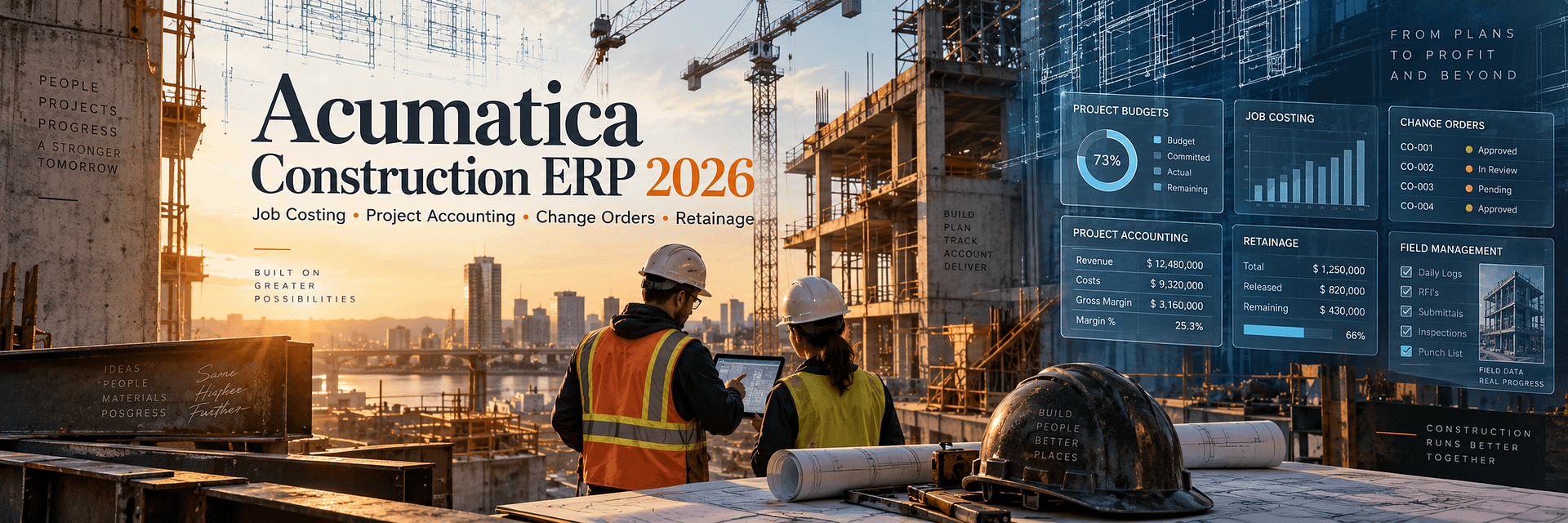

Acumatica Agentic ERP 2026 Guide to AI Automation and Data
Understanding
Agentic ERP in Acumatica Back to TOC
Acumatica Agentic ERP in 2026 gives growing businesses a
practical way to combine ERP data, AI automation, conversational analysis, and
intelligent workflows inside governed business processes. Acumatica 2026 R2,
generally available on October 1, 2026, adds capabilities that can interpret
business context, work with approved data, apply defined instructions, and take
a constrained action. In this guide, agentic ERP describes a direction rather
than a separate Acumatica product name. The released capabilities come from AI Assistant, AI Automation, AI Anomaly
Detection, AI Studio, and Model Context Protocol. Combined with
Generic Inquiries, endpoints, Business Events, import scenarios, and workflows,
these tools move AI beyond a detached chatbot and into governed ERP work.
Acumatica
Ascent and AI Readiness Back to TOC
We are pleased to have earned the 2026 Inaugural ASCENT
Badge, reflecting our commitment to staying current with Acumatica’s AI
direction and applying that knowledge to real-world ERP solutions. Acumatica Ascent 2026
included an AI readiness session covering Acumatica’s built-in AI tools, AI
Studio with external large language models, and the broader role of integrated
AI agents. That partner education is valuable because the important question is
whether AI can use the right operational context, stay within approved
boundaries, and produce an outcome that users can review and trust.
The Governed
Data Foundation Back to TOC
The data foundation begins with Acumatica’s existing
business structure. An agent does not need unrestricted database access to be
useful. On the Agents form in 2026 R2, Acumatica can provide tools that
retrieve the current record, update editable fields or detail lines, and
retrieve supporting information from published Generic Inquiries. The endpoint
selected for the target form determines which fields the current-record tools
can see and change. A Generic Inquiry can add the supporting context needed for
a decision, such as expected prices, open invoices, inventory availability,
project status, or exception data.
AI Assistant
for Conversational ERP Back to TOC
AI Assistant provides the conversational layer for questions
and analysis. Administrators decide which published Generic Inquiries are
exposed, then describe the inquiry, fields, and parameters in business language
so the assistant can connect a user’s wording to the correct data source. Users
can ask operational questions in everyday language, follow links to the
underlying records, and receive results as text, tables, charts, or pivot-style
views. The assistant can use the open form or record as context for
product-help questions, retain follow-up context in a chat, and turn useful
results into widgets that users can add to dashboards. Acumatica’s 2026 R2 documentation
positions AI Assistant as the place to explore and understand authorized data;
record updates belong to the separate AI Automation capability.
AI Automation
and Controlled Execution Back to TOC
AI Automation adds controlled execution. Acumatica agents
can retrieve the current record with the get_current tool, use one or more
published Generic Inquiries for supporting data, apply the instructions defined
for the agent, and write permitted results through the patch_current tool. The
result might be a summary, a classification, a fixed status value, a note, or
an update to an editable field or detail line. Acumatica documents examples
such as recognizing expense receipts, tagging files, summarizing service cases,
and comparing sales-order prices with expected values. A user can start an
activated agent from the target form, but the same agent action can also be
called by a configured process.
Agentic
Workflows and Business Events Back to TOC
That process control is what makes the workflow agentic. A
record change, schedule, user action, import, or other configured event can
start the sequence. The process invokes the agent, the agent writes its result,
and a later Business Event or workflow step can evaluate that result before
running another agent, sending a notification, creating a task, or invoking
another configured action. Beacon describes this sequence as an
agentic workflow. The boundaries are explicit: an agent works with
the current record on its target form, can update only fields and detail lines
exposed through the endpoint and editable on that form, and cannot create a new
record on the target form or invoke arbitrary form actions. The surrounding
workflow supplies those steps.
Anomaly
Detection and Exception Management Back to TOC
AI Anomaly Detection strengthens this pattern by identifying
unusual values before an agent or employee decides what to do. Acumatica can
analyze configured Generic Inquiry data, learn expected patterns for dimensions
such as vendors, items, or customers, and rank exceptions by severity. One
documented scenario combines anomaly results with an AI Automation agent that
compares sales-order unit prices with expected values and writes a summary back
to the order. The practical benefit is management by exception: employees spend
less time searching every transaction and more time investigating the records
that merit attention.
Native Data
Warehouse and Analytics Back to TOC
Acumatica 2026 R2 also expands the platform underneath
reporting and AI. The Native Data Warehouse
provides a dedicated, performance-optimized copy of ERP data for reporting and
analytics, reducing competition with order entry, invoicing, approvals, and
other transactional work. Acumatica describes this as a foundation that will
continue to expand. InsightXL connects live Acumatica data to Excel, while
dashboards, financial statements, AI Assistant, and external AI tools provide
other ways to work with governed information. These capabilities support a
consistent data strategy even though each surface serves a different task.
Model Context
Protocol and External AI Back to TOC
Model Context Protocol extends selected Acumatica data to
compatible external AI clients and custom applications. An administrator
configures an MCP server and exposes published Generic Inquiries as callable
tools. The tool definition, input parameters, output fields, filters, sorting,
field selection, and pagination come from the inquiry. External clients
authenticate through OAuth 2.0, each request runs on behalf of the signed-in
Acumatica user, and access rights are checked when tools are discovered and again
when they are called. MCP tool calls are logged in Acumatica.
In the current 2026 R2 design, MCP tools retrieve data from published Generic
Inquiries; they do not provide a general-purpose path for an external model to
write freely into ERP records.
Data
Governance Security and Monitoring Back to TOC
Governance depends on deliberate data design. Acumatica
recommends that each Generic Inquiry return exactly the information the model
needs and no more. Required columns should be active, descriptive captions
should explain unfamiliar fields, conditions and parameters should narrow the
records, and Select Top limits should control volume. Totals, averages, date
differences, and other calculations should be performed in the inquiry when
possible instead of asking a language model to calculate across a large result
set. For AI Automation, masking applied to values from the current-record tool
does not automatically mask sensitive columns returned by a Generic Inquiry
tool. Sensitive columns therefore need to be removed, filtered, or otherwise
protected in the inquiry itself.
Testing and monitoring complete the control model. Teams can
test an agent against an example record before activation and review the tools
called, call order, messages, timing, token consumption, results, and errors in
the processing log. Production executions appear in AI Automation History.
Reusable Agent System Instructions can centralize security, safety, and
governance guidance. These controls do not guarantee a correct result, so
implementation should define a human review point wherever an agent affects
pricing, credit, payments, regulatory information, customer commitments, or
other material business decisions.
Practical
Implementation Roadmap Back to TOC
A sound rollout starts with one narrow workflow whose input,
output, owner, and review criteria are already understood. A finance team might
begin with an exception summary for unusual vendor invoices. A distributor
might use an agent to explain sales-order price deviations. A service
organization might summarize a long case history before a representative
responds. The team can then measure accuracy, review time, exception volume,
user adoption, token use, and the frequency of manual corrections before adding
more records, more tools, or more autonomous steps. This staged approach keeps
the business process visible while the organization learns where AI judgment is
reliable and where deterministic rules remain the better choice.
By combining deep Acumatica experience with practical AI
capabilities, we help businesses improve automation, gain better insights,
streamline operations, and create greater value from their ERP environment.
Biz-Tech Services can help identify suitable use cases, design focused Generic
Inquiries, configure endpoints and agent instructions, align access rights,
establish review controls, and test the complete workflow before production
use. The goal is a useful agentic capability grounded in the company’s own
processes and governed Acumatica data.
The phrase agentic ERP is useful when it describes a
connected operating model rather than a marketing label. A general-purpose
assistant may produce a plausible answer from a prompt, but an ERP agent must
understand which company, branch, warehouse, customer, vendor, project, or
transaction is in scope. It must also know what the user is allowed to see and
what the process permits it to change. Acumatica’s approach keeps those
questions close to the configuration that already governs daily work. Forms,
endpoints, Generic Inquiries, access rights, workflows, and Business Events
become the practical guardrails around the model. The result is not
unrestricted autonomy. It is a bounded service that can reason over selected
business context and return a result to a process that people already
recognize.
Generic Inquiries are especially important because they turn
operational data into a reusable contract. The inquiry designer defines the
tables, joins, filters, parameters, calculated fields, sorting, and output
columns. That definition can be reviewed by a functional expert who understands
the business question. When the same inquiry is used for a dashboard, an AI
Assistant question, an MCP tool, or an AI Automation agent, the organization
has a clearer opportunity to compare the result with the report users already
trust. It also becomes easier to improve the data source without rewriting
every prompt. A focused inquiry with clear field captions is usually more
valuable than a broad extract that forces the model to infer relationships from
columns that were never intended for conversation.
The quality of an AI answer therefore begins before a
language model is selected. A team should first state the question in business
terms, identify the record or population that answers it, and decide how much
context is enough. For example, an inquiry that supports an invoice exception
review may need the vendor, document number, date, amount, currency, approval
status, due date, and exception reason. It may not need every address field,
internal key, or historical note. When the input is constrained, the model has
fewer opportunities to confuse unrelated values, and the user has a more direct
path from the response to the source record. This is a data design decision as
much as an AI decision.
AI Assistant administration reflects the same principle. An
inquiry should be published, exposed deliberately, and described in language
that reflects how employees ask questions. Descriptions can explain what the
inquiry returns, which filters matter, what a parameter means, and when a user
should choose another source. Field captions should be understandable without
requiring the user to know database terminology. Access rights remain the
foundation: exposing an inquiry to the assistant does not replace the
permissions that control the underlying Acumatica data. The assistant can help
users find and interpret authorized information, but it should not become a
shortcut around role design or row-level business rules.
AI Automation requires an additional distinction between
understanding and execution. The language model can interpret instructions and
select an action, but Acumatica still determines which form is targeted, which
endpoint is used, and which fields are editable. The agent’s system
instructions can define the task, expected output, escalation behavior, and
restrictions. The form supplies the current record, while Generic Inquiries
supply carefully selected context. If a result must be written, the target field
should be chosen because it is a meaningful part of the business process, not
because it happens to be technically available. This keeps the outcome visible
to employees and compatible with existing approvals, inquiries, and downstream
reporting.
The workflow around an agent deserves as much attention as
the agent itself. A Business Event can watch for a defined condition, a
schedule can run a review at a controlled interval, or a user can start an
action from a form. The agent may classify or summarize the current record,
then a deterministic workflow can route the result. For example, a fixed result
value can trigger a notification or create a review task, while a different
value can leave the record untouched. This separation makes the process easier
to explain and test. It also avoids asking a model to perform a series of
unrelated side effects when ordinary Acumatica configuration can perform them
predictably.
This is why the documented limits on agents are useful
design constraints. An agent cannot create a new record on the target form or
invoke arbitrary actions simply because a prompt requests it. It works within
the current record and the editable fields or detail lines exposed by the
configured endpoint. If a business process needs a new record, a release, an
approval, or another formal action, the implementation can place that step in a
workflow, import scenario, or Business Event with its own permissions and audit
trail. The model contributes interpretation where it is helpful; the ERP
process remains responsible for controlled state changes.
Anomaly Detection adds another practical signal. Many teams
do not need an AI system to decide every transaction; they need help finding
the small percentage that deserves attention. A configured Generic Inquiry can
provide the dimensions and values used to learn expected patterns. The
resulting anomalies can be ranked, displayed, and passed to an automation agent
for explanation or comparison. This can support reviews of prices, unusual
quantities, unexpected expense values, or other operational measures. The
important outcome is not a mysterious score. It is a traceable exception that
points an employee toward the record, the relevant values, and the next
decision.
Data sensitivity must be considered at every handoff.
Current-record masking and inquiry design solve different problems. A value
hidden in the current record may still be returned if the same information is
included as a column in a Generic Inquiry tool. For that reason, sensitive data
should be excluded from the inquiry, limited by conditions, or made available
only through a role and process that require it. The same review applies to
external MCP tools. A published inquiry becomes part of a tool definition that
another client can discover and call, so its name, description, parameters,
output columns, and access rights should be treated as an intentional public
interface within the organization’s trusted AI environment.
MCP is most useful when it connects an external assistant to
a small set of well-designed, read-oriented business questions. A tool that
returns open receivables by customer, orders awaiting approval, or inventory
below a planning threshold can be clear and testable. A tool that exposes
dozens of loosely related columns across many joins is harder to secure and
harder for a model to use correctly. Acumatica’s OAuth 2.0 flow and per-user
authorization help establish identity, while tool logging helps administrators
understand what was requested and returned. Teams should still control the
number of tools, use stable names and descriptions, and review whether each
tool has a real business owner.
The Native Data Warehouse can support a complementary
pattern for analytics at scale. Transactional screens are optimized for people
entering and approving work, while a performance-optimized copy can support
broader reporting and historical analysis. That separation helps protect the
responsiveness of daily ERP operations when a dashboard or analytical question
scans a larger population. It also creates a common place to align definitions
for measures and dimensions used in financial statements, InsightXL,
dashboards, and future AI experiences. The warehouse is not a replacement for a
transactional inquiry when an agent must work with the current record, but it
can be a strong foundation for trend analysis, planning, and management
insight.
A responsible implementation also distinguishes managed
capabilities from configurable ones. Acumatica provides built-in AI experiences
such as AI Assistant and AI Anomaly Detection, while AI Studio and AI
Automation support configuration that may involve an external large language
model provider. The available model, data path, retention terms, and
administrative controls should be reviewed with the organization’s security and
compliance stakeholders. The safest claim is not that every model will behave
identically. The safer approach is to configure the process so that the model
receives only the context it needs, produces an observable result, and cannot
bypass the controls that would apply to a human user.
Testing should include ordinary records, edge cases,
incomplete values, contradictory values, and records that the user cannot
access. An example record helps a team check whether the agent calls the right
tools and writes the expected field. The processing log can reveal unnecessary
calls, excessive context, unexpected token use, or a sequence that does not
match the intended process. AI Automation History provides a place to review
production executions. These records are valuable for improving instructions
and inquiries, but they are also part of operational accountability. A team
should agree in advance who reviews failures, how corrections are made, and
when an agent is paused.
The first production use case should be narrow enough to
measure. A finance team could begin with a daily list of unusual invoice values
and a short explanation for each exception. A distribution team could compare
order prices against an approved expectation and route only deviations. A
service team could create a concise case summary for a representative while
preserving the full history in Acumatica. A project team could review budget or
commitment anomalies before a manager’s meeting. Each example starts with a
data source, a clear output, and a human who can confirm whether the result is
useful. That makes it possible to improve the process without pretending that
every ERP decision can be automated at once.
Measures should reflect business value as well as model
behavior. Useful indicators include the time required to review an exception,
the percentage of results accepted without correction, the number of records
routed for human attention, the rate of false positives, the number of tool
calls, and the cost or token use associated with a run. Adoption matters too:
if users do not trust the explanation or cannot reach the source record, a
technically accurate answer may still fail in practice. Feedback should flow
back into the Generic Inquiry, the agent instructions, the workflow, or the
role design rather than being handled only as a prompt change.
Human oversight is not a weakness in an agentic ERP design.
It is a way to place judgment where it has the greatest business value.
Deterministic rules remain appropriate for calculations, approvals, required
fields, and repeatable routing. An AI agent is useful when language, context,
and comparison make the work difficult to express as a fixed rule. The
strongest solutions combine both: the model interprets a case, the ERP
validates permitted values, and a person reviews decisions that carry material financial,
customer, or regulatory consequences. This balance creates room for automation
while keeping responsibility visible.
For Biz-Tech Services, the practical opportunity is to help
customers move from an interesting demonstration to a durable ERP capability.
That means mapping a business question to the right Acumatica data, designing a
focused inquiry, configuring the agent and endpoint, checking roles and
sensitive fields, testing ordinary and exceptional records, and documenting the
review path. It also means explaining what the agent cannot do and where a
workflow or human approval remains necessary. The Ascent experience reinforces
the importance of current Acumatica knowledge, but the outcome customers need
is concrete: less manual searching, faster exception handling, clearer insight,
and more consistent execution across the process.
A useful discovery workshop asks a few direct questions.
Which decision takes too long today? Which records are reviewed repeatedly?
What evidence does a reviewer need before acting? Which values are
confidential? What should happen when the data is incomplete? The answers
define the first inquiry and the first agent more reliably than a generic
request to add AI. They also expose whether the current process is ready. If
users disagree about the definition of an exception, the organization may need
to clarify the business rule before introducing a model. If the needed fields
are not available through a stable form or inquiry, data preparation is part of
the project rather than a problem to hide in a prompt.
Prompts and instructions should be written as operational
guidance. They can tell an agent what to compare, how to describe a result,
which values are acceptable, and when to ask for human review. They should not
rely on hidden assumptions about abbreviations, local jargon, or a user’s
memory of an earlier conversation. A good instruction also explains what to do
when no matching record is found, when more than one record qualifies, or when
the supporting inquiry returns conflicting values. These details make testing
repeatable and reduce the risk that a fluent answer will conceal an unresolved
data question.
The target endpoint deserves a functional review because it
defines the boundary between a useful suggestion and a permitted update. Teams
should confirm which fields are editable, whether detail lines are exposed, how
values are validated, and how the updated record appears to a person opening
the form. A field that looks suitable for a note may not be suitable for a
workflow condition. A calculated value may be visible but not writable. An
agent should write to fields that have a clear meaning in the process and
should preserve the auditability that employees expect from ordinary Acumatica
changes.
External model connectivity should be evaluated with the
same care as any other integration. The implementation team should document
which data leaves the ERP boundary, which provider processes it, how
authentication is managed, and how failures are handled. Where a managed
Acumatica capability is sufficient, it may reduce configuration and operational
overhead. Where an external provider is needed, the project should define the
permitted data, retention expectations, regional requirements, and monitoring responsibilities
before activation. The best architecture is the one that meets the business
need with the smallest necessary exposure.
An agentic workflow can improve employee experience without
removing employee visibility. A user may see the original record, the relevant
inquiry results, the agent’s explanation, and the field or status that changed.
A notification can link directly to the item needing review. A dashboard can
show the volume and age of exceptions rather than only the number of successful
model calls. This makes the capability part of daily work instead of a separate
AI destination. When employees can understand the source and correct an output,
feedback becomes a practical source of continuous improvement.
The same design can support different roles while preserving
their responsibilities. A clerk may receive a concise exception explanation, a
supervisor may see the supporting values and approve a route, and an
administrator may review the processing log or adjust a Generic Inquiry.
Role-specific access should be designed intentionally rather than assuming that
a single broad agent is appropriate for everyone. Published data sources,
target forms, and workflow actions can be aligned with the responsibilities already
represented in Acumatica roles. This helps the organization scale use without
turning a helpful assistant into an uncontrolled shared credential.
Agentic ERP is therefore best understood as a disciplined
extension of Acumatica configuration. The data source is explicit, the model
task is bounded, the action is limited, and the result is placed back into a
process that can be reviewed. As the organization learns, it can add another
inquiry, another agent action, or another workflow branch while keeping each
change understandable. That incremental path is more durable than attempting to
automate an entire department in one step. It lets business owners, security
teams, and technical specialists evaluate the same evidence and decide where
the next investment will create value.
Documentation should travel with the configuration. For each
inquiry and agent, record the business purpose, owner, source fields,
parameters, permissions, expected result, review point, and fallback procedure.
Note whether the result is advisory or whether it writes to a field that drives
another process. A short runbook can explain how to pause an agent, inspect a
failed execution, correct a source inquiry, and communicate a change to users.
This information protects the investment when the original implementer is not
available and gives auditors or security reviewers a clear account of why the
capability exists.
Change management matters because agentic features alter how
people divide work with the ERP. Training should show the data source behind an
answer, the difference between a recommendation and a saved update, and the way
a user can challenge or correct a result. Teams should agree on language for
uncertainty and exceptions instead of encouraging employees to accept a
confident response automatically. A small pilot group can provide examples of
confusing field captions, missing parameters, or unnecessary notifications.
Those observations often improve the process faster than adding a more
elaborate prompt.
The long-term value comes from repetition and learning. Once
a narrow use case is stable, its inquiry may support a dashboard, an AI
Assistant question, an MCP tool, and an automation step without creating
separate definitions for every interface. Its measures can be compared over
time, and its exceptions can reveal where the underlying business process needs
attention. That compounding effect is the promise of a data-capable agentic
ERP: practical AI work remains connected to the same governed records, roles,
and operational decisions that run the business.
Use Cases
Across Business Operations Back to TOC
For finance leaders, agentic ERP can shorten the distance
between an exception and a defensible response. An assistant can retrieve an
authorized population of invoices, payments, journal entries, or customer
balances through a focused inquiry and explain what makes a record unusual. An
automation agent can write a concise conclusion or review status to the current
record, while established approval rules determine what happens next. This
approach can help teams prepare for period-end reviews, prioritize collections,
investigate price or cost deviations, and summarize supporting context. The
accounting control still belongs to Acumatica and the responsible employee; the
agent reduces research time and makes the evidence easier to consume.
Distribution companies can apply the same pattern to orders,
inventory, purchasing, and fulfillment. A Generic Inquiry can present the exact
combination of item, warehouse, availability, promised date, price, customer,
and shipment information needed for a decision. An agent can explain why an
order appears at risk, identify a mismatch between an entered price and an
expected value, or summarize the records associated with an allocation problem.
A workflow can then notify the correct role or place the order into a review
state. Because the inquiry and endpoint define the available data, the
implementation can be specific to the distributor’s policies instead of relying
on a broad model assumption about inventory management.
Manufacturers can focus agents on the moments where variance
information becomes actionable. Production inquiries can organize completed
operations, labor results, material usage, expected values, and actual costs.
Anomaly Detection can identify unusual observations within the configured
population, while an automation agent can translate the relevant values into a
concise explanation for a production manager. The goal is not to let a model
redesign a bill of material or schedule on its own. The goal is to surface a
credible exception earlier, connect it to the supporting production data, and
help the responsible person decide whether the variance reflects a one-time
event or a process issue.
Construction and project-centric businesses can use governed
inquiries to bring together budget, commitment, cost, billing, and change
information for review. A project manager might need to understand why a cost
category is moving away from plan, which commitments remain open, or whether
unapproved changes are affecting the current forecast. An agent can summarize
the relevant records when they are represented in an inquiry designed for that
purpose. Formal budget changes, approvals, billing decisions, and contractual
commitments should continue through the configured project controls. The agent
helps the manager reach those controls with better context and less manual
navigation.
Service organizations can use AI Automation to condense long
case histories, identify the latest customer request, classify the next type of
attention needed, or prepare a representative before contact. The source should
include only the case details that matter, and the output should be written to
a field or note that employees can review. If the result is intended to trigger
escalation, a fixed category is often more dependable than a long free-form
paragraph because a Business Event or workflow can evaluate it consistently.
The full activity history remains available for verification, so the summary
accelerates work without becoming the only record of the customer interaction.
Designing
Reliable AI Tools Back to TOC
The role of natural language should also be defined
carefully. AI Assistant is valuable when users know the business question but
do not know the exact inquiry, field caption, or filter sequence. It can make
authorized ERP information easier to explore and can preserve conversational
context for follow-up questions. However, the assistant should not be treated
as a substitute for well-designed reports, statutory statements, or
reconciliations. When an answer must be repeated exactly, a controlled inquiry,
report, or calculation remains the source of record. Natural language is
strongest as an access and explanation layer over governed data.
Good inquiry design improves performance as well as
accuracy. Returning thousands of unnecessary records increases processing time,
token consumption, and the chance that the model will focus on irrelevant
details. Parameters can require a date range, customer, vendor, project,
branch, warehouse, or status. Conditions can exclude records that are already
closed or otherwise outside the decision. Select Top can cap the result, and
calculated fields can provide totals or differences before the data reaches the
model. These are familiar Acumatica reporting techniques, but they become even
more important when an inquiry is used as an AI tool.
Field descriptions and tool descriptions should use the
vocabulary of the business. A column called RemainingAmount is easier to
interpret when the inquiry description explains whether it represents an open
document balance, an unbilled project amount, or a remaining commitment.
Parameters should say whether they are required and what date or status they
constrain. If two inquiries answer similar questions, their descriptions should
make the difference clear. This metadata helps a model choose the correct tool,
but it also helps administrators and functional consultants review the design
without reading every join and formula.
Reusable system instructions can provide a shared baseline
for multiple agents. They can define expectations for confidentiality, handling
missing data, refusing unsupported actions, writing concise results, and
escalating uncertainty. Agent-specific instructions can then concentrate on the
business task. Centralizing common guidance reduces inconsistent wording and
makes policy changes easier to apply. It does not remove the need to test each
agent, because a shared instruction can interact differently with different
tools and data. The processing log remains the place to confirm how the
instructions were applied in a real execution.
Token usage should be treated as an operational measure
rather than an abstract technical statistic. A high token count may indicate
that an inquiry returns too many columns, that the agent repeatedly calls the
same tool, or that instructions include material unrelated to the decision.
Reviewing token details alongside execution time and result quality can reveal
whether the process should be simplified. Cost control is therefore connected
to data design: a smaller, clearer context usually supports a faster and more
predictable agent. Teams should establish an acceptable range during testing
and investigate material changes after an inquiry or instruction update.
Deployment
Upgrade and Operations Back to TOC
Upgrade planning is important for organizations that used
earlier LLM prompt capabilities. The verified 2026 R2 release information
states that agents use tool calling to read and update record data and that
existing legacy prompts are not automatically converted. A team upgrading from
2025 R2 or 2026 R1 should review and test previously activated prompts before
users rely on them in 2026 R2. The target form, endpoint, tools, instructions,
and expected update should all be confirmed. This is a functional validation
exercise as well as a technical one because a process that completes without an
error may still produce no useful change if its earlier assumptions no longer
match the tool-based design.
Mobile use requires its own configuration review. When an
agent action is added to a form, Acumatica can expose the corresponding action
through the More menu. If the action must be available in the mobile
application, it needs to be exposed through the customization project. The
mobile experience should be tested with realistic record states and role
permissions, especially when employees initiate reviews from a warehouse, job
site, or service location. A concise result field and a clear confirmation path
are particularly valuable on a smaller screen.
Agent outputs should be designed for downstream use. A
narrative summary is helpful for a person, but a fixed value such as Review
Required, Within Policy, or Insufficient Data is easier for a workflow
condition to evaluate. Many implementations benefit from both: a short
controlled result in one field and an explanation in a note or description
field. The controlled value supports routing, while the explanation helps the
reviewer understand the reason. The permitted values should be documented,
tested against edge cases, and validated by Acumatica wherever possible.
Failure handling should be visible and proportionate to the
process. A model call can fail, a tool can return no records, an endpoint can
reject an update, or the available data can be ambiguous. The agent
instructions should specify a safe response, and the surrounding process should
avoid treating a missing result as approval. Administrators need a practical
method to review the processing log and AI Automation History, correct the
configuration, and rerun or manually complete the work. High-impact workflows
may also need a notification when an agent cannot complete its task within an
expected time.
Security review should cover identities, permissions, data
sources, and destinations. Internal Acumatica agents operate through configured
forms, endpoints, inquiries, and user access. External MCP clients authenticate
through OAuth 2.0 and operate on behalf of the signed-in user. The inquiry
still controls which data is offered as a tool, and Acumatica checks access as
tools are discovered and invoked. Security teams should review the external
client, the authorization scope, the published inquiry, logging, and the model
provider’s data practices as one end-to-end design rather than approving each
component in isolation.
Enterprise
Architecture and Long Term Governance Back to TOC
MCP can support valuable read-oriented scenarios outside the
Acumatica user interface. A compatible assistant may retrieve a customer’s open
documents, summarize orders awaiting attention, or answer a question from an
authorized inquiry without requiring a custom API for each conversation. This
does not mean that every inquiry should become an MCP tool. The strongest tool
sets are small, clearly named, stable, and owned. Pagination, filters, field
selection, and result limits should be tested with realistic questions. Tool
logs can then show which capabilities are actually used and where descriptions
need improvement.
The data warehouse, InsightXL, dashboards, Generic
Inquiries, AI Assistant, AI Automation, and MCP are complementary surfaces
rather than interchangeable features. The warehouse supports analytical
workloads and a growing foundation for historical reporting. InsightXL supports
live analysis in a familiar Excel environment. Dashboards present monitored
indicators. Generic Inquiries shape reusable operational datasets. AI Assistant
provides conversational exploration, AI Automation connects reasoning to a bounded
current-record action, and MCP gives approved external clients a
standards-based way to retrieve selected inquiry data. A coherent architecture
assigns each requirement to the surface that best fits its latency, volume,
control, and user-experience needs.
A mature governance cycle reviews agents after launch.
Business owners should examine accepted and corrected results, administrators
should review failures and usage, and the implementation team should monitor
changes to endpoints, inquiries, roles, workflows, and provider settings. A new
field or changed caption can affect the context seen by a model. A revised
inquiry condition can change the population used for anomaly detection or an
MCP tool. Versioning the configuration and recording test cases makes these
changes easier to assess. Governance is therefore an ongoing product-management
practice, not a one-time security checklist.
The strongest business case is usually built from avoided
effort and improved response time. A team can estimate how many records are
reviewed, how long a manual investigation takes, how often an exception is
found, and what delay costs the organization. After implementation, the same
measures can show whether the agent reduces search time, improves consistency,
or simply moves work to a different queue. This evidence helps leaders decide
whether to refine the use case, expand it, or keep the process primarily
deterministic. It also keeps the conversation focused on operational value
instead of the novelty of AI.
Acumatica’s agentic direction is significant because it
builds on the platform’s existing strengths: configurable business logic,
role-based access, open integration, and adaptable reporting. AI can add
interpretation and natural-language interaction, but the underlying ERP still
supplies the transactions, permissions, workflows, and audit context.
Organizations that invest in clean master data, meaningful statuses, focused
inquiries, and disciplined process ownership are better positioned to benefit.
The technology does not eliminate the fundamentals of ERP implementation; it
increases the return on getting those fundamentals right.
Frequently
Asked Questions Back to TOC
What is agentic ERP in Acumatica?
Agentic ERP describes a governed
way for AI to interpret selected business context, use approved tools, and
contribute a constrained result to an ERP process. In Acumatica 2026 R2, the
practical building blocks include AI Assistant, AI Automation agents, Generic
Inquiries, endpoints, workflows, Business Events, Anomaly Detection, AI Studio,
and MCP. It is a capability pattern rather than a separate product that
operates outside Acumatica controls.
Is Acumatica Agentic ERP fully
autonomous?
No. Acumatica agents operate
within configured boundaries. They work with a target form, the current record,
endpoint fields, and approved Generic Inquiry tools. They cannot create a new
record on the target form or invoke arbitrary actions merely because a model
requests them. Workflows, Business Events, import scenarios, permissions, and
human review provide the surrounding control.
What is the difference between AI
Assistant and AI Automation?
AI Assistant is designed for
conversational questions, analysis, product help, and exploration of authorized
information. AI Automation is designed to run a defined agent against a current
record and, when permitted, write a result through the configured endpoint. AI
Assistant helps a user understand data; AI Automation connects a bounded AI
task to an operational process.
Why are Generic Inquiries important
for Acumatica AI?
Generic Inquiries define the
records, columns, calculations, filters, parameters, sorting, and limits
available to the AI experience. They can serve as approved data tools for AI
Assistant, AI Automation, Anomaly Detection, and MCP. A focused inquiry improves
relevance, performance, security review, and repeatability because it gives the
model a deliberate business dataset instead of broad database access.
Can an Acumatica agent update
records?
An AI Automation agent can
update permitted fields or detail lines of the current record through the
patch_current tool when those elements are exposed by the selected endpoint and
editable on the target form. The implementation should choose meaningful output
fields, validate allowed values, test the update, and use a workflow or human
review for material decisions.
Can an Acumatica agent create
records or release documents?
Not directly through the
current-record agent tools described for 2026 R2. If a process requires record
creation, release, approval, notification, or another formal action, that step
should be implemented through the appropriate Acumatica workflow, Business
Event, import scenario, or other configured action with its own controls.
How does Acumatica protect sensitive
data used by agents?
Protection begins with user
access rights, endpoint design, published inquiry design, and the
model-provider configuration. Masked fields configured for current-record tools
do not automatically protect the same values if they are returned by a Generic
Inquiry. Sensitive inquiry columns should therefore be removed, filtered, or
restricted deliberately.
What does MCP add to Acumatica?
Model Context Protocol lets
compatible external AI clients discover and call selected published Generic
Inquiries as tools. Clients authenticate through OAuth 2.0, operate on behalf
of the signed-in user, and remain subject to Acumatica access checks. In the
current design, this is primarily a governed retrieval pattern, not
unrestricted external write access to ERP records.
How should a company choose its
first agentic ERP use case?
Choose a narrow, repeated
workflow with a clear data source, owner, expected result, and review point.
Good candidates involve time-consuming research or explanation, such as invoice
exceptions, price deviations, service-case summaries, file tagging, or operational
anomaly review. Avoid beginning with a decision that has unclear rules, missing
data, or irreversible consequences.
How should an Acumatica AI agent be
tested?
Test ordinary records, edge
cases, missing values, conflicting values, access restrictions, and failure
conditions. Review the processing log for tool calls, call order, inputs,
outputs, errors, timing, and token usage. Confirm the saved result in the target
form and verify every downstream workflow condition. Production executions
should continue to be monitored through AI Automation History.
What should be measured after
deployment?
Measure result accuracy,
correction rate, review time, exception volume, false positives, user adoption,
tool calls, execution time, token use, and business outcomes such as faster
response or reduced backlog. These measures show whether the process creates
value and whether the next improvement belongs in the inquiry, instructions,
workflow, permissions, or training.
How can Biz-Tech Services help?
Biz-Tech Services can help
identify viable use cases, design focused Generic Inquiries, configure agents
and endpoints, align access rights, connect agent results to workflows,
establish review controls, test the complete process, and prepare users for production.
The objective is a practical Acumatica capability that improves work while
remaining grounded in governed company data.
Sources
Back to TOC
Acumatica 2026 R2 Release With Embedded
AI
Acumatica Artificial Intelligence
Acumatica Ascent 2026 Partner Readiness
Working With AI Assistant General
Information
Use of Agent Actions in Agentic
Workflows
Configuring MCP Servers General
Information
Acumatica
ERP 2026 R2 Release Notes, AI Studio and Agentic Workflow sections
Acumatica expertise. AI-driven solutions. Real business
value.