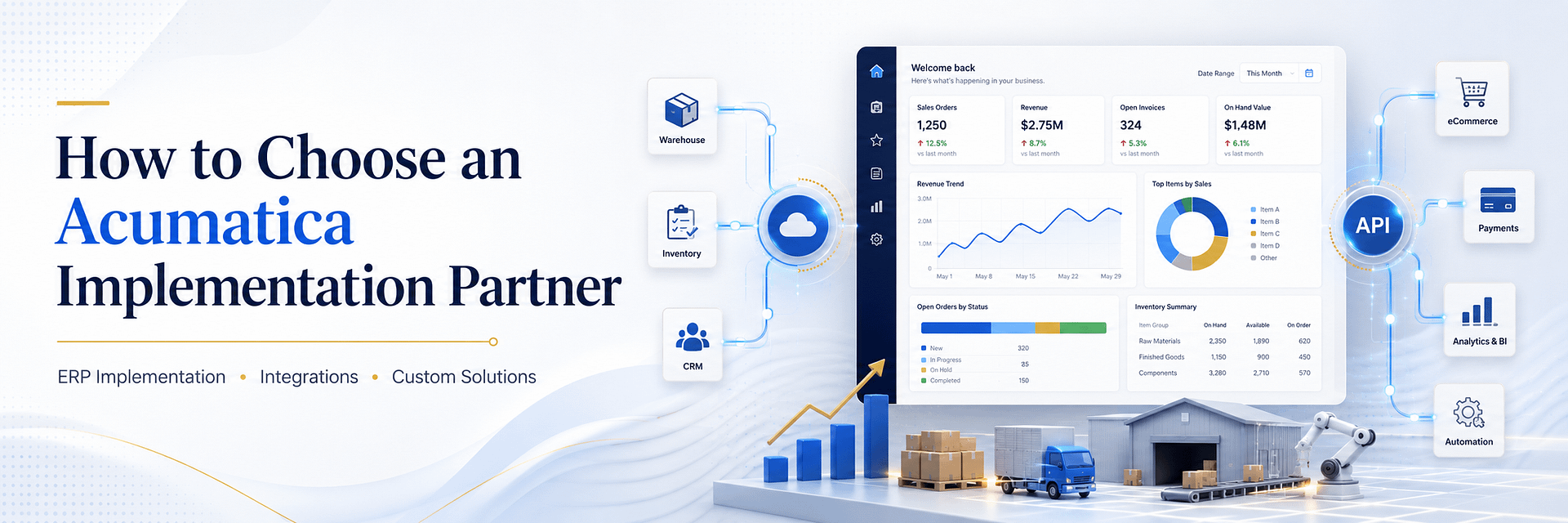
How to Choose an Acumatica Implementation Partner: Why Businesses Work with BizTech
Choosing Acumatica Cloud ERP is an important strategic decision. Choosing the right Acumatica implementation partner may be even more important. ERP software does not create business value simply because it has been purchased, licensed, or installed. Real value appears only when the ERP system reflects how the company actually operates: how it sells, purchases, receives inventory, manages warehouses, fulfills orders, invoices customers, processes payments, controls projects, analyzes profitability, and connects with outside platforms. That is why an Acumatica ERP implementation should never be treated as a basic software installation. A successful implementation requires business analysis, solution architecture, system configuration, data migration, customization, API integration, testing, user training, reporting, workflow automation, go-live preparation, and long-term support. It also requires an implementation team that understands both Acumatica technology and the operational reality behind the technology. This is where the choice of an Acumatica Gold Partner becomes critical. BizTech Services is an Acumatica Gold Partner and business technology consulting company specializing in Acumatica implementation, Acumatica integration, Acumatica customization, ERP automation, reporting, data management, eCommerce connectivity, marketplace integration, warehouse integration, payment workflows, and custom Acumatica solutions. BizTech does more than configure standard Acumatica modules. Our team designs and develops proprietary Acumatica enhancements and connectors that solve operational problems not always covered by a standard ERP deployment. Our Acumatica solutions include integrations and enhancements for:- Amazon FBA and FBM;
- Shopify;
- WooCommerce and WordPress;
- Magento;
- PayPal;
- ShipHero;
- ShipStation;
- DSCO;
- CommerceHub;
- ServiceTitan;
- Salesforce;
- EDI workflows;
- Gift Card Processing;
- Kit Processing;
- Consignment Processing;
- custom warehouse, commerce, payment, and fulfillment processes.
Why the Acumatica Implementation Partner Matters as Much as the ERP
Acumatica is a flexible, modern, and highly extensible cloud ERP platform. That flexibility creates significant opportunities, but it also means implementation decisions have long-term consequences. Two companies can license the same Acumatica modules and achieve completely different outcomes. One company may gain:- accurate inventory visibility;
- faster order processing;
- automated purchasing workflows;
- real-time financial dashboards;
- integrated eCommerce operations;
- reliable warehouse synchronization;
- clean data and trusted reports;
- strong user adoption;
- scalable operating processes.
- duplicate data;
- poorly mapped business processes;
- manual workarounds;
- unreliable reports;
- incomplete integrations;
- users returning to spreadsheets;
- expensive corrective development;
- an ERP system that never becomes the real source of truth.
- Acumatica modules;
- branches and companies;
- financial structures;
- order types;
- inventory policies;
- warehouse configurations;
- approval workflows;
- security roles;
- custom screens;
- automation rules;
- dashboards and reports;
- API connections;
- customization projects;
- external integration architecture.
Acumatica Implementation Is Not the Same as Software Installation
A software installation is technical. An ERP implementation is organizational. Installing software means publishing packages, creating environments, configuring access, and activating functionality. Implementing ERP means redesigning how information and work move through the company. A complete Acumatica implementation process may affect:- financial management;
- accounts payable;
- accounts receivable;
- cash management;
- sales order management;
- purchase order management;
- inventory control;
- warehouse operations;
- manufacturing;
- distribution;
- project accounting;
- field service;
- construction management;
- CRM;
- customer service;
- eCommerce;
- marketplace operations;
- payments and reconciliation;
- reporting and analytics.
- how the business operates today;
- which processes should remain;
- which processes should change;
- where manual work creates errors;
- which systems must be integrated;
- which reports leadership requires;
- which users need access;
- which controls and approvals are required;
- how the company expects to grow.
Why Work with an Acumatica Gold Partner?
An Acumatica Gold Partner is not simply a company that knows how to navigate Acumatica screens. The Gold Partner relationship indicates a serious and established commitment to the Acumatica ecosystem, customer delivery, technical expertise, and long-term ERP success. For a customer, working with an Acumatica Gold Partner provides several practical advantages.Deeper Acumatica Platform Experience
An experienced Acumatica Gold Partner understands standard functionality, industry editions, customization projects, APIs, webhooks, reporting tools, workflows, security, integrations, and upgrade considerations. This matters because many ERP requirements cross multiple functional areas. An inventory decision may affect order processing, purchasing, accounting, eCommerce availability, warehouse execution, and financial reporting. An implementation partner must understand those relationships before changing the system.Access to Acumatica Resources and Ecosystem Knowledge
A Gold Partner operates within the Acumatica partner ecosystem and stays aligned with platform changes, releases, development practices, implementation standards, and technical resources. That helps reduce the risk of creating customizations that work temporarily but become difficult to support later.Long-Term Implementation Accountability
ERP is not finished at go-live. Companies continue adding users, business units, products, warehouses, channels, integrations, reports, and automation. A serious Acumatica partner should support this evolution. BizTech provides implementation, integration, customization, training, optimization, and ongoing Acumatica support as parts of one long-term relationship.Ability to Handle Standard and Non-Standard Requirements
Many businesses need more than standard ERP configuration. They may require:- custom API integrations;
- marketplace automation;
- special payment workflows;
- warehouse synchronization;
- industry-specific extensions;
- custom reports and dashboards;
- external data exchange;
- custom order processing;
- specialized inventory behavior.
Who Should Implement Acumatica ERP?
Acumatica should be implemented by a partner that combines functional consulting, technical development, integration experience, data expertise, project management, and post-go-live support. The strongest Acumatica implementation team should include or have access to:- ERP business analysts;
- Acumatica functional consultants;
- Acumatica developers;
- integration architects;
- data migration specialists;
- reporting and analytics experts;
- quality assurance specialists;
- project managers;
- training and support resources.
- API authentication;
- customer mapping;
- item cross-references;
- warehouse selection;
- inventory quantity rules;
- sales tax handling;
- payment mapping;
- carrier mapping;
- order import logic;
- shipment export;
- refund processing;
- financial reconciliation;
- exception reporting.
What BizTech Provides as an Acumatica Implementation Partner
BizTech provides complete Acumatica implementation services across the ERP lifecycle. Our work can include:- ERP strategy and roadmap development;
- business process discovery;
- requirements analysis;
- solution architecture;
- Acumatica module selection;
- system configuration;
- financial structure design;
- inventory and warehouse setup;
- sales and purchasing workflows;
- data migration;
- customization development;
- API and webhook integrations;
- workflow automation;
- dashboard and report development;
- quality assurance;
- integration testing;
- user acceptance testing;
- end-user training;
- go-live planning;
- post-implementation support;
- performance optimization;
- ongoing feature development.
The BizTech Acumatica Implementation Process
A successful implementation requires structure. While every project is different, the following stages represent a practical Acumatica implementation framework.Phase 1: Business Discovery and ERP Requirements Analysis
The first stage is understanding the business before designing the system. BizTech reviews:- current software systems;
- financial processes;
- sales workflows;
- purchasing workflows;
- inventory and warehouse processes;
- manufacturing or project operations;
- customer and vendor data;
- eCommerce and marketplace channels;
- payment systems;
- existing reports;
- manual spreadsheets;
- integration requirements;
- security and compliance needs;
- future growth plans.
Phase 2: Solution Architecture and Scope Definition
After discovery, BizTech defines how Acumatica will support the business. This may include:- Acumatica editions and modules;
- company and branch structure;
- chart of accounts design;
- customer and vendor structures;
- inventory and warehouse architecture;
- order types;
- approval workflows;
- security roles;
- required integrations;
- customization requirements;
- reporting and dashboard scope;
- data migration scope;
- testing strategy;
- deployment timeline.
Phase 3: Acumatica Configuration
BizTech configures the Acumatica environment according to the approved design. Configuration may include:- General Ledger;
- Accounts Payable;
- Accounts Receivable;
- Cash Management;
- Tax Management;
- Sales Orders;
- Purchase Orders;
- Inventory Management;
- Warehouse Management;
- CRM;
- Project Accounting;
- Field Service;
- Manufacturing;
- Distribution;
- Construction;
- Commerce connectors;
- reporting and dashboards.
Phase 4: Acumatica Customization and Development
When standard configuration cannot fully support the business requirement, BizTech can develop Acumatica customizations and extensions. Custom development may include:- new screens;
- additional fields;
- custom actions;
- automated document creation;
- specialized workflow logic;
- custom inquiries;
- industry-specific extensions;
- custom validation rules;
- external API connections;
- scheduled synchronization processes;
- webhook-based event automation.
Phase 5: Acumatica Data Migration
Data migration is one of the most sensitive parts of an ERP implementation. A technically successful import can still produce a failed ERP project if the imported data is incomplete, duplicated, incorrectly mapped, or not reconciled. BizTech’s Acumatica data migration process can include:- source system analysis;
- data extraction;
- data cleansing;
- duplicate detection;
- field mapping;
- customer and vendor migration;
- inventory item migration;
- opening balance migration;
- open AR and AP migration;
- open sales and purchase order migration;
- historical data planning;
- validation;
- financial reconciliation;
- migration testing;
- final cutover import.
Phase 6: Integration Development
Modern ERP rarely operates alone. BizTech develops and configures integrations between Acumatica and external platforms using APIs, webhooks, scheduled processes, file exchange, and custom connectors. Integration work may include:- eCommerce order synchronization;
- inventory synchronization;
- customer synchronization;
- product and pricing synchronization;
- payment synchronization;
- shipment and tracking synchronization;
- refund processing;
- warehouse data exchange;
- EDI document exchange;
- CRM synchronization;
- financial data exchange;
- BI platform integration.
Phase 7: Reporting, Dashboards, and Analytics
ERP success depends on visibility. BizTech can create:- executive dashboards;
- financial reporting packs;
- inventory dashboards;
- warehouse performance dashboards;
- sales dashboards;
- profitability reports;
- project performance reports;
- eCommerce channel dashboards;
- payment status dashboards;
- exception reports;
- operational KPI alerts;
- Power BI or Tableau integrations.
Phase 8: Testing and Quality Assurance
A complete implementation requires more than checking whether individual screens open. BizTech tests complete business scenarios across modules and integrations. Testing may include:- unit testing;
- configuration testing;
- integration testing;
- data migration validation;
- financial reconciliation;
- security role testing;
- performance testing;
- end-to-end order processing;
- procure-to-pay testing;
- order-to-cash testing;
- returns and refund testing;
- warehouse transaction testing;
- user acceptance testing.
Phase 9: Acumatica User Training
Even a technically excellent ERP implementation can fail if users do not understand or trust the system. BizTech can provide:- role-based training;
- department-specific training;
- administrator training;
- process documentation;
- step-by-step guides;
- enablement videos;
- scenario-based exercises;
- go-live support materials.
Phase 10: Go-Live and Post-Implementation Support
Go-live is the beginning of production use, not the end of the project. BizTech supports:- cutover planning;
- final data migration;
- production validation;
- user support;
- issue triage;
- integration monitoring;
- performance monitoring;
- system optimization;
- feature updates;
- long-term maintenance.
Acumatica Data Migration: Why Experience Matters
Businesses often underestimate ERP data migration. They assume that data can simply be exported from one application and imported into Acumatica. In practice, data migration requires difficult decisions. The implementation team must determine:- which historical data should be migrated;
- which records should be archived;
- how duplicate customers should be handled;
- how inactive items should be treated;
- how open documents should be represented;
- how financial balances will be reconciled;
- how legacy identifiers will be preserved;
- how custom fields will be mapped;
- how integrations will recognize migrated records.
Acumatica Customization: Configuration Before Code
Acumatica is highly customizable, but customization should be approached carefully. The first question should not be: “Can this be developed?” The better question is: “What is the simplest maintainable way to support this business requirement?” BizTech evaluates four possible approaches:- standard Acumatica functionality;
- configuration and workflow changes;
- integration with another specialized system;
- custom Acumatica development.
- specialized order workflows;
- inventory extensions;
- custom processing screens;
- automated document generation;
- custom approval rules;
- payment functionality;
- kit and consignment processing;
- custom fields and inquiries;
- industry-specific functionality;
- external API integrations.
Acumatica API Integration and Custom Connectors
Acumatica’s open APIs and extensible platform are major reasons businesses choose it. However, having an API does not automatically create a reliable integration. A production integration must address:- authentication;
- rate limits;
- data transformation;
- record matching;
- duplicate prevention;
- error handling;
- retry logic;
- logging;
- alerting;
- security;
- versioning;
- traceability;
- upgrade compatibility.
- products;
- SKUs;
- categories;
- prices;
- customers;
- orders;
- taxes;
- discounts;
- payments;
- warehouses;
- inventory availability;
- shipments;
- tracking numbers;
- returns;
- refunds.
BizTech’s Proprietary Acumatica Solutions
One of the strongest reasons to work with BizTech is our portfolio of proprietary Acumatica integrations and enhancements. These solutions reflect practical experience with real business problems.Amazon–Acumatica Integration
The BizTech Amazon Connector connects Amazon FBA and FBM operations with Acumatica. The integration can support:- Amazon order import;
- FBA and FBM workflows;
- PO acknowledgments;
- shipment fulfillment updates;
- tracking synchronization;
- inventory quantity synchronization;
- customer and item mapping;
- payment and tax mapping;
- warehouse configuration;
- refund processing;
- cross-reference management.
Shopify–Acumatica Integration
The BizTech Shopify Connector links Shopify with Acumatica Cloud ERP. It can support:- order import;
- Sales Order, SO Invoice, or AR Invoice creation;
- customer synchronization;
- item synchronization;
- inventory synchronization;
- Shopify location and Acumatica warehouse mapping;
- payment method mapping;
- product field and metafield mapping;
- fulfillment updates;
- refund webhooks;
- B2B workflows.
WooCommerce–Acumatica Integration
The BizTech WooCommerce Connector links WordPress and WooCommerce with Acumatica. It can synchronize:- orders;
- products;
- inventory;
- customers;
- payments;
- prices;
- tax categories;
- product categories;
- warehouse quantities;
- fulfillment events;
- tracking information.
Magento–Acumatica Integration
The BizTech Magento Connector helps synchronize Magento commerce operations with Acumatica. It can support:- order synchronization;
- customer synchronization;
- item and SKU matching;
- category synchronization;
- customer-specific pricing;
- volume pricing;
- product images;
- inventory quantities;
- fulfillment updates.
PayPal Integration for Acumatica
The BizTech PayPal Integration connects customer payment activity with Acumatica. It supports workflows such as:- sending PayPal invoices from Acumatica;
- payment status synchronization;
- batch payment processing;
- cancellations;
- full and partial refunds;
- customer payment links;
- guest checkout;
- transaction visibility inside ERP.
ShipHero–Acumatica Integration
The BizTech ShipHero integration connects Acumatica with warehouse fulfillment operations. It can support:- orders;
- shipments;
- tracking numbers;
- purchase orders;
- purchase receipts;
- inventory transfers;
- returns;
- webhook-based updates.
ShipStation–Acumatica Integration
The BizTech ShipStation Connector supports the order-to-fulfillment cycle between ShipStation and Acumatica. The connector can handle:- order import;
- shipment synchronization;
- tracking updates;
- carrier mapping;
- status mapping;
- customer creation;
- item creation;
- multi-channel fulfillment data.
DSCO–Acumatica Integration
The BizTech DSCO Connector supports retail network workflows between DSCO and Acumatica. It can automate:- retail order import;
- order acknowledgments;
- shipment updates;
- invoice exports;
- cancellations;
- inventory synchronization;
- warehouse quantity rules.
CommerceHub–Acumatica Integration
The BizTech CommerceHub Connector helps connect Acumatica to retailer and supplier network workflows. It can support:- retail orders;
- acknowledgments;
- inventory exchange;
- shipment information;
- invoice processing;
- secure automated file exchange;
- high-volume retail operations.
ServiceTitan–Acumatica Integration
The BizTech ServiceTitan Connector can help align service operations with Acumatica financial and operational data. Depending on the implementation scope, integration may support:- customers;
- jobs;
- invoices;
- payments;
- service data;
- financial synchronization;
- cross-system traceability.
Salesforce–Acumatica Integration
The BizTech Salesforce–Acumatica Integration supports governed data exchange between CRM and ERP. The solution can include:- customer synchronization;
- order import;
- item synchronization;
- price book synchronization;
- discount synchronization;
- tax and payment options;
- address overrides;
- cross-reference mapping;
- import and export history.
Kit Processing for Acumatica
The BizTech Kit Processing solution extends Acumatica’s handling of kit items. It supports processes such as:- kit configuration;
- component control;
- serialized kit management;
- component changes during sales order entry;
- fulfillment;
- procurement;
- inventory visibility;
- custom product offerings.
Consignment Processing for Acumatica
BizTech Consignment Processing helps businesses manage inventory stored at customer or partner locations. The solution can support:- consignment warehouses;
- customer-specific warehouse mapping;
- consignment orders;
- inventory transfers;
- invoicing;
- returns;
- consigned inventory visibility;
- controlled document workflows.
Gift Card Processing for Acumatica
BizTech Gift Card Processing manages the gift card lifecycle directly inside Acumatica. It can support:- gift card issuance;
- serialized gift cards;
- code-based gift cards;
- gift card sales;
- redemption;
- balance tracking;
- transaction history;
- returns;
- expiration controls;
- use as an Acumatica payment method.
Custom Acumatica Integrations
Not every business uses a platform covered by an existing connector. BizTech also develops custom Acumatica API integrations for specialized systems, including:- industry applications;
- proprietary customer portals;
- warehouse systems;
- CRM platforms;
- shipping platforms;
- payment gateways;
- tax services;
- EDI providers;
- BI tools;
- custom databases;
- internal operational software.
Acumatica Implementation for Commerce Businesses
Commerce businesses require more than accounting. They need ERP to connect:- storefronts;
- marketplaces;
- inventory;
- warehouses;
- orders;
- payments;
- taxes;
- shipping;
- returns;
- customer data;
- financial reporting.
- product publication;
- SKU and variant mapping;
- category synchronization;
- price synchronization;
- inventory availability;
- order import;
- payment capture and reconciliation;
- tax mapping;
- warehouse selection;
- shipment confirmation;
- tracking updates;
- refunds;
- returns;
- channel profitability reporting.
Acumatica Implementation for Distribution Companies
Distribution companies need accurate inventory and fast order execution. A distribution ERP project may include:- multi-warehouse inventory;
- purchasing;
- sales orders;
- allocation and availability;
- replenishment;
- customer-specific pricing;
- shipping;
- returns;
- EDI;
- warehouse management;
- eCommerce channels;
- margin reporting.
Acumatica Implementation for Manufacturing Companies
Manufacturing ERP requires coordination across finance, production, purchasing, inventory, sales, and planning. A manufacturing implementation may involve:- BOMs;
- production orders;
- material requirements;
- work centers;
- routing;
- costing;
- quality workflows;
- shop-floor reporting;
- purchasing;
- inventory;
- sales demand;
- warehouse operations;
- financial reporting.
Acumatica Implementation for Field Service and General Business
Acumatica is also used by service organizations and general businesses that need connected financial and operational management. Field service requirements may include:- customers;
- appointments;
- dispatching;
- inventory;
- purchasing;
- service orders;
- billing;
- payments;
- financial reporting.
- financial management;
- CRM;
- reporting;
- cash management;
- accounts payable;
- accounts receivable;
- workflow automation;
- integration with external business systems.
Why Acumatica ERP Implementations Fail
ERP implementation failures are rarely caused by one dramatic technical problem. They are usually caused by accumulated planning and execution mistakes. Common causes include:Unclear Objectives
“Implement ERP” is not a measurable objective. A project should define outcomes such as:- reduce manual order entry;
- improve inventory accuracy;
- shorten financial close;
- automate marketplace fulfillment;
- create real-time profitability dashboards;
- replace spreadsheet approvals;
- connect warehouse and accounting data.
Recreating Every Legacy Process
Some legacy processes exist only because the previous system was limited. Copying every old process into Acumatica can preserve inefficiency. A qualified Acumatica consultant should challenge unnecessary steps and identify better standard workflows.Weak Data Preparation
Dirty data creates dirty ERP. Duplicate customers, inconsistent SKUs, incomplete addresses, incorrect balances, and inactive records must be addressed before go-live.Insufficient Integration Planning
External systems should not be considered at the end of the implementation. Integrations affect customers, items, warehouses, order types, taxes, payments, and financial posting. They must be included in the core architecture.Too Much Customization Too Early
Custom development should follow process validation, not precede it. The implementation team should first evaluate standard functionality and configuration.Insufficient Testing
Testing isolated features is not enough. Businesses need end-to-end testing across sales, purchasing, inventory, warehouses, payments, integrations, and accounting.Weak User Involvement
Users should participate in discovery, process validation, testing, and training. An ERP built without user input may be technically correct but operationally unusable.No Post-Go-Live Plan
The company needs support, monitoring, optimization, training, and controlled enhancement after launch. BizTech structures implementation to address these risks from the beginning.How to Evaluate an Acumatica Implementation Partner
Before selecting a partner, ask specific questions.Does the Partner Hold a Meaningful Acumatica Status?
Verify whether the company is an established Acumatica partner and whether it has a serious commitment to the platform. BizTech is an Acumatica Gold Partner.Can the Partner Handle Functional and Technical Work?
Some companies understand accounting but cannot build integrations. Others can develop code but do not understand ERP processes. The partner should combine both capabilities. BizTech provides Acumatica consulting, implementation, customization, integration, analytics, training, and support.Does the Partner Build Its Own Acumatica Products?
A partner that develops its own Acumatica solutions demonstrates deeper platform capability than one that only performs basic configuration. BizTech has developed connectors and enhancements across commerce, marketplaces, payments, warehouses, EDI, CRM, fulfillment, kits, gift cards, and consignment.Does the Partner Understand Your Industry?
Ask for relevant experience in:- commerce;
- distribution;
- manufacturing;
- field service;
- general business;
- warehousing;
- retail networks;
- project-based operations.
How Does the Partner Approach Data Migration?
The answer should include cleansing, mapping, validation, reconciliation, and testing—not only import tools.How Does the Partner Test Integrations?
Ask about:- error handling;
- duplicates;
- retries;
- logging;
- security;
- exception management;
- end-to-end testing.
What Happens After Go-Live?
Confirm whether the partner offers:- support;
- monitoring;
- issue resolution;
- performance optimization;
- feature updates;
- maintenance plans;
- long-term development.
Acumatica Implementation Timeline
There is no universal Acumatica implementation timeline. The duration depends on:- number of modules;
- number of entities and branches;
- data quality;
- migration history requirements;
- number of integrations;
- custom development;
- reporting complexity;
- user availability;
- testing requirements;
- organizational readiness.
Acumatica Implementation Cost
The cost of Acumatica implementation depends on project scope rather than one fixed number. Cost drivers may include:- module configuration;
- number of companies and branches;
- data migration volume;
- customizations;
- integrations;
- reporting;
- training;
- testing;
- support requirements;
- deployment complexity.
- corrective data migration;
- integration redevelopment;
- process redesign;
- new reporting work;
- user retraining;
- emergency support.
Security and Data Protection in Acumatica Integrations
Security must be part of integration architecture from the beginning. BizTech’s website states that integrations use SSL/TLS encryption and follow Acumatica API authentication standards. The company also identifies GDPR and data-protection best practices as part of its approach. A secure implementation should address:- credential storage;
- encrypted communication;
- API authentication;
- least-privilege access;
- role-based permissions;
- auditability;
- logging;
- backup strategy;
- patch management;
- environment separation;
- data retention;
- incident response.
Acumatica Support and Managed Services
A strong Acumatica support partner helps maintain system reliability after go-live. BizTech’s support capabilities can include:- incident response;
- issue diagnosis;
- integration monitoring;
- performance monitoring;
- capacity planning;
- health checks;
- security updates;
- patch management;
- backup planning;
- feature updates;
- workflow optimization;
- new reporting;
- user assistance;
- ongoing development.
Why BizTech Is Different from a Typical Acumatica Partner
Many Acumatica partners can configure standard modules. BizTech combines standard ERP implementation with advanced integration and product development. Our differentiators include:- Acumatica Gold Partner status;
- deep Acumatica platform expertise;
- business process consulting;
- custom Acumatica development;
- proprietary integrations and enhancements;
- eCommerce and marketplace specialization;
- warehouse and fulfillment integrations;
- payment workflow expertise;
- data migration and validation;
- reporting and analytics;
- quality assurance and testing;
- post-go-live support;
- long-term optimization.
Why Businesses Choose BizTech as Their Acumatica Gold Partner
Businesses choose BizTech when they need more than basic ERP configuration. They choose BizTech because they need an Acumatica implementation partner that can connect strategy, operations, technology, and support. BizTech can help a business:- select the right Acumatica modules;
- replace a legacy ERP;
- migrate from accounting software;
- redesign business workflows;
- clean and migrate data;
- connect eCommerce channels;
- automate marketplace operations;
- integrate warehouses;
- synchronize payments;
- build custom functionality;
- create executive dashboards;
- train users;
- support the system after go-live.
When Should a Business Contact an Acumatica Implementation Partner?
A business should consider contacting an Acumatica implementation consultant when:- financial reporting takes too long;
- inventory cannot be trusted;
- orders are re-entered manually;
- warehouse and accounting systems disagree;
- eCommerce channels are disconnected from ERP;
- payment reconciliation is manual;
- users depend heavily on spreadsheets;
- the current ERP cannot support growth;
- the company is adding entities or locations;
- management lacks real-time dashboards;
- custom processes cannot be automated;
- the business is evaluating Acumatica against NetSuite, SAP, Microsoft Dynamics 365, Epicor, Sage, or another ERP.
Final Conclusion: Choosing the Right Acumatica Implementation Partner
Acumatica is one of the most flexible and practical cloud ERP platforms for growing businesses. But flexibility creates value only when it is guided by strong implementation. The right Acumatica implementation partner should understand:- business processes;
- Acumatica functionality;
- data migration;
- customization;
- API integration;
- automation;
- reporting;
- testing;
- training;
- support.
- Acumatica Implementation Partner;
- Acumatica Gold Partner;
- Acumatica ERP Implementation;
- Acumatica Integration Partner;
- Acumatica VAR;
- Acumatica Consultant;
- Acumatica Custom Development;
- Acumatica Data Migration;
- Acumatica API Integration;
- Acumatica Support Partner;
- BizTech Acumatica Implementation;